
All Topics  
Lapse rate

 
Lapse Rate

   Email Print
   Bookmark   Link


Lapse rate


The lapse rate is defined as the negative of the rate of change in an atmospheric variable, usually temperature
Temperature

In physics, temperature is a physical property of a Physical system that underlies the common notions of hot and cold; something that feels hotter generally has the greater temperature....
, with height in an atmosphere. While typically applied to Earth's atmosphere
Earth's atmosphere

The Earth's atmosphere is a layer of gases surrounding the planet Earth that is retained by the Earth's gravity. Dry air contains roughly 78.08% nitrogen, 20.95% oxygen, 0.93% argon, 0.038% Carbon dioxide in the Earth's atmosphere, and trace amounts of other gases....
, the concept can be extended to any gravitationally supported ball of gas.

rmal, peer-reviewed
Peer review

Peer review is the process of subjecting an author's Scholarly method work, research, or ideas to the scrutiny of others who are experts in the same field....
 definition from the Glossary of Meteorology is:
The decrease of an atmospheric variable with height, the variable being temperature unless otherwise specified.
The term applies ambiguously to the environmental lapse rate and the process lapse rate, and the meaning must often be ascertained from the context.


e are two types of lapse rate:

environmental lapse rate (ELR), is the negative of the actual change of temperature with altitude of the stationary atmosphere at a specific time and specific location.


Discussion
Ask a question about 'Lapse rate'
Start a new discussion about 'Lapse rate'
Answer questions from other users
Full Discussion Forum


Recent Posts


Encyclopedia


The lapse rate is defined as the negative of the rate of change in an atmospheric variable, usually temperature
Temperature

In physics, temperature is a physical property of a Physical system that underlies the common notions of hot and cold; something that feels hotter generally has the greater temperature....
, with height in an atmosphere. While typically applied to Earth's atmosphere
Earth's atmosphere

The Earth's atmosphere is a layer of gases surrounding the planet Earth that is retained by the Earth's gravity. Dry air contains roughly 78.08% nitrogen, 20.95% oxygen, 0.93% argon, 0.038% Carbon dioxide in the Earth's atmosphere, and trace amounts of other gases....
, the concept can be extended to any gravitationally supported ball of gas.

Definition

A formal, peer-reviewed
Peer review

Peer review is the process of subjecting an author's Scholarly method work, research, or ideas to the scrutiny of others who are experts in the same field....
 definition from the Glossary of Meteorology is:
The decrease of an atmospheric variable with height, the variable being temperature unless otherwise specified.
The term applies ambiguously to the environmental lapse rate and the process lapse rate, and the meaning must often be ascertained from the context.


Types of lapse rates

There are two types of lapse rate:
  • Environmental lapse rate – which refers to the actual change of temperature with altitude for the stationary atmosphere (i.e. the temperature gradient
    Temperature gradient

    A temperature gradient is a physical quantity that describes in which direction and at what rate the temperature changes the most rapidly around a particular location....
    )
  • The adiabatic lapse rates – which refer to the change in temperature of a mass of air as it moves upwards. There are two adiabatic rates:
    • Dry adiabatic lapse rate
    • Moist adiabatic lapse rate


Environmental lapse rate

The environmental lapse rate (ELR), is the negative of the actual change of temperature with altitude of the stationary atmosphere at a specific time and specific location. The ELR at a given place varies from day to day and even during each day. As an average, the International Civil Aviation Organization
International Civil Aviation Organization

The International Civil Aviation Organization , an agency of the United Nations, codifies the principles and techniques of international air navigation and fosters the planning and development of international scheduled air transport to ensure safe and orderly growth....
 (ICAO) defines an international standard atmosphere (ISA) with a temperature lapse rate of or from sea level to 11 km . From 11 km or up to 20 km or , the constant temperature is , which is the lowest assumed temperature in the ISA. It is important to remember that the standard atmosphere contains no moisture, and that the temperature of the atmosphere does not always fall steadily. For example, there can be an inversion layer in which the temperature rises with increasing height.

Dry adiabatic lapse rate

The dry adiabatic lapse rate (DALR) is the negative of the rate at which a rising parcel
Air parcel

An air parcel is an imaginary volume of air used by meteorologists to conceptualize the thermodynamic fluid motions of the Earth's atmosphere for use in weather forecasting....
 of dry or unsaturated air changes temperature with increasing height, under adiabatic conditions. Unsaturated air has less than 100% relative humidity
Relative humidity

Relative humidity is a term used to describe the amount of water vapor that exists in a gaseous mixture of air and water....
; i.e. its temperature is higher than its dew point
Dew point

The dew point is the temperature to which a given parcel of air must be cooled, at constant barometric pressure, for water vapor to Condensation into water....
. The term adiabatic means that no heat transfer (energy transfer due to a temperature difference) occurs into or out of the parcel. Air has low thermal conductivity
Thermal conductivity

In physics, thermal conductivity, , is the List of materials properties of a material that indicates its ability to conduct heat. It appears primarily in Heat conduction#Fourier's law for heat conduction....
, and the bodies of air involved are very large, so transfer of heat by conduction
Heat conduction

Heat conduction or thermal conduction is the spontaneous heat transfer through matter, from a region of higher temperature to a region of lower temperature, and acts to equalize temperature differences....
 is negligibly small.

Under these conditions, when the air is stirred (for instance, by convection
Convection

Convection in the most general terms refers to the movement of molecules within fluids . Convection is one of the major modes of heat transfer and mass transfer....
), and a parcel of air rises, it expands, because the pressure is lower at higher altitudes. As the air parcel expands, it pushes on the air around it, doing work
Work (thermodynamics)

In thermodynamics, work is the quantity of energy transferred from one system to another without an accompanying transfer of entropy. It is a generalization of the concept of mechanical work in mechanics....
; since the parcel does work and gains no heat, it loses internal energy
Internal energy

In thermodynamics, the internal energy of a thermodynamic system, or a physical body with well-defined dimension, denoted by U, or sometimes E, is the total of the kinetic energy due to the motion of molecules and the potential energy associated with the vibrational and electricity energy of atoms within molecules or crysta...
, and so its temperature decreases at a rate of per 1,000 m. (The reverse occurs for a sinking parcel of air.)

For an ideal gas, the equation relating temperature T and pressure p for an adiabatic process is where is the heat capacity ratio
Heat capacity ratio

The heat capacity ratio or adiabatic index or ratio of specific heats, is the ratio of the heat capacity at constant pressure to heat capacity at constant volume ....
 (=7/5, for air) and z is the altitude. A second relation between the pressure and temperature is the equation of hydrostatic equilibrium
Hydrostatic equilibrium

Hydrostatic equilibrium occurs when compression due to gravity is balanced by a pressure gradient which creates a pressure gradient force in the opposite direction....
:

where g is the standard gravity
Standard gravity

Standard gravity, usually denoted by g0 or gn, is the nominal acceleration due to Earth's gravity at the Earth's surface at sea level....
, R the gas constant
Gas constant

The gas constant is a physical constant which is featured in a large number of fundamental equations in the physical sciences, such as the ideal gas law and the Nernst equation....
, and m the molar mass
Molar mass

Molar mass, symbol M, is the mass of one mole of a substance . It is a physical property which is characteristic of each pure substance. The base SI unit for mass is the kilogram but, for both practical and historical reasons, molar masses are almost always quoted in grams per mole , especially in chemistry....
. Combining these two equations to eliminate the pressure, one arrives at the result for the DALR, .

Saturated adiabatic lapse rate

When the air is saturated
Saturation (chemistry)

In chemistry, saturation has five different meanings:#In physical chemistry, saturation is the point at which a solution of a substance can dissolve no more of that substance and additional amounts of it will appear as a Precipitation ....
 with water vapour (at its dew point
Dew point

The dew point is the temperature to which a given parcel of air must be cooled, at constant barometric pressure, for water vapor to Condensation into water....
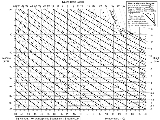
), the moist adiabatic lapse rate (MALR) or saturated adiabatic lapse rate (SALR) applies. It varies strongly with the moisture content, which depends on temperature, and lightly with pressure from (high temperature near surface) to (very low temperature), as one can see in the diagram. However, at temperatures above freezing it is usually near or . The reason for the difference is that latent heat
Latent heat

In thermochemistry, latent heat is the amount of energy in the form of heat released or absorbed by a chemical substance during a change of state of matter , or a phase transition....
 is released when water condenses. Even though there are no more than 10 grams of water in a kilogram of air at , water's high heat of vaporization creates a significant release of the energy when it condenses (and is an important source of energy in the development of thunderstorms). Until the moisture starts condensing, the parcel of air cools at the dry adiabatic lapse rate. Thus, any air that is unsaturated can be assumed to be "dry".

Significance in meteorology

The varying environmental lapse rates throughout the earth's atmosphere are of critical importance in meteorology
Meteorology

Meteorology is the interdisciplinary scientific study of the Earth's atmosphere that focuses on weather processes and forecasting . Studies in the field stretch back millennia, though significant progress in meteorology did not occur until the eighteenth century....
, particularly within the troposphere
Troposphere

The troposphere is the lowest portion of Earth's atmosphere. It contains approximately 75% of the atmosphere's mass and almost all of its water vapor and particulate....
. They are used to determine if the parcel
Air parcel

An air parcel is an imaginary volume of air used by meteorologists to conceptualize the thermodynamic fluid motions of the Earth's atmosphere for use in weather forecasting....
 of rising air will rise high enough for its water to condense to form cloud
Cloud

A cloud is a visible mass of Drop or frozen crystals floating in the Celestial body atmosphere above the surface of the Earth or another planetary body....
s, and, having formed clouds, whether the air will continue to rise and form bigger shower clouds, and whether these clouds will get even bigger and form cumulonimbus cloud
Cumulonimbus cloud

Cumulonimbus is a type of cloud that is tall, dense, and involved in thunderstorms and other intense weather. It is a result of atmospheric instability....
s (thunder clouds).

As unsaturated air rises, its temperature drops at the dry adiabatic rate. The dew point also drops (as a result of decreasing air pressure) but much more slowly, typically about per 1,000 m. If unsaturated air rises far enough, eventually its temperature will reach its dew point, and condensation will begin to form. This altitude is known as the lifting condensation level (LCL) when mechanical lift is present and the convective condensation level
Convective condensation level

The convective condensation level represents the height where an air parcel becomes saturation when lifted adiabatically to achieve buoyant ascent....
 (CCL) absent mechanical lift, in which case, the parcel must be heated from below to its convective temperature
Convective temperature

The convective temperature is the approximate temperature that air near the surface must reach for cloud formation without mechanical lift. In such case, cloud base begins at the convective condensation level , whilst with mechanical lifting, condensation begins at the lifted condensation level ....
. The cloud base
Cloud base

This article refers to meteorology, for the airborne base of Captain Scarlet see Cloudbase.The cloud base is the lowest altitude of the visible portion of the cloud....
 will be somewhere within the layer bounded by these parameters.

The difference between the dry adiabatic lapse rate and the rate at which the dew point drops is around per 1,000 m. Given a difference in temperature and dew point readings on the ground, one can easily find the LCL by multiplying the difference by 125 m/°C.

If the environmental lapse rate is less than the moist adiabatic lapse rate, the air is absolutely stable — rising air will cool faster than the surrounding air and lose buoyancy
Buoyancy

In physics, buoyancy is the upward force that keeps things afloat. The net upward buoyancy force is equal to the magnitude of the weight of fluid displaced by the body....
. This often happens in the early morning, when the air near the ground has cooled overnight. Cloud formation in stable air is unlikely.

If the environmental lapse rate is between the moist and dry adiabatic lapse rates, the air is conditionally unstable — an unsaturated parcel of air does not have sufficient buoyancy to rise to the LCL or CCL, and it is stable to weak vertical displacements in either direction. If the parcel is saturated it is unstable and will rise to the LCL or CCL, and either be halted due to an inversion layer
Inversion layer

Inversion layer may refer to one of the following:*Inversion , a layer within which an atmospheric property is inverted, i.e., its change is deviated from the normal pattern...
 of convective inhibition
Convective inhibition

Convective inhibition is a numerical measure in meteorology that indicates the amount of energy that will prevent an air parcel from rising from the surface to the level of free convection....
, or if lifting continues, deep, moist convection (DMC) may ensue, as a parcel rises to the level of free convection
Level of free convection

The level of free convection is the altitude in the Earth's atmosphere where the temperature of the environment decreases faster than the moist adiabatic lapse rate of a saturated air parcel at the same level....
 (LFC), after which it enters the free convective layer
Free convective layer

In atmospheric sciences, the free convective layer is the layer of conditional or potential instability in the troposphere. It is a layer of positive buoyancy and is the layer where deep, moist convection can occur....
 (FCL) and usually rises to the equilibrium level
Equilibrium level

In meteorology, the equilibrium level , or level of neutral buoyancy , is the height at which a rising air parcel of air is at a temperature of equal warmth to it....
 (EL).

If the environmental lapse rate is larger than the dry adiabatic lapse rate, it has a superadiabatic lapse rate, the air is absolutely unstable — a parcel of air will gain buoyancy as it rises both below and above the lifting condensation level or convective condensation level. This often happens in the afternoon over many land masses. In these conditions, the likelihood of cumulus clouds
Cumulus cloud

Cumulus clouds are a type of cloud with noticeable vertical development and clearly defined edges. Cumulus means "heap" or "pile" in Latin. These are often described as "puffy" or "cotton-like" in appearance, cumulus clouds may appear alone, in lines, or in clusters....
, showers or even thunderstorm
Thunderstorm

File:FoggDam-NT.jpgA thunderstorm, also known as an electrical storm or a lightning storm, is a form of weather characterized by the presence of lightning and its effect: thunder....
s is increased.

Meteorologists use radiosonde
Radiosonde

A radiosonde is a unit for use in weather balloons that measures various Earth's atmosphere parameters and transmits them to a fixed receiver....
s to measure the environmental lapse rate and compare it to the predicted adiabatic lapse rate to forecast the likelihood that air will rise. Charts of the environmental lapse rate are known as thermodynamic diagrams
Thermodynamic diagrams

Thermodynamic diagrams are diagrams used by scientists and engineers to represent the thermodynamic states of a material and the consequences of manipulating this material....
, examples of which include Skew-T log-P diagram
Skew-T log-P diagram

A Skew-T Log-P diagram is one of four thermodynamic diagrams commonly used in weather analysis and forecasting. In 1947, N. Herlofson proposed a modification to the emagram which allows straight, horizontal isobars, and provides for a large angle between isotherms and dry adiabats, similar to that in the tephigram....
s and tephigram
Tephigram

A tephigram is one of four thermodynamic diagrams commonly used in weather analysis and forecasting. The name evolved from the original name "T--gram" to describe the axes of temperature and entropy used to create the plot....
s. (See also Thermals).

The difference in moist adiabatic lapse rate and the dry rate is the cause of foehn wind phenomenon (also known as "Chinook wind
Chinook wind

Chinook winds, often just called chinooks, commonly refers to foehn winds in the interior West of North America, where the Canadian Prairies and Great Plains meet various mountain ranges, although the original usage is in reference to wet, warm coastal winds in the Pacific Northwest....
s" in parts of North America).

Mathematical definition

In general, a lapse rate is expressed as the negative ratio of the temperature change and the altitude change, thus:

where is the adiabatic lapse rate given in units of temperature divided by units of altitude, T = temperature, and z = altitude.

Note: In some cases, or can be used to represent the adiabatic lapse rate in order to avoid confusion with other terms symbolized by , such as the specific heat ratio
Heat capacity ratio

The heat capacity ratio or adiabatic index or ratio of specific heats, is the ratio of the heat capacity at constant pressure to heat capacity at constant volume ....
 or the psychrometric constant.

See also

  • Adiabatic process
    Adiabatic process

    In thermodynamics, an adiabatic process or an isocaloric process is a thermodynamic process in which no heat is transferred to or from the working fluid....
  • Atmospheric thermodynamics
    Atmospheric thermodynamics

    In the physical sciences, atmospheric thermodynamics is the study of heat and energy transformations in the earth?s atmospheric system. Following the fundamental laws of classical thermodynamics, atmospheric thermodynamics studies such phenomena as properties of moist air, formation of clouds, atmospheric convection, boundary layer meteorolo...
  • Fluid mechanics
    Fluid mechanics

    Fluid mechanics is the study of how fluids move and the forces on them. Fluid mechanics can be divided into fluid statics, the study of fluids at rest, and fluid dynamics, the study of fluids in motion....
    • Fluid dynamics
      Fluid dynamics

      In physics, fluid dynamics is the sub-discipline of fluid mechanics dealing with fluid flow — the natural science of fluids in motion....
  • Foehn wind


External links

  • from the Planetary Data system.
  • National Science Digital Library glossary:
  • An introduction to from U. Texas


Additional reading