
|
|
|
|
Lakota
|
| |
|
| |
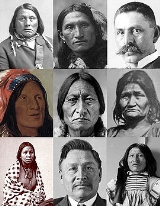
The Lakota (also Teton, Tetonwan) are a Native American tribe. They are part of a confederation of seven related Sioux tribes (the Oceti Sakowin or seven council fires) and speak Lakota, one of the three major dialects of the Sioux language.
The Lakota are the western-most of the three Sioux groups, occupying lands in both North and South Dakota.

Discussion
Ask a question about 'Lakota'
Start a new discussion about 'Lakota'
Answer questions from other users
|
Encyclopedia
The Lakota (also Teton, Tetonwan) are a Native American tribe. They are part of a confederation of seven related Sioux tribes (the Oceti Sakowin or seven council fires) and speak Lakota, one of the three major dialects of the Sioux language.
The Lakota are the western-most of the three Sioux groups, occupying lands in both North and South Dakota. The seven branches or "sub-tribes" of the Lakota are Sicangu, Oglala, Itazipco, Hunkpapa, Miniconjou, Sihasapa, and Ooinunpa.
Notable persons include Tatanka Iyotake (Sitting Bull) from the Hunkpapa band and Tašunka Witko (Crazy Horse), Mahpiya Luta (Red Cloud), Hehaka Sapa (Black Elk) and Billy Mills from the Oglala band as well as Touch the Clouds.
History
The Lakota were originally referred to as the Dakota when they lived by the great lakes, however, because of European settlement they were pushed away from the great lakes region and later called themselves the Lakota which became part of the Sioux. After their adoption of the horse, šu´ka-wakha´ ('dog [of] power/mystery/wonder') their society centered on the buffalo hunt with the horse. There were 20,000 Lakota in the mid-18th century. The number has now increased to about 70,000, of whom about 20,500 speak the Lakota language.
After 1720, the Lakota branch of the Seven Council Fires split into two major sects, the Saone who moved to the Lake Traverse area on the South Dakota-North Dakota-Minnesota border, and the Oglala-Sicangu who occupied the James River valley. By about 1750, however, the Saone had moved to the east bank of the Missouri River, followed 10 years later by the Oglala and Brulé (Sicangu).
The large and powerful Arikara, Mandan, and Hidatsa villages had prevented the Lakota from crossing the Missouri for an extended period, but when smallpox and other diseases nearly destroyed these tribes, the way was open for the first Lakota to cross the Missouri into the drier, short-grass prairies of the High Plains. These Saone, well-mounted and increasingly confident, spread out quickly. In 1765, a Saone exploring and raiding party led by Chief Standing Bear discovered the Black Hills (which they called the Paha Sapa). Just a decade later, in 1775, the Oglala and Brulé also crossed the river, following the great smallpox epidemic of 1772–1780, which destroyed three-quarters of the Missouri Valley populations. In 1776, they defeated the Cheyenne as the Cheyenne had earlier defeated the Kiowa, and gained control of the land which became the center of the Lakota universe.
Initial contacts between the Lakota and the United States, during the Lewis and Clark Expedition of 1804–1806 was marked by a standoff involving the Lakota refusing to allow the explorers to continue upstream countered by the Expedition preparing to battle. Formally, the Fort Laramie Treaty of 1851 acknowledged native sovereignty over the Great Plains in exchange for free passage along the Oregon Trail, for "as long as the river flows and the eagle flies". In Nebraska on September 3, 1855, 700 soldiers under American General William S. Harney avenged the Grattan Massacre by attacking a Lakota village, killing 100 men, women, and children. Other wars followed; and in 1862–1864, as refugees from the "Dakota War of 1862" in Minnesota fled west to their allies in Montana and Dakota Territory, the war followed them.
Because the Black Hills are sacred to the Lakota, they objected to mining in the area, which had been attempted since the early years of the 19th century. In 1868, the U.S. government signed the Fort Laramie Treaty, exempting the Black Hills from all white settlement forever. 'Forever' lasted only four years, when gold was publicly discovered there, and an influx of prospectors descended upon the area, abetted by army commanders like Lt. Colonel George Armstrong Custer. The latter tried to administer a lesson of noninterference with white policies, resulting in the Great Sioux War of 1876-77. Hunting and massacre of the buffalo were urged by General Philip Sheridan as a means to "destroying the Indians' commissary."
The Lakota with their allies, the Arapaho and the Northern Cheyenne, defeated General George Crook's army at the Battle of the Rosebud and a week later defeated the U.S. 7th Cavalry in 1876 at the Battle of the Little Bighorn, killing 258 soldiers, wiping out the entire Custer battalion, and inflicting more than 50% casualties on the regiment. Their victory over the U.S. Army would not last, however. The Lakota were defeated in a series of subsequent battles by the reinforced U.S. Army and eventually confined onto reservations, prevented from hunting buffalo and forced to accept government food distribution.
The Lakota signed a treaty in 1877 ceding the Black Hills to the United States, but a low-intensity war continued, culminating, fourteen years later, in the killing of Sitting Bull (December 15, 1890) at Standing Rock and the Massacre of Wounded Knee (December 29, 1890) at Pine Ridge.
Today, the Lakota are found mostly in the five reservations of western South Dakota: Rosebud Indian Reservation (home of the Upper Sicangu or Brulé), Pine Ridge Indian Reservation (home of the Oglala), Lower Brule Indian Reservation (home of the Lower Sicangu), Cheyenne River Indian Reservation (home of several other of the seven Lakota bands, including the Sihasapa and Hunkpapa), and Standing Rock Indian Reservation, also home to people from many bands. But Lakota also live on the Fort Peck Indian Reservation in northeastern Montana, the Fort Berthold Reservation of northwestern North Dakota, and several small reserves in Saskatchewan and Manitoba, where their ancestors fled to "Grandmother's [i.e. Queen Victoria's] Land" (Canada) during the Minnesota or Black Hills War.
Large numbers of Lakota live in Rapid City and other towns in the Black Hills, and in metro Denver. Lakota elders joined the Unrepresented Nations and Peoples Organisation (UNPO) seeking protection and recognition for their cultural and land rights.
The Lakota name now joins Sioux (H-13), Kiowa (OH-58), Apache (AH-64), Chinook (H-47), Iroquois (UH-1), and other American Indian names that have been given to aircraft. The UH-145 has been selected as the United States Army's new Light Utility Helicopter, and has been named the Lakota.
Government
Legally and by treaty a semi-autonomous "nation" within the United States, the Lakota Sioux are represented locally by officials elected to councils for the several reservations and communities in the Dakotas, Minnesota, Nebraska, and also in Manitoba and southern Saskatchewan in Canada. They are represented on the state and national level by the elected officials from the political districts of their respective states and Congressional Districts. Band or reservation members living both on and off the individual reservations are eligible to vote in periodic elections for that reservation. Each reservation has a unique local government style and election cycle based on its own constitution or articles of incorporation, although most follow a multi-member tribal council model with a chairman or president elected directly by the voters.
- The current President of the Oglala Sioux, the majority tribe of the Lakota located primarily on the Pine Ridge reservation, is Theresa Two Bulls.
- The President of the Sicangu Lakota from the Rosebud reservation is Rodney M. Bordeaux.
- The Chairman of the Standing Rock reservation, which includes peoples from several Lakota subgroups including the Hunkpapa, is Ron His Horse Is Thunder. He also is president of the Great Plains Tribal Chairman's Association (GPTCA).
- The Chairman of the Cheyenne River Sioux Tribe at the Cheyenne River reservation, comprising the Mniconjou, Izipaco, Siha Sapa, and Ooinunpa bands of the Lakota, is Joe Brings Plenty, Sr.
- The Chairman of the Lower Brule Sioux Tribe, which is home to the Lower Sicangu Lakota, is Michael Jandreau.
Tribal governments have significant leeway, as semi-autonomous political entities, in deviating from state law (e.g. Indian gaming) and are ultimately subject to supervisory oversight by the United States Congress and bureaucratic regulation by Congress through the Bureau of Indian Affairs, although the nature and legitimacy of those relationships continue to be a matter of dispute.
Independence movement
or
Beginning in 1974, some Lakota activists have taken steps to become independent from the United States, an attempt to form their own nation. These steps have included drafting their own "declaration of continuing independence" and using Constitutional and International Law to solidify their legal standing.
A 1980 U.S. Supreme Court decision awarded $122 million to eight tribes of Sioux Indians as compensation, but the court did not award land. The Lakota have refused the settlement.
In September 2007, the United Nations passed a non-binding Resolution on the Rights of Indigenous Peoples. Canada, the United States, Australia and New Zealand refused to sign.
On December 202007, a group of Lakota Representatives under the name Lakota Freedom Delegation traveled to Washington D.C. to announce a withdrawal of the Lakota Sioux from all treaties with the United States government.. These activists traveled under the official standing of the traditional Lakota Treaty Councils representing the traditional Tiospayes (matriarchal family units) which is the traditional form of Lakota governance. "We have 33 treaties with the United States that they have not lived by", said longtime political activist Russell Means, one member of the delegation that declared the Lakota a sovereign nation with property rights over thousands of square miles in South Dakota, North Dakota, Nebraska, Wyoming and Montana. The group stated that they do not act for or represent those tribal governments set up by the United States Bureau of Indian Affairs (BIA) or those Lakota who support the BIA system of government.
Reaction to the action of the Lakota Freedom Delegation were mixed. Though the group did not include any representatives of BIA tribal governments, Delegation members did have the authority of the traditional Treaty Councils. Several elected BIA tribal governments issued statements distancing themselves from the independence declaration while others said they were watching the independent movement closely. The group garnered support from other Indigenous nations and groups throughout the world.
In January 2008, the Lakota Freedom Delegation split into two groups. One group was led by Canupa Gluha Mani (Duane Martin Sr.) leader of Cante Tenza, traditional Strongheart Warrior Society that has included leaders such as Sitting Bull and Crazy Horse. This group is called Lakota Oyate. The other group is called the Republic of Lakotah led by long-time activist Russell Means. In December 2008, Lakota Oyate received the support and standing of the traditional treaty council of the Oglala Tiospayes.
Ethnonyms
The name Lakota comes from the Lakota autonym, lakhóta "feeling affection, friendly, united, allied". The early French literature does not distinguish a separate Teton division, instead lumping them into a "Sioux of the West" group with other Santee and Yankton bands.
The names Teton and Tetuwan come from the Lakota name thíthuwa (the meaning of which is obscure). This term was used to refer to the Lakota by non-Lakota Sioux groups. Other derivations include: ti tanka, Tintonyanyan, Titon, Tintonha, Thintohas, Tinthenha, Tinton, Thuntotas, Tintones, Tintoner, Tintinhos, Ten-ton-ha, Thinthonha, Tinthonha, Tentouha, Tintonwans, Tindaw, Tinthow, Atintons, Anthontans, Atentons, Atintans, Atrutons, Titoba, Tetongues, Teton Sioux, Teeton, Ti toan, Teetwawn, Teetwans, Ti-t’-wawn, Ti-twans, Tit’wan, Tetans, Tieton, and Teetonwan.
Early French sources call the Lakota Sioux with an additional modifier, such as Scioux of the West, West Schious, Sioux des prairies, Sioux occidentaux, Sioux of the Meadows, Nadooessis of the Plains, Prairie Indians, Sioux of the Plain, Maskoutens-Nadouessians, Mascouteins Nadouessi, and Sioux nomades.
Today many of the tribes continue to officially call themselves Sioux, which the Federal Government of the United States applied to all Dakota/Lakota people in the 19th and 20th centuries. However, some of the tribes have formally or informally adopted traditional names: the Rosebud Sioux Tribe is also known as the Sicangu Oyate (Brulé Nation), and the Oglala often use the name Oglala Lakota Oyate, rather than the English "Oglala Sioux Tribe" or OST. (The alternate English spelling of Ogallala is deprecated, even though it is closer to the correct pronunciation.) The Lakota have names for their own subdivisions. The Lakota also are Western of the three Sioux groups, occupying lands in both North and South Dakota.
Notable Persons
Notable persons include
Reservations
Today, one half of all enrolled Sioux live off the Reservation.
Lakota reservations recognized by the U.S. government include:
Some Lakota also live on other Sioux reservations in eastern South Dakota, Minnesota, and Nebraska:
- Santee, in Nebraska
- Crow Creek in Central South Dakota
- Yankton in Central South Dakota
- Flandreau in Eastern South Dakota
- Sisseton Wahpeton Oyate in Northeastern South Dakota and Southeastern North Dakota
- Lower Sioux in Minnesota
- Upper Sioux in Minnesota
- Shakopee in Minnesota
- Prairie Island in Minnesota
In addition several Lakota live on Wood Mountain Indian Reserve often Wood Mountain First Nation northwest of Wood Mountain Post now a Saskatchewan historic site.
See also
External links
-
-
-
-
-
- 2007/12/14
- (Edward S. Curtis)
- a Smithsonian exhibit of the annual icon chosen to represent the major event of the past year
-
|
| |
|
|