
Labor economics seeks to understand the functioning and dynamics of the
marketA market is one of many varieties of systems, institutions, procedures, social relations and infrastructures whereby parties engage in exchange. While parties may exchange goods and services by barter, most markets rely on sellers offering their goods or services in exchange for money from buyers...
for labor.
Labor markets function through the interaction of workers and employers. Labor economics looks at the suppliers of labor services (workers), the demands of labor services (employers), and attempts to understand the resulting pattern of wages, employment, and income.
In
economicsEconomics is the social science that analyzes the production, distribution, and consumption of goods and services. The term economics comes from the Ancient Greek from + , hence "rules of the house"...
,
labor is a measure of the work done by human beings. It is conventionally contrasted with such other
factors of productionIn economics, factors of production means inputs and finished goods means output. Input determines the quantity of output i.e. output depends upon input. Input is the starting point and output is the end point of production process and such input-output relationship is called a production function...
as
landIn economics, land comprises all naturally occurring resources whose supply is inherently fixed. Examples are any and all particular geographical locations, mineral deposits, and even geostationary orbit locations and portions of the electromagnetic spectrum. Natural resources are fundamental to...
and
capitalIn economics, capital, capital goods, or real capital refers to already-produced durable goods used in production of goods or services. The capital goods are not significantly consumed, though they may depreciate in the production process...
. There are theories which have developed a concept called
human capitalHuman capitalis the stock of competencies, knowledge and personality attributes embodied in the ability to perform labor so as to produce economic value. It is the attributes gained by a worker through education and experience...
(referring to the skills that workers possess, not necessarily their actual work), although there are also counter posing macro-economic system theories that think human capital is a contradiction in terms.
Compensation and measurement
WageA wage is a compensation, usually financial, received by workers in exchange for their labor.Compensation in terms of wages is given to workers and compensation in terms of salary is given to employees...
is a basic compensation for paid labor, and the compensation for labor per period of time is referred to as the
wage rate.
Other frequently used terms include:
- wage = payment per unit of time (typically an hour)
- earnings = payment accrued over a period (typically a week, a month, or a year)
- total compensation = earnings + other benefit
Employee benefits and benefits in kind are various non-wage compensations provided to employees in addition to their normal wages or salaries...
s for labour
- income = total compensation + unearned income
Unearned income is a term in economics that has different meanings and implications depending on the theoretical frame. To classical economists, with their emphasis on dynamic competition, income not subject to competition are “rents” or unearned income, such as incomes attributable to...
- economic rent
Economic rent is typically defined by economists as payment for goods and services beyond the amount needed to bring the required factors of production into a production process and sustain supply. A recipient of economic rent is a rentier....
= total compensation - opportunity costOpportunity cost is the cost of any activity measured in terms of the value of the best alternative that is not chosen . It is the sacrifice related to the second best choice available to someone, or group, who has picked among several mutually exclusive choices. The opportunity cost is also the...
Economists measure labour in terms of hours worked, total wages, or
efficiencyX-inefficiency is the difference between efficient behavior of firms assumed or implied by economic theory and their observed behavior in practice. It occurs when technical-efficiency is not being achieved due to a lack of competitive pressure...
.
- total cost = fixed cost + variable cost
Demand for labour and wage determination
Labour demand is a derived demand; that is, hiring labour is not desired for its own sake but rather because it aids in producing output, which contributes to an employer's revenue and hence profits. The demand for an additional amount of labour depends on the Marginal Revenue Product (MRP) and the
marginal costIn economics and finance, marginal cost is the change in total cost that arises when the quantity produced changes by one unit. That is, it is the cost of producing one more unit of a good...
(MC) of the worker. The MRP is calculated by multiplying the price of the end product or service by the Marginal Physical Product of the worker. If the MRP is greater than a firm's Marginal Cost, then the firm will employ the worker since doing so will increase profit. The firm only employs however up to the point where MRP=MC, and not beyond, in economic theory.
Wage differences exist, particularly in mixed and fully/partly flexible labour markets. For example, the wages of a doctor and a port cleaner, both employed by the NHS, differ greatly. But why? There are many factors concerning this issue. This includes the MRP (see above) of the worker. A doctor's MRP is far greater than that of the port cleaner. In addition, the barriers to becoming a doctor are far greater than that of becoming a port cleaner. For example to become a doctor takes a lot of education and training which is costly, and only those who are socially and intellectually advantaged can succeed in such a demanding profession. The port cleaner however requires minimal training. The supply of doctors therefore would be much more inelastic than the supply of port cleaners. The demand would also be inelastic as there is a high demand for doctors, so the NHS will pay higher wage rates to attract the profession.
The MRP of the worker is affected by other inputs to production with which the worker can work (e.g. machinery), often aggregated under the term "capital". It is typical in economic models for greater availability of capital for a firm to increase the MRP of the worker, all else equal. The education and training noted in the last paragraph are counted as "human capital". Since the amount of physical capital affects MRP, and since financial capital flows can affect the amount of physical capital available, MRP and thus wages can be affected by financial capital flows within and between countries, and the degree of capital mobility within and between countries.
Two ways of analysing labour markets
There are two sides to labour economics. Labour economics can generally be seen as the application of
microeconomicMicroeconomics is a branch of economics that studies the behavior of how the individual modern household and firms make decisions to allocate limited resources. Typically, it applies to markets where goods or services are being bought and sold...
or
macroeconomicMacroeconomics is a branch of economics dealing with the performance, structure, behavior, and decision-making of the whole economy. This includes a national, regional, or global economy...
techniques to the labour market. Microeconomic techniques study the role of individuals and individual firms in the labour market. Macroeconomic techniques look at the interrelations between the labour market, the goods market, the money market, and the foreign trade market. It looks at how these interactions influence macro variables such as employment levels, participation rates, aggregate income and
Gross Domestic ProductA variety of measures of national income and output are used in economics to estimate total economic activity in a country or region, including gross domestic product , gross national product , and net national income . All are specially concerned with counting the total amount of goods and...
.
The macroeconomics of labour markets
The
labour force is defined as the number of individuals age 16 and over, excluding those in the military, who are either employed or actively looking for work. The
participation rate is the number of people in the labour force divided by the size of the adult civilian noninstitutional population (or by the population of working age that is not institutionalised). The
nonlabour force includes those who are not looking for work, those who are institutionalised such as in prisons or psychiatric wards, stay-at home spouses, children, and those serving in the military. The
unemploymentUnemployment , as defined by the International Labour Organization, occurs when people are without jobs and they have actively sought work within the past four weeks...
level is defined as the labour force minus the number of people currently employed. The
unemployment rate is defined as the level of unemployment divided by the labour force. The
employment rate is defined as the number of people currently employed divided by the adult population (or by the population of working age). In these
statisticsStatistics is the study of the collection, organization, analysis, and interpretation of data. It deals with all aspects of this, including the planning of data collection in terms of the design of surveys and experiments....
, self-employed people are counted as employed.
Variables like employment level, unemployment level, labour force, and unfilled vacancies are called
stock variables because they measure a quantity at a point in time. They can be contrasted with
flow variables which measure a quantity over a duration of time. Changes in the labour force are due to flow variables such as natural population growth, net immigration, new entrants, and retirements from the labour force. Changes in unemployment depend on: inflows made up of non-employed people starting to look for jobs and of employed people who lose their jobs and look for new ones; and outflows of people who find new employment and of people who stop looking for employment. When looking at the overall macroeconomy, several types of unemployment have been identified, including:
- Frictional unemployment — This reflects the fact that it takes time for people to find and settle into new jobs. If 12 individuals each take one month before they start a new job, the aggregate unemployment statistics will record this as a single unemployed worker. Technological advancement often reduces frictional unemployment, for example: internet search engines have reduced the cost and time associated with locating employment.
- Structural unemployment — This reflects a mismatch between the skills and other attributes of the labour force and those demanded by employers. If 4 workers each take six months off to re-train before they start a new job, the aggregate unemployment statistics will record this as two unemployed workers. Rapid industry changes of a technical and/or economic nature will usually increase levels of structural unemployment, for example: widespread implementation of new machinery or software will require future employees to be trained in this area before seeking employment. The process of globalisation has contributed to structural changes in labour, some domestic industries such as textile manufacturing have expanded to cope with global demand, whilst other industries such as agricultural products have contracted due to greater competition from international producers.
- Natural rate of unemployment — This is the summation of frictional and structural unemployment, that excludes cyclical contributions of unemployment e.g. recessions. It is the lowest rate of unemployment that a stable economy can expect to achieve, seeing as some frictional and structural unemployment is inevitable. Economists do not agree on the natural rate, with estimates ranging from 1% to 5%, or on its meaning — some associate it with "non-accelerating inflation
In economics, inflation is a rise in the general level of prices of goods and services in an economy over a period of time.When the general price level rises, each unit of currency buys fewer goods and services. Consequently, inflation also reflects an erosion in the purchasing power of money – a...
". The estimated rate varies from country to country and from time to time.
- Demand deficient unemployment — In Keynesian economics
Keynesian economics is a school of macroeconomic thought based on the ideas of 20th-century English economist John Maynard Keynes.Keynesian economics argues that private sector decisions sometimes lead to inefficient macroeconomic outcomes and, therefore, advocates active policy responses by the...
, any level of unemployment beyond the natural rate is most likely due to insufficient demand in the overall economy. During a recession, aggregate expenditure is deficient causing the underutilisation of inputs (including labour). Aggregate expenditure (AE) can be increased, according to Keynes, by increasing consumption spending (C), increasing investment spending (I), increasing government spending (G), or increasing the net of exports minus imports (X−M).
{AE = C + I + G + (X−M)}
Neoclassical microeconomics of labour markets
Neo-classical economists view the labour market as similar to other markets in that the forces of
supply and demandSupply and demand is an economic model of price determination in a market. It concludes that in a competitive market, the unit price for a particular good will vary until it settles at a point where the quantity demanded by consumers will equal the quantity supplied by producers , resulting in an...
jointly determine price (in this case the wage rate) and quantity (in this case the number of people employed).
However, the labour market differs from other markets (like the markets for goods or the money market) in several ways. Perhaps the most important of these differences is the function of supply and demand in setting price and quantity. In markets for goods, if the price is high there is a tendency in the long run for more goods to be produced until the demand is satisfied. With labour, overall supply cannot effectively be manufactured because people have a limited amount of time in the day, and people are not manufactured.
The labour market also acts as a non-clearing market. Whereas most markets have a point of equilibrium without excess surplus or demand, the labour market is expected to have a persistent level of unemployment. Contrasting the labour market to other markets also reveals persistent
compensating differentialCompensating differential is a term used in labor economics to analyze the relation between the wage rate and the unpleasantness, risk, or other undesirable attributes of a particular job...
s among similar workers.
The competitive assumption leads to clear conclusions — workers earn their
marginal productIn economics and in particular neoclassical economics, the marginal product or marginal physical product of an input is the extra output that can be produced by using one more unit of the input , assuming that the quantities of no other inputs to production...
of labour.
Neoclassical microeconomic model — Supply
Households are suppliers of labour. In microeconomics theory, people are assumed to be rational and seeking to maximize their utility function. In this labour market model, their utility function is determined by the choice between income and leisure. However, they are constrained by the working hours available to them.
Let w denote hourly wage.
Let k denote total working hours.
Let L denote working hours.
Let π denote other incomes or benefits.
Let A denote leisure hours.
The utility function and
budget constraintA budget constraint represents the combinations of goods and services that a consumer can purchase given current prices with his or her income. Consumer theory uses the concepts of a budget constraint and a preference map to analyze consumer choices...
can be expressed as following:
- max U(w L + π, A) such that L + A ≤ k.
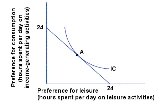
This can be shown in a graph that illustrates the trade-off between allocating your time between leisure activities and income generating activities. The linear constraint line indicates that there are only 24 hours in a day, and individuals must choose how much of this time to allocate to leisure activities and how much to working. (If multiple days are being considered the maximum number of hours that could be allocated towards leisure or work is about 16 due to the necessity of sleep) This allocation decision is informed by the curved
indifference curveIn microeconomic theory, an indifference curve is a graph showing different bundles of goods between which a consumer is indifferent. That is, at each point on the curve, the consumer has no preference for one bundle over another. One can equivalently refer to each point on the indifference curve...
labelled IC. The curve indicates the combinations of leisure and work that will give the individual a specific level of utility. The point where the highest indifference curve is just tangent to the constraint line (point A), illustrates the short-run equilibrium for this supplier of labour services.
The Income/Leisure trade-off in the short run
If the preference for consumption is measured by the value of income obtained, rather than work hours, this diagram can be used to show a variety of interesting effects. This is because the slope of the budget constraint becomes the wage rate. The point of optimization (point A) reflects the equivalency between the wage rate and the
, leisure for income (the slope of the indifference curve). Because the marginal rate of substitution, leisure for income, is also the ratio of the marginal utility of leisure (MU