
Home      Discussion      Topics      Dictionary      Almanac
Signup       Login
LMS Jubilee Class

LMS Jubilee Class

Overview
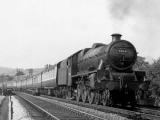
The London Midland and Scottish Railway (LMS) Jubilee Class is a class of steam locomotive
Steam locomotive
A steam locomotive is a railway locomotive that produces its power through a steam engine. These locomotives are fueled by burning some combustible material, usually coal, wood or oil, to produce steam in a boiler, which drives the steam engine...

 designed for mainline passenger work. 191 locomotives were built between 1934 and 1936. They were built concurrently with the LMS Stanier Class 5 4-6-0
LMS Stanier Class 5 4-6-0
The London Midland and Scottish Railway's Class 5 4-6-0, almost universally known as the Black Five, is a class of steam locomotive. It was introduced by William Stanier in 1934 and 842 were built between then and 1951...

.
Discussion
Ask a question about 'LMS Jubilee Class'
Start a new discussion about 'LMS Jubilee Class'
Answer questions from other users
Full Discussion Forum
 
Unanswered Questions
Encyclopedia
The London Midland and Scottish Railway (LMS) Jubilee Class is a class of steam locomotive
Steam locomotive
A steam locomotive is a railway locomotive that produces its power through a steam engine. These locomotives are fueled by burning some combustible material, usually coal, wood or oil, to produce steam in a boiler, which drives the steam engine...

 designed for mainline passenger work. 191 locomotives were built between 1934 and 1936. They were built concurrently with the LMS Stanier Class 5 4-6-0
LMS Stanier Class 5 4-6-0
The London Midland and Scottish Railway's Class 5 4-6-0, almost universally known as the Black Five, is a class of steam locomotive. It was introduced by William Stanier in 1934 and 842 were built between then and 1951...

.

History


The last 5 Patriots of Henry Fowler
Henry Fowler (engineer)
Sir Henry Fowler, KBE was a Chief Mechanical Engineer of the Midland Railway and subsequently the London, Midland and Scottish Railway.- Biography :...

's Patriot class
LMS Patriot Class
The Patriot Class was a class of 52 express passenger steam locomotives built for the London Midland and Scottish Railway. The first locomotive of the class was built in 1930 and the last in 1934. All of the Patriot class locomotives were withdrawn from service by 1965...

 on order, 5552 to 5557, were built with William Stanier
William Stanier
Sir William Arthur Stanier, FRS was Chief Mechanical Engineer of the London, Midland and Scottish Railway.- Biography :...

’s taper boiler and so became the first of the Jubilee class. 113 locomotives were ordered straight from the drawing board. They were initially a disappointment; their moderate degree of superheating often left them short of steam. Changes to the blastpipe and chimney dimensions helped to transform them.

On 29 April 1935 no. 5552, the first of the class, permanently swapped identities with no. 5642 which had been named Silver Jubilee on 19 April 1935 in recognition of the Silver Jubilee of King George V on 6 May of that year. This change gave the name to the rest of the class, see LMS Jubilee Class 5552 Silver Jubilee
LMS Jubilee Class 5552 Silver Jubilee
London Midland and Scottish Railway's number 5552 , named Silver Jubilee was Jubilee Class 4-6-0 express steam locomotive. It was specially named for the silver jubilee of George V.- Overview :...

. Earlier on (from summer 1934), they had been known as the "Red Staniers" (because of the crimson
Crimson
Crimson is a strong, bright, deep red color. It is originally the color of the dye produced from a scale insect, Kermes vermilio, but the name is now also used as a generic term for those slightly bluish-red colors that are between red and rose; besides crimson itself, these colors include...

 livery), to distinguish them from the "Black Staniers" (the LMS Stanier Black Five class).

They are often associated with the Midland Division, i.e. the lines inherited from the former Midland Railway
Midland Railway
The Midland Railway was a railway company in the United Kingdom from 1844 to 1922, when it became part of the London, Midland and Scottish Railway....

. This is because until the late 1950s, it was rare for any 7P locomotives to work south of Leeds. Until then, Jubilees were the largest express engine normally found on the lines running out of St Pancras
St Pancras railway station
St Pancras railway station, also known as London St Pancras and since 2007 as St Pancras International, is a central London railway terminus celebrated for its Victorian architecture. The Grade I listed building stands on Euston Road in St Pancras, London Borough of Camden, between the...

 or radiating from Derby
Derby
Derby , is a city and unitary authority in the East Midlands region of England. It lies upon the banks of the River Derwent and is located in the south of the ceremonial county of Derbyshire. In the 2001 census, the population of the city was 233,700, whilst that of the Derby Urban Area was 229,407...

. They could nevertheless be found on main lines throughout the former LMS
London, Midland and Scottish Railway
The London Midland and Scottish Railway was a British railway company. It was formed on 1 January 1923 under the Railways Act of 1921, which required the grouping of over 120 separate railway companies into just four...

 system.

The power classification was 5XP, in common with the earlier Patriot class. In January 1951, the classification was revised to 6P; this was revised again to 6P5F in November 1955, but the latter change was not applied to the locomotives' cabsides, which continued to show 6P. The two rebuilt locomotives
LMS Rebuilt Jubilee Class
The London Midland and Scottish Railway Rebuilt Jubilee Class consisted of two 4-6-0 steam locomotives.Both were rebuilt in 1942 from the LMS Jubilee Class engines—5736 Phoenix in April 1942 and 5735 Comet a month later. They were the second and third examples of the LMS 2A boilered 4-6-0...

 (nos. 5735/6) were reclassified 6P in July 1943, being revised to 7P in 1951.

Construction


Although built over only a 3 year period the class had many variations due to improvements being made as they were built. The major differences were:
  • Boilers – 10 variations, mainly affecting the number of tubes. The earlier boilers were domeless but later boilers were domed. There were 2 sizes of fire grate area depending on whether the firebox throatplate was straight or sloping.
  • Bogies – Approximately 50 of the earlier locomotives were built with ex-Claughton bogies which had a 6’3” wheelbase compared to the later locomotives built with new bogies that had a wheelbase of 6’ 6”.
  • Smokebox Saddle – The first 113 locomotives were built with a 2 piece saddle, the rest had a conventional 1 piece saddle.
  • Tenders – 3 basic patterns were fitted; Fowler 3,500 gall. Fowler high-sided (10 off) and Stanier 4,000 gall. However, taking into account rivets, wheelbase, and welds this can be subdivided into a total of 8 patterns.

Withdrawal


45637 Windward Islands was scrapped in 1952 due to damage sustained in the Harrow and Wealdstone rail crash
Harrow and Wealdstone rail crash
The Harrow and Wealdstone rail crash was a major railway disaster and collision on the British railway system on 8 October 1952.The accident took place from central London...

. The remaining locomotives were withdrawn between 1961 and 1967.

Details


Preservation


Four jubilees have been preserved, (4)5593 Kolhapur
LMS Jubilee Class 5593 Kolhapur
London Midland and Scottish Railway Jubilee Class 5593 named Kolhapur is a preserved British steam locomotive.-Service:...

, (4)5596 Bahamas
LMS Jubilee Class 5596 Bahamas
London Midland and Scottish Railway Jubilee Class 5596 Bahamas is a preserved British steam locomotive.-History:...

 and (4)5690 Leander
LMS Jubilee Class 5690 Leander
London Midland and Scottish Railway Jubilee Class No. 5690 Leander is a preserved British steam locomotive.- Overview :...

 have been worked in preservation.

The fourth, (4)5699 Galatea
LMS Jubilee Class 5699 Galatea
London Midland and Scottish Railway Jubilee Class No. 5699 Galatea is a preserved British steam locomotive.- Overview :...

, was saved from Woodham Brothers scrapyard as a rusting hulk and is slowly being restored. She requires one new set of driving wheels after one of hers was cut up in Barry when she was derailed.
Number Name Location Condition Notes Link to database
LMS BR
5690 45690 Leander West Coast Railway Company
West Coast Railway Company
West Coast Railways, also known as West Coast Railway Company, is a railway spot-hire company and charter train operator, based at Carnforth in Lancashire, on the site of the old Steamtown heritage depot...

, Carnforth
Carnforth
- References :...

In full working order, with main-line certificate
5593 45593 Kolhapur Tyseley Locomotive Works Awaiting overhaul
5596 45596 Bahamas Keighley and Worth Valley Railway
Keighley and Worth Valley Railway
The Keighley and Worth Valley Railway is a long branch line that served mills and villages in the Worth Valley and is now a heritage railway line in West Yorkshire, England. It runs from Keighley to Oxenhope. It connects to the national rail network line at Keighley railway station...

Awaiting overhaul Double chimney
5699 45699 Galatea West Coast Railway Company
West Coast Railway Company
West Coast Railways, also known as West Coast Railway Company, is a railway spot-hire company and charter train operator, based at Carnforth in Lancashire, on the site of the old Steamtown heritage depot...

, Carnforth
Carnforth
- References :...

scrapyard condition, undergoing restoration

Gallery


External links