
|
|
|
|
Kingsnake
|
| |
|
| |
- "Lampropeltis" redirects here. The trilobite genus erroneously named so by Öpik in 1967 is now Lampropeltastes.
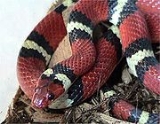
Kingsnakes are a type of colubrid snake that are members of the Lampropeltis genus, which also includes the milk snake.
Lampropeltis means "shiny shield" (from Greek ?aµp???, "shine" + pe?ta, "small shield"), due to their dorsal scales. The majority of kingsnakes have quite vibrant patterns on their skin.

Discussion
Ask a question about 'Kingsnake'
Start a new discussion about 'Kingsnake'
Answer questions from other users
|
Recent Posts

Encyclopedia
- "Lampropeltis" redirects here. The trilobite genus erroneously named so by Öpik in 1967 is now Lampropeltastes.
Kingsnakes are a type of colubrid snake that are members of the Lampropeltis genus, which also includes the milk snake.
Lampropeltis means "shiny shield" (from Greek ?aµp???, "shine" + pe?ta, "small shield"), due to their dorsal scales. The majority of kingsnakes have quite vibrant patterns on their skin. Kingsnakes use constriction to kill their prey and tend to be opportunistic when it comes to their diet; they will eat other snakes (ophiophagy), including venomous snakes,lizards, rodents, birds, and eggs. The Common Kingsnakes genus are known to be immune to the venom of other snakes and are known to eat rattlesnakes. The "king" in their name (as with the king cobra) is a reference to their taste for other snakes. Kingsnakes are not nesscarily immune to the venom of snakes from different localities. These snakes are commonly kept as pets because of their docile temperaments.
Some species of kingsnake, such as the Scarlet Kingsnake, have coloration and patterning which can cause them to be confused with the venomous coral snakes. There are several mnemonic rhymes to help people distinguish between the coral snake and its non-venomous look-alikes, such as "If red touches black, it's OK, Jack. If red touches yellow, you're a dead fellow." and "Red on yellow, kill a fellow. Red on black, Don't kill Jack." and "If yellow follows red, you're dead." These rhymes refer to the color of the rings on the snake, and only apply to those coral snakes found in the United States.
Taxonomic reclassification is an ongoing process, and differing sources often disagree, granting full species status to a group of these snakes that another source considers a subspecies. In the case of Lampropeltis catalinensis, for example, only a single specimen exists, and therefore classification is not necessarily finite. In addition, hybridization between species which have overlapping geographic ranges is not uncommon, confusing taxonomists further.
Kingsnakes are commonly kept as pets, due to their ease of care. Kingsnakes are overall hardy and simple to care for. Their captive diet usually consists of appropriately sized rodents, prekilled. Giving live rodents is an illegal offence and bad for the snakes health, the rodents are too high in fat. Kingsnakes are generally docile, curious and gentle. Kingsnakes seem to enjoy being handled. They also seemed to be mesmerized by patterns flashing on a television.
Species
Lampropeltis alterna (Brown, 1901)Lampropeltis calligasterLampropeltis calligaster calligaster (Harlan, 1827)South Florida Mole Kingsnake, Lampropeltis calligaster occipitolineata (Price, 1987)Mole Kingsnake, Lampropeltis calligaster rhombomaculata (Holbrook, 1840)Santa Catalina Island Kingsnake, Lampropeltis catalinensis (Van Denburgh & Slevin, 1921)Common Kingsnake, Lampropeltis getulaLampropeltis getula californiae (Blainville, 1835)Florida Kingsnake, Lampropeltis getula floridana (Blanchard, 1919)Eastern Kingsnake, Lampropeltis getula getula (Linnaeus, 1766)Apalachicola Kingsnake, Lampropeltis getula meansi (Krysko & Judd, 2006)Speckled Kingsnake, Lampropeltis getula holbrooki (Stejneger, 1902)Black Kingsnake, Lampropeltis getula niger (Yarrow, 1882)Black Mexican Kingsnake, Lampropeltis getula nigrita (Zweifel & Norris, 1955)Desert Kingsnake, Lampropeltis getula splendida (Baird & Girard, 1853)Outer Banks Kingsnake, Lampropeltis getula sticticeps (Barbour & Engels, 1942)
*Lampropeltis mexicana
Lampropeltis mexicana leonis (Günther, 1893)Durango Mountain Kingsnake, Lampropeltis mexicana greeri (Webb, 1961)Nuevo Leon Kingsnake, Lampropeltis mexicana thayeri (Loveridge, 1924)Lampropeltis pyromelanaLampropeltis pyromelana infralabialis (Tanner, 1953)Sonoran Mountain Kingsnake, Lampropeltis pyromelana knoblochi (Taylor, 1940)Arizona Mountain Kingsnake, Lampropeltis pyromelana pyromelana (Cope, 1866)Ruthven's Kingsnake, Lampropeltis ruthveni (Blanchard, 1920)Lampropeltis triangulum
**Scarlet Kingsnake, Lampropeltis triangulum elapsoides (Holbrook, 1838)
Lampropeltis webbi (Bryson, Dixon & Lazcano, 2005)Lampropeltis zonataLampropeltis zonata agalma (Van Denburgh & Slevin, 1923)Todos Santos Island Kingsnake, Lampropeltis zonata herrerae (Van Denburgh & Slevin, 1923)Sierra Mountain Kingsnake, Lampropeltis zonata multicincta (Yarrow, 1882)Coast Mountain Kingsnake, Lampropeltis zonata multifasciata (Bocourt, 1886)San Bernardino Mountain Kingsnake, Lampropeltis zonata parvirubra (Zweifel, 1952)San Diego Mountain Kingsnake, Lampropeltis zonata pulchra (Zweifel, 1952)St. Helena Mountain Kingsnake, Lampropeltis zonata zonata (Blainville, 1835)
External links
- Species account from the Iowa Reptile and Amphibian Field Guide
-
|
| |
|
|