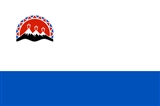
Kamchatka Krai is a
federal subjectRussia is a federation that consists of 83 subjects. These subjects are of equal federal rights in the sense that they have equal representation—two delegates each—in the Federation Council . However, they do differ in the degree of autonomy they enjoy...
of
RussiaRussia , officially known as both Russia and the Russian Federation , is a country in northern Eurasia . It is a semi-presidential republic, comprising 83 federal subjects...
. It is a
kraiKrai or kray is a term used to refer to nine of Russia's 83 federal subjects. The term is often translated as territory, province, country or region....
formed July 1, 2007 as a result of the merger of
Kamchatka OblastKamchatka Oblast was a federal subject of Russia . To the north, it bordered Magadan Oblast and Chukotka Autonomous Okrug. Koryak Autonomous Okrug was located in the northern part of the oblast...
and Koryak Autonomous Okrug, after a referendum held on the issue on October 23, 2005. The administrative centre is the city of
Petropavlovsk-KamchatskyPetropavlovsk-Kamchatsky is the main city and the administrative, industrial, scientific, and cultural center of Kamchatka Krai . Population: .-Geography:...
. The
okrugOkrug is an administrative division of some Eastern European Slavic states. The word "okrug" is a loanword in English, but it is nevertheless often translated as "area", "district", or "region"...
retains the status of a special administrative division of the krai under the name of Koryak Okrug.
The merger united the Russian Federation's constituent parts on the
Kamchatka PeninsulaThe Kamchatka Peninsula is a 1,250-kilometer long peninsula in the Russian Far East, with an area of 472,300 km². It lies between the Pacific Ocean to the east and the Sea of Okhotsk to the west...
.
Discussion
Ask a question about 'Kamchatka Krai'
Start a new discussion about 'Kamchatka Krai'
Answer questions from other users
|
Kamchatka Krai is a
federal subjectRussia is a federation that consists of 83 subjects. These subjects are of equal federal rights in the sense that they have equal representation—two delegates each—in the Federation Council . However, they do differ in the degree of autonomy they enjoy...
of
RussiaRussia , officially known as both Russia and the Russian Federation , is a country in northern Eurasia . It is a semi-presidential republic, comprising 83 federal subjects...
. It is a
kraiKrai or kray is a term used to refer to nine of Russia's 83 federal subjects. The term is often translated as territory, province, country or region....
formed July 1, 2007 as a result of the merger of
Kamchatka OblastKamchatka Oblast was a federal subject of Russia . To the north, it bordered Magadan Oblast and Chukotka Autonomous Okrug. Koryak Autonomous Okrug was located in the northern part of the oblast...
and Koryak Autonomous Okrug, after a referendum held on the issue on October 23, 2005. The administrative centre is the city of
Petropavlovsk-KamchatskyPetropavlovsk-Kamchatsky is the main city and the administrative, industrial, scientific, and cultural center of Kamchatka Krai . Population: .-Geography:...
. The
okrugOkrug is an administrative division of some Eastern European Slavic states. The word "okrug" is a loanword in English, but it is nevertheless often translated as "area", "district", or "region"...
retains the status of a special administrative division of the krai under the name of Koryak Okrug.
The merger united the Russian Federation's constituent parts on the
Kamchatka PeninsulaThe Kamchatka Peninsula is a 1,250-kilometer long peninsula in the Russian Far East, with an area of 472,300 km². It lies between the Pacific Ocean to the east and the Sea of Okhotsk to the west...
. The krai is a part of the country's
Far Eastern Federal DistrictThe Far Eastern Federal District , is the largest of the seven federal districts of Russia, while being also the least populated, with a population of under seven million. The Far Eastern Federal District was established in 2000 by then-President Vladimir Putin and is currently being governed by...
.
Demographics
- Births (2008 Jan-Nov) : 3,673 (11.55 per 1000)
- Deaths (2008 Jan-Nov) : 3,554 (11.17 per 1000)
Vital statistics for 2007
Source:
- Births: 3,931 (11.32 per 1000, 11.36 for urban areas & 11.20 for rural areas).
- Deaths: 3,863 (11.13 per 1000, 10.49 for urban areas & 13.63 for rural areas).
- Natural Growth Rate: +0.02% per year (+0.09% for urban areas & -0.24% for rural areas).
After nearly two decades, Kamchatka recorded a net natural population growth instead of decline in 2007. However in first half of 2008, the trend was reversed and population decline was observed again, partly due to increased mortality rate among the rural population.
Ethnic Composition
According to 2002 Census:
Out of those who stated their nationality in Census, around 91.85% of the population is White (Slav, Germanic, Finnic or Moldvin), while close to 4.46% is indigenous (Mostly Koryak). (A small number of Russian speaking Cossacks and other nationalities boycotted the census, refusing to state their nationality. In Kamchatka close to 3.3% refused to state their nationality).
| Ethnic Group |
Pop |
Percent |
| Total population |
358,801 |
100.00% |
| Total White |
318,943 |
88.89% |
| Russians |
290,108 |
80.85% |
| Ukrainians |
20,870 |
5.82% |
| Belorussians |
3,489 |
0.97% |
| Mordivians |
1,170 |
0.33% |
| Germans |
707 |
0.20% |
| Moldavians |
662 |
0.18% |
| Udmurts |
503 |
0.14% |
| Other White |
1,434 |
0.40% |
| Total Tribal |
15,497 |
4.32% |
| Koryaks |
7,328 |
2.04% |
| Itelmens |
2,296 |
0.64% |
| Kamchadals |
1,881 |
0.52% |
| Evens |
1,779 |
0.50% |
| Chukchis |
1,487 |
0.41% |
| Aleuts |
446 |
0.12% |
| Other Tribal |
280 |
0.08% |
| Total Turkic/Caucassian/Asian |
12,673 |
3.53% |
| Tatars |
3,617 |
1.01% |
| Koreans |
1,749 |
0.49% |
| Azerbajdzhanians |
1,311 |
0.37% |
| Chuvash |
1,292 |
0.36% |
| Armenians |
948 |
0.26% |
| Bashkirs |
575 |
0.16% |
| Other Asian |
3,181 |
0.89% |
| Not Stated |
11,602 |
3.23% |
| Other |
86 |
0.02% |