

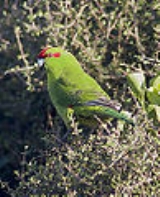
Kakariki

Encyclopedia
The three species of Kākāriki or New Zealand parakeets are the most common species
of parakeet
in the genus
Cyanoramphus
, family
Psittacidae
. The birds' Māori
name, which is the most commonly used, means "small parrot".
The three species on mainland New Zealand are the Yellow-crowned Parakeet
, Cyanoramphus auriceps, the Red-fronted Parakeet or Red-crowned Parakeet, C. novaezelandiae, and the critically endangered
Malherbe's Parakeet
(or Orange-fronted Parakeet), C. malherbi.
, and have become endangered as a result of habitat destruction
following human settlement and nest predation by introduced species
of mammal
. Scarce on the mainland, kākāriki have survived well on outlying islands, and also through breeding in captivity since they make good pet
s. A licence from the New Zealand Department of Conservation
is now required to breed them in captivity.
In October 2004, according to the Porirua City News (17 November, page 8), two pairs of Red-crowned Parakeets were seen in the Porirua
Scenic Reserve, probably having flown from Kapiti Island
.
Mitochondrial DNA
analysis has indicated that the Orange-fronted Parakeet is a separate species and not just a colour variation of the Yellow-crowned Parakeet. The Orange-fronted Parakeet is highly endangered, with less than 200 individuals remaining in the North Canterbury region of the South Island. Furthermore, Chatham Island's Yellow-crowned Parakeet and the red-crowned populations of New Caledonia
, Norfolk Island
and the subantarctic islands have been determined to be distinct species (Boon et al., 2001).
Species
In biology, a species is one of the basic units of biological classification and a taxonomic rank. A species is often defined as a group of organisms capable of interbreeding and producing fertile offspring. While in many cases this definition is adequate, more precise or differing measures are...
of parakeet
Parakeet
Parakeet is a term for any one of a large number of unrelated small to medium sized species of parrot, that generally have long tail feathers...
in the genus
Genus
In biology, a genus is a low-level taxonomic rank used in the biological classification of living and fossil organisms, which is an example of definition by genus and differentia...
Cyanoramphus
Cyanoramphus
Cyanoramphus is a genus of parakeets native to New Zealand and islands of the southern Pacific Ocean. The New Zealand forms are often referred to as kākāriki. They are small to medium sized parakeets with long tails and predominately green plumage. Most species are forest species, although several...
, family
Family (biology)
In biological classification, family is* a taxonomic rank. Other well-known ranks are life, domain, kingdom, phylum, class, order, genus, and species, with family fitting between order and genus. As for the other well-known ranks, there is the option of an immediately lower rank, indicated by the...
Psittacidae
Parrot
Parrots, also known as psittacines , are birds of the roughly 372 species in 86 genera that make up the order Psittaciformes, found in most tropical and subtropical regions. The order is subdivided into three families: the Psittacidae , the Cacatuidae and the Strigopidae...
. The birds' Māori
Maori language
Māori or te reo Māori , commonly te reo , is the language of the indigenous population of New Zealand, the Māori. It has the status of an official language in New Zealand...
name, which is the most commonly used, means "small parrot".
The three species on mainland New Zealand are the Yellow-crowned Parakeet
Yellow-crowned Parakeet
The Yellow-crowned Parakeet, Cyanoramphus auriceps, is a species of parakeet endemic to the islands of New Zealand. The species is found across the main three islands of New Zealand, North Island, South Island and Stewart Island/Rakiura, as well as on the subantarctic Auckland Islands...
, Cyanoramphus auriceps, the Red-fronted Parakeet or Red-crowned Parakeet, C. novaezelandiae, and the critically endangered
Critically endangered
Version 2010.3 of the IUCN Red List of Threatened Species identified 3744 Critically Endangered species, subspecies and varieties, stocks and subpopulations.Critically Endangered by kingdom:*1993 Animalia*2 Fungi*1745 Plantae*4 Protista-References:...
Malherbe's Parakeet
Malherbe's Parakeet
The Malherbe's Parakeet, Cyanoramphus malherbi, is a small parrot endemic to New Zealand. In New Zealand it is commonly known as the Orange-fronted Parakeet, a name it shares with a species from Middle America...
(or Orange-fronted Parakeet), C. malherbi.
Habitat
All above subspecies are native to New ZealandNew Zealand
New Zealand is an island country in the south-western Pacific Ocean comprising two main landmasses and numerous smaller islands. The country is situated some east of Australia across the Tasman Sea, and roughly south of the Pacific island nations of New Caledonia, Fiji, and Tonga...
, and have become endangered as a result of habitat destruction
Habitat destruction
Habitat destruction is the process in which natural habitat is rendered functionally unable to support the species present. In this process, the organisms that previously used the site are displaced or destroyed, reducing biodiversity. Habitat destruction by human activity mainly for the purpose of...
following human settlement and nest predation by introduced species
Introduced species
An introduced species — or neozoon, alien, exotic, non-indigenous, or non-native species, or simply an introduction, is a species living outside its indigenous or native distributional range, and has arrived in an ecosystem or plant community by human activity, either deliberate or accidental...
of mammal
Mammal
Mammals are members of a class of air-breathing vertebrate animals characterised by the possession of endothermy, hair, three middle ear bones, and mammary glands functional in mothers with young...
. Scarce on the mainland, kākāriki have survived well on outlying islands, and also through breeding in captivity since they make good pet
Pet
A pet is a household animal kept for companionship and a person's enjoyment, as opposed to wild animals or to livestock, laboratory animals, working animals or sport animals, which are kept for economic or productive reasons. The most popular pets are noted for their loyal or playful...
s. A licence from the New Zealand Department of Conservation
New Zealand Department of Conservation
The Department of Conservation , commonly known by its acronym, "DOC", is the state sector organisation which deals with the conservation of New Zealand’s natural and historic heritage...
is now required to breed them in captivity.
In October 2004, according to the Porirua City News (17 November, page 8), two pairs of Red-crowned Parakeets were seen in the Porirua
Porirua
Porirua is a city in the Wellington Region of New Zealand, immediately north of the city of Wellington, with their central business districts 20 km apart. A large proportion of the population commutes to Wellington, so it may be considered a satellite city. It almost completely surrounds...
Scenic Reserve, probably having flown from Kapiti Island
Kapiti Island
-External links:* , Department of Conservation* * , Nature Coast Enterprise *...
.
Mitochondrial DNA
Mitochondrial DNA
Mitochondrial DNA is the DNA located in organelles called mitochondria, structures within eukaryotic cells that convert the chemical energy from food into a form that cells can use, adenosine triphosphate...
analysis has indicated that the Orange-fronted Parakeet is a separate species and not just a colour variation of the Yellow-crowned Parakeet. The Orange-fronted Parakeet is highly endangered, with less than 200 individuals remaining in the North Canterbury region of the South Island. Furthermore, Chatham Island's Yellow-crowned Parakeet and the red-crowned populations of New Caledonia
New Caledonia
New Caledonia is a special collectivity of France located in the southwest Pacific Ocean, east of Australia and about from Metropolitan France. The archipelago, part of the Melanesia subregion, includes the main island of Grande Terre, the Loyalty Islands, the Belep archipelago, the Isle of...
, Norfolk Island
Norfolk Island
Norfolk Island is a small island in the Pacific Ocean located between Australia, New Zealand and New Caledonia. The island is part of the Commonwealth of Australia, but it enjoys a large degree of self-governance...
and the subantarctic islands have been determined to be distinct species (Boon et al., 2001).
