


KDE 3

Encyclopedia
K Desktop Environment 3 was the third series of releases of the K Desktop Environment (now called KDE Software Compilation
). There were six major releases in this series.
A new printing framework, KDEPrint debuted. Its modular design enabled it to support different printing engines, such as CUPS, LPRng, LPR, LPD or other servers or programs. In conjunction with CUPS, KDEPrint was able to manage an elaborate enterprise networked printing system. As KDEPrint provides a command-line interface, the framework, including the GUI configuration elements, are accessible to non-KDE applications, such as OpenOffice.org
, the Mozilla Application Suite
, and Acrobat Reader.
This release also introduced a new KDE address book library which provides a central address book to all KDE applications. The new library is based on the vCard
standard and has provisions for being extended by additional backends like LDAP or database servers.
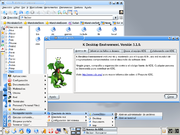 K Desktop Environment 3.1 introduced new default window (Keramik) and icon (Crystal) styles as well as a number of feature enhancements.
Kontact
included greatly improved LDAP integration throughout Kontact, enhanced security for KMail (S/MIME, PGP/MIME and X.509v3 support) and Exchange 2000 compatibility for KOrganizer. The desktop "lockdown" framework, introduced in version 3.0, enabling system administrators to restrict various configuration settings, such as bookmarks, user actions, and launching applications was extended. Other improvements included tabbed browsing in Konqueror
, KGet
- a new download manager, a new multimedia player plugin (based on Xine
) and a desktop sharing framework.
 K Desktop Environment 3.2 included new features, such as inline spell checking for web forms and e-mails, improved e-mail and calendaring support, tabs in Konqueror and support for Microsoft Windows desktop sharing protocol (RDP). Performance and standards compliance were improved with lowered start up times for applications and increased support for FreeDesktop.org
standards to strengthen interoperability with other Linux and UNIX software. Working in concert with Apple's Safari web browser team, KDE's web support saw performance boosts and increased compliance with web standards.
Usability was improved by reworking many applications, dialogs and control panels to focus on clarity and utility, and reducing clutter in many menus and toolbars. Hundreds of new icons were created to improve the consistency of the environment, and there were changes to the default look including new splash screens, animated progress bars and styled panels. The Plastik style debuted in this release.
New applications included:
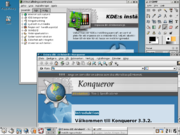 K Desktop Environment 3.3 focused on integrating different desktop components. Kontact was integrated with Kolab, a groupware application, and Kpilot. Konqueror features better support for Instant Messaging contacts, with the capability to send files to IM contacts, and support for IM protocols (e.g.
 irc:// ), while KMail can display the online presence of IM contacts. Juk has support for burning audio CDs with K3b
.
There were also many small desktop enhancements. Konqueror received tab improvements, an RSS feed viewer sidebar and a searchbar - compatible with all keyword: searches. HTML composing, anti-spam/anti-virus wizards, automatic handling of mailing lists, improved support for cryptography and a quick search bar were additions to KMail. Kopete gains support for file transfers with Jabber, aRts gains jack support and KWin has new buttons to support more features, such as "always on top".
New applications included:
 Accessibility
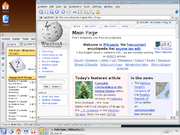
was a key focus for K Desktop Environment 3.4. A text-to-speech system was included with support built into Konqueror, Kate, KPDF and the standalone application KSayIt, and support for text-to-speech synthesis is integrated with the desktop. A new high contrast style and a complete monochrome icon set were available, plus an icon effect to paint all icons in two chosen colors, converting third party application icons into high contrast monochrome icons.
Kontact got support for various groupware servers, while Kopete was integrated into Kontact. KMail stores passwords securely with KWallet. KPDF can select, copy & paste text and images from PDFs, along with many other improvements. A new application, Akregator provides the ability to read news from RSS-enabled websites in one application.
DBUS/HAL
support allows dynamic device icons to keep in sync with the state of all devices. Kicker has an improved look and feel, and the trash system was redesigned to be more flexible. SVG files may be used as wallpapers. KHTML has improved standards support, putting it close to full support for CSS
2.1 and the CSS 3 Selectors module. In addition, KHTML plug-ins were made configurable, so the user can selectively disable ones that are not used. There were also improvements to the way Netscape plug-ins are handled.
, providing integrated and simple-to-install widgets for the user's desktop. Konqueror included an ad-block feature and became the second web browser to pass the Acid2
CSS test, ahead of Firefox and Internet Explorer
. Kopete gained webcam support for MSN and Yahoo! IM
protocols. The edutainment module included three new applications (KGeography
, Kanagram and blinKen), while Kalzium
also saw improvements.
release manager for KDE 3.5, has released Trinity to pick up where the KDE e.V. left. This fork keeps the KDE 3.5 branch alive, and also includes continuing bugs fixes, enhancements with additional features, and compatibility with recent hardware.
The Kolab Enterprise packages are also still actively being developed and tested based on Kontact 3.5; a version based on Kontact 4 is available but not recommended for regular use.
KDE Software Compilation
The KDE Software Compilation is a desktop environment and an associated range of KDE Applications produced by KDE. Prior to version 4.4, released in February 2010, the Software Compilation was known as KDE, which used to stand for K Desktop Environment until November 2009...
). There were six major releases in this series.
K Desktop Environment 3.0
K Desktop Environment 3.0 introduced better support for restricted usage. Some environments, such as kiosks, Internet cafes and enterprise deployments, demand that the user not have full access to all the capabilities of a piece of software, in order to preclude certain undesirable actions. To address these needs, KDE 3.0 included a new lockdown framework. This is essentially a permissions-based system for altering application configuration options and supplements standard UNIX permissions. The KDE panel and the desktop manager were modified to employ this system, but other major desktop components, such as Konqueror and the Control Center, had to wait for subsequent releases.A new printing framework, KDEPrint debuted. Its modular design enabled it to support different printing engines, such as CUPS, LPRng, LPR, LPD or other servers or programs. In conjunction with CUPS, KDEPrint was able to manage an elaborate enterprise networked printing system. As KDEPrint provides a command-line interface, the framework, including the GUI configuration elements, are accessible to non-KDE applications, such as OpenOffice.org
OpenOffice.org
OpenOffice.org, commonly known as OOo or OpenOffice, is an open-source application suite whose main components are for word processing, spreadsheets, presentations, graphics, and databases. OpenOffice is available for a number of different computer operating systems, is distributed as free software...
, the Mozilla Application Suite
Mozilla Application Suite
The Mozilla Application Suite is a cross-platform integrated Internet suite. Its development was initiated by Netscape Communications Corporation, before their acquisition by AOL. It is based on the source code of Netscape Communicator...
, and Acrobat Reader.
This release also introduced a new KDE address book library which provides a central address book to all KDE applications. The new library is based on the vCard
VCard
vCard is a file format standard for electronic business cards. vCards are often attached to e-mail messages, but can be exchanged in other ways, such as on the World Wide Web or Instant Messaging...
standard and has provisions for being extended by additional backends like LDAP or database servers.
K Desktop Environment 3.1
Kontact
Kontact
KMail supports folders, filtering, viewing HTML mail, and international character sets. It can handle IMAP, IMAP IDLE, dIMAP, POP3, and local mailboxes for incoming mail. It can send mail via SMTP or sendmail...
included greatly improved LDAP integration throughout Kontact, enhanced security for KMail (S/MIME, PGP/MIME and X.509v3 support) and Exchange 2000 compatibility for KOrganizer. The desktop "lockdown" framework, introduced in version 3.0, enabling system administrators to restrict various configuration settings, such as bookmarks, user actions, and launching applications was extended. Other improvements included tabbed browsing in Konqueror
Konqueror
Not to be confused with the Conqueror web browser.Konqueror is a web browser and file manager that provides file-viewer functionality for file systems such as local files, files on a remote ftp server and files in a disk image. It is a core part of the KDE desktop environment...
, KGet
KGet
KGet is a free download manager for KDE. By default it is the download manager used for Konqueror, but can also be used with Mozilla Firefox. KGet is part of the KDE Network package, and was featured by Tux Magazine and Free Software Magazine.-History:...
- a new download manager, a new multimedia player plugin (based on Xine
Xine
xine is a multimedia playback engine for Unix-like operating systems released under the GNU General Public License. xine is built around a shared library that supports different frontend player applications. Another important feature of xine is the ability to manually correct the synchronization...
) and a desktop sharing framework.
K Desktop Environment 3.2
Freedesktop.org
freedesktop.org is a project to work on interoperability and shared base technology for free software desktop environments for the X Window System on Linux and other Unix-like operating systems. It was founded by Havoc Pennington from Red Hat in March 2000.The organisation focuses on the user....
standards to strengthen interoperability with other Linux and UNIX software. Working in concert with Apple's Safari web browser team, KDE's web support saw performance boosts and increased compliance with web standards.
Usability was improved by reworking many applications, dialogs and control panels to focus on clarity and utility, and reducing clutter in many menus and toolbars. Hundreds of new icons were created to improve the consistency of the environment, and there were changes to the default look including new splash screens, animated progress bars and styled panels. The Plastik style debuted in this release.
New applications included:
- JuKJuKJuK is a free software audio player by KDE, the default player since K Desktop Environment 3.2. JuK supports collections of MP3, Ogg Vorbis, and FLAC audio files....
, a jukebox-style music player. - KopeteKopeteKopete is a multi-protocol, free software instant messaging client. Although it can run in numerous environments, it was designed for and integrates with the KDE desktop environment...
instant messenger with support for AOL Instant Messenger, MSN, Yahoo Messenger, ICQ, Gadu-Gadu, Jabber, IRC, SMS and WinPopup. - KWalletKWalletKWallet is a credentials management application for the KDE Software Compilation desktop environment . It provides a centralized way for users to store sensitive passwords in encrypted files, called "wallets". For added security, each wallet can be used to store a different kind of credentials,...
, providing integrated, secure storage of passwords and web form data. - KontactKontactKMail supports folders, filtering, viewing HTML mail, and international character sets. It can handle IMAP, IMAP IDLE, dIMAP, POP3, and local mailboxes for incoming mail. It can send mail via SMTP or sendmail...
, a unified interface that draws KDE's email, calendaring, address book, notes and other PIM features together. - KGpg, KDE interface to industry-standard encryption tools.
- KIG, an interactive geometry program.
- KSVG, a viewer for SVG files.
- KMag, KMouseTool and KMouth. New accessibility tools.
- KGoldRunner, a new game.
K Desktop Environment 3.3
K3b
K3b is a CD and DVD authoring application by KDE for Unix-like computer operating systems. It provides a graphical user interface to perform most CD/DVD burning tasks like creating an Audio CD from a set of audio files or copying a CD/DVD, as well as more advanced tasks such as burning eMoviX...
.
There were also many small desktop enhancements. Konqueror received tab improvements, an RSS feed viewer sidebar and a searchbar - compatible with all keyword: searches. HTML composing, anti-spam/anti-virus wizards, automatic handling of mailing lists, improved support for cryptography and a quick search bar were additions to KMail. Kopete gains support for file transfers with Jabber, aRts gains jack support and KWin has new buttons to support more features, such as "always on top".
New applications included:
- KolourpaintKolourPaintKolourPaint is a free, raster graphics editor for the KDE, similar to Microsoft's Paint application before Windows 7, but has some additional features such as support for transparency....
, a replacement for KPaint - KWordQuiz, KLatin and KTurtleKTurtleKTurtle is an educational programming environment for turtle graphics. It is released under the open source GNU General Public License and is part of the KDE SC 4. KTurtle has a built-in programming language that is loosely based on the Logo programming language...
expand the list of education packages for schools and families - Kimagemapeditor and klinkstatus for web designers
- KSpell2, a new spellchecking library that fixes KSpell's shortcomings
- KThemeManager, a new control center module to globally handle KDE visual themes
K Desktop Environment 3.4
Accessibility
Accessibility is a general term used to describe the degree to which a product, device, service, or environment is available to as many people as possible. Accessibility can be viewed as the "ability to access" and benefit from some system or entity...
was a key focus for K Desktop Environment 3.4. A text-to-speech system was included with support built into Konqueror, Kate, KPDF and the standalone application KSayIt, and support for text-to-speech synthesis is integrated with the desktop. A new high contrast style and a complete monochrome icon set were available, plus an icon effect to paint all icons in two chosen colors, converting third party application icons into high contrast monochrome icons.
Kontact got support for various groupware servers, while Kopete was integrated into Kontact. KMail stores passwords securely with KWallet. KPDF can select, copy & paste text and images from PDFs, along with many other improvements. A new application, Akregator provides the ability to read news from RSS-enabled websites in one application.
DBUS/HAL
HAL (software)
HAL was a software project providing a hardware abstraction layer for Unix-like computer systems.HAL is now deprecated on GNU/Linux systems, with functionality being merged into udev as of 2008–2010...
support allows dynamic device icons to keep in sync with the state of all devices. Kicker has an improved look and feel, and the trash system was redesigned to be more flexible. SVG files may be used as wallpapers. KHTML has improved standards support, putting it close to full support for CSS
CSS
-Computing:*Cascading Style Sheets, a language used to describe the style of document presentations in web development*Central Structure Store in the PHIGS 3D API*Closed source software, software that is not distributed with source code...
2.1 and the CSS 3 Selectors module. In addition, KHTML plug-ins were made configurable, so the user can selectively disable ones that are not used. There were also improvements to the way Netscape plug-ins are handled.
K Desktop Environment 3.5
The K Desktop Environment 3.5 release included SuperKarambaSuperKaramba
SuperKaramba is a tool that allows one to easily create functionality enhancement modules on a KDE desktop. Currently, only Linux is officially supported, although it also works well on FreeBSD and NetBSD...
, providing integrated and simple-to-install widgets for the user's desktop. Konqueror included an ad-block feature and became the second web browser to pass the Acid2
Acid2
Acid2 is a test page published and promoted by the Web Standards Project to expose web page rendering flaws in web browsers and other applications that render HTML. Named after the acid test for gold, it was developed in the spirit of Acid1, a relatively narrow test of compliance with the Cascading...
CSS test, ahead of Firefox and Internet Explorer
Internet Explorer
Windows Internet Explorer is a series of graphical web browsers developed by Microsoft and included as part of the Microsoft Windows line of operating systems, starting in 1995. It was first released as part of the add-on package Plus! for Windows 95 that year...
. Kopete gained webcam support for MSN and Yahoo! IM
Instant messaging
Instant Messaging is a form of real-time direct text-based chatting communication in push mode between two or more people using personal computers or other devices, along with shared clients. The user's text is conveyed over a network, such as the Internet...
protocols. The edutainment module included three new applications (KGeography
KGeography
KGeography is a Free and open source educational software game that tests students geographical knowledge. It forms part of KDE SC 4. Current version ships with KDE Education Project 3.5.- Learning :Browse the maps clicking in a map division to see its name...
, Kanagram and blinKen), while Kalzium
Kalzium
Kalzium is a periodic table of the elements for KDE SC 4.It contains information about 103 chemical elements, including mass, charge, picture, discovery information, chemical and energy data, and a model of the atom. The table itself can be configured to display numeration, state of matter, and...
also saw improvements.
Release schedule
| Date | Event |
|---|---|
| 3.0 | |
| 3 April 2002 | KDE 3.0 released |
| 22 May 2002 | 3.0.1 Maintenance release. |
| 2 July 2002 | 3.0.2 Maintenance release. |
| 19 August 2002 | 3.0.3 Maintenance release. |
| 9 October 2002 | 3.0.4 Maintenance release. |
| 18 November 2002 | 3.0.5 Maintenance release. |
| 21 December 2002 | 3.0.5a Maintenance release. |
| 3.1 | |
| 28 January 2003 | KDE 3.1 released |
| 20 March 2003 | 3.1.1 Maintenance release. |
| 19 May 2003 | 3.1.2 Maintenance release. |
| 29 July 2003 | 3.1.3 Maintenance release. |
| 16 September 2003 | 3.1.4 Maintenance release. |
| 14 January 2004 | 3.1.5 Maintenance release. |
| 3.2 | |
| 3 February 2004 | KDE 3.2 released |
| 9 March 2004 | 3.2.1 Maintenance release. |
| 19 April 2004 | 3.2.2 Maintenance release. |
| 9 June 2004 | 3.2.3 Maintenance release. |
| 3.3 | |
| 19 August 2004 | KDE 3.3 released |
| 12 October 2004 | 3.3.1 Maintenance release. |
| 8 December 2004 | 3.3.2 Maintenance release. |
| 3.4 | |
| 16 March 2005 | KDE 3.4 released |
| 31 May 2005 | 3.4.1 Maintenance release. |
| 28 July 2005 | 3.4.2 Maintenance release. |
| 13 October 2005 | 3.4.3 Maintenance release. |
| 3.5 | |
| 29 November 2005 | KDE 3.5 released |
| 31 January 2006 | 3.5.1 Maintenance release. |
| 28 March 2006 | 3.5.2 Maintenance release. |
| 31 May 2006 | 3.5.3 Maintenance release. |
| 2 August 2006 | 3.5.4 Maintenance release. |
| 11 October 2006 | 3.5.5 Maintenance release. |
| 25 January 2007 | 3.5.6 Maintenance release. |
| 22 May 2007 | 3.5.7 Maintenance release. |
| 16 October 2007 | 3.5.8 Maintenance release. |
| 19 February 2008 | 3.5.9 Maintenance release. |
| 26 August 2008 | 3.5.10 Maintenance release. |
Forking
The Trinity Desktop Environment project, organised and led by Timothy Pearson, KubuntuKubuntu
Kubuntu is an official derivative of the Ubuntu operating system using the KDE Plasma Desktop instead of the Unity graphical environment. It is part of the Ubuntu project and uses the same underlying system. It is possible to install both the KDE Plasma Desktop as well as the Unity desktop on...
release manager for KDE 3.5, has released Trinity to pick up where the KDE e.V. left. This fork keeps the KDE 3.5 branch alive, and also includes continuing bugs fixes, enhancements with additional features, and compatibility with recent hardware.
The Kolab Enterprise packages are also still actively being developed and tested based on Kontact 3.5; a version based on Kontact 4 is available but not recommended for regular use.