

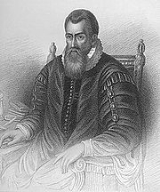
John Napier

Overview
John Napier of Merchiston (1550 – 4 April 1617) – also signed as Neper, Nepair – named Marvellous Merchiston, was a Scottish
mathematician
, physicist
, astronomer
& astrologer
, and also the 8th Laird
of Merchistoun
. He was the son of Sir Archibald Napier of Merchiston. John Napier is most renowned as the discoverer of the logarithm
. Napier is the inventor of the so-called "Napier's bones
". Napier also made common the use of the decimal point in arithmetic and mathematics.
Scotland
Scotland is a country that is part of the United Kingdom. Occupying the northern third of the island of Great Britain, it shares a border with England to the south and is bounded by the North Sea to the east, the Atlantic Ocean to the north and west, and the North Channel and Irish Sea to the...
mathematician
Mathematics
Mathematics is the study of quantity, space, structure, and change. Mathematicians seek out patterns and formulate new conjectures. Mathematicians resolve the truth or falsity of conjectures by mathematical proofs, which are arguments sufficient to convince other mathematicians of their validity...
, physicist
Physicist
A physicist is a scientist who studies or practices physics. Physicists study a wide range of physical phenomena in many branches of physics spanning all length scales: from sub-atomic particles of which all ordinary matter is made to the behavior of the material Universe as a whole...
, astronomer
Astronomer
An astronomer is a scientist who studies celestial bodies such as planets, stars and galaxies.Historically, astronomy was more concerned with the classification and description of phenomena in the sky, while astrophysics attempted to explain these phenomena and the differences between them using...
& astrologer
Astrologer
An astrologer practices one or more forms of astrology. Typically an astrologer draws a horoscope for the time of an event, such as a person's birth, and interprets celestial points and their placements at the time of the event to better understand someone, determine the auspiciousness of an...
, and also the 8th Laird
Laird
A Laird is a member of the gentry and is a heritable title in Scotland. In the non-peerage table of precedence, a Laird ranks below a Baron and above an Esquire.-Etymology:...
of Merchistoun
Merchiston
Merchiston is a prosperous, mainly residential area in the south-west of Edinburgh, Scotland. The housing is primarily a mixture of large, late Georgian, Victorian and Edwardian villas – several of the latter by Edward Calvert – together with a smaller number of Victorian tenements and...
. He was the son of Sir Archibald Napier of Merchiston. John Napier is most renowned as the discoverer of the logarithm
Logarithm
The logarithm of a number is the exponent by which another fixed value, the base, has to be raised to produce that number. For example, the logarithm of 1000 to base 10 is 3, because 1000 is 10 to the power 3: More generally, if x = by, then y is the logarithm of x to base b, and is written...
. Napier is the inventor of the so-called "Napier's bones
Napier's bones
Napier's bones is an abacus created by John Napier for calculation of products and quotients of numbers that was based on Arab mathematics and lattice multiplication used by Matrakci Nasuh in the Umdet-ul Hisab and Fibonacci writing in the Liber Abaci. Also called Rabdology...
". Napier also made common the use of the decimal point in arithmetic and mathematics.
Unanswered Questions
