
Encyclopedia
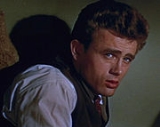
James Byron Dean was an American
film actor who epitomized youthful
angst. Dean's mainstream status as a cultural icon is best embodied in the title of his most cited role in
Rebel Without a Cause is a 1955 [i] film [i] which tells the story of a rebellious teenager [i] ...
. As with
Buddy Holly,
Bruce Lee, and
Marilyn Monroe, his death at a young age helped guarantee a legendary status.
Childhood and education
Born in
Marion, Indiana to Winton and Mildred Wilson Dean, James Dean and his family moved to
Santa Monica, California six years after his father had left farming to become a
dental technician. Dean was enrolled in
Brentwood Public School until his mother died of
cancer in 1940.
At age nine, Dean was sent by his father to live with his aunt Ortense and uncle Marcus Winslow on a farm in
Fairmount, Indiana, where he was brought up with a
Quaker influence. In
high school Dean played on the school
basketball team and studied forensics and
drama. After graduating from Fairmount High School in 1949, Dean moved back to
California to live with his father and stepmother.
He enrolled in
Santa Monica College , pledged to the
Sigma Nu fraternity and majored in pre-law. Dean transferred to the
University of California, Los Angeles and changed his major to
drama, resulting in estrangement from his father.
Acting career
Dean began his acting career with a
Pepsi-Cola commercial followed by a stint as a stunt tester in the
Beat the Clock game show. He quit college to focus on his budding career, but struggled to get jobs in
Hollywood and paid his bills only by working as a parking lot attendant at
CBS Studios.
Following friends' advice, Dean moved to
New York City to pursue live stage acting, where he was accepted to study under
Lee Strasberg in the storied Actors Studio. His career picked up, and he did several episodes on early-
1950s TV shows such as
Kraft Television Theater,
Studio One,
Lux Video Theatre,
Robert Montgomery Presents,
Danger and
General Electric Theater. One early role, for the
CBS series,
Omnibus saw Dean portraying the same type of disaffected youth he would later immortalize in
Rebel Without a Cause . Positive reviews for his role in
André Gide's
The Immoralist is a novel [i] by Andr Gide [i], published in France [i] in 1902 as
L'immoraliste ...
led to calls from Hollywood and paved the way to film stardom.
East of Eden
Director
Elia Kazan was looking for a new actor to play the role of Cal in
East of Eden is a novel [i] by Nobel Prize [i] winner John Steinbeck [i], ...
; Dean and another relatively unknown actor,
Paul Newman, were the final two chosen. Following a screen test in
New York City the part was given to Dean.
On March 8, 1954, Dean left
New York City and headed for Los Angeles to begin shooting
East of Eden. Dean played the son of a constantly disapproving father .
The relationship between Cal and his father paralleled that between Dean and his own father, and so Dean took the role personally. He became known on the set for his improvisational contributions to the script; his creativity proved to be very important as some of the most famous scenes were his addition to the script. Dean would apparently drive past cinemas during the release of the film and stare in amazement as people lined up to see him. He received an
Academy Award nomination for Best Actor in a Leading Role
Rebel Without a Cause
He followed this up in rapid succession with the starring role in
Rebel Without a Cause, a film that would prove to be hugely popular amongst teenagers. The film is widely cited as an accurate representation of
teenage angst of the early 1950s.
The film co-starred
Natalie Wood and
Sal Mineo. Director
Nicholas Ray often encouraged Dean’s creative input.
During filming, Dean purchased one of only 90
Porsche 550 Spyders, and introduced himself to competitive
auto racing, where he had early success.
Giant
Giant which was posthumously released in 1956, saw Dean play a supporting role to both
Elizabeth Taylor and
Rock Hudson. His role was notable in that, in order to portray an older version of his character in one scene, Dean dyed his hair grey and shaved some of it off to give himself a receding hairline.
Giant would be Dean’s last film. Towards the end of the film, an artfully aged Dean is at a banquet set to make a speech. This would be his last ever on-screen appearance. That scene has been dubbed “The Last Supper”.
Dean was nominated for an Academy Award after the release of the film.
Racing Career and "Little Bastard"
When Dean got the part in
East of Eden, he bought himself a red race-prepared
MG TD and shortly afterwards, a white
Ford Woodie station wagon. Dean upgraded his MG to a
Porsche 356 Speedster which he raced. Dean came second in the
Palm Springs Road Races in March 1955, after a driver was disqualified, he came third in May 1955 at
Bakersfield and was running fourth at the
Santa Monica Road Races later that month until he retired with an engine failure. Dean traded the car in for a
Porsche 550 Spyder.
Dean was contractually barred from racing during the filming of
Giant, but with that out of the way, he was free to compete again. The Porsche was in fact a stopgap for Dean, as delivery of a superior Lotus Mk. X was delayed and he needed a car to compete at the races in
Salinas, California.
Dean's 550 was customized by the young George Barris, who would go on to greater things, including the design of the
Batmobile. Dean's Porsche was numbered 130 at the front, side and back. The car had a
tartan on the seating and two red striping at the rear of its wheelwell. The car was given the nickname "Little Bastard" by
Bill Hickman, his language coach on
Giant. Dean was keen to show off his new sportscar to friends, but his acting friends had bad feelings about the car. Barris would later have bad premonitions about the car.
Death
Dean and his mechanic Rolf Wuetherich set off from Competition Motors where they had prepared his
Porsche 550 Spyder that morning for a sports car race at Palm Springs. Dean originally intended to tow the Porsche to the meeting point at
Salinas behind his Ford, crewed by Hickman and photographer Stanford Roth, who was planning a photo story of Dean at the races. At the last minute Dean decided he needed more time to familiarise himself with the car. Later in the afternoon, Dean was pulled over for speeding. Already having left the Ford far behind, they stopped for fuel and to meet up with fellow racer Lance Reventlow.
Dean was driving west on
U.S. Highway 466 near
Cholame, California when a 1950 Ford Tudor driven from the opposite direction by 23-year-old
Cal Poly student Donald Turnupseed attempted to take the fork onto
California State Route 41 and crossed into Dean's lane without seeing him. The two cars hit almost head on. According to a story in the October 1, 2005 edition of the
Los Angeles Times,
California Highway Patrol officer Ron Nelson and his partner had been finishing a coffee break in
Paso Robles when they were called to the scene of the accident, where they saw a heavily-breathing Dean being placed into an ambulance. Wuetherich had been thrown from the car but survived with a broken jaw and other injuries. Dean was taken to Paso Robles War Memorial Hospital where he was pronounced dead on arrival at 5:59PM at the age of 24. His last known words, uttered right before impact, are said to have been: "That guy's got to stop... He'll see us.", though are also, and probably more famously, known to be "My fun days are over."
Contrary to reports of Dean's speeding, which persisted decades after his death, Nelson said "the wreckage and the position of Dean's body indicated his speed was more like 55 mph ." Turnupseed received a gashed forehead and bruised nose and was not cited by police for the accident. He died of
lung cancer in 1995. Rolf Wuetherich would die in a road accident in
Germany in 1981. While completing
Giant, and to promote
Rebel Without a Cause, Dean had recently filmed a short interview with actor Gig Young for an episode of "Warner Bros. Presents" wherein he ad-libbed the popular phrase "The life you save may be your own" instead into "The life you save may be
mine." Dean's sudden death prompted the studio to re-film the section, and the piece was never aired - though in the past several sources have referred to the footage, mistakenly identifying it as a public service announcement. ,
The curse of "Little Bastard"
Since Dean's death, his Porsche 550 Spyder has been infamous as being the vehicle that killed not only him, but for injuring and killing several others in the years following his death.
Over the years, many groups of people believed that the actor's vehicle and all of its parts were cursed. Legendary Hot Rodder George Barris bought the wreck for $2,500, only to have it slip off its trailer and break a mechanic's leg.
Soon afterwards, Barris sold the
engine and drive-train to
physicians Troy McHenry and William Eschrid respectively. While racing against each other, the former would be killed instantly when his vehicle spun out of control and crashed into a tree, while the latter would be seriously injured when his vehicle rolled over while going into a curve.
Barris later sold two tires, which malfunctioned as well. The tires, which were unharmed in Dean's accident, blew up simultaneously causing the buyer's automobile to go off the road.
Two young would-be thieves were injured while attempting to steal parts from the car. One tried to steal the steering wheel from the Porsche; his arm ripped open on a piece of jagged metal. Later, another man was injured while trying to steal the bloodstained front seat. This would be the final straw for Barris, who decided to store "Little Bastard" away, but was quickly persuaded by the
California Highway Patrol to loan the wrecked car in a highway safety exhibit.
The first exhibit from the CHP featuring the car ended unsuccessfully, as the garage storing the Spyder went up in flames, destroying everything except the car itself, which suffered almost no damage whatsoever from the fire. The second display, at a
Sacramento High School, ended when the car fell, breaking a student's hip. "Little Bastard" also found itself causing trouble while being transported several times. On its way to
Salinas, the truck containing the vehicle lost control, causing the driver to fall out, only to be crushed by the Porsche after it fell off the back. On two separate occasions, once on a
freeway and again in
Oregon, the car came off other trucks, although no injuries were reported, another vehicle's
windshield was shattered in Oregon.
Its last use in a CHP exhibit was in 1959. In 1960, when being returned to George Barris in Los Angeles,
California, the car would mysteriously vanish. It has not been seen since. ***This info is highly unlikely and not true...
Legacy
James Dean is one of five people to have been nominated for a Best Actor Academy Award for their first feature role and the only one nominated twice posthumously. He is buried in Park Cemetery in
Fairmount, Indiana.
Of the films released in the
1950s Rebel Without a Cause is a 1955 [i] film [i] which tells the story of a rebellious teenager [i] ...
, is most often cited as having symbolized the growing post-war rebellion of 1950s teenagers along with playing a part in the emergence of rock and roll as a lasting cultural phenomenon. Many young people of that and later generations modeled themselves after James Dean. His charm would forever influence the young generation of his time. His charismatic screen presence and very brief career combined with the publicity surrounding his death at a young age transformed Dean into a cult figure and
pop icon of apparently timeless fascination.
Sexuality
Dean's sexual orientation is a matter of some debate. Often considered a
gay film icon , there are many published accounts of Dean having had sexual relationships with both men and women. In literary critic Ron Martinetti's biography, "The James Dean Story," Martinetti writes, "Only one of Dean's
homosexual relationships is dealt with in this book — and that in his early days in Hollywood and New York with a director named Rogers Brackett. Toward the end of his own life, however, when he was stricken with cancer, Rogers granted me the only interviews he ever gave on Dean. He was tired of the "half-truths" that had been published and wanted "to set the record straight."
However, William Bast, Dean's close friend, roommate, and indeed his first biographer , who knew Dean throughout the last five years of his short life, has recently [2006] published an unexpurgated version of his first book, in which he now reveals that he and Dean were sexually involved, and describes the difficult circumstances of their involvement . In this book Bast also deals frankly with some of Dean's other homosexual involvements, including Dean's relationship with Brackett.
Furthermore,
Boze Hadleigh, a Hollywood biographer who focused on film figures who he believed to be gay or bisexual, published a 1972 interview with
Sal Mineo in which the actor said, "
Nick told me they had a big affair." Further sources support the view that Dean could have had several homosexual relationships.John Gilmore, a friend of Dean from the early days in New York, and later in Hollywood where he was a member of Dean's "Night Watch" motorcyle riders, wrote a book on James Dean claiming they had an "experimental" homosexual encounter. Gilmore writes that Dean was "multi-sexual." In his
Natalie Wood biography,
Gavin Lambert, himself homosexual and part of the Hollywood gay circles of the 50s and
60s, describes Dean as being bisexual. According to Hollywood biographer Lawrence J. Quirk, Mike Connolly, gay gossip columnist for the
Hollywood Reporter was one of two major trade publications of the film industry [i] in the United States [i] ...
from 1951 to 1966, "would put the make on the most prominent young actors, including Robert Francis,
Guy Madison,
Anthony Perkins,
Nick Adams and James Dean. Quirk said there was rampant gossip at gay parties regarding not only Connolly's escapades with these actors but also a noteworthy pornography collection he would display to those he favored." In her memoir of her brief affair with Dean, actress Liz Sheridan confirms that Dean had an affair with Rogers Brackett, a radio director for an advertising agency whom Dean met in the summer of 1951 while working as a parking attendant at
CBS. Robert Aldrich and Garry Wotherspoon's book
Who's Who in Contemporary Gay and Lesbian History: From World War II to the Present Day includes an entry on James Dean. "Live Fast, Die Young – The Wild Ride of Making Rebel Without a Cause," a recent book by Lawrence Frascella and Al Weisel, states that
Rebel director Nicholas Ray knew Dean to be bisexual.
However, after Dean signed his deal with Warner Brothers, the studio's public relations department, perhaps seeking to squash any rumors about the actor's sexuality that might have followed him from New York, actively began generating stories about Dean's liaisons with a variety of young actresses, including but not limited to, the young Italian star Pier Angeli, who was shooting "The Silver Chalice" on an adjoining Warner lot. For a very short time the story of a Dean-Angeli love affair was also promoted by Dean himself, who fed it to various gossip columnists, and indeed to anyone who cared to listen, including his costar, Julie Harris, who in interviews has reported that Dean told her about being madly in love with Angeli. In his autobiography, "East of Eden" director Elia Kazan, while dismissing the notion that Dean could possibly have had any success with women, paradoxically also alluded to Dean and Angeli's "romance," claiming that he had heard them loudly making love in Dean's dressing room, although how he alone could have been aware of this while the rest of the staff at Warner Brothers remained in ignorance of this noisy turmoil is a mystery. Angeli's mother was supposed to have disapproved of the relationship because Dean was not a Catholic, among other things. In any event, Dean soon found himself dumped by Angeli in favor of singer-actor Vic Damone, whom she had previously dated, and whom she in fact married, although the marriage was reportedly a disaster. Some friends of Dean still maintain that he was heartbroken over Angeli's marriage, although Bast reports that Dean seemed merely angered at being dumped, and losing out in what he saw chiefly as a contest of wills between himself and Angeli's mother. Gossip columnists, however, kept the myth of the eternal romance churning, reporting that shortly before Angeli died in the 1970s, she maintained that Dean was the only man she ever loved.
In his 1992 biography, 'James Dean: Little Boy Lost', journalist Joe Hyams, who claims to have known Dean personally, devotes an entire chapter to Dean's alleged relationship with Angeli; however, he also presents what appears to be a far-fetched account alleging Dean's early molestation by a minister, and describes it as Dean's first homosexual encounter . Hyams also suggests that any homosexual acts that the undeniably shrewd Dean involved himself in appear to have been strictly "for trade," as a means of advancing his career, a notion that may be partially true, but is certainly not the entire truth, as evidenced by Bast and other writers.
Memorial
In 1977, a Dean memorial was built in
Cholame, California. The stylized sculpture composed of
concrete and
stainless steel around a
tree of heaven growing in front of the Cholame post office was made in
Japan and transported to
Cholame, accompanied by the project's benefactor, Seita Ohnishi. Ohnishi chose the site after examining the location of the accident, now little more than a few road signs and flashing yellow signals. In September 2005, the intersection of Highways 41 and 46 in Cholame was dedicated as the James Dean Memorial Highway as part of the commemoration of the 50th anniversary of his death.
The dates and hours of Dean's birth and death are etched into the sculpture, along with a handwritten description by Dean's close friend, William Bast, of one of Dean's favorite lines from
Antoine de Saint-Exupery's
The Little Prince , published in 1943, is French [i] aviator [i] Antoine de Saint-Exupry [i]' ...
- "What is essential is invisible to the eye."
Walz Hardcore Cycles also built a memorial bike for James Dean with the number 130 on it. The number comes from his silver Porsche 550 Spyder, he had the number 130 painted on the hood, and on the back end of the car, he commissioned car customizer George Barris to paint his nickname, "Little Bastard."
The James Dean Gallery opened in 2004 in
Indiana and closed due to financial problems at the end of February 2006.
Trivia
- James Dean's estate still earns about $5,000,000 per year, according to Forbes Magazine.
- James Dean's trademark squint was actually a result of being filmed or photographed without his glasses.
- James Dean was the first person to ever receive a posthumous Academy Award nomination for Best Actor and remains the only person to have two such nominations posthumously.
- James Dean has received more fan mail posthumously than any other person.
- James Dean was noted by writer/director George Lucas and actor Hayden Christensen as a direct inspiration for the latter's portrayal of Anakin Skywalker in .
- In John Cougar Mellencamp's song Jack and Diane, the second verse talks about Jack "scratching his head and does his best James Dean." The next line starts with "Well then there" a sequence of words uttered to Jim Backus in Rebel Without a Cause.
- British singer Daniel Bedingfield's second single from his 2002 album, Gotta Get Thru This, is titled, "James Dean ." "James Dean" is only said in the song's first line, "I could be the James Dean of the music scene." Ironically, Bedingfield himself was seriously injured in a car accident on New Year's Day 2004.
- Phil Ochs wrote the biographical song "Jim Dean of Indiana" and recorded it on his final album.
- The Smiths, song "Stretch out and Wait", Morrissey uses lines from "Rebel without a cause" the lines from the movie in the song are "As we lie, you say : Will the world end in the night time ? Or will the world end in the day time ? And is there any point ever having children ? Oh, I don't know. What I do know is we're Here and it's Now". Also, the first solo video from Morrissey for the song "Suedehead" shows him walking around sites in Fairmount Indiana, home of James Dean and acting out famous Dean photos by photographer Dennis Stock
- The song "The Boy With The Thorn In His Side" by The Smiths is said to be written about Dean by Morrissey who is a Dean fan.
- Dean's also mentioned in Billy Joel's history themed song "We Didn't Start the Fire".
- Don McLean also mentions Dean in "American Pie", the line goes "When the jester sang for the king and queen, in a coat he borrowed from James Dean..."
- Dean is mentioned in the song"moviestar" made by Harpo.
- Dean is mentioned in Lou Reed's "Walk on the Wild Side."
- Dean's official height was 5'8", although many people believe he was slightly shorter.
- Dean is also mentioned in american rock group Bon Jovi's song "These Days", the line goes "I guess she's tryin' to be James Dean".
- Singer Hilary Duff has a song, Mr. James Dean, which is a tribute to the actor.
- Rapper Jay-Z's song "Allure" off The Black Album lines mention "Even James Dean couldn't escape the allure/ Dyin young, leavin good lookin corpse."
- Popular Band Senses Fail refers to James Dean in their song "Choke on this", the line goes "You can be my James Dean, I'll be your sweet queen."
- Dean is mentioned in Rufus Wainwright's song "Peach Trees" from his album "Want Two": "And I really do wish you were here next to me, cos I'm going to see James Dean."
- Dean is the subject of the John Prine song "Picture Show".
- The Eagles recorded a song called "James Dean" on their album "On The Border".
- Deana Carter mentions Dean in her song "One Day At A Time" the line goes: "And Thelma and Louise, you got nothing on me, and you can tell ol' James Dean to get in line".
- Dean is mentioned in David Essex's hit single Rock On, in the line "See her shake on the movie screen, Jimmy Dean ".
- Dean is one of the stars referenced in Madonna's song Vogue.
- Rock group The Goo Goo Dolls has a song titled "James Dean", off of their album "Jed", where the subject dreams of being just like Dean, until 'And then you go and you tell me/that you found out Dean was gay...'
- Dean is mentioned in Sensation White Edition 2006
- Alternative band Anberlin mentions James Dean, "so mysterious - shadows meet James Dean"
- In Brian K. Vaughan's comic series Runaways, the titular characters meet up twice at a fictional James Dean memorial.
- JD Fortune, the new lead singer of INXS has 'Little Bastard' tattooed on his lower back and adopted 'Dean' as his middle name in honor of the actor.
- The Frank and Walters' song "This is not a song" contains the line "This song is not about old James Dean 'cause he's mentioned in too many songs already".
- Writer James Schroeder shares the same first and middle name with James Dean.
- Dean beat out 350 actors to land the key role of Malcolm in "Macbeth" while at UCLA.
- Dean has also been referenced in several country music songs, including Shenandoah's "I Wanna Be Loved Like That" with the opening lyric "Natalie Wood gave her heart to James Dean," and Sawyer Brown's "Some Girls Do" with the lyric "You was laughing at me, I was doing James Dean."
Filmography
- Fixed Bayonets
- Sailor Beware
- Has Anybody Seen My Gal?
- Trouble Along the Way
- East of Eden is a novel [i] by Nobel Prize [i] winner John Steinbeck [i], ...
- Rebel Without a Cause is a 1955 [i] film [i] which tells the story of a rebellious teenager [i] ...
- Giant
Stage
Broadway
- See the Jaguar,
- The Immoralist is a novel [i] by Andr Gide [i], published in France [i] in 1902 as L'immoraliste ...
- based on the book by Andre Gide
Off-Broadway
Television
- Father Peyton's Family Theatre, "Hill Number One"
- The Web, "Sleeping Dogs"
- Studio One, "Ten Thousand Horses Singing"
- Lux Video Theater, "The Foggy, Foggy Dew"
- Kraft Television Theater, "Prologue to Glory"
- Studio One, "Abraham Lincoln"
- Hallmark Hall of Fame is the longest-running and most-honored anthology program in the history of American [i]...
, "Forgotten Children" - The Kate Smith Show, "Hounds of Heaven"
- Treasury Men In Action, "The Case of the Watchful Dog"
- You Are There, "The Capture of Jesse James"
- Danger, "No Room"
- Treasury Men In Action, "The Case of the Sawed-Off Shotgun"
- Tales of Tomorrow, "The Evil Within"
- Campbell Soundstage, "Something For An Empty Briefcase"
- Studio One Summer Theater, "Sentence of Death"
- Danger, "Death Is My Neighbor"
- The Big Story is an American [i] news [i]/talk [i] television [i] program on the Fox News Channel [i] ...
, "Rex Newman, Reporter for the Globe and News" - Omnibus
...
, "Glory In Flower"
- Kraft Television Theater, "Keep Our Honor Bright"
- Campbell Soundstage, "Life Sentence"
- Kraft Television Theater, "A Long Time Till Dawn"
- Armstrong Circle Theater, "The Bells of Cockaigne"
- Robert Montgomery Presents the Johnson's Wax Program, Harvest
- Danger, "The Little Women"
- Philco TV Playhouse, "Run Like A Thief"
- Danger, "Padlocks"
- General Electric Theater, "I'm A Fool"
- General Electric Theater, "The Dark, Dark Hour"
- U.S. Steel Hour, "The Thief"
- Lux Video Theatre, "The Life of Emile Zola" - appeared in a promotional interview for East of Eden is a novel [i] by Nobel Prize [i] winner John Steinbeck [i], ...
shown after the program aired - Schlitz Playhouse of Stars, "The Unlighted Road"
References
External links
- at NNDB
- Spotlight on James Dean
- at