All Topics  
Isostatic depression


   Email Print
   Bookmark   Link


Isostatic depression


Isostatic Depression is the term used by geologists for the sinking of large parts of the earth's crust into the asthenosphere
Asthenosphere

The asthenosphere is the mechanically weak ductily-deforming region of the upper Mantle of the Earth. It lies below the lithosphere, at depths between 100 and 200 km below the surface, but perhaps extending as deep as 400 km ....
. The sinking is caused by a heavy weight placed on the earth's surface. Often this is caused by the heavy weight of glacial ice due to continental glaciation, a process in which permanent ice places pressure on the earth's crust thereby depressing it with its weight.

After continental glaciation has receded, it is common for isostatic rebound to take place.


Discussion
Ask a question about 'Isostatic depression'
Start a new discussion about 'Isostatic depression'
Answer questions from other users
Full Discussion Forum


Encyclopedia


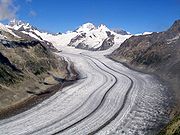
Grosser Aletschgletscher 3178
Isostatic Depression is the term used by geologists for the sinking of large parts of the earth's crust into the asthenosphere
Asthenosphere

The asthenosphere is the mechanically weak ductily-deforming region of the upper Mantle of the Earth. It lies below the lithosphere, at depths between 100 and 200 km below the surface, but perhaps extending as deep as 400 km ....
. The sinking is caused by a heavy weight placed on the earth's surface. Often this is caused by the heavy weight of glacial ice due to continental glaciation, a process in which permanent ice places pressure on the earth's crust thereby depressing it with its weight.

After continental glaciation has receded, it is common for isostatic rebound to take place.

See also

  • Subsidence
    Subsidence

    In geology, engineering, and surveying, subsidence is the motion of a surface as it shifts downward relative to a datum such as sea-level. The opposite of subsidence is Tectonic uplift, which results in an increase in elevation....
  • Glacier
    Glacier

    A glacier is a large, slow-moving mass of ice, formed from compacted layers of snow, that slowly deforms and flows in response to gravity and high pressure....
  • Proglacial lake
    Proglacial lake

    In geology, a proglacial lake is a lake formed either by the damming action of a moraine or ice dam during the retreat of a melting glacier, or one formed by meltwater trapped against an ice sheet due to isostatic depression of the crust around the ice....