
Home      Discussion      Topics      Dictionary      Almanac
Signup       Login
Islander 36

Islander 36

Overview
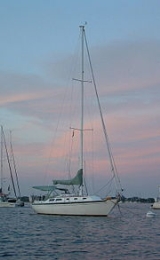
Picked by Cruising World Magazine as one of the top twenty sailboats of all time, the Islander 36 sloop is an excellent all around, 36 foot long, inboard powered, family cruiser and weekend racer. The boat conveniently sleeps four and has berths for a somewhat crowded six.

The I-36, as it is commonly referred to, was a California built, fiberglass reinforced boat with a early 1970’s to 1984 production run of about 650 vessels.
Discussion
Ask a question about 'Islander 36'
Start a new discussion about 'Islander 36'
Answer questions from other users
Full Discussion Forum
 
Encyclopedia
Picked by Cruising World Magazine as one of the top twenty sailboats of all time, the Islander 36 sloop is an excellent all around, 36 foot long, inboard powered, family cruiser and weekend racer. The boat conveniently sleeps four and has berths for a somewhat crowded six.

The I-36, as it is commonly referred to, was a California built, fiberglass reinforced boat with a early 1970’s to 1984 production run of about 650 vessels. When properly rigged the I-36 can be single handed, and in factory configuration can easily be handled by two people.

There is an active owners group, The Islander 36 Association based in San Francisco, CA. The Association holds several yearly regatta and cruise events, plus offers maintenance and repair advise to I-36 owners.

Islander 36


Although Islander had been an active sailboat manufacturer for many years they unfortunately ceased operations during the recessionary mid 1980's. During its boat building existence Islander produced many sizes of sailboats ranging from to . The most popular and largest selling boat Islander produced was their long sloop, commonly called the I-36. This boat is of fiberglass construction with a wood cored fiberglass deck and cabin roof. It has a skeg
Skeg
A skeg is a sternward extension of the keel of boats and ships which have a rudder mounted on the centre line. The term also applies to the lowest point on an outboard motor or the outdrive of an inboard/outboard...

 mounted rudder and a fin keel.

Alan Gurney designed the hull and rig, and Joe Artese designed the interior, deck styling and cockpit. From the start of its design through the end of its production the I-36 yacht
Yacht
A yacht is a high end recreational boat. It designates two rather different classes of watercraft, sailing and power boats. Yachts are different from working ships mainly by their leisure purpose. It was not until the rise of the steamboat and other types of powerboat that sailing vessels in...

 was considered a mid to upper-end sailing vessel. During the last few years of its production the I-36 interiors were largely finished in teak, with a teak and holly cabin sole (floor). Earlier models also used the teak and holly floor, with a mix of white fiberglass and teak accents on the bulkheads (walls) in the living areas. Ventilation below deck is provided by two overhead hatches and six opening cabin ports. There are also four, larger, non-opening side windows allowing good visibility from down below.

This boat follows the general layout for most single-mast sailing yachts, having a mainsail and a foresail, with the cockpit at the back of the boat. All Islanders of this length are inboard powered. This yacht is ideally suited for weekend or vacation cruising, and the occasional longer length voyage. A few of these boats have made significant blue water passages, with some California based boats having made the open ocean passage to Hawaii.
On July 16th 2009 Zac Sunderland
Zac Sunderland
Zac Sunderland was, for some six weeks, the youngest person to sail solo around the world, and remains the first person ever to accomplish this feat before their 18th birthday. Zac completed his trip, after 13 months and 2 days at sea, on July 16, 2009 at age 17, when he sailed back in to his port...

, a 17 year old, became the youngest person to circumnavigate the world alone by yacht; he did so in an Islander 36 sloop. He departed June 14th 2008 from Marina del Rey, California. Zac stated he chose the Islander 36 for several reasons - it is a fairly inexpensive and dependable boat that is heavy enough to handle heavy seas yet also can move quickly in light air. Although his boat, Intrepid, had previously sailed around the world, she was easily modified to insure extra safety and stability for his trip. He indicated they added a cutter rig, new keel bolts, reinforced the hull in front of keel, installed a hard dodger, reinforced cabin walls and bulkheads. Zac says his boat handles extremely well, and can go hull speed (around 7 knots) with 10 knots of wind on the beam. He has been in as much as 20' seas with no issues. The only problem Zac feels the Islander has is when going down wind, she tends to fishtail because of her narrow stern.

The popularity of the I-36 was demonstrated by the fact that it was selected as one of the World's Twenty Best Boats by Cruising World Magazine . This model has classic lines, and when at anchor is often praised for its looks by passengers in passing boats.

There is an active owner's association, the Islander 36 Association, which offers club racing activities in the San Francisco Bay area. The association also provides support and advise on repairs or upgrades to Islander owners.

Engine types


The Islander 36 has had many engines types installed during its years of production. The early boats had gas engines, but later models offered diesel engines at an extra cost over the gas models. After the Atomic 4, and Palmer P-60 gas engine era, the mid 1970 diesel models used the Perkins 4-108 diesel engine. Later in the 1970’s the Westerbek L-25 four-cylinder diesel was offered. In 1980's all Islander 36’ were diesel powered. Early '80s used a Pathfinder diesel engine, and the last generation models utilized the Yanmar motor. When fixed with the proper pitch propeller an I-36 will easily power along at 6.5 to over , depending upon wind, water and boat bottom conditions.

Foredeck


The foredeck is typical, containing an anchor roller and locker, two mooring cleats, and the forestay
Forestay
On a sailing vessel, a forestay, sometimes just called a stay, is a piece of standing rigging which keeps a mast from falling backwards. It is attached either at the very top of the mast, or in fractional rigs between about 1/8 and 1/4 from the top of the mast. The other end of the forestay is...

. The area under the roller and cleats is trimmed out in teak. The front overhead hatch is on an elevated section over the V-berth portion of the cabin. There is a clear space between the anchor locker and the cabin
Cabin (ship)
A cabin or berthing is an enclosed room generally on a ship or an aircraft. A cabin which protrudes above the level of a ship's deck may be referred to as a "deckhouse."-Sailing ships:...

, allowing for maneuverability on deck.

Cockpit


The cockpit
Cockpit (sailing)
In the Royal Navy, the term cockpit originally referred to the area where the coxswain was stationed. This led to the word being used to refer to the area towards the stern of a small decked vessel that houses the rudder controls, also the common location of the ship's surgeon during a naval...

 is reasonably deep, with small to medium sized drains, making this model yacht easily suitable for calm to medium wave waters. Most I-36's have a wheel for steering, and an emergency tiller attachment should a tiller be needed. An engine monitor panel is to the right of the wheel, about knee height. To port and starboard are cockpit coming boxes, ideal for storage of jib sheets, winch handles and such. A deep locker with engine access is in the starboard bench, and two lazarettes on the aft bench, with the tiller attachment placed between the two. Winches are positioned sufficiently aft so that the helmsman can trim sails, although a crew member is better positioned for this task.

Cabin


Entering through the companionway the galley
Galley (kitchen)
The galley is the compartment of a ship, submarine, train or aircraft where food is cooked and prepared. It can also refer to a land based kitchen on a naval base....

 is immediately to the right, while a chart table over a drawer stack is to the left. A wall separates the aft end of the galley from the cockpit sail locker. The galley is separated on its forward side from the main cabin by a low wall. Aft of the chart table is a quarter berth. Forward of the chart table and galley are two settees; the port settee is able to unfold into a double sleeping berth.

Moving forward, the main cabin continues with a hanging locker to the starboard side and a head to the port side. The mast passes through the cabin roof at the aft-most point of the head. At the most forward section of the main cabin is door to the v-berth, master stateroom. This sleeping area contains a second hanging locker, plus an anchor locker door at the narrow end of the v-berth. The head
Head (watercraft)
The head is a ship's water closet or toilet.The term derives from sailing ships in which the toilet area for the regular sailors was placed at the head or bow of the ship. In sailing ships this position was sensible for two reasons...

 has a door, sink with storage underneath, shower, and toilet. The galley has a sink, refrigerator or icebox, and a combined stove-oven.

Mid-deck


The mast rises from the deck aft of the bow. Four shroud
Shroud
Shroud usually refers to an item, such as a cloth, that covers or protects some other object. The term is most often used in reference to burial sheets, winding-cloths or winding-sheets, such as the famous Shroud of Turin or Tachrichim that Jews are dressed in for burial...

s are on each side of the mast, two lower shrouds for fore and aft adjustment of mast prebend, plus the upper and intermediate shrouds to keep the mast straight. There are two pairs of spreaders. The standard mast is tall off the deck, however a taller mast option was also offered. There is a perforated toe rail running along the deck and hull joint, and a genoa car track set well inboard. Teak handrails and cabin side teak eyebrow trim pieces are mounted on the raised cabin roof.

As Islander 36s are no longer in production many have been customized to suit the desires of former users. Cruising Islanders are more likely to have the winches for halyards and other lines mounted on the mast itself. Racing boats are more likely to have moved the sail control winches to the deck, just forward of the cockpit. Sail size, weight, and style are also variable on yachts of this age, although the original total sail area was .

I-36 in a yacht club race


Islander 36s are widely used for weekend cruising, vacation sailing, and club racing events. These boats have a relatively small mainsail compared to other yachts of their size, with a large genoa (sail)
Genoa (sail)
The genoa or jenny was originally referred to as the 'overlapping jib' or the Genoa jib, being named after the city of Genoa as explained below. It is a type of large jib used on bermuda rigged craft, commonly the single-masted sloop and twin-masted boats such as yawl and ketch...

 to increase sail area. The boom is relatively high from the bottom of the cockpit, and the end is more forward, making it harder to hit with one’s head. Mainsail controls are achieved through a cabin-top mounted winch, leading to a traveler car system running across the deck in front of the main cabin's sliding hatch.

It would be normal for a I-36 to have a smaller headsail for heavy winds, and a larger, 150% sail for lighter air sailing. The 150% headsail (number 1 headsail) is typically suitable up to 15 or of wind. Original sail plans for this model vessel show it being outfitted with a headsail as large as 180%.

Islander 36 boats are favorably rated in PHRF
PHRF
Performance Handicap Racing Fleet is a handicapping system used in yacht racing. It allows dissimilar classes of sailboats to be raced against each other...

handicap rating classification tables, and they are frequently sailed in club regattas or single class sailing events. It is not at all uncommon for a well maintained boat with fairly new sails to hold her own, or even win club regattas when sailed against boats much newer in age.

Modern organizations


Several organizations and associations are directly or indirectly related to the Islander 36. The Islander 36 Association has information on races for these and other yachts, as well as tips for maintenance and other useful information.

The Latitude 38 magazine, although not directly related, has information about the San Francisco Bay where the Islander 36 Association is headquartered and a significant number of Islander 36s are sailed.

Soundings Magazine is a publication for both sail and power boats, and has a large classified section where used boats are listed for sale. This publication also has useful articles on cruising destinations, seamanship skills and marine repairs.

For readers interested in yacht racing, its rule and regulations, as well as great boating information the U S Sailing association is a great source of information.

External links