
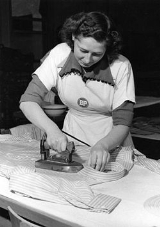
Ironing is the use of a heated tool (an
ironA clothes iron, also referred to as simply an iron, is a small appliance used in ironing to remove wrinkles from fabric.Ironing works by loosening the ties between the long chains of molecules that exist in polymer fiber materials. With the heat and the weight of the ironing plate, the fibers are...
) to remove
wrinkleA wrinkle is a fold, ridge or crease in the skin. Skin wrinkles typically appear as a result of aging processes such as glycation or, temporarily, as the result of prolonged immersion in water. Wrinkling in the skin is caused by habitual facial expressions, aging, sun damage, smoking, poor...
s from fabric. The heating is commonly done to a temperature of 180-220 °Celsius, depending on the fabric. Ironing works by loosening the bonds between the long-chain
polymerA polymer is a large molecule composed of repeating structural units. These subunits are typically connected by covalent chemical bonds...
moleculeA molecule is an electrically neutral group of at least two atoms held together by covalent chemical bonds. Molecules are distinguished from ions by their electrical charge...
s in the fibers of the material. While the molecules are hot, the fibers are straightened by the weight of the iron, and they hold their new shape as they cool. Some fabrics, such as cotton, require the addition of water to loosen the intermolecular bonds. Many
modern fabricsSynthetic polymers are often referred to as "plastics", such as the well-known polyethylene and nylon. However, most of them can be classified in at least three main categories: thermoplastics, thermosets and elastomers....
(developed in or after the mid-twentieth century) are advertised as needing little or no ironing.
Permanent pressA permanent press is a characteristic of fabric that has been chemically processed to resist wrinkles and hold its shape. Alternative terms include wrinkle resistant, wash and wear, no-iron,durable press, and easy care...
clothing was developed to reduce the ironing necessary by combining wrinkle-resistant
polyesterPolyester is a category of polymers which contain the ester functional group in their main chain. Although there are many polyesters, the term "polyester" as a specific material most commonly refers to polyethylene terephthalate...
with
cottonCotton is a soft, fluffy staple fiber that grows in a boll, or protective capsule, around the seeds of cotton plants of the genus Gossypium. The fiber is almost pure cellulose. The botanical purpose of cotton fiber is to aid in seed dispersal....
.
The first known use of metal to "iron" clothes, however, is known to have occurred in China The electric iron was invented in 1882, by Henry W. Seeley. Seeley patented his "electric flatiron" on June 6, 1882 (U.S. Patent no. 259,054).
Equipment
Iron
The iron is the
small applianceSmall appliance refers to a class of home appliances that are portable or semi-portable or which are used on tabletops, countertops, or other platforms in the United States of America...
used to remove
wrinkleA wrinkle is a fold, ridge or crease in the skin. Skin wrinkles typically appear as a result of aging processes such as glycation or, temporarily, as the result of prolonged immersion in water. Wrinkling in the skin is caused by habitual facial expressions, aging, sun damage, smoking, poor...
s from fabric. It is also known as a clothes iron, flat iron, or smoothing iron. The piece at the bottom is called a sole plate.
Ironing board
Most ironing is done on an ironing board, a small, portable, foldable table with a heat resistant surface. Some commercial-grade ironing boards incorporate a heating element and a pedal-operated vacuum to pull air through the board and dry the garment.
On 16 February 1858 W. Vandenburg and J. Harvey patented an ironing table that facilitated pressing sleeves and pant legs. A truly portable folding ironing board was first patented in Canada in 1875 by John B. Porter. The invention also included a removable press board used for sleeves. In 1892
Sarah BooneSarah Boone was an African American inventor who on April 26, 1892, obtained United States patent rights for her improvements to the ironing board. Boone's ironing board was designed to improve the quality of ironing sleeves and the bodies of women's garments. The board was very narrow, curved, and...
obtained a patent in the United States for improvements to the ironing board, allowing for better quality ironing for shirt sleeves.
Tailor's ham
A
tailor's hamA tailor's ham or dressmaker's ham is a tightly stuffed pillow used as a curved mold when pressing curved areas of clothing, such as darts, sleeves, cuffs, collars, or waistlines. Pressing on a curved form allows a garment better to fit body contours. To accommodate tapering or garments of...
or
dressmakers ham is a tightly stuffed pillow in the shape of a ham used as a mold when pressing curves such as sleeves or collars.
Commercial equipment
Commercial
dry cleaningDry cleaning is any cleaning process for clothing and textiles using a chemical solvent other than water. The solvent used is typically tetrachloroethylene , abbreviated "perc" in the industry and "dry-cleaning fluid" by the public...
and full-service laundry providers usually use a large appliance called a steam press to do most of the work of ironing clothes. Alternately, a rotary iron may be used.
Historically, larger tailors' shops included a tailor's stove, a
stoveA stove is an enclosed heated space. The term is commonly taken to mean an enclosed space in which fuel is burned to provide heating, either to heat the space in which the stove is situated or to heat the stove itself, and items placed on it...
used by
tailorA tailor is a person who makes, repairs, or alters clothing professionally, especially suits and men's clothing.Although the term dates to the thirteenth century, tailor took on its modern sense in the late eighteenth century, and now refers to makers of men's and women's suits, coats, trousers,...
s to quickly and efficiently heat multiple irons. In many developing countries a cluster of solid irons, heated alternatively from a single heating source, are used for pressing cloths at small commercial outlets.
LPGLPG may stand for:* Liquefied petroleum gas* Laboratoire de Planetologie, Grenoble, France* Landwirtschaftliche Produktionsgenossenschaft * Llanfairpwll railway station, Wales; National Rail station code LPG.* LPG...
operated Iron made by K. Linga Brahmam can be a good alternative.
Recommended ironing temperatures
| Textile | | Temperature |
|
ToileToile is the name of a fabric that entered the English language around the 16th century from a French word meaning "linen cloth" or "canvas" — particularly cloth or canvas for painting on... |
240 °C |
|
| Triacetate ("Estron", "Silene", "Tricell") |
200 °C |
220-250 °C |
CottonCotton is a soft, fluffy staple fiber that grows in a boll, or protective capsule, around the seeds of cotton plants of the genus Gossypium. The fiber is almost pure cellulose. The botanical purpose of cotton fiber is to aid in seed dispersal.... |
204 °C / 400 °F |
180-220 °C |
* * * |
| Linen Linen is a textile made from the fibers of the flax plant, Linum usitatissimum. Linen is labor-intensive to manufacture, but when it is made into garments, it is valued for its exceptional coolness and freshness in hot weather.... (flax) |
|
215-240 °C |
* * * |
ViscoseViscose is a viscous organic liquid used to make rayon and cellophane. Viscose is becoming synonymous with rayon, a soft material commonly used in shirts, shorts, coats, jackets, and other outer wear.-Manufacture:... /Rayon |
190 °C |
150-180 °C |
* * |
WoolWool is the textile fiber obtained from sheep and certain other animals, including cashmere from goats, mohair from goats, qiviut from muskoxen, vicuña, alpaca, camel from animals in the camel family, and angora from rabbits.... |
148 °C / 300 °F |
160-170 °C |
* * |
| Polyester Polyester is a category of polymers which contain the ester functional group in their main chain. Although there are many polyesters, the term "polyester" as a specific material most commonly refers to polyethylene terephthalate... |
148 °C / 300 °F |
|
* |
SilkSilk is a natural protein fiber, some forms of which can be woven into textiles. The best-known type of silk is obtained from the cocoons of the larvae of the mulberry silkworm Bombyx mori reared in captivity... |
148 °C / 300 °F |
140-165 °C |
* |
| SympaTex SympaTex is a type of fabric that is branded as waterproof with "breatheable" fabrics made or licenced by SympaTex Technologies GmbH. The fabric features a waterproof, windproof and breatheable membrane that is laminated to fabrics either on its inner surface or sandwiched between two fabric layers... |
|
|
* |
| Acetate An acetate is a derivative of acetic acid. This term includes salts and esters, as well as the anion found in solution. Most of the approximately 5 billion kilograms of acetic acid produced annually in industry are used in the production of acetates, which usually take the form of polymers. In... ("Arnel", "Celco", "Dicel") |
143 °C |
180 °C |
* |
| Acrylic Acrylic fibers are synthetic fibers made from a polymer with an average molecular weight of ~100,000, about 1900 monomer units. To be called acrylic in the U.S, the polymer must contain at least 85% acrylonitrile monomer. Typical comonomers are vinyl acetate or methyl acrylate... |
135 °C |
180 °C |
|
| Lycra/Spandex Spandex or elastane is a synthetic fibre known for its exceptional elasticity. It is strong, but less durable than natural Latex, its major non-synthetic competitor. It is a polyurethane-polyurea copolymer that was co-invented in 1959 by chemists C. L. Sandquist and Joseph Shivers at DuPont's... |
135 °C |
|
|
NylonNylon is a generic designation for a family of synthetic polymers known generically as polyamides, first produced on February 28, 1935, by Wallace Carothers at DuPont's research facility at the DuPont Experimental Station... -6 |
|
150 °C |
NylonNylon is a generic designation for a family of synthetic polymers known generically as polyamides, first produced on February 28, 1935, by Wallace Carothers at DuPont's research facility at the DuPont Experimental Station... -66 |
|
180-220 °C |
|
| Temperature |
| * |
< 110 °C |
| * * |
< 150 °C |
| * * * |
< 200 °C |
Another source suggests slightly higher temperatures, for example, 180-220 °C for cotton
Chemistry
When the fabric is heated, the molecules are more easily reoriented. In the case of cotton fibres, which are derivatives of
celluloseCellulose is an organic compound with the formula , a polysaccharide consisting of a linear chain of several hundred to over ten thousand β linked D-glucose units....
, the hydroxyl groups that crosslink the cellulose polymer chains are reformed at high temperatures, and become somewhat "locked in place" upon cooling the item. In
permanent pressA permanent press is a characteristic of fabric that has been chemically processed to resist wrinkles and hold its shape. Alternative terms include wrinkle resistant, wash and wear, no-iron,durable press, and easy care...
pressed clothes, chemical agents such as
dimethylol ethylene ureaDimethylol ethyleneurea is an organic compound derived from formaldehyde and urea. It is a colourless solid that is used for treating cellulose-based heavy fabrics to inhibit wrinkle formation...
are added as crosslinking agents.