
All Topics  
Interlace


   Email Print
   Bookmark   Link


Interlace


Interlaced scan refers to one of two common methods for "painting" a video image on an electronic display screen (the second is progressive scan) by scanning or displaying each line or row of pixels. This technique uses two fields to create a frame. One field contains all the odd lines in the image, the other contains all the even lines of the image. A PAL based television display, for example, scans 50 fields every second (25 odd and 25 even).


Discussion
Ask a question about 'Interlace'
Start a new discussion about 'Interlace'
Answer questions from other users
Full Discussion Forum


Encyclopedia


Interlaced scan refers to one of two common methods for "painting" a video image on an electronic display screen (the second is progressive scan) by scanning or displaying each line or row of pixels. This technique uses two fields to create a frame. One field contains all the odd lines in the image, the other contains all the even lines of the image. A PAL based television display, for example, scans 50 fields every second (25 odd and 25 even). The two sets of 25 fields work together to create a full frame every 1/25th of a second, resulting in a display of 25 frames per second
Frame rate

Frame rate, or frame frequency, is the measurement of the frequency at which an imaging device produces unique consecutive images called Film frames....
.

Description

With progressive scan
Progressive scan

Progressive or noninterlaced scanning is a method for displaying, storing or transmitting moving images in which all the lines of each Film frame are drawn in sequence....
, an image is captured, transmitted and displayed in a path similar to text on a page: line by line, from top to bottom.

The interlaced scan pattern in a CRT (cathode ray tube
Cathode ray tube

The cathode ray tube is a vacuum tube containing an electron gun and a fluorescent screen, with internal or external means to accelerate and deflect the electron beam, used to create images in the form of light emitted from the fluorescent screen....
) display completes such a scan too, but only for every second line. This is carried out from the top left corner to the bottom right corner of a CRT display. This process is repeated again, only this time starting at the second row, in order to fill in those particular gaps left behind while performing the first progressive scan on alternate rows only.

Such scan of every second line is called interlacing. A field is an image that contains only half of the lines needed to make a complete picture. The afterglow of the phosphor of CRTs, in combination with the persistence of vision
Persistence of vision

Persistence of vision is the phenomenon of the eye by which even nanoseconds of exposure to an image result in milliseconds of reaction from the retina to the optic nerves....
 results in two fields being perceived as a continuous image which allows the viewing of full horizontal detail with half the bandwidth that would be required for a full progressive scan while maintaining the necessary CRT refresh rate to prevent flicker.

Only CRTs can display interlaced video directly – other display technologies require some form of deinterlacing
Deinterlacing

Deinterlacing is the process of converting interlaced video, like common analog television signals, into a non-interlaced form....
.

History

When motion picture film was developed, it was observed that the movie screen had to be illuminated at a high rate to prevent visible flicker
Flicker (screen)

Flicker is visible fading between cycles displayed on video displays, especially the refresh interval on cathode ray tube based computer display....
. The exact rate necessary varies by brightness, with 40 Hz being acceptable in dimly lit rooms, while up to 80 Hz may be necessary for bright displays that extend into peripheral vision. The film solution was to project each frame of film three times using a three bladed shutter: a movie shot at 16 frames per second would thus illuminate the screen 48 times per second. Later, when sound film became available, the higher projection speed of 24 frames per second enabled a two bladed shutter to be used maintaining the 48 times per second illumination — but only in projectors that were incapable of projecting at the lower speed.

But this solution could not be used for television — storing a full video frame and scanning it twice would require a frame buffer, a method that did not become feasible until the late 1980s. In addition, avoiding on-screen interference patterns caused by studio lighting and the limits of vacuum tube technology required that CRTs for TV be scanned at AC
Alternating current

In alternating current the movement of electric charge periodically reverses direction. An electric charge would for instance move forward, then backward, then forward, then backward, over and over again....
 line frequency. (This was 60 Hz in the US, 50 Hz Europe.) In 1936 when the analog standards were being set in the UK, CRTs could only scan at around 200 lines in 1/50th of a second. By using interlace, a pair of 202.5-line fields could be superimposed to become a sharper 405 line frame. The vertical scan frequency remained 50 Hz, so flicker was not a problem, but visible detail was noticeably improved. As a result, this system was able to supplant John Logie Baird
John Logie Baird

John Logie Baird was a Scottish engineer and inventor of the world's first working television system. Although Baird's electromechanical system was eventually displaced by purely electronic systems , his early successes demonstrating working television broadcasts and his colour and cinema television work earn him a prominent place in televis...
's 240 line mechanical progressive scan system that was also being used at the time.

From the 1940s onward, improvements in technology allowed the US and the rest of Europe to adopt systems using progressively more bandwidth to scan higher line counts, and achieve better pictures. However the fundamentals of interlaced scanning were at the heart of all of these systems. The US adopted the 525 line
480i

480i is the shorthand name for a video mode, namely the United States NTSC television Television system or digital television systems with the same characteristics....
 system known as NTSC
NTSC

NTSC is the analog television system used in most of the Americas, Japan, South Korea, Taiwan, the Philippines, Burma, and some Pacific island nations and territories ....
, Europe adopted the 625 line
576i

576i is a standard-definition television video mode used in PAL and SECAM countries. In digital applications it's usually referred to as "576i", in analogue contexts it's often quoted as "625 lines"....
 system, and the UK switched from its 405 line system to 625 in order to avoid having to develop a unique method of color TV. France switched from its unique 819 line system to the more European standard of 625. It should be noted that although the term PAL
PAL

PAL, short for Phase Alternating Line, is a color-encoding system used in broadcast television systems in large parts of the world. Other common analog television systems are SECAM and NTSC....
 is often used to describe the line and frame standard of the TV system, this is in fact incorrect and refers only to the method of superimposing the colour information on the standard 625 line broadcast. The French adopted their own SECAM
SECAM

SECAM, also written S?CAM , is an analog television system first used in France.A team led by Henri de France working at Compagnie Fran?aise de T?l?vision invented SECAM....
 system which was also adopted by some other countries, notably Russia and its satellites. PAL has been used on some otherwise NTSC broadcasts notably in Brazil.

Application

Interlacing is used by all the analogue TV broadcast systems in current use:
  • PAL
    PAL

    PAL, short for Phase Alternating Line, is a color-encoding system used in broadcast television systems in large parts of the world. Other common analog television systems are SECAM and NTSC....
    : 50 fields per second, 625 lines, upper field drawn first
  • SECAM
    SECAM

    SECAM, also written S?CAM , is an analog television system first used in France.A team led by Henri de France working at Compagnie Fran?aise de T?l?vision invented SECAM....
    : 50 fields per second, 625 lines
  • NTSC
    NTSC

    NTSC is the analog television system used in most of the Americas, Japan, South Korea, Taiwan, the Philippines, Burma, and some Pacific island nations and territories ....
    : 59.94 fields per second, 525 lines
  • PAL-M: 59.94 fields per second, 525 lines


Benefits of interlacing

With any video system there are trade-offs. One of the most important factors is bandwidth, measured in megahertz (for analog video), or bit rate (for digital video). The greater the bandwidth, the more expensive and complex the entire system (camera, storage systems such as tape recorders or hard disks, transmission systems such as cable television systems or respectively internet, and displays such as television monitors or digital monitors).

Interlaced video reduces the signal bandwidth by a factor of two, for a given line count and refresh rate.

Alternatively, a given bandwidth can be used to provide an interlaced video signal with twice the display refresh rate for a given line count (versus progressive scan video). A higher refresh rate reduces flicker on CRT monitors. The higher refresh rate improves the portrayal of motion, because objects in motion are captured and their position is updated on the display more often. The human visual system averages the rapidly displayed still pictures into a moving picture image, and so interlace artifacts aren't usually objectionable when viewed at the intended field rate, on an interlaced video display.

For a given bandwidth and refresh rate, interlaced video can be used to provide a higher spatial resolution than progressive scan. For instance, 1920x1080 pixel resolution interlaced HDTV with a 60 Hz field rate (known as 1080i60) has a similar bandwidth to 1280x720 pixel progressive scan HDTV with a 60 Hz frame rate (720p60), but approximately 50% more spatial resolution.

Note that this is assuming an analog or uncompressed digital video signal. With digital video compression, as used in all current digital TV standards, interlacing introduces some additional inefficiencies over fully progressive video, and so the bandwidth savings are significantly less than half.

Problems caused by interlacing

Interlaced video is designed to be captured, transmitted or stored and displayed in the same interlaced format. Because each frame of interlaced video is composed of two fields that are captured at different moments in time, interlaced video frames will exhibit motion artifacts if the recorded objects are moving fast enough to be in different positions when each individual field is captured. These artifacts may be more visible when interlaced video is displayed at a slower speed than it was captured or when still frames are presented.

Because modern computer video displays are progressive scan systems, interlaced video will have visible artifacts when it is displayed on computer systems. Computer systems are frequently used to edit video and this disparity between computer video display systems and television signal formats means that the video content being edited cannot be viewed properly unless separate video display hardware is utilized.

To minimize the artifacts caused by interlaced video display on a progressive scan monitor, a process called deinterlacing
Deinterlacing

Deinterlacing is the process of converting interlaced video, like common analog television signals, into a non-interlaced form....
 can be utilized. This process is not perfect, and it generally results in a lower resolution, particularly in areas with objects in motion. Deinterlacing systems are integrated into progressive scan television displays in order to provide the best possible picture quality for interlaced video signals.

Interlace introduces a potential problem called interline twitter. This aliasing effect only shows up under certain circumstances, when the subject being shot contains vertical detail that approaches the horizontal resolution of the video format. For instance, a person on television wearing a shirt with fine dark and light stripes may appear on a video monitor as if the stripes on the shirt are "twittering". Television professionals are trained to avoid wearing clothing with fine striped patterns to avoid this problem. High-end video cameras or Computer Generated Imagery systems apply a low-pass filter to the vertical resolution of the signal in order to prevent possible problems with interline twitter.
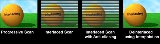
This animation demonstrates the interline twitter effect. The two interlaced images use half the bandwidth of the progressive one. The interlaced scan (second from left) precisely duplicates the pixels of the progressive image (far left), but interlace causes details to twitter. Real interlaced video blurs such details to prevent twitter, as seen in the third image from the left, but such softening (or anti-aliasing) comes at the cost of resolution. A line doubler could never restore the third image to the full resolution of the progressive image. Note – Because the frame rate has been slowed down, you will notice additional flicker in simulated interlaced portions of this image.


Interline twitter is the primary reason that interlacing is unacceptable for a computer display. Each scanline on a high-resolution computer monitor is typically used to display discrete pixels that do not span the scanlines above or below. When the overall interlaced framerate is 30 frames per second, a pixel that spans only one scanline is visible for 1/30th of a second followed by 1/30th of a second of darkness, reducing the per-line/per-pixel framerate to 15 frames per second.

To avoid this problem, sharp detail is typically never displayed on standard interlaced television. When computer graphics are shown on a standard television, the screen is treated as if it were half the resolution of what it actually is or even lower. If text is displayed, it will be large enough so that horizontal lines are never just one scanline wide. Most fonts used in television programming have wide, fat strokes, and do not include fine-detail serif
Serif

In typography, serifs are semi-structural details on the ends of some of the strokes that make up letters and symbols. A typeface that has serifs is called a serif typeface ....
s that would make the twittering more visible.

Despite arguments against it and the calls by many prominent technological companies such as Microsoft to leave interlacing to history, interlacing continues to be supported by the television standard setting organizations and is still being included in new digital video transmission formats such as DV, DVB (including its HD modifications), and ATSC.

Interlace and computers

In the 1970s, computers and home video game systems began using TV sets as display devices. At this point, a 480-line NTSC
NTSC

NTSC is the analog television system used in most of the Americas, Japan, South Korea, Taiwan, the Philippines, Burma, and some Pacific island nations and territories ....
 signal was well beyond the graphics abilities of low cost computers, so these systems used a simplified video signal which caused each video field to scan directly on top of the previous one, rather than each line between two lines of the previous field. This marked the return of progressive scan
Progressive scan

Progressive or noninterlaced scanning is a method for displaying, storing or transmitting moving images in which all the lines of each Film frame are drawn in sequence....
ning not seen since the 1920s. Since each field became a complete frame on its own, modern terminology would call this 240p on NTSC sets, and 288p on PAL
PAL

PAL, short for Phase Alternating Line, is a color-encoding system used in broadcast television systems in large parts of the world. Other common analog television systems are SECAM and NTSC....
. While consumer devices were permitted to create such signals, broadcast regulations prohibited TV stations from transmitting video like this. Computer monitor standards such as CGA
Color Graphics Adapter

The Color Graphics Adapter , originally also called the Color/Graphics Adapter or IBM Color/Graphics Monitor Adapter, introduced in 1981, was International Business Machines's first color graphics card, and the first color computer display standard for the IBM PC....
 were further simplifications to NTSC, which improved picture quality by omitting modulation of color, and allowing a more direct connection between the computer's graphics system and the CRT.

By the mid-1980s computers had outgrown these video systems and needed better displays. The Apple IIgs
Apple IIGS

The Apple , the fifth model inception of the Apple II, was the most powerful member of the Apple II series of microcomputer made by Apple Inc.. At the time of its release, it was capable of advanced color graphics and then-state-of-the-art sound synthesis that surpassed those of most other computers, including the black and white Macintosh ....
 suffered from the use of the old scanning method, with the highest display resolution being 640x200, resulting in a severely distorted tall narrow pixel
Pixel

In digital imaging, a pixel is the smallest item of information in an image. Pixels are normally arranged in a 2-dimensional grid, and are often represented using dots, squares, or rectangles....
 shape, making the display of realistic proportioned images difficult. Solutions from various companies varied widely. Because PC monitor signals did not need to be broadcast, they could consume far more than the 6, 7 and 8 MHz
Hertz

The hertz is a measure of frequency per unit of time, or the number of list of cycles per second. It is the SI base unit of frequency in the International System of Units , and is used worldwide in both general-purpose and scientific contexts....
 of bandwidth that NTSC and PAL signals were confined to. Apple Inc. built a custom 342p display into the Macintosh, and EGA
Enhanced Graphics Adapter

The Enhanced Graphics Adapter is the IBM PC computer display standard specification located between Color Graphics Adapter and Video Graphics Array in terms of color and space resolution....
 for IBM compatible PCs was 350p. The Commodore Amiga
Amiga

The Amiga is a family of personal computers originally developed by Amiga Corporation. Development on the Amiga began in 1982 with Jay Miner as the principal hardware designer....
 created a true interlaced NTSC signal (as well as RGB
RGB color model

The RGB color model is an additive color in which red, green, and blue light are added together in various ways to reproduce a broad array of colors....
 variations). This ability resulted in the Amiga dominating the video production field until the mid 1990s, but the interlaced display mode caused flicker problems for more traditional PC applications where single-pixel detail is required. 1987 saw the introduction of VGA, on which PCs soon standardized, Apple only followed suit some years later with the Mac when the VGA standard was improved to match Apple's proprietary 24 bit colour video standard also introduced in 1987.

In the late 1980s and early 1990s, monitor and graphics card manufacturers introduced newer high resolution standards that once again included interlace. These monitors ran at very high refresh rates, intending that this would alleviate flicker problems. Such monitors proved very unpopular. While flicker was not obvious on them at first, eyestrain and lack of focus nevertheless became a serious problem. The industry quickly abandoned this practice, and for the rest of the decade all monitors included the assurance that their stated resolutions were "non-interlaced". This experience is why the PC industry today remains against interlace in HDTV, and lobbied for the 720p standard. Also the industry is lobbying beyond 720p, actually 1080/60p for NTSC legacy countries, and 1080/50p for PAL legacy countries.

See also

  • 480i
    480i

    480i is the shorthand name for a video mode, namely the United States NTSC television Television system or digital television systems with the same characteristics....
    : standard-definition
    Standard-definition television

    Standard-definition television refers to television systems that have a resolution that meets standards but not considered either Enhanced-definition television or High-definition television....
     interlaced video usually used in traditionally NTSC
    NTSC

    NTSC is the analog television system used in most of the Americas, Japan, South Korea, Taiwan, the Philippines, Burma, and some Pacific island nations and territories ....
     countries (North and parts of South America, Japan)
  • 576i
    576i

    576i is a standard-definition television video mode used in PAL and SECAM countries. In digital applications it's usually referred to as "576i", in analogue contexts it's often quoted as "625 lines"....
    : standard-definition
    Standard-definition television

    Standard-definition television refers to television systems that have a resolution that meets standards but not considered either Enhanced-definition television or High-definition television....
     interlaced video usually used in traditionally PAL
    PAL

    PAL, short for Phase Alternating Line, is a color-encoding system used in broadcast television systems in large parts of the world. Other common analog television systems are SECAM and NTSC....
     and SECAM
    SECAM

    SECAM, also written S?CAM , is an analog television system first used in France.A team led by Henri de France working at Compagnie Fran?aise de T?l?vision invented SECAM....
     countries
  • 1080i
    1080i

    1080i is the shorthand name of a format of high-definition video modes. 1080 denotes the number of horizontal scan lines - also known as vertical resolution - and the letter i stands for interlaced....
    : high-definition television
    High-definition television

    High-definition television is a digital television broadcasting system with higher than traditional television systems . HDTV is digitally broadcast; the earliest implementations used analog broadcasting, but today digital television signals are used, requiring less Bandwidth due to digital video compression....
     (HDTV) digitally broadcast in 16:9 (widescreen) aspect ratio standard
  • Progressive scan
    Progressive scan

    Progressive or noninterlaced scanning is a method for displaying, storing or transmitting moving images in which all the lines of each Film frame are drawn in sequence....
    : the opposite of interlacing; the image is displayed line by line.
  • Deinterlacing
    Deinterlacing

    Deinterlacing is the process of converting interlaced video, like common analog television signals, into a non-interlaced form....
    : converting an interlaced video signal into a non-interlaced one
  • Telecine
    Telecine

    Telecine is the process of transferring film film into video form. The term is also used to refer to the equipment used in the process.Telecine enables a motion picture, captured originally on film, to be viewed with standard video equipment, such as televisions, VCR or computers....
    : a method for converting film frame rates to television frame rates using interlacing
  • Federal Standard 1037C
    Federal Standard 1037C

    Federal Standard 1037C, entitled Telecommunications: Glossary of Telecommunication Terms is a United States Federal Standard, issued by the General Services Administration pursuant to the Federal Property and Administrative Services Act of 1949, as amended....
    : defines Interlaced scanning
  • Interleaving
    Interleaving

    Interleaving in computer science is a way to arrange data in a non-contiguous way in order to increase performance.It is used in:* time-division multiplexing in telecommunications...
  • Moving image formats
    Moving image formats

    This article discusses moving image capture, transmission and presentation from today's technical and creative points of view; concentrating on aspects of frame rates....
  • Wobulation
    Wobulation

    Wobulation is a term which refers to the known variation in a characteristic. Examples of where the term is used, include to describe advanced radar waveform modulations - where the repetition rate or centre frequency of a signal is changed in a repetitive fashion to reduce the probability of detection....
    : a variation of interlacing used in DLP displays


External links

  • – An article that describes field-based, interlaced, digitized video and its relation to frame-based computer graphics with lots of illustrations
  • - An article that explains with diagrams how the field order of PAL and NTSC has arisen, and how PAL and NTSC is digitized
  • – Video Interlacing/Deinterlacing
  • (planetmath.org)