
All Topics  
Injection moulding

 
Injection Moulding

   Email Print
   Bookmark   Link


Injection moulding


Injection molding (British English: moulding) is a manufacturing
Manufacturing

Manufacturing is the use of machine, tool and labor to make things for use or sale. The term may refer to a range of human activity, from handicraft to high tech, but is most commonly applied to Industry production, in which raw material are transformed into finished good on a large scale....
 process for producing parts from both thermoplastic
Thermoplastic

A thermoplastic is a polymer that turns to a liquid when heated and freezes to a very glassy state when cooled sufficiently. Most thermoplastics are high-molecular mass polymers whose Chain s associate through weak Van der Waals forces ; stronger dipole interactions and hydrogen bonding ; or even stacking of aromatic rings ....
 and thermosetting plastic
Plastic

Plastic is the general common term for a wide range of synthetic or semisynthetic organic chemistry solid materials suitable for the manufacture of industrial products....
 materials. Material is fed into a heated barrel, mixed, and forced into a mold cavity where it cools and hardens to the configuration of the mold cavity. After a product is designed, usually by an industrial design
Industrial design

Industrial design is an applied art whereby the aesthetics and usability of mass-produced Product may be improved for marketability and Manufacturing....
er or an engineer
Engineer

An engineer is a person professionally engaged in a field of engineering. Engineers are concerned with developing economical and safe solutions to practical problems, by applying mathematics and scientific knowledge while considering technical constraints....
, molds are made by a moldmaker
Moldmaker

Moldmaker is the designation for a profession in the metalworking and ceramics industry. It is a variety of the profession of the toolmaker. The moldmaker produces Molding s for the injection molding , die casting and ceramics industries....
 (or toolmaker) from metal, usually either steel
Steel

Steel is an alloy consisting mostly of iron, with a carbon content between 0.2% and 2.14% by weight , depending on grade. Carbon is the most cost-effective alloying material for iron, but various other alloying elements are used such as manganese, chromium, vanadium, and tungsten....
 or aluminium
Aluminium

Aluminium or aluminum is a silvery white and ductile member of the boron group of chemical elements. It has the symbol Al; its atomic number is 13....
, and precision-machined to form the features of the desired part.


Discussion
Ask a question about 'Injection moulding'
Start a new discussion about 'Injection moulding'
Answer questions from other users
Full Discussion Forum


Recent Posts


Encyclopedia


Injection molding (British English: moulding) is a manufacturing
Manufacturing

Manufacturing is the use of machine, tool and labor to make things for use or sale. The term may refer to a range of human activity, from handicraft to high tech, but is most commonly applied to Industry production, in which raw material are transformed into finished good on a large scale....
 process for producing parts from both thermoplastic
Thermoplastic

A thermoplastic is a polymer that turns to a liquid when heated and freezes to a very glassy state when cooled sufficiently. Most thermoplastics are high-molecular mass polymers whose Chain s associate through weak Van der Waals forces ; stronger dipole interactions and hydrogen bonding ; or even stacking of aromatic rings ....
 and thermosetting plastic
Plastic

Plastic is the general common term for a wide range of synthetic or semisynthetic organic chemistry solid materials suitable for the manufacture of industrial products....
 materials. Material is fed into a heated barrel, mixed, and forced into a mold cavity where it cools and hardens to the configuration of the mold cavity. After a product is designed, usually by an industrial design
Industrial design

Industrial design is an applied art whereby the aesthetics and usability of mass-produced Product may be improved for marketability and Manufacturing....
er or an engineer
Engineer

An engineer is a person professionally engaged in a field of engineering. Engineers are concerned with developing economical and safe solutions to practical problems, by applying mathematics and scientific knowledge while considering technical constraints....
, molds are made by a moldmaker
Moldmaker

Moldmaker is the designation for a profession in the metalworking and ceramics industry. It is a variety of the profession of the toolmaker. The moldmaker produces Molding s for the injection molding , die casting and ceramics industries....
 (or toolmaker) from metal, usually either steel
Steel

Steel is an alloy consisting mostly of iron, with a carbon content between 0.2% and 2.14% by weight , depending on grade. Carbon is the most cost-effective alloying material for iron, but various other alloying elements are used such as manganese, chromium, vanadium, and tungsten....
 or aluminium
Aluminium

Aluminium or aluminum is a silvery white and ductile member of the boron group of chemical elements. It has the symbol Al; its atomic number is 13....
, and precision-machined to form the features of the desired part. Injection molding is widely used for manufacturing a variety of parts, from the smallest component to entire body panels of cars
Automobile

An automobile or motor car is a wheeled motor vehicle for transportation passengers, which also carries its own car engine or motor. Most definitions of the term specify that automobiles are designed to run primarily on roads, to have seating for one to eight people, to typically have four wheels, and to be constructed principally f...
.

Process Characteristics

  • Utilizes a ram or screw-type plunger to force molten plastic material into a mold cavity
  • Produces a solid or open-ended shape which has conformed to the contour of the mold
  • Uses thermoplastic or thermoset materials
  • Produces a parting line, sprue, and gate marks
  • Ejector pin marks are usually present


History

In 1868 John Wesley Hyatt
John Wesley Hyatt

John Wesley Hyatt was an United States inventor. He is mainly known for simplifying the production of celluloid, arguably the first industrial plastic....
 developed a plastic material he named Celluloid
Celluloid

Celluloid is the name of a class of Chemical compound created from nitrocellulose and camphor, plus dyes and other agents. Generally regarded to be the first thermoplastic, it was first created as Parkesine in 1856 and as Xylonite in 1869 before being registered as Celluloid in 1870....
 which had been invented in 1851 by Alexander Parks. Hyatt improved it so that it could be processed into finished form. In 1872 John, with his brother Isaiah, patented the first injection molding machine
Injection molding machine

Injection molding machine - a machine for making plastic parts. Manufacturing products by injection molding process. Consist of two main parts, an injection unit and a clamping unit....
. This machine was relatively simple compared to the machines we use today. It basically worked like a large hypodermic needle
Hypodermic needle

A hypodermic needle is a hollow needle commonly used with a syringe to Injection substances into the body. They may also be used to take liquid samples from the body, for example taking blood from a vein in venipuncture....
 injecting plastic through a heated cylinder into a mold. The industry progressed slowly over the years producing products such as collar stays
Collar stays

Collar stays are shirt accessories.Collar stays are smooth, rigid strips of metal , horn , mother of pearl, or plastic, rounded at one end and pointed at the other, inserted into specially made pockets on the underside of a man's shirt Collar to stabilize the collar?s points....
, buttons, and hair combs until it exploded in the 1940s because World War 2 created a huge demand for inexpensive, mass-produced products. In 1946 James Hendry
James Hendry

James Hendry was Regius Professor of Midwifery at the University of Glasgow from 1943 until his death in 1945.Hendry was born at Beith, Ayrshire, to John Hendry, a butcher, and his wife Maggie Allan....
 built the first screw injection machine. This machine allowed material to be mixed before injection, which meant colored plastic or recycled plastic could be added to the virgin material and mixed thoroughly before being injected. Today screw injection machines account for 95% of all injection machines. The industry has evolved over the years from producing combs and buttons to producing a vast array of products for many industries including automotive, medical, aerospace
Aerospace

Aerospace comprises the atmosphere of Earth and surrounding outer space. Typically the term is used to refer to the industry that researches, designs, manufactures, operates, and maintains vehicles moving through Aircraft and Space exploration....
, consumer, toys, plumbing
Plumbing

Plumbing is the skilled trade of working with pipe , Tubing and plumbing fixtures for drinking water systems and the drainage of waste. A plumber is someone who installs or repairs piping systems, plumbing fixtures and equipment such as water heaters....
, packaging, and construction
Construction

In the fields of architecture and civil engineering, construction is a process that consists of the building or assembling of infrastructure. Far from being a single activity, large scale construction is a feat of multitasking....
.

Applications

Injection molding is used to create many things such as milk cartons, containers, bottle caps, automotive dashboards, pocket combs, and most other plastic products available today. Injection molding is the most common method of part manufacturing. It is ideal for producing high volumes of the same object. Some advantages of injection molding are high production rates, high tolerances are repeatable, wide range of materials can be used, low labour cost, minimal scrap losses, and little need to finish parts after molding. Some disadvantages of this process are expensive equipment investment, running costs may be high, and parts must be designed with molding consideration.

Examples of Polymers Best Suited for the Process

Most polymers may be used, including all thermoplastics, some thermosets, and some elastomers. In 1995 there were approximately 18,000 different materials available for injection molding and that number was increasing at an average rate of 750 per year. The available materials are alloys or blends of previously developed materials meaning that product designers can choose from a vast selection of materials, one that has exactly the right properties. Materials are chosen based on the strength and function required for the final part but also each material has different parrameters for molding that must be taken into account. Common polymers like Epoxy
Epoxy

In chemistry, epoxy or polyepoxide is a thermosetting epoxide polymer that cures when mixed with a catalyst agent or hardener. Most common epoxy resins are produced from a reaction between epichlorohydrin and bisphenol-A....
 and phenolic
Phenolic

Phenolic may refer to*Polyphenol, a large class of natural compounds found in colorful plants and with laboratory evidence of antioxidant activity...
 are examples of thermosetting plastics while nylon
Nylon

Nylon is a generic designation for a family of synthetic polymers known generically as polyamides and first produced on February 28, 1935 by Wallace Carothers at DuPont....
, polyethylene
Polyethylene

Polyethylene or polythene is a thermoplastic commodity heavily used in consumer products . Over 60 million tons of the material are produced worldwide every year....
, and polystyrene
Polystyrene

Polystyrene , sometimes abbreviated PS, is an Aromaticity polymer made from the aromatic monomer styrene, a liquid hydrocarbon that is commercially manufactured from petroleum by the chemical industry....
 are thermoplastic
Thermoplastic

A thermoplastic is a polymer that turns to a liquid when heated and freezes to a very glassy state when cooled sufficiently. Most thermoplastics are high-molecular mass polymers whose Chain s associate through weak Van der Waals forces ; stronger dipole interactions and hydrogen bonding ; or even stacking of aromatic rings ....
.

Design Considerations for the Process

It is important when designing products for injection molding that you consider how they will be formed in the machine, how they will be taken out of the machine, and the structure of the final product. Some important guidelines are:

1. Use approximately uniform wall thicknesses throughout your designs.
2. Keep walls thin - typically between 1/32" and 1/10". This allows for proper cooling and reduces cost by minimizing use of material. Thin walls also reduce problems with material shrinkage. Although some unevenness will occur due to shrinkage, walls as thick as 1/5" can be used. Keep wall thickness at least wall length / 50. Keep 90 deg walls under 0.25" high. Keep thickness of ejection pin surface wall at least .07".
3. To strengthen parts, instead of using thicker walls, use additional structures such as ribs. Use fillets at the base of ribs.
4. When using a rib make it about half the main wall thickness.
5. Round corners and edges wherever possible.
6. For easy release of the part from the mold, add a slight taper to the sides (typically ~ 2 deg) - especially for textured walls and walls higher than 0.25".
7. Avoid undercuts that are impossible to remove from the mold.
8. Lighter colors hide flow patterns better than dark colors.
9. Where walls meet at a 90 angle, round inside and outside to at least .05" radius - sharper outside corners can create molding problems and sharper inside corners will increase tooling cost.
10. Keep holes at least .015" from edges.

Equipment

Plasticsinjectionmoulder Die
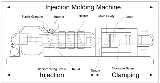
Injection molding machines consist of a material hopper, an injection ram or screw-type plunger, and a heating unit. They are also known as presses, they hold the molds in which the components are shaped. Presses are rated by tonnage, which expresses the amount of clamping force that the machine can exert. This force keeps the mold closed during the injection process. Tonnage can vary from less than 5 tons to 6000 tons, with the higher figures used in comparatively few manufacturing operations. The total clamp force needed is determined by the projected area of the part being molded. This projected area is multiplied by a clamp force of from 2 to 8 tons for each square inch of the projected areas. As a rule of thumb, 4 or 5 tons/in2 can be used for most products. If the plastic material is very stiff, it will require more injection pressure to fill the mold, thus more clamp tonnage to hold the mold closed. The required force can also be determined by the material used and the size of the part, larger parts require higher clamping force.

Mold

Mold or die are the common terms used to describe the tooling used to produce plastic parts in molding.

Traditionally, molds have been expensive to manufacture. They were usually only used in mass production where thousands of parts were being produced. Molds are typically constructed from hardened steel, pre-hardened steel, aluminium, and/or beryllium-copper alloy. The choice of material to build a mold from is primarily one of economics, steel molds generally cost more to construct, but their longer lifespan will offset the higher initial cost over a higher number of parts made before wearing out. Pre-hardened steel molds are less wear resistant and are used for lower volume requirements or larger components. The steel hardness is typically 38-45 on the Rockwell-C scale
Rockwell scale

The Rockwell scale is a hardness scale based on the indentation hardness of a material. The Rockwell test determines the hardness by measuring the depth of penetration of an indenter under a large load compared to the penetration made by a preload....
. Hardened steel molds are heat treated after machining. These are by far the superior in terms of wear resistance and lifespan. Typical hardness ranges between 50 and 60 Rockwell-C (HRC). Aluminium molds can cost substantially less, and when designed and machined with modern computerized equipment, can be economical for molding tens or even hundreds of thousands of parts. Beryllium copper is used in areas of the mold which require fast heat removal or areas that see the most shear heat generated. The molds can be manufactured by either CNC machining or by using Electrical Discharge Machining processes

Image:Injection molding die side A.JPG|"A" side of die for 25% glass-filled acetal with 2 side pulls. Image:Injection molding die with insert.JPG|Close up of removable insert in "A" side. Image:Injection molding die B side.JPG|"B" side of die with side pull actuators. Image:Injection molding die insert.JPG|Insert removed from die.

Mold Design


The mold consists of two primary components, the injection mold (A plate) and the ejector mold (B plate). Plastic resin enters the mold through a sprue
Sprue

A sprue may refer to:*Sprue , a feature in molding and casting molds*Coeliac disease, also known as sprue, a disease of the small intestine*Tropical sprue, disease...
 in the injection mold, the sprue bushing is to seal tightly against the nozzle of the injection barrel of the molding machine and to allow molten plastic to flow from the barrel into the mold, also known as cavity The sprue bushing directs the molten plastic to the cavity images through channels that are machined into the faces of the A and B plates. These channels allow plastic to run along them, so they are referred to as runners. The molten plastic flows through the runner and enters one or more specialized gates and into the cavity geometry to form the desired part.

The amount of resin required to fill the sprue, runner and cavities of a mold is a shot. Trapped air in the mold can escaped through air vents that are grinded into the parting line of the mold. If the trapped air is not allowed to escape, it is compressed by the pressure of the incoming material and is squeezed into the corners of the cavity, where it prevents filling and causes other defects as well. The air can become so compressed that it ignites and burns the surrounding plastic material. To allow for removal of the molded part from the mold, the mold features must not overhang one another in the direction that the mold opens, unless parts of the mold are designed to move from between such overhangs when the mold opens (utilizing components called Lifters).

Sides of the part that appear parallel with the direction of draw (The axis of the cored position (hole) or insert is parallel to the up and down movement of the mold as it opens and closes) are typically angled slightly with (draft) to ease release of the part from the mold. Insufficient draft can cause deformation or damage. The draft required for mold release is primarily dependent on the depth of the cavity: the deeper the cavity, the more draft necessary. Shrinkage must also be taken into account when determining the draft required. If the skin is too thin, then the molded part will tend to shrink onto the cores that form them while cooling, and cling to those cores or part may warp, twist, blister or crack when the cavity is pulled away. The mold is usually designed so that the molded part reliably remains on the ejector (B) side of the mold when it opens, and draws the runner and the sprue out of the (A) side along with the parts. The part then falls freely when ejected from the (B) side. Tunnel gates, also known as submarine or mold gate, is located below the parting line or mold surface. The opening is machined into the surface of the mold on the parting line
Parting line

A parting line in molding making is the place where two or more parts of the mold meet. At times, either because the mold halves do not meet with enough precision or because injection pressure is high, material will creep into the space between the molds....
. The molded part is cut (by the mold) from the runner system on ejection from the mold. Ejector pins, also known as knockout pin, is a circular pin placed in either half of the mold (usually the ejector half) which pushes the finished molded product, or runner system out of a mold.

The standard method of cooling is passing a coolant
Coolant

A coolant is a fluid which flows through a device in order to prevent its overheating, transferring the heat produced by the device to other devices that utilize or dissipate it....
 (usually water) through a series of holes drilled through the mold plates and connected by hoses to form a continueous pathway. The coolant absorbs heat from the mold (which has absorbed heat from the hot plastic) and keeps the mold at a proper temperature to solidify the plastic at the most efficient rate.

To ease maintenance and venting, cavities and cores are divided into pieces, called inserts, and sub-assemblies, also called inserts, blocks, or chase blocks. By substituting interchangeable inserts, one mold may make several variations of the same part.

More complex parts are formed using more complex molds. These may have sections called slides, that move into a cavity perpendicular to the draw direction, to form overhanging part features. When the mold is opened, the slides are pulled away from the plastic part by using stationary “angle pins” on the stationary mold half. These pins enter a slot in the slides and cause the slides to move backward when the moving half of the mold opens. The part is then ejected and the mold closes. The closing action of the mold causes the slides to move forward along the angle pins.

Some molds allow previously molded parts to be reinserted to allow a new plastic layer to form around the first part. This is often referred to as overmolding. This system can allow for production of one-piece tires and wheels.

2-shot or multi-shot molds are designed to "overmold" within a single molding cycle and must be processed on specialized injection molding machines with two or more injection units. This process is actually an injection molding process performed twice. In the first step, the base color material is molded into a basic shape. Then the second material is injection-molded into the remaining open spaces. That space is then filled during the second injection step with a material of a different color.

A mold can produce several copies of the same parts in a single "shot". The number of "impressions" in the mold of that part is often incorrectly referred to as cavitation. A tool with one impression will often be called a single impression(cavity) mold. A mold with 2 or more cavities of the same parts will likely be referred to as multiple impression (cavity) mold. Some extremely high production volume molds (like those for bottle caps) can have over 128 cavities.

In some cases multiple cavity tooling will mold a series of different parts in the same tool. Some toolmakers call these molds family molds as all the parts.

Effects on the material properties

The mechanical properties of a part are usually little effected. Some parts can have internal stresses in them. This is one of the reasons why it's good to have uniform wall thickness when molding. One of the physical property changes is shrinkage. A permanent chemical property change is the material thermoset, which can't be remelted to be injected again.

Tool Materials

Tool steel or beryllium-copper are often used. Mild steel, aluminum, nickel or epoxy are only suitable for prototype or very short production runs.

Geometrical Possibilities

The most commonly used plastic molding process, injection molding, is used to create a large variety of products with different shapes and sizes. Most importantly, they can create products with complex geometry that many other processes cannot. There are a few precautions when designing something that will be made using this process to reduce the risk of weak spots. First, streamline your product or keep the thickness relatively uniform. Second, try and keep your product between 2 to 20 inches.

The size of a part will depend on a number of factors (material, wall thickness, shape,process ect). The initial raw material required may be measured in the form of granules, pellets or powders. Here are some ranges of the sizes.
Method Raw Materials Maximum Size Minimum Size
Injection Molding (thermo-plastic) Granules, Pellets, Powders 700 oz. Less than 1 oz.
Injection Molding (thermo-setting) Granules, Pellets, Powders 200 oz. Less Than 1 oz.


Machining

Molds are built through two main methods: standard machining and EDM
Electrical discharge machining

Electrical Discharge Machining is a machining method primarily used for hard metals or those that would be impossible to machine with traditional techniques....
. Standard Machining
Machining

Conventional machining, one of the most important material removal methods, is a collection of material-working processes in which power-driven machine tools, such as Lathe s, milling machines, and drill presses are used with a sharp cutting tool to mechanically cut the material to achieve the desired geometry....
, in its conventional form, has historically been the method of building injection molds. With technological development, CNC machining
Machining

Conventional machining, one of the most important material removal methods, is a collection of material-working processes in which power-driven machine tools, such as Lathe s, milling machines, and drill presses are used with a sharp cutting tool to mechanically cut the material to achieve the desired geometry....
 became the predominant means of making more complex molds with more accurate mold details in less time than traditional methods.

The electrical discharge machining (EDM)
Electrical discharge machining

Electrical Discharge Machining is a machining method primarily used for hard metals or those that would be impossible to machine with traditional techniques....
 or spark erosion process has become widely used in mold making. As well as allowing the formation of shapes which are difficult to machine, the process allows pre-hardened molds to be shaped so that no heat treatment is required. Changes to a hardened mold by conventional drilling and milling normally require annealing to soften the steel, followed by heat treatment to harden it again. EDM is a simple process in which a shaped electrode, usually made of copper or graphite, is very slowly lowered onto the mold surface (over a period of many hours), which is immersed in paraffin oil. A voltage applied between tool and mold causes spark erosion of the mold surface in the inverse shape of the electrode.

Cost

The cost of manufacturing molds depends on a very large set of factors ranging from number of cavities, size of the parts (and therefore the mold), complexity of the pieces, expected tool longevity, surface finishes and many others. The initial cost is great, however the piece part cost is low, so with greater quantities the overall price decreases.

Injection process

Plasticsinjectionmoulderjones
With Injection Molding, granular plastic is fed by gravity from a hopper into a heated barrel. As the granules are slowly moved forward by a screw-type plunger, the plastic is forced into a heated chamber, where it is melted. As the plunger advances, the melted plastic is forced through a nozzle that rests against the mold, allowing it to enter the mold cavity through a gate and runner system. The mold remains cold so the plastic solidifies almost as soon as the mold is filled.

Injection Molding Cycle

The sequence of events during the injection mold of a plastic part is called the injection molding cycle. The cycle begins when the mold closes, followed by the injection of the polymer into the mold cavity. Once the cavity is filled, a holding pressure is maintained to compensate for material shrinkage. In the next step, the screw turns, feeding the next shot to the front screw.This causes the screw to retract as the next shot is prepared. Once the part is sufficiently cool, the mold opens and the part is ejected.

Time Function


The time it takes to make a product using injection molding can be calculated by adding:

Twice the Mold Open/Close Time (2M)

+

Injection Time (T)

+

Cooling Time (C)

+

Ejection Time (E)


Where T is found by dividing:

Mold Size (S) / Flow Rate (F)
Total time = 2M + T + C + E

T = V/R


V = Mold cavity size (in3)

R = Material flow rate (in3/min)
The total cycle time can be calculated using tcycle = tclosing + tcooling + tejection
  • The closing and ejection times, can last from a fraction of a second to a few seconds, depending on the size of the mold and machine. The cooling times, which dominate the process, depend on the maximum thickness of the part.


Different types of Injection Molding Processes

Although most injection molding processes are covered by the conventional process description above, there are several important molding variations including:
  • Co-injection(sandwich)molding
  • Fusible(lost, soluble)core injection molding
  • Gas-assisted injection molding
  • In-mold decoration and in mold lamination
  • Injection-compression molding
  • Insert and outsert molding
  • Lamellar (microlayer) injection molding
  • Low-pressure injection molding
  • Microinjection molding
  • Microcellular molding
  • Multicomponent injection molding(overmolding)
  • Multiple live-feed injection molding
  • Powder injection molding
  • Push-Pull injection molding
  • Reaction injection molding
  • Resin transfer molding
  • Rheomolding
  • Structural foam injection molding
  • Structural reaction injection molding
  • Thin-wall molding
  • Vibration gas injection molding
  • Water assisted injection molding
  • Rubber injection
  • Injection molding of liquid silicone rubber
For more details about the different types injection processes.

Process Troubleshooting

Optimal process settings are critical to influencing the cost, quality, and productivity of plastic injection molding. Process optimization is done using the following methods. Injection speeds are usually determined by performing viscosity curves. Process windows are performed varying the melt temperatures and holding pressures. Pressure drop studies are done to check if the machine has enough pressure to move the screw at the set rate. Gate seal or gate freeze studies are done to optimize the holding time. A cooling time study is done to optimize the cooling time.

Molding trial

When filling a new or unfamiliar mold for the first time, where shot size for that mold is unknown, a technician/tool setter usually starts with a small shot weight and fills gradually until the mold is 95 to 99% full. Once this is achieved a small amount of holding pressure will be applied and holding time increased until gate freeze off (solidification time) has occurred. Gate solidification time is an important as it determines cycle time, which itself is an important issue in the economics of the production process. Holding pressure is increased until the parts are free of sinks and part weight has been achieved. Once the parts are good enough and have passed any specific criteria, a setting sheet is produced for people to follow in the future.

Molding defects

Injection molding is a complex technology with possible production problems. They can either be caused by defects in the molds or more often by part processing (molding)

Molding DefectsAlternative nameDescriptionsCauses
BlisterBlisteringRaised or layered zone on surface of the partTool or material is too hot, often caused by a lack of cooling around the tool or a faulty heater
Burn marksAir Burn/ Gas BurnBlack or brown burnt areas on the part located at furthest points from gateTool lacks venting, injection speed is too high
Color streaks (US)Colour streaks (UK)Localized change of color/colourMasterbatch isn't mixing properly, or the material has run out and it's starting to come through as natural only
Delamination
Delamination

Delamination is a mode of failure for composite materials. In laminated materials repeated cyclic stresses, impact, and so on can cause layers to separate, forming a mica-like structure of separate layers, with significant loss of mechanical toughness....
 Thin mica like layers formed in part wallContamination of the material e.g. PP
Polypropylene

Polypropylene or polypropene is a thermoplastic polymer, made by the chemical industry and used in a wide variety of applications, including packaging, textiles , stationery, plastic parts and reusable containers of various types, laboratory equipment, loudspeakers, automotive components, and polymer banknotes....
 mixed with ABS
Acrylonitrile butadiene styrene

Acrylonitrile butadiene styrene is a common thermoplastic used to make light, rigid, molded products such as piping , musical instruments , golf club heads , automotive body parts, wheel covers, enclosures, protective head gear, airsoft Airsoft gun and toys, including Lego bricks....
, very dangerous if the part is being used for a safety critical application as the material has very little strength when delaminated as the materials cannot bond
Flash
Molding flash

File:Airfix54mm.JPGFlash or flashing is excess material attached to a molding , forging, or casting product, which must usually be removed....
BurrsExcess material in thin layer exceeding normal part geometryTool damage, too much injection speed/material injected, clamping force too low. Can also be caused by dirt and contaminants around tooling surfaces.
Embedded contaminatesEmbedded particulatesForeign particle (burnt material or other) embedded in the partParticles on the tool surface, contaminated material or foreign debris in the barrel, or too much shear heat burning the material prior to injection
Flow marksFlow linesDirectionally "off tone" wavy lines or patternsInjection speeds too slow (the plastic has cooled down too much during injection, injection speeds must be set as fast as you can get away with at all times)
Jetting Deformed part by turbulent flow of materialPoor tool design, gate position or runner. Injection speed set too high.
Polymer degradation
Polymer degradation

Polymer degradation is a change in the properties - tensile strength, colour, shape, etc - of a polymer or polymer based product under the influence of one or more environmental factors such as heat, light or chemicals....
 polymer breakdown from hydrolysis
Hydrolysis

Hydrolysis is a chemical reaction during which one or more water are split into hydrogen and hydroxide ions which may go on to participate in further reactions....
, oxidation etc
Excess water in the granules, excessive temperatures in barrel
Sink marks Localized depression (In thicker zones)Holding time/pressure too low, cooling time too short, with sprueless hot runners this can also be caused by the gate temperature being set too high
Short shotNon-fill / Short moldPartial partLack of material, injection speed or pressure too low
Splay marksSplash mark / Silver streaksCircular pattern around gate caused by hot gasMoisture in the material, usually when hygroscopic resins are dried improperly
StringinessStringingString like remain from previous shot transfer in new shotNozzle temperature too high. Gate hasn't frozen off
Voids Empty space within part (Air pocket)Lack of holding pressure (holding pressure is used to pack out the part during the holding time). Also mold may be out of registration (when the two halves don't center properly and part walls are not the same thickness).
Weld line
Weld line

In manufacturing, Weld line or Knit line or Meld line is the line where two flow fronts meet, and at it there is inability of two or more flow fronts to "knit" together, or "weld", during the molding process....
Knit line / Meld lineDiscolored line where two flow fronts meetMold/material temperatures set too low (the material is cold when they meet, so they don't bond)
WarpingTwistingDistorted partCooling is too short, material is too hot, lack of cooling around the tool, incorrect water temperatures (the parts bow inwards towards the hot side of the tool)


Tolerances and Surfaces


Molding tolerance is a specified allowance on the deviation in parameters such as dimensions, weights, shapes, or angles, ect. To maximize control in setting tolerances there is usually a minimum and maximum limit on thickness, based on the process used. Injection molding typically is capable of tolerances equivalent to an IT Grade
IT Grade

IT Grade refers to the International Tolerance Grade of an industrial process defined in ISO 286. This grade identifies what tolerances a given process can produce for a given dimension....
 of about 9–14. The possible tolerance of a thermoplastic or a thermoset is ±0.008 to ±0.002 inches. Surface finishes of two to four microinches or better are can be obtained. Rough or pebbled surfaces are also possible.

Molding Type Typical Possible
Thermoplastic ±0.008 ±0.002
Thermoset ±0.008 ±0.002

Lubrication and Cooling

Obviously, the mold must be cooled in order for the production to take place. Because of the heat capacity, inexpensiveness, and availability of water, water is used as the primary cooling agent. To cool the mold, water can be channeled through the mold to account for quick cooling times. Usually a colder mold is more efficient because this allows for faster cycle times. However, this is not always true because crystalline materials require the opposite of a warmer mold and lengthier cycle time.

Power Requirements

The power required for this process of injection molding depends on many things and varies between materials used. Manufacturing Processes Reference Guide states that the power requirements depend on "a material's specific gravity, melting point, thermal conductivity, part size, and molding rate." Below is a table from page 243 of the same reference as previously mentioned which best illustrates the characteristics relevant to the power required for the most commonly used materials.

Material Specific Gravity Melting Point (°F)
Epoxy 1.12 to 1.24 248
Phenolic 1.34 to 1.95 248
Nylon 1.01 to 1.15 381 to 509
Polyethylene 0.91 to 0.965 230 to 243
Polystyrene 1.04 to 1.07338


See also

  • Reaction injection molding
    Reaction injection molding

    Reaction injection molding is similar to injection molding except that a reaction occurs within the mold. The process uses thermoset polymers instead of thermoplastic polymers used in standard injection molding....
    , a similar technique to standard injection molding, enables the use of thermoset polymers to produce large and complex parts.
  • Liquid injection molding, a process that involves an integrated system for proportioning, mixing, and dispensing dual-component liquid resin formulations and directly injecting the resultant mix into a mold which is clamped under pressure.
  • Hobby injection molding
    Hobby injection molding

    Hobby Injection molding machines, also known as benchtop injectors, hold molds on a smaller scale. These home builders are commonly referred to as a "backyard engineer", referring to the fact that these machines are being built in home shops, garages and backyards....


External links