

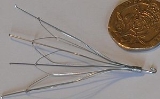
Inferior vena cava filter

Encyclopedia
An inferior vena cava filter, also IVC filter or Greenfield Filter a type of vascular filter, is a medical device that is implanted by interventional radiologists or vascular surgeons into the inferior vena cava
to prevent fatal pulmonary emboli
(PEs).
IVC filters are used in case of contraindication
to anticoagulation, failure of anticoagulation or complication to anticoagulation in patients who have a venous thromboembolic disease or in prophylactic use for patients with a high risk of pulmonary embolism.
s, access to the venous system can be obtained via the femoral vein
(the large vein in the groin), the internal jugular vein
(the large vein in the neck) or the arm veins with one design. Choice of route depends mainly on the number and location of any blood clot within the venous system. To place the filter, a catheter is guided into the IVC using fluoroscopic guidance, then the filter is pushed through the catheter and deployed into the desired location, usually just below the junction of the IVC and the lowest renal vein
.
Review of prior cross-sectional imaging or a venogram of the IVC is performed before deploying the filter to assess for potential anatomic variations, thrombi within the IVC, or areas of stenoses, as well as to estimate the diameter of the IVC. Rarely, ultrasound-guided placement is preferred in the setting of contrast allergy, renal insufficiency, and when patient immobility is desired. The size of the IVC may affect which filter is deployed, as some (such as the Birds Nest) are approved to accommodate larger cavae. There are situations where the filter is placed above the renal veins (e.g. pregnant patients or women of childbearing age, renal or gonadal vein thromboses, etc.). Also, if there is duplication of the IVC, the filter is placed above the confluence of the two IVCs or a filter can be placed within each IVC.
. Previously, filters that had been in the IVC for less than three weeks were considered suitable to attempt retrieval, as filters that have been in place longer might have been overgrown by cells from the IVC wall and there was an increased risk of IVC injury if the filter is dislodged. Newer designs, and developments in techniques mean that some filters can now be left in for prolonged periods and retrievals after a year are now being reported. This would include the ALN, Bard G2 and G2x, Option, Tulip and Celect filters.
Inferior vena cava
The inferior vena cava , also known as the posterior vena cava, is the large vein that carries de-oxygenated blood from the lower half of the body into the right atrium of the heart....
to prevent fatal pulmonary emboli
Pulmonary embolism
Pulmonary embolism is a blockage of the main artery of the lung or one of its branches by a substance that has travelled from elsewhere in the body through the bloodstream . Usually this is due to embolism of a thrombus from the deep veins in the legs, a process termed venous thromboembolism...
(PEs).
IVC filters are used in case of contraindication
Contraindication
In medicine, a contraindication is a condition or factor that serves as a reason to withhold a certain medical treatment.Some contraindications are absolute, meaning that there are no reasonable circumstances for undertaking a course of action...
to anticoagulation, failure of anticoagulation or complication to anticoagulation in patients who have a venous thromboembolic disease or in prophylactic use for patients with a high risk of pulmonary embolism.
Placement
IVC filters are placed endovascularly, meaning that they are inserted via the blood vessels. Historically, IVC filters were placed surgically, but as designs changed they could be placed via the groin through a thin tube or catheter. With modern filters that can be compressed into much thinner catheterCatheter
In medicine, a catheter is a tube that can be inserted into a body cavity, duct, or vessel. Catheters thereby allow drainage, administration of fluids or gases, or access by surgical instruments. The process of inserting a catheter is catheterization...
s, access to the venous system can be obtained via the femoral vein
Femoral vein
In the human body, the femoral vein is a blood vessel that accompanies the femoral artery in the femoral sheath. It begins at the adductor canal and is a continuation of the popliteal vein...
(the large vein in the groin), the internal jugular vein
Internal jugular vein
The two internal jugular veins collect the blood from the brain, the superficial parts of the face, and the neck.-Path:On both sides and at the base of the brain, the inferior petrosal sinus and the sigmoid sinus join to form the internal jugular vein...
(the large vein in the neck) or the arm veins with one design. Choice of route depends mainly on the number and location of any blood clot within the venous system. To place the filter, a catheter is guided into the IVC using fluoroscopic guidance, then the filter is pushed through the catheter and deployed into the desired location, usually just below the junction of the IVC and the lowest renal vein
Renal vein
The renal veins are veins that drain the kidney. They connect the kidney to the inferior vena cava.It is usually singular to each kidney, except in the condition "multiple renal veins".It also divides into 2 divisions upon entering the kidney:...
.
Review of prior cross-sectional imaging or a venogram of the IVC is performed before deploying the filter to assess for potential anatomic variations, thrombi within the IVC, or areas of stenoses, as well as to estimate the diameter of the IVC. Rarely, ultrasound-guided placement is preferred in the setting of contrast allergy, renal insufficiency, and when patient immobility is desired. The size of the IVC may affect which filter is deployed, as some (such as the Birds Nest) are approved to accommodate larger cavae. There are situations where the filter is placed above the renal veins (e.g. pregnant patients or women of childbearing age, renal or gonadal vein thromboses, etc.). Also, if there is duplication of the IVC, the filter is placed above the confluence of the two IVCs or a filter can be placed within each IVC.
Indications for use
Most filters are placed for the following reasons.- Failure of anticoagulation; e.g. development of deep vein thrombosis (DVT) or pulmonary emboli (PE) despite adequate anticoagulation.
- Contraindications to anticoagulation; e.g. a patient at risk of PE who has another condition that puts them at risk of bleeding, such as a recent bleed into the brain, or a patient about to undergo major surgery
- Large clots in the vena cava or iliac veins
- Patients at high risk of having a PE
Retrieval
Most IVC filters are permanent, but some filters are now available that are "retrievable." Retrievable filters are fitted with a device (varying from model to model) that allows them to be pulled back into a catheter (technically a "sheath") and removed from the body, often through the Jugular veinJugular vein
The jugular veins are veins that bring deoxygenated blood from the head back to the heart via the superior vena cava.-Internal and external:There are two sets of jugular veins: external and internal....
. Previously, filters that had been in the IVC for less than three weeks were considered suitable to attempt retrieval, as filters that have been in place longer might have been overgrown by cells from the IVC wall and there was an increased risk of IVC injury if the filter is dislodged. Newer designs, and developments in techniques mean that some filters can now be left in for prolonged periods and retrievals after a year are now being reported. This would include the ALN, Bard G2 and G2x, Option, Tulip and Celect filters.
IVC filter brands
- B Braun Tempofilter IVC filter (retrievable)
- B Braun VenaTech LGM IVC filter (no longer sold)
- B Braun VenaTech LP IVC filter
- Bard G2x IVC (retrievable, unlimited indwell time)
- Bard G2 (retrievable)
- Cook Gianturco-Roehm Bird's Nest IVC Filter (permanent)
- Cook Günther Tulip (retrievable)
- Cook Celect (retrievable)
- Cordis OptEase IVC filter (retrievable, 23 day indwell time)
- Cordis TrapEase IVC filter
- Mobin-Uddin Umbrella IVC filter (no longer sold)
- ALN IVC filter (retrievable)
- Rex Medical Option IVC filter (retrievable)
- Rafael Medical SafeFlo Vena Cava Filter (for permanent implantation)
- Bard Eclipse (http://www.bardpv.com/_vascular/product.php?p=152 )
External links
- IVC filters - emedicine.com
- IVC filters - Medical College of Wisconsin
- IVC filter - GPnotebook.co.uk
- history of Lazar Greenfield and his filter - Invention & Technology