
All Topics  
Import quota


   Email Print
   Bookmark   Link


Import quota


An import quota is a type of protectionist
Protectionism

Protectionism is the economic policy of restraining trade between nations, through methods such as tariffs on imported goods, restrictive import quota, and a variety of other restrictive government regulations designed to discourage imports, and prevent foreign take-over of local markets and companies....
 trade restriction
Trade restriction

A trade restriction is an artificial restriction on the trade of goods between two countries. It is the result of protectionism. However, the term is not uncontroversial since what one part may see as a trade restriction another may see as a way to protect consumers from inferior, harmful or dangerous products....
 that sets a physical limit on the quantity of a good that can be imported into a country in a given period of time. Quotas, like other trade restrictions, are used to benefit the producers of a good in a domestic economy at the expense of all consumers of the good in that economy.

Critics say quotas often lead to corruption (bribes to get a quota allocation), smuggling (circumventing a quota), and higher prices for consumers.

In economics, quotas are thought to be less economically efficient than tariff
Tariff

A tariff is a tax imposed on goods when they are moved across a political boundary. They are usually associated with protectionism, the economic policy of restraining trade between nations....
s which in turn are less economically efficient than free trade
Free trade

Free trade is a type of trade policy that allows traders to act and transact without coercive interference from government. Thus, the policy permits trading partners mutual gains from trade, with goods and services produced according to the law of comparative advantage....
.

mport quota works by reducing the amount of foreign goods a country may import.


Discussion
Ask a question about 'Import quota'
Start a new discussion about 'Import quota'
Answer questions from other users
Full Discussion Forum


Encyclopedia


An import quota is a type of protectionist
Protectionism

Protectionism is the economic policy of restraining trade between nations, through methods such as tariffs on imported goods, restrictive import quota, and a variety of other restrictive government regulations designed to discourage imports, and prevent foreign take-over of local markets and companies....
 trade restriction
Trade restriction

A trade restriction is an artificial restriction on the trade of goods between two countries. It is the result of protectionism. However, the term is not uncontroversial since what one part may see as a trade restriction another may see as a way to protect consumers from inferior, harmful or dangerous products....
 that sets a physical limit on the quantity of a good that can be imported into a country in a given period of time. Quotas, like other trade restrictions, are used to benefit the producers of a good in a domestic economy at the expense of all consumers of the good in that economy.

Critics say quotas often lead to corruption (bribes to get a quota allocation), smuggling (circumventing a quota), and higher prices for consumers.

In economics, quotas are thought to be less economically efficient than tariff
Tariff

A tariff is a tax imposed on goods when they are moved across a political boundary. They are usually associated with protectionism, the economic policy of restraining trade between nations....
s which in turn are less economically efficient than free trade
Free trade

Free trade is a type of trade policy that allows traders to act and transact without coercive interference from government. Thus, the policy permits trading partners mutual gains from trade, with goods and services produced according to the law of comparative advantage....
.

Economic analysis

An import quota works by reducing the amount of foreign goods a country may import. In a competitive market, the equilibrium
Economic equilibrium

In economics, economic equilibrium is simply a state of the world where economic forces are balanced and in the absence of external influences the values of economic variables will not change....
 point which determines the price and quantity produced of a good is where the demand curve
Demand curve

In economics, the demand curve can be defined as the Graph depicting the relationship between the price of a certain commodity, and the amount of it that consumers are willing and able to purchase at that given price....
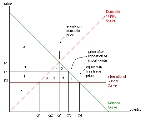
 and the domestic supply curve intersect. In the case of a purely domestic market, this point is at P* and Q* (see Figure 1). When international trade is introduced into the market, this equilibrium may change. Let us assume that the price of a certain good is below P* when imported from abroad than when produced domestically. We will also assume that the world economy can supply more goods at that price.In this case, the international supply curve is a horizontal line at P2, which is the price of that imported good. In this case, the equilibrium price lowers to P2, and the equilibrium quantity produced increases from Q* to Q4. Domestic producers will actually produce less (Q1), while the balance (the difference between Q1 and Q4) will be supplied by imports.

When free international trade is introduced, consumers benefit significantly. In a purely domestic market, the consumer surplus is represented by the area A. With free international trade, this surplus increases to include B, C, D, E, F, G, H, and I because they only have to pay price P2 for the good instead of the higher price P*, and they are able to purchase the quantity Q4 instead of the quantity Q*. On the other hand, domestic producers of the good are adversely affected. In a purely domestic market, the domestic producer surplus is represented by areas B, E, and J. With the introduction of free international trade, they lose areas B and E to consumers because they can only get the price P2 for their goods instead of the price P*. Finally, the economy on the whole benefits by areas C, D, F, G, H, and I, as these are areas of surplus that did not exist before the introduction of free trade. As is evident, all of the economic benefit goes to consumers.

Because of the adverse effects of free trade on domestic producers, those producers may attempt to petition the government to enact an import quota. When this happens, the government will restrict the quantity of a good that can be imported in order to increase the price and allow producers to recover some of their lost surplus. If the government restricts total imports to the difference between Q2 and Q3, three things will happen. First, producers will increase output from Q1 to Q2. Second, imports will decline from the difference between Q1 and Q4 to the difference between Q2 and Q3. Third, the price will rise to reflect the new total quantity consumed, which is now Q3.

The effect of an import quota on domestic producers is to allow them to recover the producer surplus in area E, which they take away from consumers. The effect on international producers is that they now obtain areas G and H as a surplus. The effect on consumers is that they lose E, F, G, H, and I. The effect on the total world economy is that areas F and I are lost in what is called a deadweight loss
Deadweight loss

In economics, a deadweight loss is a loss of economic efficiency that can occur when equilibrium for a good or service is not Pareto efficiency....
. F represents producer surplus which is lost by goods consumed but not at a surplus to producers. I represents consumer surplus which is lost as these goods are not consumed at all. The effect on the domestic economy is that E is gained, but F, G, H, and I are lost. The following table summarizes the effect on the various stakeholders of an import quota.

Economics of domestic trade, quota-restricted trade, and free trade
Situation Consumer surplus Domestic producer surplus Foreign producer surplus World economy Domestic economy
Purely domestic marketAB, E, Jnoneloss of C, D, F, G, H, Iloss of C, D, F, G, H, I
Free international tradeA, B, C, D, E, F, G, H, IJnonenonenone
Trade with import quotaA, B, C, DE, JG, Hloss of F, Iloss of F, G, H, I


To summarize, free international trade represents the highest net benefit for consumers, the world economy, and the domestic economy. Purely domestic trade represents the least beneficial situation for domestic consumers, the world economy, and the domestic economy, but the most beneficial situation for domestic producers. An import quota is the most beneficial to foreign producers and somewhat beneficial to domestic producers, but is harmful to consumers, the world economy, and the domestic economy.

Other issues that deserve consideration are whether the international producers which obtain the quota rights are the most efficient producers or not. If they are not, this represents an additional deadweight loss to the world economy and a reduced benefit to those producers. Tariff
Tariff

A tariff is a tax imposed on goods when they are moved across a political boundary. They are usually associated with protectionism, the economic policy of restraining trade between nations....
s are generally seen as a more advantageous way to protect domestic producers without creating as much damage to the world economy as a whole.