

IRT Ninth Avenue Line

Encyclopedia
The IRT
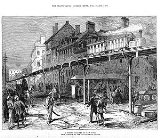
Ninth Avenue Line, often called the Ninth Avenue El, was the first elevated railway
in New York City
. It opened in 1868 as the West Side and Yonkers Patent Railway, a cable-hauled
line. It ceased operation in 1940.
The last section in use, over the Harlem River
, was known as the Polo Grounds Shuttle, and was closed in 1958. This portion used the now-removed Putnam Bridge swing bridge and went through a tunnel, complete with partially-underground stations.
by Charles T. Harvey and ran from July 1, 1868 to 1870. The line used multiple one-mile-long (1.6 km-long) cable loops, driven by steam engine
s in cellars of buildings adjacent to the track. Each loop was started when a car neared it and stopped when it had passed. The cables were equipped with collars that the car connected to with "claws". As the claws could not be "slipped" the car was jerked each time it moved to the next cable. The system proved cumbersome, broke down several times and eventually the company ran out of money and the system was abandoned. The new owners replaced the cable cars with steam locomotives.
company were taken over with a 99 year lease by the Interborough Rapid Transit Company
on April 1, 1903. The rebuilding project was extended all the way north to 116th St., creating Manhattan's first three-track elevated, although center-track express service did not begin until 1916.
The line began at South Ferry and ran along Greenwich Street from Battery Place to Gansevoort Street in lower Manhattan, Ninth Avenue in midtown (joining with the Sixth Avenue El
at 53rd Street, continuing along Columbus Avenue in upper Manhattan between 59th Street and 110th, turning east on 110th and running north on Eighth Avenue until the Harlem River.
The line was closed in 1940 and dismantled, following the purchase of the IRT by the City of New York. The line from 155th Street north into the Bronx was continued as the "Polo Grounds Shuttle" until 1958.
The Ninth Ave Elevated was over 100 feet (30.5 m) above the street at "Suicide Curve," which made a 90-degree turn from 9th Ave onto 110th St. then another from 110th St. onto 8th Avenue. The curve at 53rd Street, however, was the site of a September 11, 1905, derailment
that was the worst accident in the history of New York's elevated railway
s.
to the southern tip of Manhattan
, the stations were:
Interborough Rapid Transit Company
The Interborough Rapid Transit Company was the private operator of the original underground New York City Subway line that opened in 1904, as well as earlier elevated railways and additional rapid transit lines in New York City. The IRT was purchased by the City in June 1940...
Ninth Avenue Line, often called the Ninth Avenue El, was the first elevated railway
Elevated railway
An elevated railway is a form of rapid transit railway with the tracks built above street level on some form of viaduct or other steel or concrete structure. The railway concerned may be constructed according to the standard gauge, narrow gauge, light rail, monorail or suspension railway system...
in New York City
New York City
New York is the most populous city in the United States and the center of the New York Metropolitan Area, one of the most populous metropolitan areas in the world. New York exerts a significant impact upon global commerce, finance, media, art, fashion, research, technology, education, and...
. It opened in 1868 as the West Side and Yonkers Patent Railway, a cable-hauled
Cable car (railway)
A cable car or cable railway is a mass transit system using rail cars that are hauled by a continuously moving cable running at a constant speed. Individual cars stop and start by releasing and gripping this cable as required...
line. It ceased operation in 1940.
The last section in use, over the Harlem River
Harlem River
The Harlem River is a navigable tidal strait in New York City, USA that flows 8 miles between the Hudson River and the East River, separating the boroughs of Manhattan and the Bronx...
, was known as the Polo Grounds Shuttle, and was closed in 1958. This portion used the now-removed Putnam Bridge swing bridge and went through a tunnel, complete with partially-underground stations.
The West Side and Yonkers Patent Railway
The West Side and Yonkers Patent Railway was built on Greenwich StreetGreenwich Street (Manhattan)
Greenwich Street is a north-south street in the New York City borough of Manhattan. It extends from the intersection of Ninth Avenue and Gansevoort Street in the Meatpacking District at its northernmost end to its southern end at Battery Park, interrupted between Vesey and Liberty Streets by the...
by Charles T. Harvey and ran from July 1, 1868 to 1870. The line used multiple one-mile-long (1.6 km-long) cable loops, driven by steam engine
Steam engine
A steam engine is a heat engine that performs mechanical work using steam as its working fluid.Steam engines are external combustion engines, where the working fluid is separate from the combustion products. Non-combustion heat sources such as solar power, nuclear power or geothermal energy may be...
s in cellars of buildings adjacent to the track. Each loop was started when a car neared it and stopped when it had passed. The cables were equipped with collars that the car connected to with "claws". As the claws could not be "slipped" the car was jerked each time it moved to the next cable. The system proved cumbersome, broke down several times and eventually the company ran out of money and the system was abandoned. The new owners replaced the cable cars with steam locomotives.
Extension
The Ninth Avenue Elevated was extended up Greenwich Street and Ninth Avenue by 1891. The Ninth Avenue El and several other lines of the Manhattan RailwayManhattan Railway
The Manhattan Railway was an elevated railway company in Manhattan and the Bronx, New York City, United States.It operated four lines* Second Avenue Line* Third Avenue Line* Sixth Avenue Line* Ninth Avenue Line-History:...
company were taken over with a 99 year lease by the Interborough Rapid Transit Company
Interborough Rapid Transit Company
The Interborough Rapid Transit Company was the private operator of the original underground New York City Subway line that opened in 1904, as well as earlier elevated railways and additional rapid transit lines in New York City. The IRT was purchased by the City in June 1940...
on April 1, 1903. The rebuilding project was extended all the way north to 116th St., creating Manhattan's first three-track elevated, although center-track express service did not begin until 1916.
The line began at South Ferry and ran along Greenwich Street from Battery Place to Gansevoort Street in lower Manhattan, Ninth Avenue in midtown (joining with the Sixth Avenue El
IRT Sixth Avenue Line
The IRT Sixth Avenue Line, often called the Sixth Avenue Elevated or Sixth Avenue El, was the second elevated railway in Manhattan in New York City, following the Ninth Avenue Elevated. In addition to its transportation role, it also captured the imagination of artists and poets.The line ran south...
at 53rd Street, continuing along Columbus Avenue in upper Manhattan between 59th Street and 110th, turning east on 110th and running north on Eighth Avenue until the Harlem River.
The line was closed in 1940 and dismantled, following the purchase of the IRT by the City of New York. The line from 155th Street north into the Bronx was continued as the "Polo Grounds Shuttle" until 1958.
The Ninth Ave Elevated was over 100 feet (30.5 m) above the street at "Suicide Curve," which made a 90-degree turn from 9th Ave onto 110th St. then another from 110th St. onto 8th Avenue. The curve at 53rd Street, however, was the site of a September 11, 1905, derailment
Ninth Avenue derailment
The Ninth Avenue derailment on the Ninth Avenue Elevated in Manhattan on September 11, 1905 was the worst accident on the New York City elevated railways....
that was the worst accident in the history of New York's elevated railway
Elevated railway
An elevated railway is a form of rapid transit railway with the tracks built above street level on some form of viaduct or other steel or concrete structure. The railway concerned may be constructed according to the standard gauge, narrow gauge, light rail, monorail or suspension railway system...
s.
Station listing
From the BronxThe Bronx
The Bronx is the northernmost of the five boroughs of New York City. It is also known as Bronx County, the last of the 62 counties of New York State to be incorporated...
to the southern tip of Manhattan
Manhattan
Manhattan is the oldest and the most densely populated of the five boroughs of New York City. Located primarily on the island of Manhattan at the mouth of the Hudson River, the boundaries of the borough are identical to those of New York County, an original county of the state of New York...
, the stations were:
| Station | Tracks | Opening date | Closing date | Transfers & Notes |
|---|---|---|---|---|
| merge with IRT Jerome Avenue Line IRT Jerome Avenue Line The IRT Jerome Avenue Line, also unofficially known as IRT Woodlawn Line, is a New York City Subway Line along Jerome Avenue in the Bronx. It was opened on June 2, 1917 as a shuttle service between Kingsbridge Road and 149th Street. This was in advance of through service to the IRT Lexington Avenue... between 161st Street and 167th Street 167th Street (IRT Jerome Avenue Line) 167th Street is a local station on the IRT Jerome Avenue Line of the New York City Subway. Located at the intersection of 167th Street and River Avenue in the Bronx, it is served by the 4 train at all times... |
||||
| Anderson – Jerome Avenue | all | July 1, 1918 | August 31, 1958 | Still exists in ruins |
| Sedgwick Avenue Sedgwick Avenue (IRT Ninth Avenue Line) Sedgwick Avenue was an elevated, ground level and underground station on the Bronx extension of the IRT Ninth Avenue Line. This station was built to connect to the New York & Putnam Railroad passenger trains that terminated there instead of the former 155th Street terminal and New York Central... |
all | July 1, 1918 http://nycsubway.org/perl/show?30768? | August 31, 1958 | Still exists in ruins |
| Manhattan Manhattan Manhattan is the oldest and the most densely populated of the five boroughs of New York City. Located primarily on the island of Manhattan at the mouth of the Hudson River, the boundaries of the borough are identical to those of New York County, an original county of the state of New York... – Bronx border, bridge over Harlem River Harlem River The Harlem River is a navigable tidal strait in New York City, USA that flows 8 miles between the Hudson River and the East River, separating the boroughs of Manhattan and the Bronx... |
||||
| tracks split to the 159th Street Yard | ||||
| 155th Street 155th Street (IRT Ninth Avenue Line) 155th Street was an elevated railway station in New York City which was in use from 1870 until 1958, serving as the north terminal of the Ninth Avenue Line from its opening until 1918 and then as a southern terminal of a surviving stub portion from 1940 until its closure.- History :The Ninth Avenue... |
all | August 31, 1958 | ||
| 151st Street 151st Street (IRT Ninth Avenue Line) 151st Street was a station on the demolished IRT Ninth Avenue Line. It had 2 levels. The lower level had two tracks and two side platforms and served local trains. The upper level was built as part of the Dual Contracts and had one track that served express trains. The next stop to the north was... |
local | June 11, 1940 | ||
| 145th Street 145th Street (IRT Ninth Avenue Line) 145th Street was a station on the demolished IRT Ninth Avenue Line. It had 2 levels. The lower level was built first and had 2 tracks and 2 side platforms and served local trains. The upper level was built as part of the Dual Contracts and had 1 track and 2 side platforms over the local tracks that... |
all | June 11, 1940 | ||
| 140th Street 140th Street (IRT Ninth Avenue Line) 140th Street was a station on the demolished IRT Ninth Avenue Line. It had 2 levels. The lower level was built first and had two tracks and two side platforms and served local trains. The upper level was built as part of the Dual Contracts and had one track that served express trains that bypassed... |
local | June 11, 1940 | ||
| 135th Street 135th Street (IRT Ninth Avenue Line) 135th Street was a station on the demolished IRT Ninth Avenue Line. It had two levels. The lower level was built first and had two tracks and two side platforms and served local trains. The upper level was built as part of the Dual Contracts and had one track that served express trains that... |
local | June 11, 1940 | ||
| 130th Street 130th Street (IRT Ninth Avenue Line) 130th Street was a station on the demolished IRT Ninth Avenue Line. It had two levels. The lower level was built first and had two tracks and two side platforms and served local trains. The upper level was built as part of the Dual Contracts and had one track that served express trains that... |
local | June 11, 1940 | ||
| 125th Street 125th Street (IRT Ninth Avenue Line) 125th Street was a station on the demolished IRT Ninth Avenue Line. It had three tracks and two island platforms. It closed on July 11, 1940. The next southbound stop was 116th Street for all trains. The next northbound local stop was 130th Street. The next northbound express stop was 145th Street.... |
all | June 11, 1940 | ||
| 116th Street 116th Street (IRT Ninth Avenue Line) 116 Street was a station on the demolished IRT Ninth Avenue Line in New York City. It had three tracks and two island platforms. It closed on July 11, 1940. The next southbound local stop was 110th Street. The next southbound express stop was 66th Street. The next northbound stop was 125th Street... |
all | June 11, 1940 | ||
| 110th Street 110th Street (IRT Ninth Avenue Line) 110th Street was a station on the demolished IRT Ninth Avenue Line. It had two levels. The lower level was built first and had two tracks and two side platforms and served local trains. The upper level was built as part of the Dual Contracts and had one track that served express trains that... |
local | June 11, 1940 | ||
| 104th Street 104th Street (IRT Ninth Avenue Line) 104th Street was a station on the demolished IRT Ninth Avenue Line. It had two levels. The lower level was built first and had two tracks and two side platforms and served local trains. The upper level was built as part of the Dual Contracts and had one track that served express trains that... |
local | June 11, 1940 | ||
| 99th Street 99th Street (IRT Ninth Avenue Line) 99th Street was a station on the demolished IRT Ninth Avenue Line. It had 2 levels. The lower level was built first and had two tracks and two side platforms and served local trains. The upper level was built as part of the Dual Contracts and had one track that served express trains that bypassed... |
local | June 11, 1940 | ||
| 93rd Street 93rd Street (IRT Ninth Avenue Line) 93rd Street was a station on the demolished IRT Ninth Avenue Line. It had two levels. The lower level was built first and had two tracks and two side platforms and served local trains. The upper level was built as part of the Dual Contracts and had one track that served express trains that bypassed... |
local | June 11, 1940 | ||
| 81st Street 81st Street (IRT Ninth Avenue Line) 81st Street was a station on the demolished IRT Ninth Avenue Line. It had two levels. The lower level was built first and had two tracks and two side platforms and served local trains. The upper level was built as part of the Dual Contracts and had one track that served express trains that bypassed... |
local | June 9, 1879 | June 11, 1940 | |
| 72nd Street 72nd Street (IRT Ninth Avenue Line) 72nd Street was a station on the demolished IRT Ninth Avenue Line. It had two levels. The lower level was built first and had two tracks and two side platforms and served local trains. The upper level was built as part of the Dual Contracts and had one track that served express trains that bypassed... |
local | June 9, 1879 | June 11, 1940 | |
| 66th Street 66th Street (IRT Ninth Avenue Line) 66th Street was a station on the demolished IRT Ninth Avenue Line. It had two levels. The lower level was built first and had two tracks and two side platforms. The upper level was built as part of the Dual Contracts and had two track and two side platforms over the lower level local tracks. The... |
all | June 11, 1940 | ||
| 59th Street 59th Street (IRT Ninth Avenue Line) 59th Street was a station on the demolished IRT Ninth Avenue Line. It had two levels. The lower level was built first and had two tracks and two side platforms that served local trains. The upper level was built as part of the Dual Contracts and had one track that served express trains. It closed... |
local | June 9, 1879 | June 11, 1940 | |
| merged at 53rd Street with branch of IRT Sixth Avenue Line IRT Sixth Avenue Line The IRT Sixth Avenue Line, often called the Sixth Avenue Elevated or Sixth Avenue El, was the second elevated railway in Manhattan in New York City, following the Ninth Avenue Elevated. In addition to its transportation role, it also captured the imagination of artists and poets.The line ran south... |
||||
| 50th Street 50th Street (IRT Ninth Avenue Line) 50th Street was a station on the demolished IRT Ninth Avenue Line. It had two levels. The lower level was built first and had two tracks and two side platforms that served local trains. The upper level was built as part of the Dual Contracts and had one track that served express trains. It closed... |
local | June 11, 1940 | ||
| 42nd Street 42nd Street (IRT Ninth Avenue Line) 42nd Street was a station on the demolished IRT Ninth Avenue Line. It had two levels. On the lower level, the local trains stopped, on two tracks serving two side platforms. The upper level was built as part of the Dual Contracts and had one track which carried express trains bypassing the station.... |
local | June 11, 1940 | ||
| 34th Street 34th Street (IRT Ninth Avenue Line) 34th Street was a station on the demolished IRT Ninth Avenue Line. It had two levels. The lower level was built first and had two tracks and two side platforms. The upper level was built as part of the Dual Contracts and had one track and two side platforms over the lower level local tracks. It... |
all | June 11, 1940 | ||
| 30th Street 30th Street (IRT Ninth Avenue Line) 30th Street was a station on the demolished IRT Ninth Avenue Line. It had two levels. The lower level was built first and had two tracks and two side platforms. The upper level was built as part of the Dual Contracts and had one track that served express trains that bypassed the station. It closed... |
local | June 11, 1940 | ||
| 23rd Street 23rd Street (IRT Ninth Avenue Line) 23rd Street was a station on the demolished IRT Ninth Avenue Line. It had two levels. The lower level was built first and had two tracks and two side platforms. The upper level was built as part of the Dual Contracts and had one track that served express trains that bypassed the station. It closed... |
local | June 11, 1940 | ||
| 14th Street 14th Street (IRT Ninth Avenue Line) 14th Street was a station on the demolished IRT Ninth Avenue Line, an elevated railway in New York City. It had two levels. The lower level was built first and had two tracks and two side platforms. The upper level was built as part of the Dual Contracts and had one track and two side platforms... |
all | June 11, 1940 | ||
| Christopher Street Christopher Street (IRT Ninth Avenue Line) Christopher Street was a station on the demolished IRT Ninth Avenue Line. It had three tracks, one island platform and two side platforms. It was served by trains from the IRT Ninth Avenue Line. It closed on July 11, 1940. The next southbound local stop was Houston Street. The next southbound... |
all | June 11, 1940 | ||
| Houston Street Houston Street (IRT Ninth Avenue Line) Houston Street was a station on the demolished IRT Ninth Avenue Line. It had three tracks and two side platforms. It was served by trains from the IRT Ninth Avenue Line. It closed on July 11, 1940. The next southbound stop was Desbrosses Street. The next northbound stop was Christopher Street.... |
local | June 11, 1940 | ||
| Desbrosses Street Desbrosses Street (IRT Ninth Avenue Line) Desbrosses Street was a station on the demolished IRT Ninth Avenue Line. It had three tracks, one island platform and two side platforms. It was served by trains from the IRT Ninth Avenue Line It closed on July 11, 1940. The next southbound stop was Franklin Street, while the next southbound... |
all | June 11, 1940 | ||
| Franklin Street Franklin Street (IRT Ninth Avenue Line) Franklin Street was a station on the demolished IRT Ninth Avenue Line. It had three tracks and two side platforms. It was served by trains from the IRT Ninth Avenue Line It closed on July 11, 1940. The next southbound stop was Warren Street. The next northbound stop was Desbrosses Street.... |
local | June 11, 1940 | ||
| Warren Street Warren Street (IRT Ninth Avenue Line) Warren Street was a station on the demolished IRT Ninth Avenue Line. It had three tracks, one island platform and two side platforms. It was served by trains from the IRT Ninth Avenue Line It closed on July 11, 1940. The next southbound local stop was Barclay Street The next southbound express stop... |
all | June 11, 1940 | ||
| Barclay Street Barclay Street (IRT Ninth Avenue Line) Barclay Street was a station on the demolished IRT Ninth Avenue Line. It had three tracks and two side platforms. It was served by trains from the IRT Ninth Avenue Line It closed on July 11, 1940. The next southbound stop was Cortlandt Street. The next northbound stop was Warren Street.... |
local | June 11, 1940 | ||
| Cortlandt Street Cortlandt Street (IRT Ninth Avenue Line) Cortlandt Street was a station on the demolished IRT Ninth Avenue Line. It had three tracks, one island platform and two side platforms. It was served by trains from the IRT Ninth Avenue Line It closed on July 11, 1940. The next southbound stop for all trains was Rector Street. The next northbound... |
all | June 11, 1940 | ||
| Rector Street Rector Street (IRT Ninth Avenue Line) Rector Street was a station on the demolished IRT Ninth Avenue Line. It had two tracks and two side platforms, though two additional tracks ended at a bumper just south of the station. It was served by trains from the IRT Ninth Avenue Line. It closed on July 11, 1940. The next southbound stop was... |
local | June 11, 1940 | ||
| split from IRT Sixth Avenue Line IRT Sixth Avenue Line The IRT Sixth Avenue Line, often called the Sixth Avenue Elevated or Sixth Avenue El, was the second elevated railway in Manhattan in New York City, following the Ninth Avenue Elevated. In addition to its transportation role, it also captured the imagination of artists and poets.The line ran south... |
||||
| Battery Place Battery Place (IRT Ninth Avenue Line) Battery Place was a station on the long-demolished Ninth Avenue and Sixth Avenue elevated train lines in New York City. It was located at the southern terminus of Greenwich Street at the north end of Battery Park.... |
all | June 11, 1940 | ||
| South Ferry | all | various ferries (see South Ferry) | ||
External links
- Beach Pneumatic Transit Co by Joseph Brennan Full of Photographs and information about the line, particularly Chapter 14.
- NYCsubway.org - The 9th Avenue Elevated
- 1939 track map
- The Sedgwick Avenue station is at 40.831423°N 73.932264°W
