
All Topics  
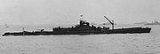
I-400 class submarine

 
I 400 Class Submarine

   Email Print
   Bookmark   Link


I-400 class submarine


The Sen Toku I-400-class (????????) submarine
Submarine

A submarine is a watercraft capable of independent operation below water. It differs from a submersible, which has only limited underwater capability....
s of the Imperial Japanese Navy
Imperial Japanese Navy

The origins of the Imperial Japanese Navy trace back to early interactions with nations on the Asia, beginning in the early history of Japan#Feudal Japan and reaching a peak of activity during the 16th and 17th centuries at a time of cultural diffusion with European power during the Age of Discovery....
 were the largest submarines of World War II
World War II

World War II, or the Second World War , was a global military conflict which involved a Participants in World War II, including all of the great powers, organised into two opposing military alliances: the Allies of World War II and the Axis powers....
, and remained the largest ever built prior to the development of nuclear ballistic missile submarines in the 1960s. They were submarine aircraft carrier
Submarine aircraft carrier

Submarine aircraft carriers are submarines equipped with fixed wing aircraft for observation or attack missions. These submarines saw their most extensive use during World War II, although their operational significance remained rather small....
s able to carry 3 Aichi M6A
Aichi M6A

The Aichi M6A Seiran was a submarine-launched attack floatplane designed for the Imperial Japanese Navy....
 Seiran aircraft underwater to their destinations. They were designed to surface, launch the planes then dive again quickly before they were discovered.


Discussion
Ask a question about 'I-400 class submarine'
Start a new discussion about 'I-400 class submarine'
Answer questions from other users
Full Discussion Forum


Encyclopedia


The Sen Toku I-400-class (????????) submarine
Submarine

A submarine is a watercraft capable of independent operation below water. It differs from a submersible, which has only limited underwater capability....
s of the Imperial Japanese Navy
Imperial Japanese Navy

The origins of the Imperial Japanese Navy trace back to early interactions with nations on the Asia, beginning in the early history of Japan#Feudal Japan and reaching a peak of activity during the 16th and 17th centuries at a time of cultural diffusion with European power during the Age of Discovery....
 were the largest submarines of World War II
World War II

World War II, or the Second World War , was a global military conflict which involved a Participants in World War II, including all of the great powers, organised into two opposing military alliances: the Allies of World War II and the Axis powers....
, and remained the largest ever built prior to the development of nuclear ballistic missile submarines in the 1960s. They were submarine aircraft carrier
Submarine aircraft carrier

Submarine aircraft carriers are submarines equipped with fixed wing aircraft for observation or attack missions. These submarines saw their most extensive use during World War II, although their operational significance remained rather small....
s able to carry 3 Aichi M6A
Aichi M6A

The Aichi M6A Seiran was a submarine-launched attack floatplane designed for the Imperial Japanese Navy....
 Seiran aircraft underwater to their destinations. They were designed to surface, launch the planes then dive again quickly before they were discovered. They also carried torpedo
Torpedo

Note: Prior to 1900, in naval usage "torpedo" could also refer to what today is called a naval mine. For that usage, see naval mine.The modern torpedo is a self-propelled explosive projectile weapon, launched above or below the water surface, propelled underwater toward a target, and designed to detonate on contact or in proximity t...
es for close range combat.

The
I-400 class was designed with the range to travel anywhere in the world and return. A fleet of 18 boats was planned in 1942, and work started on the first in January 1943 at the Kure, Hiroshima
Kure, Hiroshima

is a cities of Japan located in Hiroshima prefecture, Japan.As of the January 1, 2008, the city has an estimated population of 246,118 and a population density of 696 persons per km?....
 arsenal. Within a year the plan was scaled back to five, of which only three (
I-400 at Kure
Kure, Hiroshima

is a cities of Japan located in Hiroshima prefecture, Japan.As of the January 1, 2008, the city has an estimated population of 246,118 and a population density of 696 persons per km?....
, and
I-401
Japanese submarine I-401

The I-400 class submarine I-401 was once the largest submarine in the world. It was commanded by Lieutenant Commander Nambu. Capable of carrying three two-seat Aichi M6A1 "Seiran" float torpedo bombers, the Sen Tokus were built to launch a surprise air strike against the Panama Canal....
 and
I-402 at Sasebo) were completed.

Characteristics

Each submarine had four 3,000 horsepower
Horsepower

Horsepower is the name of several non-International System of Units units of power . It was originally defined to allow the output of steam engines to be measured and compared with the power output of draft horses....
 (2.2 MW) engines and carried enough fuel to go around the world one-and-a-half times - more than enough to reach the United States traveling east or west. They displaced 6,500 tons and were over 400 feet (120 m) long, three times the size of the typical submarines of the time. They had a figure-eight hull shape affording additional strength to handle the on-deck hangar for housing the three aircraft. They also had four anti-aircraft guns, a large deck gun, and eight torpedo tubes.

Seiran
They were able to carry three Aichi M6A
Seiran
Aichi M6A

The Aichi M6A Seiran was a submarine-launched attack floatplane designed for the Imperial Japanese Navy....
 aircraft
Aircraft

An aircraft is a vehicle which is able to flight by being supported by the air, or in general, the atmosphere, of a planet. Examples include balloons, airplanes and helicopters....
, each carrying an 800 kilogram (1,764 lb) bomb 650 miles (1000 km) at 295 miles per hour (474 km/h). The existence of the Seiran was unknown to Allied intelligence. The wings of the Seiran folded back, the horizontal stabilizers folded down, and the top of the vertical stabilizer folded over so the overall forward profile of the aircraft was within the diameter of its propeller. When prepared for flight, they had a wing span of 40 feet (12 m) and a length of 38 feet (11.6 m). A crew of four could prepare and get all three airborne in 45 minutes. The planes were launched from a 120-foot (37-m) catapult
Aircraft catapult

An aircraft catapult is a device used to launch aircraft from ships?in particular aircraft carriers?as a form of assisted take off. It consists of a track built into the flight deck, below which is a large piston or shuttle that is attached through the track to the Undercarriage of the aircraft....
 on the deck of the giant submarine. A restored Seiran airplane is displayed at the National Air and Space Museum
National Air and Space Museum

The National Air and Space Museum of the Smithsonian Institution is a museum in Washington, D.C., United States, and is the most popular of the Smithsonian museums....
 in Washington, D.C.
Washington, D.C.

Washington, D.C. , formally the District of Columbia and commonly referred to as Washington, the District, or simply D.C., is the Capital of the United States, founded on July 16, 1790....
. Only one was ever recovered and it had been ravaged by weather and souvenir collectors, but the restoration team was able to reconstruct it accurately.

Operational history

As the war turned against the Japanese and their fleet no longer had free rein in the Pacific, the Commander-in-Chief of the Japanese Combined Fleet, Admiral Isoroku Yamamoto
Isoroku Yamamoto

Admiral of the Fleet was the commander-in-chief of the Combined Fleet during World War II, a graduate of the Imperial Japanese Naval Academy and a student of the U.S....
, devised a daring plan to attack the cities of New York
New York

The State of New York is a U.S. state in the Mid-Atlantic States and Northeastern United States regions of the United States and is the nation's List of U.S....
, Washington D.C., and other large American cities as well as to destroy the Panama Canal
Panama Canal

The Panama Canal is a man-made canal which joins the Pacific Ocean and Atlantic Ocean oceans. One of the largest and most difficult engineering projects ever undertaken, it had an enormous impact on shipping between the two oceans, replacing the long and treacherous route via the Drake Passage and Cape Horn at the southernmost tip of South Am...
.
I400crew
One of Yamamoto’s plans was to use the
sen toku (secret submarine attack), so that in the opening days of 1945, preparations were under way to attack the Panama Canal. The strategy was to cut the supply lines and access to the Pacific Ocean
Pacific Ocean

The Pacific Ocean is the largest of the Earth's oceanic divisions. Its name is derived from the Latin name Mare Pacificum, "peaceful sea", bestowed upon it by the Portugal explorer Ferdinand Magellan....
 by U.S. ships. The plan was to sail westward through the Indian Ocean
Indian Ocean

The Indian Ocean is the third largest of the world's oceanic divisions, covering about 20% of the water on the Earth's surface. It is bounded on the north by Asia ; on the west by Africa; on the east by Indochina, the Sunda Islands, and Australia; and on the south by the Southern Ocean ....
, around the southern tip of Africa
Africa

Africa is the world's second-largest and second most-populous continent, after Asia. At about 30.2 million km? including adjacent islands, it covers 6% of the Earth's total surface area and 20.4% of the total land area....
, and attack the canal’s Gatun Locks from the east, a direction from which the Americans would not expect an attack and would be ill-prepared to defend. The flights would, of course, be one-way trips. None of the pilots expected to survive the attack, a tactic called
tokko
Japanese Special Attack Units

During the Second World War, , also abbreviated to ???, tokkotai), also called shimbu-tai by the Imperial Japanese Army, were specialized units normally used for suicide missions....
. Each pilot was presented with a tokko short sword, symbolic of the ultimate sacrifice.

Before the attack could commence from the Japanese naval base at Maizuru, word reached Japan that the Allies were preparing for an assault on the home islands. The mission was changed to attack the Allied naval base on Ulithi
Ulithi

Ulithi is an atoll in the Caroline Islands of the western Pacific Ocean, about 191 km east of Yap. It consists of 40 islets totalling 4.5 km? , surrounding a lagoon about 30 km long and 15 km wide?at 548 km? the fourth largest in the world....
 where the invasion was being assembled. Before that could take place, the Emperor announced the surrender of Japan.

On August 22, 1945, the crews of the submarines were ordered to destroy all their weapons. The torpedoes were fired without arming and the aircraft were launched without unfolding the wings and stabilizers. When
I-401 surrendered to an American destroyer, the U.S. crew was astounded at its size. The commander of the submarine fleet, Captain Ariizumi, apparently decided on suicide rather than surrender to the Americans. He requested that his body be wrapped in the Japanese flag and buried at sea, and shot himself. His body was never presented as proof of his death.

American inspections

I400hangar
The U.S. Navy boarded and recovered 24 submarines including the three
I-400 submarines, taking them to Sasebo Bay
Sasebo, Nagasaki

is a cities of Japan located in Nagasaki Prefecture, Japan. As of 2009, the city has an estimated population of 252,698 and the population density of 694 persons per km?....
 to study them. While there, they received a message that the Soviets were sending an inspection team to examine the submarines. To keep the technology out of the hands of the Soviets, Operation
Road’s End was instituted. Most of the submarines were taken to a position designated as Point Deep Six, about 40 miles (60 km) west of Nagasaki and off the Goto Islands
Goto Islands

The , literally: "five-island archipelago") are Islands of Japan in the East China Sea, off the western coast of Kyushu. The islands are a part of Nagasaki Prefecture....
, were packed with charges of C-2 explosive and destroyed. They are today at a depth of 200 meters.

I400gun
Four remaining submarines (
I-400, I-401, I-201
I-200 class submarine

The I-200-class submarines were submarines of the Imperial Japanese Navy during World War II. These submarines were of advanced design, built for high underwater speed, and were known as Senkou ....
 and
I-203
I-200 class submarine

The I-200-class submarines were submarines of the Imperial Japanese Navy during World War II. These submarines were of advanced design, built for high underwater speed, and were known as Senkou ....
 were sailed to Hawaii by U.S. Navy technicians for further inspection. Upon completion of the inspections, the submarines were scuttled in the waters off Kalaeloa near Oahu
Oahu

'Oahu' or 'Oahu' , known as Gathering_place#Island_of_O.7B.7Bokina.7D.7Dahu_as_The_Gathering_Place, is the third largest of the Hawaiian Islands and most populous of the islands in the State of Hawaii....
 in Hawaii
Hawaii

File:Pahoehoe and Aa flows at Hawaii.jpgThe State of Hawaii is a U.S. state in the United States, located on an archipelago in the central Pacific Ocean southwest of the continental United States, southeast of Japan, and northeast of Australia....
 by torpedoes from the American submarine USS
Cabezon
USS Cabezon (SS-334)

USS Cabezon was a Balao class submarine submarine of the United States Navy, named for the cabezon, a saltwater fish of sculpin family inhabiting the North Atlantic and North Pacific Oceans ....
 on May 31, 1946, apparently because Soviet scientists were again demanding access to them. The wreckage of
I 401 was rediscovered by the Pisces deep-sea submarines of the Hawaii Undersea Research Laboratory in March 2005 at a depth of 820 meters.

See also

  • AM type submarine - IJN 2-aircraft submarine seaplane tender
  • Submarine aircraft carrier
    Submarine aircraft carrier

    Submarine aircraft carriers are submarines equipped with fixed wing aircraft for observation or attack missions. These submarines saw their most extensive use during World War II, although their operational significance remained rather small....
  • French submarine Surcouf


External links


  • — review of novel by John Mannock about I-400-class submarine