
All Topics  
Human skeleton

 
Human Skeleton

   Email Print
   Bookmark   Link


Human skeleton


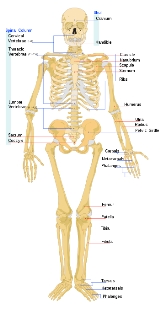
The human skeleton consists of both fused and individual bone
Bone

Bones are rigid organ that form part of the endoskeleton of vertebrates. They function to move, support, and protect the various organs of the body, produce red blood cell and white blood cells and store minerals....
s supported and supplemented by ligament
Ligament

Ligaments connect bone to bone. In anatomy, the term ligament is used to denote three different types of structures:# Fibrous Tissue that connects bones to other bones....
s, tendon
Tendon

A tendon is a tough band of fibrous connective tissue that usually connects muscle to bone and is capable of withstanding tension . Tendons are similar to ligaments except that ligaments join one bone to another....
s, muscle
MUSCLE

MUSCLE is public domain, multiple sequence alignment software for protein and nucleotide sequences.MUSCLE is integrated into UGENE bioinformatics tool as a plugin....
s and cartilage
Cartilage

Cartilage is a type of dense connective tissue. It is composed of specialized cells called chondrocyte that produce a large amount of extracellular matrix composed of collagen fibers, abundant ground substance rich in proteoglycan, and elastin fibers....
. It serves as a scaffold which supports organs, anchors muscles, and protects organs such as the brain
Human brain

The human brain is the center of the human nervous system and is a highly complex organ. It has the same general structure as the brains of other mammals, but is over five times as large as the "average brain" of a mammal with the same body size....
, lung
Lung

The lung is the essential respiration organ in air-breathing animals, including most tetrapods, a few fish and a few snails. In mammals and the more complex life forms, the two lungs are located in the chest on either side of the heart....
s and heart
Heart

The heart is a muscle organ in all vertebrates responsible for pumping blood through the blood vessels by repeated, rhythmic contractions, or a similar structure in annelids, mollusks, and arthropods....
. The biggest bone in the body is the femur
Femur

The femur, or thigh bone, is the most proximal bone of the leg in vertebrates capable of walking or jumping, such as most land mammals, birds, many reptiles such as lizards, and amphibians such as frogs....
 and the smallest is the stapes
Stapes

The stapes or stirrup is the stirrup-shaped small bone or ossicles in themiddle ear which is attached to the incus laterally and to the fenestra ovalis, the "oval window" medially....
 bone in the middle ear
Middle ear

The middle ear is the portion of the ear internal to the eardrum, and external to the oval window of the cochlea. The mammalian middle ear contains three ossicles, which couple vibration of the eardrum into waves in the fluid and membranes of the inner ear....
. In an adult, the skeleton comprises around 13% of the total body weight , and half of this weight is water.

Fused bones include those of the pelvis
Pelvis

The pelvis or pelvic girdle is the irregular bone structure located at the base of the spine . In the adult human, it is formed by the sacrum and the coccyx, the caudal part of the axial skeleton, and a pair of hip bones, part of the appendicular skeleton or human leg....
 and the cranium.


Discussion
Ask a question about 'Human skeleton'
Start a new discussion about 'Human skeleton'
Answer questions from other users
Full Discussion Forum


Recent Posts


Encyclopedia


The human skeleton consists of both fused and individual bone
Bone

Bones are rigid organ that form part of the endoskeleton of vertebrates. They function to move, support, and protect the various organs of the body, produce red blood cell and white blood cells and store minerals....
s supported and supplemented by ligament
Ligament

Ligaments connect bone to bone. In anatomy, the term ligament is used to denote three different types of structures:# Fibrous Tissue that connects bones to other bones....
s, tendon
Tendon

A tendon is a tough band of fibrous connective tissue that usually connects muscle to bone and is capable of withstanding tension . Tendons are similar to ligaments except that ligaments join one bone to another....
s, muscle
MUSCLE

MUSCLE is public domain, multiple sequence alignment software for protein and nucleotide sequences.MUSCLE is integrated into UGENE bioinformatics tool as a plugin....
s and cartilage
Cartilage

Cartilage is a type of dense connective tissue. It is composed of specialized cells called chondrocyte that produce a large amount of extracellular matrix composed of collagen fibers, abundant ground substance rich in proteoglycan, and elastin fibers....
. It serves as a scaffold which supports organs, anchors muscles, and protects organs such as the brain
Human brain

The human brain is the center of the human nervous system and is a highly complex organ. It has the same general structure as the brains of other mammals, but is over five times as large as the "average brain" of a mammal with the same body size....
, lung
Lung

The lung is the essential respiration organ in air-breathing animals, including most tetrapods, a few fish and a few snails. In mammals and the more complex life forms, the two lungs are located in the chest on either side of the heart....
s and heart
Heart

The heart is a muscle organ in all vertebrates responsible for pumping blood through the blood vessels by repeated, rhythmic contractions, or a similar structure in annelids, mollusks, and arthropods....
. The biggest bone in the body is the femur
Femur

The femur, or thigh bone, is the most proximal bone of the leg in vertebrates capable of walking or jumping, such as most land mammals, birds, many reptiles such as lizards, and amphibians such as frogs....
 and the smallest is the stapes
Stapes

The stapes or stirrup is the stirrup-shaped small bone or ossicles in themiddle ear which is attached to the incus laterally and to the fenestra ovalis, the "oval window" medially....
 bone in the middle ear
Middle ear

The middle ear is the portion of the ear internal to the eardrum, and external to the oval window of the cochlea. The mammalian middle ear contains three ossicles, which couple vibration of the eardrum into waves in the fluid and membranes of the inner ear....
. In an adult, the skeleton comprises around 13% of the total body weight , and half of this weight is water.

Fused bones include those of the pelvis
Pelvis

The pelvis or pelvic girdle is the irregular bone structure located at the base of the spine . In the adult human, it is formed by the sacrum and the coccyx, the caudal part of the axial skeleton, and a pair of hip bones, part of the appendicular skeleton or human leg....
 and the cranium. Not all bones are interconnected directly: There are three bones in each middle ear
Middle ear

The middle ear is the portion of the ear internal to the eardrum, and external to the oval window of the cochlea. The mammalian middle ear contains three ossicles, which couple vibration of the eardrum into waves in the fluid and membranes of the inner ear....
 called the ossicles
Ossicles

Not to be confused with ossicones.The ossicles are the three smallest bones in the human body. They are contained within the middle ear space and serve to transmit sounds from the air to the fluid-filled labyrinth ....
 that articulate only with each other. The hyoid bone
Hyoid bone

The hyoid bone is a horseshoe shaped bone situated in the anterior midline of the neck between the chin and the thyroid cartilage. At rest, it lies at the level of the base of the mandible in the front and the third cervical vertebra behind....
, which is located in the neck and serves as the point of attachment for the tongue
Tongue

The tongue is skeletal muscle on the floor of the mouth that manipulates food for chewing . It is the primary organ of taste. Much of the upper surface of the tongue is covered in papillae and taste buds....
, does not articulate with any other bones in the body, being supported by muscles and ligaments.

Development

Early in gestation
Gestation

Gestation is the carrying of an embryo or fetus inside a female viviparous animal. Mammals during mammalian pregnancy can have one or more gestations at the same time ....
, a fetus
Fetus

A fetus is a developing mammal or other viviparous vertebrate, after the embryonic stage and before childbirth. The plural is fetuses, or sometimes feti....
 has a cartilaginous skeleton from which the long bone
Long bone

The long bones are those that are longer than they are wide, and grow primarily by elongation of the diaphysis, with an epiphysis at the ends of the growing bone....
s and most other bones gradually form throughout the remaining gestation period and for years after birth in a process called endochondral ossification
Endochondral ossification

Endochondral ossification is one of the two processes during fetal development of the mammal skeleton in which bone tissue is created. It is also an essential process during the rudimentary formation of long bones, the growth of the Epiphyseal plate of long bones, and the healing of bone healing....
. The flat bones of the skull
Skull

The skull is a bone structure found in the head of many animals. The skull supports the structures of the face and protects the head against injury....
 and the clavicle
Clavicle

In human anatomy, the clavicle or collar bone is classified as a flat bone that makes up part of the shoulder girdle . It receives its name from the Latin clavicula because the bone rotates along its axis like a key when the shoulder is Abduction ....
s are formed from connective tissue in a process known as intramembranous ossification
Intramembranous ossification

Intramembranous ossification is one of the two processes during fetal development of the mammal skeleton in which bone tissue is created. It is also an essential process during the healing of bone healing and the rudimentary formation of bone of the Human skull....
, and ossification of the mandible
Ossification of the mandible

The mandible is ossified in the fibrous membrane covering the outer surfaces of Meckel's cartilages.These cartilages form the cartilaginous bar of the mandibular arch , and are two in number, a right and a left....
 occurs in the fibrous membrane covering the outer surfaces of Meckel's cartilages. At birth a newborn baby has approximately 270 bones, whereas on average an adult human has 206 bones (these numbers can vary slightly from individual to individual). The difference comes from a number of small bones that fuse together during growth, such as the sacrum
Sacrum

The sacrum is a large, triangular bone at the base of the vertebral column and at the upper and back part of the pelvic cavity, where it is inserted like a wedge between the two hip bones....
 and coccyx
Coccyx

The coccyx , commonly referred to as the tailbone, is the final segment of the human spine . Comprising three to five separate or fused vertebrae below the sacrum, it is attached to the sacrum by a fibrocartilaginous joint, the sacrococcygeal symphysis, which permits limited movement between the sacrum and the coccyx....
 of the vertebral column
Vertebral column

In human anatomy, the vertebral column is a column of 24 vertebrae, the sacrum, intervertebral discs, and the coccyx situated in the dorsum aspect of the torso, separated by spinal discs....
. The sacrum (the bone at the base of the spine
Spine

Spine or Spinal may refer to:...
) consists of five bones which are separate at birth but fuse together into a solid structure in later years. An infant is born with zones of cartilage, called epiphyseal plate
Epiphyseal plate

The epiphyseal plate is a hyaline cartilage plate in the metaphysis at each end of a long bone. The plate is found in children and adolescents; in adults, who have stopped growing, the plate is replaced by an epiphyseal line....
s, between segments of bone to allow further growth. Longitudinal bone growth ends when the bone of the epiphysis and diaphysis fuses. This process, called epiphyseal plate closure, happens at about 18 years of age in females and 21 years of age in males. There are 206 bones in the human body.

Organisation

Much of the human skeleton
Skeleton

In biology, a skeleton is a rigid framework that provides protection and structure in many types of animal, particularly those of the phylum Chordata and of the superphylum Ecdysozoa....
 maintains the ancient segmental pattern present in all vertebrate
Vertebrate

Vertebrates are members of the subphylum Vertebrata, chordates with Vertebras or Vertebral columns. The grouping sometimes includes the hagfish, which have no vertebrae, but are genetically quite closely related to lampreys, which do have vertebrae....
s (mammals, birds, fish, reptiles and amphibians) with basic units being repeated. This segmental pattern is particularly evident in the vertebral column and in the ribcage.

There are 206 bones in the adult human skeleton, a number which varies between individuals and with age - newborn babies have 270 bones some of which fuse together. These bones are organized into a longitudinal axis, the axial skeleton
Axial skeleton

The axial skeleton consists of the 80 bones in the head and trunk of the human body. It is composed of five parts; the human skull, the ossicles of the inner ear, the hyoid bone of the throat, the chest, and the vertebral column....
, to which the appendicular skeleton
Appendicular skeleton

The appendicular skeleton consists of 126 bones in the human body which make motion possible and protects the organs of digestion, excretion, and reproduction....
 is attached.

Axial skeleton

The axial skeleton (80 bones) is formed by the vertebral column
Vertebral column

In human anatomy, the vertebral column is a column of 24 vertebrae, the sacrum, intervertebral discs, and the coccyx situated in the dorsum aspect of the torso, separated by spinal discs....
 (26), the thoracic cage (12 pairs of rib
Rib

In vertebrate anatomy, ribs are the long curved bones which form the ribcage. In most vertebrates, ribs surround the chest and protect the lungs, heart, and other internal Organ s of the thorax....
s and the sternum
Sternum

The sternum is a long flat bone located in the center of the chest . It connects to the rib via cartilage, forming the rib cage with them, and thus helps to protect the lungs, heart and major blood vessels from physical trauma....
), and the skull
Skull

The skull is a bone structure found in the head of many animals. The skull supports the structures of the face and protects the head against injury....
 (22 bones and 7 associated bones). The axial skeleton transmits the weight from the head, the trunk, and the upper extremities down to the lower extremities at the hip joints, and is therefore responsible for the upright position of the human body. Most of the body weight is located in front of the spinal column which therefore have the erector spinae
Erector spinae

The Erector spin? , a bundle of muscles and tendons, and its prolongations in the thoracic and cervical regions, lie in the groove on the side of the vertebral column....
 muscles and a large amount of ligament
Ligament

Ligaments connect bone to bone. In anatomy, the term ligament is used to denote three different types of structures:# Fibrous Tissue that connects bones to other bones....
s attached to it resulting in the curved shape of the spine. The 240 skeletal muscles acting on the axial skeleton position the spine, allowing for small movements in the thoracic cage for breathing
Breathing

Breathing takes oxygen in and carbon dioxide out of the body. Aerobic respiration organisms require oxygen to create energy via Cellular respiration, in the form of the metabolism of energy-rich molecules such as glucose....
, and the head, where they control the minute and complex facial movements.

Appendicular skeleton

The appendicular skeleton (126 bones) is formed by the pectoral girdles (4), the upper limbs (60), the pelvic girdle (2), and the lower limbs (60). Their functions are to make locomotion possible and to protect the major organs of locomotion, digestion, excretion, and reproduction.

Function

The skeleton has six main functions:

Support

The skeleton provides the framework which supports the body and maintains its shape. The pelvis and associated ligaments and muscles provide a floor for the pelvic structures. Without the ribs, costal cartilages, and the intercostal muscles the lungs would collapse.

Movement

The joints between bones permit movement, some allowing a wider range of movement than others, e.g. the ball and socket joint allows a greater range of movement than the pivot joint at the neck. Movement is powered by skeletal muscle
Skeletal muscle

They generally contract voluntarily , although they can contract involuntarily through Reflex action. The whole muscle is wrapped in a special type of connective tissue, epimysium....
s, which are attached to the skeleton at various sites on bones. Muscles, bones, and joints provide the principal mechanics for movement, all coordinated by the nervous system.

Protection

The skeleton protects many vital organ
Organ (anatomy)

In biology, an organ is a biological tissue that performs a specific function or group of functions. Usually there is a main tissue and sporadic tissues....
s:
  • The skull
    Skull

    The skull is a bone structure found in the head of many animals. The skull supports the structures of the face and protects the head against injury....
     protects the brain
    Human brain

    The human brain is the center of the human nervous system and is a highly complex organ. It has the same general structure as the brains of other mammals, but is over five times as large as the "average brain" of a mammal with the same body size....
    , the eye
    Eye

    Eyes are Organ that detect light, and send signals along the optic nerve to the visual system and other areas of the brain. Complex optical systems with resolving power have come in ten fundamentally different forms, and 96% of animal species possess a complex optical system....
    s, and the middle
    Middle ear

    The middle ear is the portion of the ear internal to the eardrum, and external to the oval window of the cochlea. The mammalian middle ear contains three ossicles, which couple vibration of the eardrum into waves in the fluid and membranes of the inner ear....
     and inner ear
    Inner ear

    The inner ear is the labyrinth , a system of passages comprising two main functional parts:* the organ of hearing, or cochlea* and the vestibular apparatus, the organ of balance that consists of three semicircular canals and the Vestibule of the ear....
    s.
  • The spine
    Vertebral column

    In human anatomy, the vertebral column is a column of 24 vertebrae, the sacrum, intervertebral discs, and the coccyx situated in the dorsum aspect of the torso, separated by spinal discs....
     protects the spinal cord
    Spinal cord

    The spinal cord is a long, thin, tubular bundle of neuron and glia that extends from the brain. The brain and spinal cord together make up the central nervous system....
    .
  • The rib cage, spine, and sternum
    Sternum

    The sternum is a long flat bone located in the center of the chest . It connects to the rib via cartilage, forming the rib cage with them, and thus helps to protect the lungs, heart and major blood vessels from physical trauma....
     protect the lung
    Lung

    The lung is the essential respiration organ in air-breathing animals, including most tetrapods, a few fish and a few snails. In mammals and the more complex life forms, the two lungs are located in the chest on either side of the heart....
    s, heart
    Heart

    The heart is a muscle organ in all vertebrates responsible for pumping blood through the blood vessels by repeated, rhythmic contractions, or a similar structure in annelids, mollusks, and arthropods....
     and major blood vessels
    Circulatory system

    The circulatory system is an organ that moves nutrients, gases, and wastes to and from cells to help fight diseases and help stabilize body temperature and pH to maintain homeostasis....
    .
  • The clavicle
    Clavicle

    In human anatomy, the clavicle or collar bone is classified as a flat bone that makes up part of the shoulder girdle . It receives its name from the Latin clavicula because the bone rotates along its axis like a key when the shoulder is Abduction ....
     and scapula
    Scapula

    In anatomy, the scapula, omo, or shoulder blade, is the bone that connects the humerus with the clavicle .The scapula forms the posterior part of the shoulder girdle....
     protect the shoulder
    Shoulder

    In human anatomy, the shoulder joint comprises the part of the body where the humerus attaches to the scapula. The shoulder refers to the group of structures in the region of the joint....
    .
  • The ilium
    Ilium (bone)

    The ilium is the uppermost and largest bone of the pelvis, and appears in most vertebrates including mammals and birds, but not bony fish. All reptiles have an ilium except snakes, although some snake species have a tiny bone which is considered to be an ilium....
     and spine protect the digestive and urogenital systems and the hip
    Hip (anatomy)

    In anatomy, the hip or coxa in medical termonology is the bone projection of the femur which is known as the greater trochanter, and the overlying muscle and fat....
    .
  • The patella
    Patella

    The patella, also known as the knee cap or kneepan, is a thick, triangular bone which articulates with the femur and covers and protects the knee joint....
     and the ulna
    Ulna

    The ulna is a long bone, prism atic in form, placed at the Anatomical terms of location#Relative directions side of the forearm, parallel with the radius ....
     protect the knee
    Knee

    ----The knee is the lower extremity joint connecting the femur, patella, and the tibia and the surrounding anatomical region which includes the popliteal fossa, also known as "knee pit"....
     and the elbow respectively.
  • The carpals
    Carpus

    In tetrapods, the carpals is the sole cluster of the bones in the wrist between the radius and ulna and the metacarpus. The bones of the carpus do not belong to individual fingers , whereas those of the metacarpus do....
     and tarsals
    Tarsus (skeleton)

    In tetrapods, the tarsus are the cluster of bones in the foot between the tibia and fibula and the metatarsus. The bones of the tarsus do not belong to individual toes, whereas those of the metatarsus do....
     protect the wrist
    Wrist

    In human anatomy, the wrist is the flexible and narrower connection between the forearm and the hand. The wrist is essentially a double row of small short bones, called carpals, intertwined to form a malleable hinge....
     and ankle
    Ankle

    In human anatomy, the ankle joint is formed where the foot and the human leg meet. The ankle, or talocrural joint, is a synovial hinge joint that connects the distal ends of the tibia and fibula in the lower limb with the proximal end of the talus bone in the foot....
     respectively.


Blood cell production

The skeleton is the site of haematopoiesis
Haematopoiesis

Haematopoiesis is the formation of blood cellular components. All cellular blood components are derived from haematopoietic stem cells. In a healthy adult person, approximately 1011?1012 new blood cells are produced daily....
, which takes place in red bone marrow
Bone marrow

Bone marrow is the flexible biological tissue found in the hollow interior of bones. In adults, marrow in large bones produces new blood cells....
.

Storage

Bone matrix can store calcium
Calcium

Calcium is the chemical element with the symbol Ca and atomic number 20. It has an atomic mass of 40.078 amu. Calcium is a soft grey alkaline earth metal, and is the fifth most abundant element by mass in the earth's Crust ....
 and is involved in calcium metabolism
Calcium metabolism

Calcium metabolism or calcium homeostasis is the mechanism by which the body maintains adequate calcium levels. Derangements of this mechanism lead to hypercalcemia or hypocalcemia, which both can have important consequences for health....
, and bone marrow
Bone marrow

Bone marrow is the flexible biological tissue found in the hollow interior of bones. In adults, marrow in large bones produces new blood cells....
 can store iron
Iron

Iron is a chemical element with the symbol Fe and atomic number 26. Iron is a Group 8 element and period 4 element. Iron is lustrous and silvery in color....
 in ferritin
Ferritin

Ferritin is a globular protein complex consisting of 24 protein subunits and is the main intracellular iron storage protein in both prokaryotes and eukaryotes, keeping it in a soluble and non-toxic form....
 and is involved in iron metabolism
Human iron metabolism

Human iron metabolism is the set of chemical reactions maintaining human homeostasis of iron. Iron is an essential element for most life on Earth, including human beings....
.

Endocrine regulation

Bone cells release a hormone called osteocalcin
Osteocalcin

Osteocalcin is a noncollagenous protein found in bone and dentin. It is secreted by osteoblasts and thought to play a role in mineralization and calcium ion homeostasis....
, which contributes to the regulation of blood sugar
Blood sugar

Blood sugar concentration, or glucose level, refers to the amount of glucose present in a mammal's blood. Normally, the blood glucose level is maintained at a Reference_ranges_for_blood_tests#Electrolytes_and_Metabolites between about 4 and 6 mM ....
 (glucose
Glucose

Glucose , a monosaccharide also known as grape sugar, blood sugar, or corn sugar, is a very important carbohydrate in biology....
) and fat deposition. Osteocalcin increases both the insulin
Insulin

Insulin is a hormone with extensive effects on both metabolism and several other body systems . Insulin causes most of the body's cells to take up glucose from the blood , storing it as glycogen in the liver and muscle, and stops use of fat as an energy source....
 secretion and sensitivity, in addition to boosting the number of insulin-producing cells
Beta cell

Beta cells are a type of cell in the pancreas in areas called the islets of Langerhans. They make up 65-80% of the cells in the islets....
 and reducing stores of fat.

Sex-based differences

There are many differences between the male and female human skeletons. Most prominent is the difference in the pelvis, owing to characteristics required for the processes of childbirth
Childbirth

Childbirth is the culmination of a human pregnancy or gestation period with the delivery of one or more newborn infants from a woman's uterus. The process of normal human childbirth is categorized in three stages of labour: the shortening and dilation of the cervix, descent and delivery of the infant, and delivery of the placenta.....
. The shape of a female pelvis is flatter, more rounded and proportionally larger to allow the head of a fetus to pass. Men tend to have slightly thicker and longer limbs and digit bones (phalanges), while women tend to have narrower rib cages, smaller teeth, less angular mandible
Mandible

The mandible or inferior maxillary bone forms the lower jaw and holds the lower tooth in place. It also refers to both the upper and lower sections of the beaks of birds....
s, less pronounced cranial features such as the brow ridges and external occipital protuberance
External occipital protuberance

Near the middle of the occipital squama is the external occipital protuberance, and extending lateralward from it on either side is the superior nuchal line, and above this the faintly marked highest nuchal line....
 (the small bump at the back of the skull), and the carrying angle of the forearm is more pronounced in females. Females also tend to have more rounded shoulder blades.

Disorders

There are many disorders of the skeleton. One of the most common is osteoporosis
Osteoporosis

Osteoporosis is a disease of bone that leads to an increased risk of bone fracture. In osteoporosis the bone mineral density is reduced, bone microarchitecture is disrupted, and the amount and variety of collagen proteins in bone is altered....
.

Osteoporosis

Osteoporosis is a disease
Disease

A disease or medical condition is an abnormal condition of an organism that impairs bodily functions, associated with specific symptoms and Medical signs....
 of bone
Bone

Bones are rigid organ that form part of the endoskeleton of vertebrates. They function to move, support, and protect the various organs of the body, produce red blood cell and white blood cells and store minerals....
, which leads to an increased risk of fracture
Bone fracture

A bone fracture is a medical condition in which a bone is cracked or broken. It is a break in the continuity of the bone. While many fractures are the result of high force impact force or Stress fracture, bone fracture can also occur as a result of certain medical conditions that weaken the bones, such as osteoporosis, certain types of cance...
. In osteoporosis, the bone mineral density (BMD) is reduced, bone microarchitecture is disrupted, and the amount and variety of non-collagen
Collagen

Collagen is the main protein of connective tissue in animals and the most abundant protein in mammals, making up about 25% to 35% of the whole-body protein content....
ous proteins in bone is altered. Osteoporosis is defined by the World Health Organization
World Health Organization

The World Health Organization is a specialized agency of the United Nations that acts as a coordinating authority on international public health....
 (WHO) in women as a bone mineral density 2.5 standard deviation
Standard deviation

In statistics, standard deviation is a simple measure of the variability or statistical dispersion of a data set. A low standard deviation indicates that all of the data points are very close to the same value , while high standard deviation indicates that the data are ?spread out? over a large range of values....
s below peak bone mass (20-year-old sex-matched healthy person average) as measured by DXA
Dual energy X-ray absorptiometry

Dual energy X-ray absorptiometry is a means of measuring bone mineral density . Two X-ray beams with differing energy levels are aimed at the patient's bones....
; the term "established osteoporosis" includes the presence of a fragility fracture
Fragility fracture

In traumatology, a fragility fracture is a bone fracture that occurs as a result of a fall from standing height or less. There are three fracture sites said to be typical of fragility fractures: vertebral fractures, fractures of the neck of the femur and Colles fracture of the wrist....
. Osteoporosis is most common in women after the menopause
Menopause

The Menopause is the permanent cessation of menstruation which occurs a considerable length of time before the end of the lifespan.The word was first applied to humans, and because of this it literally means the cessation of monthly cycles or menstrual cycles, from the Greek roots meno and pausis ....
, when it is called postmenopausal osteoporosis, but may develop in men and premenopausal women in the presence of particular hormonal disorders and other chronic
Chronic (medicine)

In medicine, a chronic disease is a disease that is long-lasting or recurrent. The term chronic describes the Course of the disease, or its rate of onset and development....
 diseases or as a result of smoking
Tobacco smoking

Tobacco smoking is the inhalation of smoke from burned dried or cured leaves of the tobacco plant, most often in the form of a cigarette. People may smoke casually for pleasure, habitually to satisfy an addiction to the nicotine present in tobacco and to the act of smoking, or in response to social pressure....
 and medications, specifically glucocorticoid
Glucocorticoid

Glucocorticoids are a class of steroid hormones which bind to the glucocorticoid receptor , which is present in almost every animal cell.GCs are part of the feedback mechanism in the immune system which turns immune activity down....
s, when the disease is craned steroid- or glucocorticoid-induced osteoporosis (SIOP or GIOP).

Osteoporosis can be prevented with lifestyle advice and medication, and preventing falls in people with known or suspected osteoporosis is an established way to prevent fractures. Osteoporosis can also be prevented with having a good source of calcium and vitamin D. Osteoporosis can be treated with bisphosphonate
Bisphosphonate

In pharmacology, bisphosphonates are a class of drugs that inhibit osteoclast action and the bone resorption. Its uses include the prevention and treatment of osteoporosis, osteitis deformans , bone metastasis , multiple myeloma, osteogenesis imperfecta and other conditions that feature bone fragility....
s and various other medical treatments.

Gallery


See also