
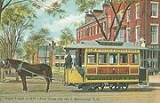
Horsecar
A horsecar was an animal-powered streetcar .
In the United States, during the 19th century, one of the earliest form of public transit to develop was the
omnibus. These were local version of the
stagecoach lines, and picked up and dropped off passengers on a regular route and without the need to be pre-hired.
The omnibus was an improvement over walking.
The first streetcar lines used horsecars and were an improvement over transportation by omnibus. One of the advantages was the low rolling resistance of metal wheels on iron or steel
rails , allowing the animals to haul a greater load for a given effort over the omnibus.
Encyclopedia
A
horsecar was an animal-powered streetcar .
In the United States, during the 19th century, one of the earliest form of public transit to develop was the
omnibus. These were local version of the
stagecoach lines, and picked up and dropped off passengers on a regular route and without the need to be pre-hired.
The omnibus was an improvement over walking.
The first streetcar lines used horsecars and were an improvement over transportation by omnibus. One of the advantages was the low rolling resistance of metal wheels on iron or steel
rails , allowing the animals to haul a greater load for a given effort over the omnibus. The horse-drawn streetcar combined the low cost, flexibility, and safety of animal power with the efficiency, smoothness, and all-weather capability of a rail right-of-way.
Some of the earliest streetcars appeared in
Baltimore, Maryland in 1828 and in
New York City in 1832. These streetcars used horses and sometimes mules to haul the cars, usually two as a team. Rarely, other animals were tried, including humans in emergency circumstances. By the mid 1880s, there were 415 street railway companies in the United States operating over 6000 miles of track and carrying 188 million passengers per year using horsecars.
Problems with horsecars included the fact that any given animal could only work so many hours on a given day, had to be housed, groomed, fed and cared for day in and day out, and produced prodigious amounts of manure, which the streetcar company was charged with storing and then disposing of. Since a typical horse pulled a streetcar for perhaps a dozen miles a day and worked for four or five hours, many systems needed ten or more horses in stable for each horsecar.
Horsecars were largely replaced by electric-powered
streetcars following the invention by
Frank J. Sprague of an overhead
trolley system on streetcars for collecting electricity from
overhead wires. His spring-loaded
trolley pole used a wheel to travel along the wire. In late 1887 and early 1888, using his trolley system, Sprague installed the first successful large electric street railway system in
Richmond, Virginia.
Long a transportation obstacle, the hills of Richmond included grades of over 10%, and were an excellent proving ground for acceptance of the new technology in other cities. Within a year, the economy of electric power had replaced more costly horsecars in many cities. By 1889 110 electric railways incorporating Sprague's equipment had been begun or planned on several continents. By the turn of the century, there were almost no horsecars left in the USA.
New York City had the last regular horsecar line in the United States, closing in 1917.
Toronto's horse drawn streetcar operations ended in 1891. A rare survival was a mule-powered line in
Celaya, Mexico which operated until 1956. Horse-drawn trams still operate as a tourist attraction in
Douglas, Isle of Man, near a heritage steam railway and electric trams.
Replica horsecar lines are in operation at all
Disney theme parks except
Tokyo and
Hong Kong as part of the parks'
Main Street, U.S.A. "themed land".
External links