
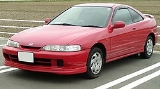
The
Honda Integra, a car sold as an
AcuraAcura is the luxury vehicle division of Japanese automaker Honda Motor Company. The Acura brand has been used in the US, Canada, and Hong Kong since March 1986 to market Honda's performance vehicles and near-performance vehicles. The brand was introduced to Mexico in 2004 and to China in 2006...
in North America and as a
Hondais a Japanese multinational corporation primarily known as a manufacturer of automobiles and motorcycles. Honda is the world's largest manufacturer of motorcycles as well as the world's largest manufacturer of internal combustion engines measured by volume. Honda surpassed Nissan in 2001 to become...
elsewhere, is a sporty
front-wheel driveFront-wheel drive is a form of engine/transmission layout used in motor vehicles, where the engine drives the front wheels only. Most modern front-wheel drive vehicles feature a transverse engine, rather than the conventional longitudinal engine arrangement generally found in rear-wheel drive and...
vehicle sold both as a sedan and hatchback. In the
AcuraAcura is the luxury vehicle division of Japanese automaker Honda Motor Company. The Acura brand has been used in the US, Canada, and Hong Kong since March 1986 to market Honda's performance vehicles and near-performance vehicles. The brand was introduced to Mexico in 2004 and to China in 2006...
lineup it was the smallest, least expensive model, designed to offer a competitor to vehicles like the
Volkswagen Golf VR6The Volkswagen Golf is a hatchback / small family car manufactured by Volkswagen since 1974 and marketed worldwide across six generations, in various body configurations and under various nameplates -- prominently as the Volkswagen Rabbit in the United States and Canada , and as the Volkswagen...
, which was the most well known and popular "hot hatch" of the late 1990s when the Integra was introduced. Although a sedan was available for the first three generations of the Integra, it was dropped when the vehicle transitioned to its fourth generation "DC5" platform, sold as the
RSXThe Honda Integra DC5 is a Japanese vehicle, which was also known as the Acura RSX in North America. It is available in base and "Type-S" trim levels in North America, and a "Integra iS / Integra Type S" and "Type R" version sold in Japan and Oceania...
in
North AmericaNorth America is the northern continent of the Americas, situated in the Earth's northern hemisphere and in the western hemisphere. It is bordered on the north by the Arctic Ocean, on the east by the North Atlantic Ocean, on the southeast by the Caribbean Sea, and on the west by the North Pacific...
. The
Acura TSXThe Acura TSX is an entry-level luxury car manufactured by Honda. Introduced in April 2003, it was sold only in the United States and Canada, but from the 2009 model year on it will also be available in Mexico...
now takes the Integra sedan's spot in the lineup.
Under the Honda lineup, the Integra was near the middle, slotting above smaller cars such as the
Honda CityThe Honda City is a subcompact car manufactured by the Japanese manufacturer Honda since 1981 for the Asian market.Since 2002, the City is also known as the Honda Fit Aria...
, the
Honda CivicThe Honda Civic is a line of compact cars developed and manufactured by Honda. In North America, the Civic is the second-longest continuously-running nameplate from a Japanese manufacturer; only the Toyota Corolla, introduced in 1968, has been in production longer...
, and the
Honda LogoThe Honda Logo series GA3 and GA5, is a supermini produced by the Japanese automaker Honda between 1996 and 2001. The Logo was available as a three-door and five-door hatchback. It was sold in the United Kingdom from 2000 until 2001. It was a platform mate to the Honda Capa and replaced the Honda...
. The Honda Integra was considered to be mid-sized car by Japanese standards.
AV, DA1-DA3
This vehicle debuted in
Japanis an island country in East Asia. Located in the Pacific Ocean, it lies to the east of the Sea of Japan, People's Republic of China, North Korea, South Korea and Russia, stretching from the Sea of Okhotsk in the north to the East China Sea and Taiwan in the south...
in 1985 as the
Honda QuintThe Honda Quint was a subcompact car manufactured by Honda Motor Co. Ltd. of Japan, based on the Honda Civic. It was introduced in 1980 in Japan, and was available to export markets including Europe and Southeast Asia the following year. Its export name was Honda Quintet. This model was...
Integra before going on sale a year later in North America as part of the then-new
AcuraAcura is the luxury vehicle division of Japanese automaker Honda Motor Company. The Acura brand has been used in the US, Canada, and Hong Kong since March 1986 to market Honda's performance vehicles and near-performance vehicles. The brand was introduced to Mexico in 2004 and to China in 2006...
lineup. Three and five-door hatchback and four-door saloon bodies were available, with a 1.6 L DOHC 16-valve
four-cylinderThe inline-four engine or straight-four engine is a four-cylinder internal combustion engine with all four cylinders mounted in a straight line, or plane along the crankcase. The single bank of cylinders may be oriented in either a vertical or an inclined plane with all the pistons driving a...
engine powering both. The engine was the vehicle's most publicized feature, as DOHC, multi-valve engines were anything but commonplace in entry-level models at the time. The 5-door hatchback model was also sold in Australia but was rebadged as the Rover 416i.
The Integra was based on the less-sporty
CivicThe Honda Civic is a line of compact cars developed and manufactured by Honda. In North America, the Civic is the second-longest continuously-running nameplate from a Japanese manufacturer; only the Toyota Corolla, introduced in 1968, has been in production longer...
, although it featured a small list of key upgrades over its lesser stablemate to help merit a price increase over the CRX Si, which was otherwise the sportiest
compactA compact car , or small family car , is a classification of cars which are larger than a supermini but smaller than or equal to a mid-size car...
vehicle being offered by Honda/Acura; enlarged 4-wheel disc brakes replaced the small front-disc/rear-drum setup used by the Civic and CRX, suspension calibration was re-worked, better tires were used and a 113
hpHorsepower is the name of several non-SI units of power. It was originally defined to allow the output of steam engines to be measured and compared with the power output of draft horses. The horsepower was widely adopted to measure the output of piston engines, turbines, electric motors and other...
DOHC
fuel injectedFuel injection is a system for mixing fuel with air in an internal combustion engine. It has become the primary fuel delivery system used in gasoline automotive engines, having almost completely replaced carburetors in the late 1980s....
16-valve engine was used in place of the SOHC unit from the CRX Si. Combined with sleeker styling and a nicer interior, buyers were effectively convinced that the Integra was worth the extra money, and nearly 228,000 units were sold during the four year run of the first generation model.
The first generation Integras actually came with two different engines. Although they shared the same engine code (D16A1), there were a few differences. The engine differed in the years 1986 to 1987 and 1988 to 1989. The two engines are commonly called the "Browntop" and "Blacktop" due to the color of their valve covers. The "browntop" came in 1986 and 1987 Integras while the "blacktop" came in 1988 and 1989 models. The improvements in the "blacktop" engine included lighter rods, domed pistons for slightly higher compression, and an electric advance distributor (the "browntop" came with a vacuum advance distributor). The overall gain in performance was about for .
The original Integra was not without its shortcomings though; despite producing and featuring a reachable 7100 rpm redline, the new DOHC engine lacked low-end torque for daily city driving.
DA5-DA9, DB1-DB2
Honda debuted the second generation Integra in 1989 as a 1990 model, now powered by a new 1.8 L engine (B18A1) making 130 hp (140 hp 1992-1993), giving the model a necessary boost in performance. The three-door hatchback (DA9 chassis code) continued to be available, but the 5-door hatchback was discontinued due to poor market reception and was replaced by a more conventional 4-door sedan body style (DB1 chassis code).
Trim levels for 1990 and 1991 included the RS (base model), LS, and a new GS trim level that featured anti-lock brakes, a first for the Integra. The 1991 GS had the option of leather interior.
For 1992, Acura added the GS-R trim level (DB2 chassis code), powered by a variant of the very successful B16A engine, called the B17A1, which was only available in USDM (United States Domestic Market) models. The difference between the B16A and B17A1 is the deck height and compression ratio and its displacement, the B17A1 is a 1678 cc engine. It featured a
VTEC-DOHC VTEC:Honda's system is a simple method of endowing the engine with multiple camshaft profiles optimized for low and high RPM operations. Instead of one cam lobe actuating each valve, there are two: one optimized for low-RPM stability & fuel efficiency; the other designed to maximize high-RPM...
system, as found in the then-new
NSXThe Honda NSX, or Acura NSX in North America, was a sports car produced between 1990 and 2005 by the Japanese automaker Honda. It sports a mid-engine, rear-wheel drive layout and was powered by an all-aluminum V6 gasoline engine featuring Honda's "variable valve timing and lift electronic control" ...
, bumping output to and a 8000 rpm redline. Other features exclusive to the GS-R include the charcoal grey cloth interior (leather as a rare option), body-colored trim and front lip, and the third brake light mounted in the spoiler. Sunroof, power everything, and 14-inch 6-spoke aluminum wheels came standard as well.
The 92–93 Acura Integra GS-R is the rarest Integra to date because of its B17A engine, low production numbers, and unavailability in the used car market. This model Integra holds its retail value extremely well because of its rarity, reliability, and performance. It is estimated that approximately 1,200 were manufactured in 1992, and around 1,000 in 1993, for a total of around 2,200 ever produced. The 92–93 USDM GS-R was available in only three colors: Milano Red, Frost White, and Aztec Green Pearl . Canadian market GS-R's came in Milano Red, Black, and Aztec Green Pearl.
Other small updates came on to all trim levels in 1992, namely new front and rear bumpers, a new steering wheel, new taillights, new ECU, new camshafts, and chromed interior door handles.
The second generation was the last Integra to be sold without
airbagAn airbag is a vehicle safety device. It is an occupant restraint consisting of a flexible envelope designed to inflate rapidly in an automobile collision, to prevent vehicle occupants from striking interior objects such as the steering wheel or window....
s in the
United StatesThe United States of America is a federal constitutional republic comprising fifty states and a federal district...
. Motorized passive seat belts were used instead.
CanadaCanada is a country occupying most of northern North America, extending from the Atlantic Ocean in the east to the Pacific Ocean in the west and northward into the Arctic Ocean...
and the rest of the world received standard seat belts.
This generation also saw Acura make a bit of a marketing shift. Prior to the 1991 model year, Acura had made a minor point of the supposed understated elegance of minimal exterior badging. Therefore, from the 1986 to 1990 model years, the only external clues to any Integra's identity came at the rear, where badges for "Acura" "Integra", and the trim level appeared. For the 1991 model year however, Acura's "A" caliper logo appeared for the very first time on the front of the hood, as well as between the taillights. Every Integra made since then has had the "A" badges. 262,285 units were sold from 1990 to 1993.
DB6-DB9, DC1-DC2, DC4 (1993-1997)
Honda debuted the third generation model in 1993 in Japan. Acura followed in 1994. It had an unusual four headlight front end design which was dubbed "bug eyes" by some enthusiasts. Standard power from the B18B engine increased to , and the GS-R received the B18C1 VTEC engine, equipped with a dual-stage intake manifold, ported exhaust manifold and a displacement increase (from the second generation integra) from 1.7 liters to 1.8 liters, bringing power up to .
In 1998, Honda redesigned the Integra after the new Integra Type-R was released. In Japan the redesign had two more conventional looking headlights as the bug eye look had
proven unpopular, outside Japan it had a slightly revised version of the four headlight front.
A
Type R model was added for the 1995 model year in Japan and in 1997 in other markets, powered by a highly tuned, hand-finished variant of the GS-R's engine. That same year the Integra GSR was sold in Japan as the SiR-G. The JDM B18C Spec-R (B18C5 for USDM) equipped Type-R produced . Although it had an impressive rev limit, the Type R was still hampered by some criticism; its maximum torque output of only 133.8 lb·ft at 7500 rpm meant that the engine would have to be revved high to achieve the best performance.
Third-generation mid-model change (1998-2001)
Despite some popular demand for an Integra re-design for 1998, Honda chose to give the third generation model a slight facelift and re-release it. The 1998 Integra had slightly larger headlights, a more aggressive front bumper, all-red taillights, and a revised rear bumper. There were also some minor cosmetic changes to the interior, and small revisions to the electrical and mechanical components. The GS-R edition received 6-spoke "blade" style wheels as a stylistic change, and leather interior. Once again, the Type-R saw a limited release in the US. During this facelift, the sedan was not sold in
CanadaCanada is a country occupying most of northern North America, extending from the Atlantic Ocean in the east to the Pacific Ocean in the west and northward into the Arctic Ocean...
after 1997, replaced by the
Acura ELIn 1996, the Acura EL is a rebadged Honda Civic sold as a compact entry-level luxury car developed by Honda as an entry-level vehicle , and sold only in Canada. It replaced the Integra sedan in the lineup, while the Integra sedan continued to be sold in the United States until 2001. The car had...
, a
rebadgedBadge engineering is a term that describes the rebadging of one product as another. Due to the high cost of designing and engineering a totally new model, or establishing a new brand , it is often more cost-effective to rebadge a single product multiple times.The term derives from the trademark...
JDM
Honda DomaniThe Honda Domani is a car made by Honda and marketed in east Asia, including Japan. It was introduced in November 1992, replacing the Concerto in Honda's lineup."Domani" is Italian for "tomorrow"....
.
It is easy to quickly differentiate a 1998-2001 Integra from an older model in which the headlights are set slightly deeper within their respective cavities. With the 1998 model, the headlights became flush with the shape of the bumper, completely filling the cavities. These models are still popular among racing enthusiasts all around the continental US and
Puerto RicoPuerto Rico , officially the Commonwealth of Puerto Rico , is a self-governing unincorporated territory of the United States located in the northeastern Caribbean, east of the Dominican Republic and west of the Virgin Islands...
.
For 1998, Honda kept the base RS and LS trims and designated the previous LS "Special Edition" as GS. All models, (Excluding the GS-R and Type R) came out sporting a B18B Honda engine with a five speed
manual transmissionA manual transmission, or manual gearbox is a type of transmission used in motor vehicle applications...
or its
automaticAn automatic transmission is an automobile gearbox that can change gear ratios automatically as the vehicle moves, freeing the driver from having to shift gears manually...
version.
The Acura Integra was recently cataloged as one of the most thief-friendly cars in America. The Acura Integra featured six times in the top ten list, the 1998 model being the thieves' favorite.
Type R Trim Level (1997–2001 excluding 1999)
The Type R was the pinnacle of the Integra line. It had many exclusive features found on no other Integra. This trim of the Integra only came with a 5 speed manual transmission. The interior had red stitching on the arm rest and shift knob for 1998, and after year 2000, faux carbon fiber for cup holders, climate control, cluster bezzel, and the shifter plate. The Canadian market received a limited number of vehicles in the final year of production (2001) with the ultra rare red interior which composed of red front and rear seats.
The Type R's B18C5 engine was not merely a tuned version of the GS-R's B18C1. The Type-R's head is a re-worked PR-3 head, with better valves, camshafts, retainers, stiffer valve springs and a red cover. During production, the B16 heads would get a green marker line to signify a 'perfect cast', and these would be the heads put away and later used for Type R engines which would recieve a hand port and polish. Molybdenum-coated, high compression pistons and stronger-but-lighter connecting rods strengthened the reciprocating assembly. Extra counter-weights were installed on the crankshaft which altered its vibration modes to enhance durability at high rpm. The intake valves were reshaped with a thinner stem and crown that reduced weight and improved flow. The intake ports were given a minor port and polish. Stiffer valve springs resisted float on more aggressive camshafts. Intake air was now drawn from inside the fender well, for a colder, denser charge. That intake fed a short-runner intake manifold with a larger throttle body for better breathing. An improved stainless steel exhaust collector with more gentle merge angles, a change to a larger, consistent piping diameter, flared internal piping in the
mufflerA muffler is a device for reducing the amount of noise emitted by a machine. On internal combustion engines, the engine exhaust blows out through the muffler....
allowed easier exit of gases. A re-tuned engine computer also contributed to improved power output, which allowed the Type-R to accelerate from 0 to in 6.2 seconds (as opposed to the GS-R's 7.0).
The transmission gearing used was very similar to that of the civic Si from 1999-2000, which featured closer gear ratios in second through fifth gears, in order to take advantage of the additional rev range. However, the Type R transmissions featured stronger synchros in all 5 gears. The
North AmericaNorth America is the northern continent of the Americas, situated in the Earth's northern hemisphere and in the western hemisphere. It is bordered on the north by the Arctic Ocean, on the east by the North Atlantic Ocean, on the southeast by the Caribbean Sea, and on the west by the North Pacific...
n version retained the same 4.4 final drive throughout the Type-R's production run, unlike the Japanese version, which in 1998 changed to a 4.785 final drive along with revised gearing (However the 4th and 5th gear in the 4.785 transmission was from the GSR transmission, which made the ratios for 4th and 5th on the 4.75 nearly identical to the 4th and 5th gear in the 4.4 tranny, resulting in easier cruising at higher speeds). Unlike the other model Integras with a open differential, The Type R came with a
torque-sensingTorsen is a type of limited slip differential used in automobiles. It was invented by American Vernon Gleasman and manufactured by the Gleason Corporation. Torsen is a contraction of Torque-Sensing...
limited slip type.
The chassis received enhancements in the form of reinforcements to the rear wheel wells, roof rail, and other key areas. "Performance rods", chassis braces that were bolted in place, were added to the rear trunk wall and subframe. The front strut tower bar was replaced with a stronger aluminum piece. Honda marketed a rear strut tower bar as a dealer accessory as well, but it required cutting of the damper mount access panels. Camber rigidity was improved at the rear by increasing wheel bearing span by 10 mm. This rigidity was further improved in 1998 when the smaller upper suspension link was changed from a stamped steel part to a fabricated part with a more rigid bushing. The Type-R's body also received a new functional rear spoiler, body-colored rocker panels and front lip, and 5-bolt hubs with special lightweight Type-R wheels. Under those wheels was a much larger set of disc brakes, front and back. The tires were upgraded to
Bridgestoneis a multinational rubber conglomerate founded in 1931 by in the city of Kurume, Fukuoka, Japan. The name Bridgestone comes from a calque translation and transposition of ishibashi, meaning "stone bridge" in Japanese....
RE010 summer tires.
The Type-R received very aggressive tuning in its suspension settings. All soft rubber bushings were replaced with much stiffer versions, as much as 5.3 times higher in durometer readings. The springs and dampers were much stiffer, with a reduction in ride height. The rear anti-roll bar diameter was initially increased to in
diameterIn geometry, a diameter of a circle is any straight line segment that passes through the center of the circle and whose endpoints are on the circle. The diameters are the longest chords of the circle...
, and further enlarged to 23 mm in diameter in 1998. The front anti-roll bar retained the same size, although the end links were changed to a more responsive sealed ball joint as opposed to a rubber bushing on the lesser models. The result was a chassis with very responsive, racetrack-ready handling that ably absorbed mid-corner bumps. Mild oversteer was easy to induce with a
lift of the throttleLift-off oversteer is a form of oversteer in an automobile that occurs when the vertical load on the tires shifts from the rear to the front quickly due to throttle release while cornering...
, and during steady-state cornering the car maintained a slight tail-out stance.
The interior was stripped down to reduce weight. The air conditioning system was optional in early models and nearly all the sound-dampening material was eliminated. This provided for a much noisier ride, but since the Type-R was marketed as a race car for the street, most owners didn't mind. The seats were also unique to the Type-R. For the U.S. market, the upholstery was done in Alcantara and mesh, with the bottom cushion made softer than the standard Integras to preserve comfort. The Japanese market cars used
RecaroRECARO GmbH & Co. KG, commonly known as Recaro, is a German company based in Kirchheim unter Teck in the vicinity of Stuttgart, known for their automobile bucket seats...
SRII seats—a slightly smaller variant of the Recaro SRD. This seat is actually heavier than the standard Integra seats.
Integra SJ (EK3)
The
IntegraSJ (standing for "Sedan Joyful") was a rebadged
CivicThe Honda Civic is a line of compact cars developed and manufactured by Honda. In North America, the Civic is the second-longest continuously-running nameplate from a Japanese manufacturer; only the Toyota Corolla, introduced in 1968, has been in production longer...
Ferio, with modified headlamps and grille similar to the
OrthiaThe Honda Orthia is a Japanese Domestic Market car model manufactured by the Honda Motor Corporation. It is a small station wagon based on the sixth generation Honda Civic. Introduced in February 1996 as what Honda called a Sport Utility Wagon it was available as 2WD or 4WD...
's and slightly larger rear lights. It was made from 1996 to 2001, and used the 1493 cc D15B engine. Honda's press material of the time indicated that the SJ was intended to provide a "formal sedan" for the Integra range; another reason may have been to sell Ferios using a more upmarket model name, as was the case with the Nissan Laurel Spirit.
In Thailand, the Integra SJ was sold as the
Isuzu, is a Japanese car, commercial vehicle and heavy truck manufacturing company, headquartered in Tokyo. In 2005, Isuzu became the world's largest manufacturer of medium to heavy duty trucks. It has assembly and manufacturing plants in the Japanese city of Fujisawa, as well as in the prefectures...
Vertex, last passenger car ever for that market. (This followed Isuzu's practice of selling Honda models as Isuzus which started with the
GeminiThe Isuzu Gemini was a compact car built, in several generations, by Isuzu and sold from 1974 to 2000. The same basic product was built and/or sold under several other names, sometimes by other General Motors brands, in various markets around the world.-1974:...
; while Honda also selling Isuzu's sport utility vehicles in Japan and North America, and pickup truck in Thailand.)
A total of 301,103 Integras were sold from 1994 to 2001.
Fourth generation (2002-2006)
DC5 Integra
The fourth generation Integra, produced from 2002 on, was renamed the
Acura RSXThe Honda Integra DC5 is a Japanese vehicle, which was also known as the Acura RSX in North America. It is available in base and "Type-S" trim levels in North America, and a "Integra iS / Integra Type S" and "Type R" version sold in Japan and Oceania...
for the
United StatesThe United States of America is a federal constitutional republic comprising fifty states and a federal district...
,
CanadaCanada is a country occupying most of northern North America, extending from the Atlantic Ocean in the east to the Pacific Ocean in the west and northward into the Arctic Ocean...
and
Hong KongHong Kong , officially the Hong Kong Special Administrative Region, is a highly autonomous territory of the People's Republic of China, facing Guangdong to the north and the South China Sea to the east, west and south...
in accordance with Acura's new alphabetical naming scheme. It also had an entirely new engine, the
K-seriesThe Honda K series engine is a four-cylinder four-stroke engine. The K series engines are equipped with DOHC valvetrains and use roller rockers to reduce friction. The engines use a coil-on-plug, distributorless ignition system with a coil for each spark plug. This system eliminates the need for...
. It came in two models in the United States, the RSX base model, and the RSX-S boasting the K20A2 engine from 2002 to 2004, while the 2005 and 2006 RSX-S came with a K20Z1. The RSX was still sold as a Honda Integra in
Japanis an island country in East Asia. Located in the Pacific Ocean, it lies to the east of the Sea of Japan, People's Republic of China, North Korea, South Korea and Russia, stretching from the Sea of Okhotsk in the north to the East China Sea and Taiwan in the south...
and
AustraliaAustralia , officially the Commonwealth of Australia, is a country in the Southern Hemisphere comprising the continental mainland , the island of Tasmania, and numerous smaller islands in the Indian and Pacific Oceans...
, markets where
AcuraAcura is the luxury vehicle division of Japanese automaker Honda Motor Company. The Acura brand has been used in the US, Canada, and Hong Kong since March 1986 to market Honda's performance vehicles and near-performance vehicles. The brand was introduced to Mexico in 2004 and to China in 2006...
did not exist.
In March 2006, Honda announced that the Integra would be discontinued in June after its final 300 cars were sold, due to the shrinkage of the coupe market. The reaction of the consumers towards the discontinuation, however, forced Honda to extend production until July 2006 and produce 150 more Integras. The Acura RSX was discontinued as well, as the RSX did not fit within the confines of Acura's re-structured market strategy, and that the introduction of the similarly powerful and less expensive 2006 model-year
Honda Civic SiThe Honda Civic Si is a sport compact / hot hatch version of the Civic built by the Japanese automaker Honda. The Si trim, which stands for "Sport Injected", was introduced for the third generation of Honda Civics in both Japan and North America...
was there to fill in the gap left by the RSX.
Awards
The Integra was on
Car and DriverCar and Driver is an American automotive enthusiast magazine. Its total circulation is 1.31 million. It is owned by Hachette Filipacchi Magazines. Originally headquartered in New York City, the magazine has been based in Ann Arbor, Michigan since the late 1970s.-History:Car and Driver was founded...
magazine's annual
Ten BestCar and Driver magazine annually nominates a list of what it considers the Ten Best cars and Five Best trucks.All production vehicles for sale in that calendar year are considered with these restrictions:# The vehicle must be on sale by January...
list six times, in 1987, 1988, and 1994 through 1997. The GS-R model was called out specifically in 1994 and 1995. It made a return on the Ten Best as the Acura RSX, for 2002 and 2003. The Integra Type-R (DC2) was named as the 'best front-wheel-drive drivers' car ever' by
Evo MagazineEvo is a British automobile magazine dedicated to performance cars, from hot hatches to supercars. The first issue was produced in November 1998 as an unofficial successor to Performance Car, which had become part of Car Magazine. It is published monthly but has recently taken the decision to...
in 2006.
External links