
All Topics  
Harry Arminius Miller


   Email Print
   Bookmark   Link


Harry Arminius Miller


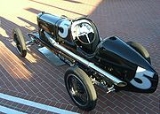
Harry Arminius Miller (December 9, 1875 – May 3, 1943) was an influential and famous American
United States

The United States of America is a Federal government constitutional republic comprising U.S. state and a federal district. The country is situated mostly in central North America, where its Contiguous United States and Washington, D.C., the Capital districts and territories, lie between the Pacific Ocean and Atlantic Oceans, Borders of the U...
 race car builder, most active in the 1920s and 1930s. In the opinion of noted American racing historian Griffith Borgeson
Griffith Borgeson

Griffith Borgeson was an influential United States race car historian, described by the Society of Automotive Engineers as one of the world's preeminent automotive historians....
, Miller was "the greatest creative figure in the history of the American racing car".

built by Miller won the Indianapolis 500
Indianapolis 500

The Indianapolis 500-Mile Race, often shortened to Indianapolis 500 or Indy 500 or commonly known simply as The 500, is an USA automobile auto racing, held annually over the Memorial Day weekend at the Indianapolis Motor Speedway in Speedway, Indiana....
 nine times; three more instances were won by his engines running in other chassis.


Discussion
Ask a question about 'Harry Arminius Miller'
Start a new discussion about 'Harry Arminius Miller'
Answer questions from other users
Full Discussion Forum


Recent Posts


Encyclopedia


Harry Arminius Miller (December 9, 1875 – May 3, 1943) was an influential and famous American
United States

The United States of America is a Federal government constitutional republic comprising U.S. state and a federal district. The country is situated mostly in central North America, where its Contiguous United States and Washington, D.C., the Capital districts and territories, lie between the Pacific Ocean and Atlantic Oceans, Borders of the U...
 race car builder, most active in the 1920s and 1930s. In the opinion of noted American racing historian Griffith Borgeson
Griffith Borgeson

Griffith Borgeson was an influential United States race car historian, described by the Society of Automotive Engineers as one of the world's preeminent automotive historians....
, Miller was "the greatest creative figure in the history of the American racing car".

Biography

Cars built by Miller won the Indianapolis 500
Indianapolis 500

The Indianapolis 500-Mile Race, often shortened to Indianapolis 500 or Indy 500 or commonly known simply as The 500, is an USA automobile auto racing, held annually over the Memorial Day weekend at the Indianapolis Motor Speedway in Speedway, Indiana....
 nine times; three more instances were won by his engines running in other chassis. Miller cars accounted for no less than 83% of the Indy 500 fields between 1923 and 1928.

If Offenhauser
Offenhauser

Offenhauser was an United States of America racing engine manufacturer that operated from 1933 to 1983.The Offenhauser engine, familiarly known as the "Offy", was developed by Fred Offenhauser and his employer Harry Arminius Miller, after maintaining and repairing a 1913 Peugeot Grand Prix motor racing car of the type which had won the Ind...
 engines, a re-badged Miller derivative, and the dominant engine at the Indy 500 and on the Champ car
Champ Car

Champ Car, was the name for a class and specification of automobiles used in American Championship Car Racing for many decades, primarily for use in the Indianapolis 500 auto race....
 circuit in the 1950s and 1960s (although it kept winning until the 1970s) are added, the number of wins at Indianapolis alone increases by 28, with over 200 more elsewhere. It was not until 1981 that an Indy 500 start did not feature a single Miller-derived engine.

Miller started off manufacturing carburetors for passenger and race cars. His involvement with the racing side of his carburettor business led to repairing and later building race cars. After repairing the 1913 Peugeot
Peugeot

Peugeot is a major France automobile brand, part of PSA Peugeot Citro?n. Its parent company PSA Peugeot Citro?n is the second largest carmaker in Europe, behind Volkswagen....
 Grand Prix
Grand Prix motor racing

Grand Prix motor racing has its roots in organised automobile racing that began in France as far back as 1894. It quickly evolved from a simple road race from one town to the next, to Endurance racing for car and driver....
 car which was the state of the art at the time, Miller and his employees, Leo Goosen and Fred Offenhauser
Fred Offenhauser

Fred Offenhauser , was an automotive engineer and mechanic who designed the Offenhauser racing engine, nicknamed the "Offy", which dominated competition in the Indianapolis 500 race for decades....
 designed the Miller racing engine from the Peugeot 4 cylinder, double overhead camshaft, 4 valves per cylinder layout. This began a thoroughbred line of race motors that dominated American racing well into the 1970s.

Miller went bankrupt in 1933. His shop foreman and chief machinist Fred Offenhauser purchased the shop and continued development of the engine as the Offenhauser or "Offy" engine until the start of World War 2. Fred retired from the business in 1946, selling out to two of his racing friends: three-time Indianapolis 500 winner Louis Meyer
Louis Meyer

Louis Meyer July 21 1904 - October 7 1995) was an United States International Motorsports Hall of Fame race car driver best known as the first three-time winner of the Indianapolis 500....
 and Meyer's one-time riding mechanic and highly skilled engine builder Dale Drake.

Meyer and Drake Engineering, with Leo Goosen as chief engineer, continued to develop the Offy throughout the 40s, 50s, and into the 60s; often filling the engine bays of all 33 Indy 500 starters with Offy engines or their close cousins the V8 Novi engines.

After Lou Meyer sold out of Meyer and Drake in the 1960s to form his own company to sell Ford double overhead-cam V8 racing engines in competition with the Offy, Dale Drake and Leo Goosen persevered and reorganized Meyer and Drake as Drake Engineering. After enduring three years of Ford DOHC dominance at Indy, Drake's company prevailed in 1968 with the first turbocharged engine to win at Indianapolis behind Bobby Unser.

Descendants of the Offys (and thus the Millers) in the form of the turbocharged Drake-Goosen-Sparks (DGS) and Drake-Offy engines battled against descendants of the Ford DOHC until the Cosworth DFV and DFX engines originally developed as Formula 1 engines by Mike Costin and Keith Duckworth finally became too powerful at reduced manifold pressure (turbo boost) (artificial limits pushed through by Ford and Chevy as they could not compete with the Head Design of the Offy which could run at much higher boost levels. The Offy was not designed for lower boost levels and by the time they could design an engine with the short notice given them it was to late) limits mandated by the race sanctioning bodies for the Offys to overcome. The last Offy to finish a race at Indianapolis powered Gary Bettenhausen from a starting position of 32nd to a 3rd place finish in 1980.

Awards

  • He was named to the National Sprint Car Hall of Fame
    National Sprint Car Hall of Fame & Museum

    The National Sprint Car Hall of Fame & Museum is a Hall of Fame and museum for Sprint car racing drivers.The museum is located in Knoxville, Iowa, United States, the home of the Knoxville Nationals at Knoxville Raceway....
     in 1990.
  • He was inducted into the Motorsports Hall of Fame of America
    Motorsports Hall of Fame of America

    The Motorsports Hall of Fame of America is a Hall of Fame and museum in Novi, Michigan for United States motorsports legends....
     in 1999.
  • He was inducted into the Automotive Hall of Fame
    Automotive Hall of Fame

    The Automotive Hall of Fame is a Hall of Fame for notable figures in the development of the automobile industry....
     in 2003.


Further reading


  • Mark L. Dees, The Miller Dynasty: A Technical History of the Work of Harry A. Miller, His Associates, and His Successors (Barnes, Scarsdale, 1981; second edition Hippodrome, Moorpark, 1994) This is the definitive work on Miller, but was published in limited editions, and may be hard to find
  • Griffith Borgeson, Miller (Motorbooks International, Osceola, 1993)
  • Griffith Borgeson, The Last Great Miller: The Four-Wheel-Drive Indy Car (SAE
    Society of Automotive Engineers

    SAE International is a professional organization for mobility engineering professionals in the aerospace, automotive, and commercial vehicle industries....
    , Warrendale, 2000). This car was built with sponsorship from the of Clintonville, Wisconsin.
  • Griffith Borgeson, The Golden Age of the American Racing Car (Bonanza, New York, 1966; second edition SAE
    Society of Automotive Engineers

    SAE International is a professional organization for mobility engineering professionals in the aerospace, automotive, and commercial vehicle industries....
    , Warrendale, 1998)


External links