
The
half dime, or
half disme, was a
silver coinA coin is a piece of hard material that is standardized in weight, is produced in large quantities in order to facilitate trade, and primarily can be used as a legal tender token for commerce in the designated country, region, or territory....
, valued at five
centIn many national currencies, the cent is a monetary unit that equals 1⁄100 of the basic monetary unit. Etymologically, the word cent derives from the Latin word "centum" meaning hundred. Cent also refers to a coin which is worth one cent....
s, formerly
mintA mint is an industrial facility which manufactures coins for currency.The history of mints correlates closely with the history of coins. One difference is that the history of the mint is usually closely tied to the political situation of an era...
ed in the
United StatesThe United States of America is a federal constitutional republic comprising fifty states and a federal district...
.
Some numismatists consider the denomination to be the first coin minted by the
United States MintThe United States Mint primarily produces circulating coinage for the United States to conduct its trade and commerce. The Mint was created by Congress with the Coinage Act of 1792, and placed within the Department of State...
under the Coinage Act of 1792, with production beginning on or about
July 1792The 1792 half disme was an American silver coin with a face value of five cents. Although it is subject to debate as to whether this was intended to be circulating coinage or instead an experimental issue, President George Washington referred to it as "a small beginning" and many of the coins...
. However, others consider the
1792 half dismeThe 1792 half disme was an American silver coin with a face value of five cents. Although it is subject to debate as to whether this was intended to be circulating coinage or instead an experimental issue, President George Washington referred to it as "a small beginning" and many of the coins...
to be nothing more than a
pattern coinA pattern coin is a coin which has not been approved for release, produced for the purpose of evaluating a proposed coin design. They are often off-metal strikes, to proof standard or piedforts...
, or 'test piece', and this matter continues to be subject to debate.
These coins were much smaller than dimes in diameter and thickness, appearing to be "half dimes". In the 1860s, powerful
nickelNickel is a chemical element with the chemical symbol Ni and atomic number 28. It is a silvery-white lustrous metal with a slight golden tinge. Nickel belongs to the transition metals and is hard and ductile...
interests successfully lobbied for the creation of new coins, which would be made of a
copperCopper is a chemical element with the symbol Cu and atomic number 29. It is a ductile metal with very high thermal and electrical conductivity. Pure copper is soft and malleable; an exposed surface has a reddish-orange tarnish...
-nickel
alloyAn alloy is a mixture or metallic solid solution composed of two or more elements. Complete solid solution alloys give single solid phase microstructure, while partial solutions give two or more phases that may or may not be homogeneous in distribution, depending on thermal history...
; production of such coins began in 1865, and were struck in two denominations —
threeThe United States three cent piece was a unit of currency equaling 3/100th of a United States dollar. The mint produced two different three-cent coins: the three-cent silver and the three-cent nickel. Its purchasing power in 1851 would be equivalent to $ today.-History:The three cent coin has an...
and
five centsThe nickel is a five-cent coin, representing a unit of currency equaling five hundredths of one United States dollar. A later-produced Canadian nickel five-cent coin was also called by the same name....
(the latter introduced in 1866).
The introduction of the copper-nickel five-cent pieces made the
silverSilver is a metallic chemical element with the chemical symbol Ag and atomic number 47. A soft, white, lustrous transition metal, it has the highest electrical conductivity of any element and the highest thermal conductivity of any metal...
coins of the same denomination redundant, and they were discontinued in 1873.
The following types of half dimes were produced by the
United States MintThe United States Mint primarily produces circulating coinage for the United States to conduct its trade and commerce. The Mint was created by Congress with the Coinage Act of 1792, and placed within the Department of State...
or under the authority of the Coinage Act of 1792:
1792 Half Disme
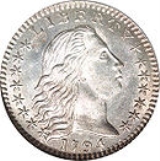
Flowing Hair 1794-1795
The flowing hair half dime was designed by
Robert ScotRobert Scot was the first Chief Engraver of the United States Mint from its inception in 1793 until his death in 1823. He was succeeded by William Kneass.-Early life:...
and this same design was also used for half dollar and dollar silver coins minted during the same period. The obverse bears a Liberty portrait similar to that appearing on the 1794 half cent and
centIn many national currencies, the cent is a monetary unit that equals 1⁄100 of the basic monetary unit. Etymologically, the word cent derives from the Latin word "centum" meaning hundred. Cent also refers to a coin which is worth one cent....
but without the liberty cap and pole. Mintage of the 1794 version was 7,765 while 78,660 of the 1795 version were produced.
Draped Bust (Small Eagle Reverse) 1796-1797
The obverse of the draped bust half dime was based on a sketch by artist
Gilbert StuartGilbert Charles Stuart was an American painter from Rhode Island.Gilbert Stuart is widely considered to be one of America's foremost portraitists...
, with the dies engraved by
Robert ScotRobert Scot was the first Chief Engraver of the United States Mint from its inception in 1793 until his death in 1823. He was succeeded by William Kneass.-Early life:...
and John Eckstein. The primary 1796 variety bears fifteen stars representing the then number of states in the union. In 1797, fifteen and sixteen star varieties were produced - the sixteenth star representing newly admitted
TennesseeTennessee is a U.S. state located in the Southeastern United States. It has a population of 6,346,105, making it the nation's 17th-largest state by population, and covers , making it the 36th-largest by total land area...
- as well as a thirteen star variety after the mint realized that it could not continue to add more stars as additional states joined the union. The reverse bears an open wreath surrounding a small eagle perched on a cloud. 54,757 half dimes of this design were minted.
Draped Bust (Heraldic Eagle Reverse) 1800-1805
Following a two year haitus, mintage of half dimes resumed in 1800. The obverse remained essentially the same as the prior version, but the reverse was revised substantially. The eagle on the reverse now had outstretched wings, heraldic style. This reverse design first appeared on gold quarter and half eagles and then dimes and dollars in the 1790s. Mintage of the series never surpassed 40,000, with none produced in 1804. No denomination or mintmark appears on the coins; all were minted in Philadelphia.
Capped Bust 1829-1837
Production of half dimes resumed in 1829 based on a new design by Chief Engraver
William KneassWilliam Kneass was the second Chief Engraver of the United States Mint from 1824 until his death in 1840. Kneass designed the Classic Head motif which appeared on Quarter Eagle and Half Eagle gold pieces from 1834-1839. He also modified John Reich's Capped Bust design on the dime through...
, who is believed to have adapted an earlier John Reich design. All coins were minted at Philadelphia and display no mintmark. The high circulating mintage in the series was in 1835, when 2,760,000 were struck, and the low of 871,000 was in 1837. Both Capped Bust and Liberty Seated half dimes were minted in 1837.
Seated Liberty (various subtypes) 1837-1873
These were the last silver half dimes produced. The design features Liberty seated on a rock and holding a shield and was first conceived in 1835 used first on the silver dollar patterns of 1836. The series is divided into several subtypes. The first was struck at Philadelphia in 1837 and New Orleans in 1838 and lacks stars on the obverse. In 1838 a semicircle of 13 stars was added around the obverse border, and this basic design was used through 1859. In 1853, small arrows were added to each side of the date to reflect a reduction in weight due to rising silver prices, and the arrows remained in place through 1855. The arrows were dropped in 1856, with the earlier design resumed through 1859. In 1860, the obverse stars were replaced with the inscription UNITED STATES OF AMERICA and the reverse wreath was enlarged. This design stayed in place through the end of the series. In 1978 a unique 1870-S Seated Liberty half dime became known. The Seated Liberty half dime was produced at the Philadelphia, San Francisco and New Orleans mints in an aggregate amount of 84,828,478 coins struck for circulation.
See also
United States Seated Liberty coinageThe Seated Liberty designs appeared on most regular-issue silver United States coinage during the mid- and late-nineteenth century, from 1836 through 1891. The denominations which featured the Seated Liberty design included the half dime, the dime, the quarter, the half dollar, and until 1873 the...
.
1870-S half dime
In 1978 a coin collector surprised the coin collecting community with an 1870-
S (San Francisco)The San Francisco Mint is a branch of the United States Mint, and was opened in 1854 to serve the gold mines of the California Gold Rush. It quickly outgrew its first building and moved into a new one in 1874. This building, the Old United States Mint, also known affectionately as The Granite Lady,...
half dime, believed to have been found in a dealer's box of cheap coins at a coin show. According to mint records for 1870, no half dimes had been minted in San Francisco; yet it was a genuine 1870-S half dime. At an auction later that same year, the 1870-S half dime sold for $425,000. It is believed that another example may exist—along with other denominations minted that year in San Francisco—in the cornerstone of the old San Francisco Mint.
Canada
CanadaCanada is a North American country consisting of ten provinces and three territories. Located in the northern part of the continent, it extends from the Atlantic Ocean in the east to the Pacific Ocean in the west, and northward into the Arctic Ocean...
also once used silver coins of five-cent denomination; they were colloquially referred to as "fish scales" because they were very thin (the term "half dime" never having been used in Canada), and were produced until Canada also switched to
nickel five-cent piecesThe Canadian five-cent coin, commonly called a nickel, is a coin worth five cents or one-twentieth of a Canadian dollar. It was patterned on the corresponding coin in the neighbouring United States...
in 1922.
External links