
All Topics  
Haleakala

 
Haleakala

   Email Print
   Bookmark   Link


Haleakala


Haleakala ( in English and in Hawaiian
Hawaiian phonology

This article is a linguistic description of the phonology system of Hawaiian language based on documented experiences of the people who developed the Hawaiian alphabet during the 1820s and scholarly research on the Hawaiian language conducted by lexicographers and linguists from 1949 to present....
), or the East Maui Volcano, is a massive shield volcano
Shield volcano

A shield volcano is a large volcano with shallow-sloping sides. The name derives from a translation of "Skjaldbrei?ur", an Icelandic shield volcano whose name means "broad shield", from its resemblance to a warrior's shield....
 that forms more than 75% of the Hawaiian Island
Hawaiian Islands

The Hawaiian Islands are an archipelago of 19 islands and atolls, numerous smaller islets, and undersea seamounts in the North Pacific Ocean, extending some 1,500 miles from the Hawaii in the south to northernmost Kure Atoll....
 of Maui
Maui

The island of Maui is the second-largest of the Hawaiian Islands at 727.2 square miles and is the List of islands of the United States by area....
.

y Hawaiians applied the name Haleakala ("house of the sun") to the summit area only, most likely because from the west side of the island, the sun could be seen rising up over the eastern side of the mountain. In Hawaiian folklore, the depression at the summit of Haleakala was home to the grandmother of the demigod Maui
Maui (Hawaiian mythology)

In Hawaiian mythology, Maui is a culture hero who appears in several different genealogies. In the Ulu line he is the son of Akalana and his wife Hinakawea ....
.


Discussion
Ask a question about 'Haleakala'
Start a new discussion about 'Haleakala'
Answer questions from other users
Full Discussion Forum


Encyclopedia


Haleakala ( in English and in Hawaiian
Hawaiian phonology

This article is a linguistic description of the phonology system of Hawaiian language based on documented experiences of the people who developed the Hawaiian alphabet during the 1820s and scholarly research on the Hawaiian language conducted by lexicographers and linguists from 1949 to present....
), or the East Maui Volcano, is a massive shield volcano
Shield volcano

A shield volcano is a large volcano with shallow-sloping sides. The name derives from a translation of "Skjaldbrei?ur", an Icelandic shield volcano whose name means "broad shield", from its resemblance to a warrior's shield....
 that forms more than 75% of the Hawaiian Island
Hawaiian Islands

The Hawaiian Islands are an archipelago of 19 islands and atolls, numerous smaller islets, and undersea seamounts in the North Pacific Ocean, extending some 1,500 miles from the Hawaii in the south to northernmost Kure Atoll....
 of Maui
Maui

The island of Maui is the second-largest of the Hawaiian Islands at 727.2 square miles and is the List of islands of the United States by area....
.

History

Early Hawaiians applied the name Haleakala ("house of the sun") to the summit area only, most likely because from the west side of the island, the sun could be seen rising up over the eastern side of the mountain. In Hawaiian folklore, the depression at the summit of Haleakala was home to the grandmother of the demigod Maui
Maui (Hawaiian mythology)

In Hawaiian mythology, Maui is a culture hero who appears in several different genealogies. In the Ulu line he is the son of Akalana and his wife Hinakawea ....
. According to the legend, Maui's grandmother helped him capture the sun and force it to slow its journey across the sky in order to lengthen the day. In modern times, Haleakala has become synonymous with the entire East Maui volcano.

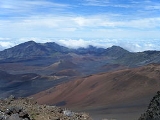
From the summit one looks down into a massive depression some 11.25 km (7 mi) across, 3.2 km (2 mi) wide, and nearly 800 m (2,600 ft) deep. The surrounding walls are steep and the interior mostly barren-looking with a scattering of volcanic cones. The volcano is officially considered active and has produced numerous eruptions in the last 30,000 years. This volcanic activity has been along two rift zones, the southwest and east. These two rift zones together form an arc that extends from La Perouse Bay
La Perouse Bay

La Perouse Bay is located south of the town of Wailea-Makena, Hawaii at the end of Makena Alanui Road The bay's Hawaiian name is Keoneoio. It was later named for the French explorer Captain Jean-Fran?ois de Galaup, comte de La P?rouse....
 on the southwest, through the Haleakala Crater and to Hana
Hana, Hawai'i

Hana is a census-designated place in Maui County, Hawaii, United States. The population was 709 at the 2000 United States Census. Hana is located at the eastern end of the island of Maui and is one of the most isolated towns in the state....
, to the east. The east rift zone continues under the ocean beyond the east coast of Maui as Haleakala Ridge, making the combined rift zones one of the longest in the Hawaiian Islands chain.

Until recently, East Maui Volcano was thought to have last erupted around 1790, based largely on comparisons of maps made during the voyages of La Perouse
Jean-François de Galaup, comte de La Pérouse

Jean Fran?ois de Galaup, comte de La P?rouse was a History of the French Navy officer and explorer whose expedition vanished in Oceania....
 and George Vancouver
George Vancouver

Captain George Vancouver Royal Navy was an officer in the Royal Navy, best known for his Vancouver Expedition, including the shores of the modern day Alaska, British Columbia, Washington and Oregon....
. Recent advanced dating tests, however, have shown that the last eruption was more likely to have been in the 1600s. These last flows from the southwest rift zone
Rift zone

A rift zone is a feature of some volcanoes, especially the shield volcanoes of Hawaii, in which a linear series of fissure vents in the volcanic edifice allows lava to be erupted from the volcano's flank instead of from its summit....
 of Haleakala make up the large lava deposits of the Ahihi Kina`u/La Perouse Bay area of South Maui. In addition, contrary to popular belief, Haleakala "crater" is not volcanic in origin, nor can it accurately be called a caldera (which is formed through when the summit of a volcano collapses to form a depression). Rather, scientists believe that Haleakala's "crater" was formed when the headwalls of two large erosional valleys merged at the summit of the volcano. These valleys formed the two large gaps — Ko‘olau on the north side and Kaupo on the south — on either side of the depression.

Macdonald, Abbott, & Peterson state it this way:

Haleakala is far smaller than many volcanic craters (caldera
Caldera

A caldera is a cauldron-like volcano feature usually formed by the collapse of land following a volcanic eruption such as the one at Yellowstone National Park....
s); there is an excellent chance that it is not extinct, but only dormant; and strictly speaking it is not of volcanic origin, beyond the fact that it exists in a volcanic mountain.


National Park

Surrounding and including the "crater" is Haleakala National Park
Haleakala National Park

Haleakala National Park is a United States national park located on the island of Maui in the state of Hawaii. The park covers , of which is a wilderness area....
, a 28,655 acre (115.963 km²) park of which 19,270 acres (77.983 km²) are wilderness
Wilderness

Wilderness or wildland is a natural environment on Earth that has not been significantly modified by human activity. It may also be defined as: "The most intact, undisturbed wild natural areas left on our planet - those last truly wild places that humans do not control and have not developed with roads, pipelines or other industrial i...
. The park includes the summit depression, Kipahulu Valley on the southeast, and ‘Ohe‘o Gulch (and pools), extending to the shoreline in the Kipahulu area. From the summit, there are two main trails leading into Haleakala: Sliding Sands Trail and Halemau‘u Trail.

The temperature near the summit tends to vary between about 40°F (5°C) and 60°F (16°C) and, especially given the thin air and the possibility of dehydration at that elevation, the walking trails can be more challenging than one might expect. Despite this, Haleakala is popular with tourists and locals alike, who often venture to its summit, or to the visitor center just below the summit, to view the sunrise.

Astrophysical research

Haleakala Telescopes
Because of the remarkable clarity, dryness, and stillness of the air, and its location above one-third of the atmosphere, as well as the absence of the lights of major cities, the summit of Haleakala (like Mauna Kea
Mauna Kea

Mauna Kea is a volcano#volcanic activity in the U.S. state of Hawaii, one of five volcanoes which together form the Hawaii . Mauna kea means "white mountain" in the Hawaiian language, a reference to its summit being regularly covered by snow in winter....
) is one of the most sought-after locations in the world for ground-based telescopes. As a result of the geographic importance of this observational platform, experts come from all over the world to take part in research at "Science City", an astrophysical complex operated by the U.S. Department of Defense, University of Hawaii
University of Hawaii

The University of Hawaii System, formally the University of Hawaii and popularly known as UH, is a public, co-educational college and university system that confers associate, bachelor, master, doctoral and post-doctoral degrees through three university campuses, seven community college campuses, an employment training center, th...
, Smithsonian Institution
Smithsonian Institution

The Smithsonian Institution is an educational and research institute and associated museum complex, administered and funded by the government of the United States and by funds from its Financial endowment, contributions, and profits from its shops and its magazine....
, Air Force
United States Air Force

The United States Air Force is the aerial warfare branch of the Military of the United States and one of the uniformed services of the United States....
, Federal Aviation Agency, and others.

Some of the telescopes operated by the US Department of Defense are involved in researching man-made (e.g. spacecraft, monitoring satellites, rockets, and laser technology) rather than celestial objects. The program is in collaboration with defense contractors in the new Maui Research and Technology Park in Kihei. The astronomers on Haleakala are concerned about increasing light pollution
Light pollution

Light pollution, also known as photopollution or luminous pollution, is excessive or obtrusive artificial light. The International Dark-Sky Association , "The Light Pollution Authority," defines light pollution as: It obscures the stars in the night sky for city dwellers, interferes with astronomy observatory, and, like an...
 as Maui's population grows. Nevertheless, new telescopes are added, such as the Pan-STARRS
Pan-STARRS

Pan-STARRS is a planned astronomical survey that will conduct astrometry and photometry of much of the entire sky on a continuous basis. By detecting any differences from previous observations of the same areas of the sky, it is expected to discover a very large number of new asteroids, comets, variable stars and other celestial objects....
 in 2006.

Transportation

Haleakalamap
A well traveled, modern and quite curvy road leads all the way to the top of this spectacular mountain. The road is open to the public (although parts of it are restricted) and is a well-maintained two-lane highway, however it contains many blind turns and areas where the outer lane is quite close to very steep dropoffs. Local animals, including cattle, are often encountered in the roadway. There is a USD$10.00 per vehicle entrance fee to the park. Public transportation does not go through the park, but tour buses visit the summit regularly. Cycling and horseback riding are other popular ways to explore the park.

See also

  • Evolution of Hawaiian volcanoes
    Evolution of Hawaiian volcanoes

    The 15 volcanoes that make up the 8 principal islands of Hawaii are the youngest in a chain of over 125 volcanoes that stretch across the North Pacific Ocean, called the Hawaiian-Emperor seamount chain....
  • Mountain peaks of North America
    Mountain peaks of North America

    This article comprises three sortable tables of major summit of Greater North America.This article defines Greater North America as the northern portion of the continental landmass of the Americas extending from the Panama to Alaska plus the islands surrounding North America....
  • Mountain peaks of the United States
    Mountain peaks of the United States

    This article comprises three sortable tables of major summit of the United States.Topographic elevation is the vertical distance above the reference geoid, a precise mathematical model of the Earth sea level as an equipotential gravitational surface....
  • Hawaii hotspot
    Hawaii hotspot

    Name=Hawaiian-Emperior seamount chain| Map=...
  • Haleakala Wilderness
    Haleakala Wilderness

    Haleakala Wilderness is a designated wilderness area within Haleakala National Park on the island of Maui in the United States state of Hawaii. It was designated on October 20, 1976, with , and was expanded to in 2005....


External links

  • - nonprofit organization that conducts cultural interpretation and restoration in the Kipahulu district of Haleakala National Park through a Cooperative Agreement with the National Park Service