


Great Southern and Western Railway

Encyclopedia

Irish gauge
Irish gauge railways use a track gauge of . It is used in* Ireland * Australia where it is also known as Victorian Broad Gauge* Brazil where it is also known as Bitola larga no Brasil....
railway company in Ireland in the late 19th and early 20th centuries. It grew to have the largest of Ireland's "Big Four" railway networks, taking over smaller companies and increasing its route mileage for much of its history.
The core of the GS&WR was the Dublin Kingsbridge
Dublin Heuston railway station
Dublin Heuston , commonly called Heuston Station , is one of Ireland's main railway stations, serving the south, southwest and west. It is operated by Iarnród Éireann , the national railway operator...
– main line, the "Premier Line", still one of Ireland's most important main line railways. William Dargan
William Dargan
William Dargan , an engineer, often seen as the father of Irish railways, came from Killeshin, County Laois, Ireland. Born in 1799, he constructed Ireland's first railway from Dublin to Dún Laoghaire in 1833. He constructed over of railway to important urban centres of Ireland...
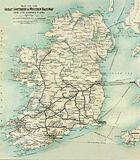
was the driving force behind this and other GS&WR routes (and also for other railways in Ireland not part of the GS&WR). The company's headquarters were Kingsbridge station. At its greatest extent the GS&WR included, in addition to the Dublin – Cork main line, the Dublin – and – Waterford lines and numerous branch lines.
Competition
The GS&WR competed with the Midland Great Western RailwayMidland Great Western Railway
The Midland Great Western Railway was the third largest Irish gauge railway company in Ireland. It was incorporated in 1845 and absorbed into the Great Southern Railway in 1924. It served part of Leinster, County Cavan in Ulster and much of Connaught...
for many years. Both ran services westwards from Dublin: the GS&WR running southwest to , Cork and Waterford, and the MGWR running west to , , , and . The GS&WR also had designs on rail traffic to the west of Ireland. A branch was built from the Dublin – Cork main line to connect with the MGWR Dublin – Galway line at . Many years later Córas Iompair Éireann
CIE
-Organizations:* Cambridge International Examinations, an international examination board* Cleveland Institute of Electronics, a private technical and engineering educational institution — the International Commission on Illumination...
made this GS&WR branch part of its Dublin – Galway main line.
Waterford, Limerick and Western Railway
In 1901 the GS&WR bought the Waterford, Limerick and Western Railway, which gave it both the Waterford - Limerick - Athenry - Claremorris - Collooney cross-country route and the North Kerry line and branches. The WLWR, recently dubbed the Western Rail Corridor, traversed MGWR territory. It did, however, complement the radial MGWR lines from Dublin, enabling Limerick – Galway and Galway – Sligo traffic, and linked intermediate destinations in the west of Ireland. For a very short time the MGWR exercised running powersTrackage rights
Trackage rights , running rights or running powers is an agreement whereby a railway company has the right to run its trains on tracks owned by another railway company....
over the Athenry - Limerick section of this route.
GS&WR hotels
In an effort to encourage tourism the Killarney Junction Railway, which was operated by the GS&WR, opened in 1854 a hotel next to its station in KillarneyKillarney
Killarney is a town in County Kerry, southwestern Ireland. The town is located north of the MacGillicuddy Reeks, on the northeastern shore of the Lough Lein/Leane which are part of Killarney National Park. The town and its surrounding region are home to St...
. In was the first railway-owned hotel in Ireland and one of the first of its kind in the World. In the following years the GS&WR established further hotels in County Kerry
County Kerry
Kerry means the "people of Ciar" which was the name of the pre-Gaelic tribe who lived in part of the present county. The legendary founder of the tribe was Ciar, son of Fergus mac Róich. In Old Irish "Ciar" meant black or dark brown, and the word continues in use in modern Irish as an adjective...
at Caragh Lake
Caragh Lake
Caragh Lake is a large and scenic lake in County Kerry, Ireland.-Ecology:The lake is included within a large Special Area of Conservation, ....
, Kenmare
Kenmare
Kenmare is a small town in the south of County Kerry, Ireland. The name Kenmare is the anglicised form of Ceann Mara meaning "head of the sea", referring to the head of Kenmare Bay.-Location:...
, Waterville
Waterville, County Kerry
Waterville, historically known as Carrean , is a village in County Kerry, Ireland, on the Iveragh peninsula. The town is sited on a narrow isthmus, with Lough Currane on the east side of the town, and Ballinskelligs Bay on the west, and the Currane River connecting the two.The town's name in Irish...
and Parknasilla. The company also owned small hotels at and close to its stations in Dublin and Cork.
In 1925 the hotels became part of Great Southern Hotels, a subsidiary of Great Southern Railways. The Great Southern Hotels Group was dissolved in 2006, when its hotels were sold of separately to private investors.
GS&WR routes today
The GS&WR is perhaps the best remembered of the former independent rail operators in Ireland's railway historyHistory of rail transport in Ireland
The history of rail transport in Ireland began only a decade later than that of Great Britain. By its peak in 1920, Ireland counted 5,500 route kilometers...
, with GS&WR routes remaining some of the most heavily used in Ireland, connecting Dublin to Limerick, Cork, and Waterford. The coats of arms of these cities still adorn the facade of Heuston Station.
Great Southern Railways
In 1924 the GS&WR merged with the Midland Great Western RailwayMidland Great Western Railway
The Midland Great Western Railway was the third largest Irish gauge railway company in Ireland. It was incorporated in 1845 and absorbed into the Great Southern Railway in 1924. It served part of Leinster, County Cavan in Ulster and much of Connaught...
, the Cork, Bandon and South Coast Railway
Cork, Bandon and South Coast Railway
Cork, Bandon and South Coast Railway , was an Irish gauge railway in Ireland. It opened in 1851 as the Cork and Bandon Railway, changed its name to Cork Bandon and South Coast Railway in 1888 and became part of the Great Southern Railway in 1924....
and most other railways wholly within the Irish Free State
Irish Free State
The Irish Free State was the state established as a Dominion on 6 December 1922 under the Anglo-Irish Treaty, signed by the British government and Irish representatives exactly twelve months beforehand...
to form the Great Southern Railway. In 1925 the GSR merged with the Dublin and South Eastern Railway
Dublin and South Eastern Railway
The Dublin and South Eastern Railway was an Irish gauge railway in Ireland from 1846 to 1925.It was incorporated by Act of Parliament in 1846 as the "Waterford, Wexford, Wicklow and Dublin Railway Company". In 1860 it was renamed the "Dublin, Wicklow and Wexford Railway Company" and on 31...
to form the Great Southern Railways. Cross-border railways were excluded from the mergers.
Coras Iompair Éireann
In 1945, further amalgamation with the Grand Canal Co., and the Dublin United Tramway Company brought about the creation of Córas Iompair Éireann ("Irish State Transport Company"). CIÉ was nationalised in 1950, but was divided into separate rail and road companies in 1987. From then until today, the railways are operated by Iarnród EireannIarnród Éireann
Iarnród Éireann is the national railway system operator of Ireland. Established on 2 February 1987, it is a subsidiary of Córas Iompair Éireann . It operates all internal intercity, commuter and freight railway services in the Republic of Ireland, and, jointly with Northern Ireland Railways, the...
("Irish Rail").
See also
- Alexander McDonnell (engineer)Alexander McDonnell (engineer)Alexander McDonnell was an Irish locomotive engineer and civil engineer. He was born in Dublin on 18 December 1829 and died in Holyhead on 14 December 1904. He was educated at Trinity College, Dublin, where he graduated with an Honours degree in Mathematics...
– Locomotive, Carriage and Wagon Superintendent (1864 – 1883) - History of rail transport in IrelandHistory of rail transport in IrelandThe history of rail transport in Ireland began only a decade later than that of Great Britain. By its peak in 1920, Ireland counted 5,500 route kilometers...
- Rail transport in IrelandRail transport in IrelandRail services in Ireland are provided by Iarnród Éireann in the Republic of Ireland and by Northern Ireland Railways in Northern Ireland.Most routes in the Republic radiate from Dublin...
- Iarnród ÉireannIarnród ÉireannIarnród Éireann is the national railway system operator of Ireland. Established on 2 February 1987, it is a subsidiary of Córas Iompair Éireann . It operates all internal intercity, commuter and freight railway services in the Republic of Ireland, and, jointly with Northern Ireland Railways, the...