

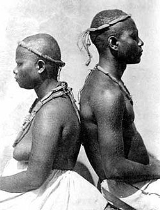
Great Andamanese

Encyclopedia
Great Andamanese is a collective term used to refer to related indigenous peoples
who lived throughout most of the Great Andaman
archipelago
, the main and closely situated group of island
s in the Andaman Islands
. Numbering between 200 and 700, each of the Great Andamanese peoples maintained a distinct language. Their collective identity is based on cultural similarity and of linguistic
analysis; their languages were closely related, and formed one of the two identified families
of indigenous Andamanese languages
, the Great Andamanese family
. Once the most numerous people in the Andaman Islands
, with an estimated population of 10,000 in 1789, as of February 2010 there are only 52.
Onge, Jarawa, Jangil
, Sentinelese, and the Shompen of Great Nicobar Island to the south, are thought to be the original inhabitants of the islands, having emigrated from the mainland tens of thousands of years ago.
established a permanent settlement and penal colony
on Great Andaman in the 1860s, there were perhaps 5000 Great Andamanese. The government made proactive attempts to pacify and coopt the tribes, recruiting them to capture escaped convicts. Populations went into sharp decline as contact intensified. They were rapidly introduced to the outside world and quickly moved from a stone-age existence to exposure to the industrial era. The migration of mainland settlers to the islands accelerated this decline. By 1901, 600 were left, and by 1927, 20 years prior to Indian independence, only 100 survived. At independence, that had shrunk to about 25. After dipping to 19 in 1961, their numbers rebounded somewhat to about 50 today, still far too small for a self-sustaining society. They currently live on Strait island
, and the cultural and linguistic identities of the individual groups have largely been lost.
The population of Great Andamanese stood at 52 individuals in January 2010 following the death of Boa Sr, the oldest living Great Andamanese elder and last known with some knowledge of the Aka-Bo language
.
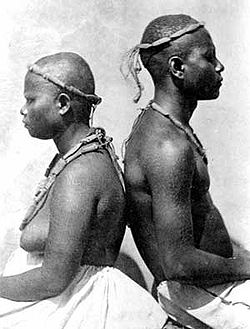 The Great Andamanese peoples are collectively distinguished from other indigenous Andamanese groups by culture, geography and language. The peoples that originally lived in the southern part of Great Andaman, some areas of South Andaman Island
, Rutland Island
, and Little Andaman Island speak languages which are classified in a separate language family, Ongan
.
The ten Great Andamanese groups were generally distributed in distinct territories running along the narrow geography of Great Andaman, which runs in a north–south line for some 350 km but is only some 50 km wide at its widest extent. This peculiar geography meant that groups typically had at most three neighbours. Arranged roughly from north to south, the different Great Andamanese peoples were:
Indigenous peoples
Indigenous peoples are ethnic groups that are defined as indigenous according to one of the various definitions of the term, there is no universally accepted definition but most of which carry connotations of being the "original inhabitants" of a territory....
who lived throughout most of the Great Andaman
Great Andaman
Great Andaman is the main archipelago of the Andaman Islands of India. It comprises five major islands. From north to south, these are North Andaman, Middle Andaman, South Andaman, Baratang and Rutland Island...
archipelago
Archipelago
An archipelago , sometimes called an island group, is a chain or cluster of islands. The word archipelago is derived from the Greek ἄρχι- – arkhi- and πέλαγος – pélagos through the Italian arcipelago...
, the main and closely situated group of island
Island
An island or isle is any piece of sub-continental land that is surrounded by water. Very small islands such as emergent land features on atolls can be called islets, cays or keys. An island in a river or lake may be called an eyot , or holm...
s in the Andaman Islands
Andaman Islands
The Andaman Islands are a group of Indian Ocean archipelagic islands in the Bay of Bengal between India to the west, and Burma , to the north and east...
. Numbering between 200 and 700, each of the Great Andamanese peoples maintained a distinct language. Their collective identity is based on cultural similarity and of linguistic
Linguistics
Linguistics is the scientific study of human language. Linguistics can be broadly broken into three categories or subfields of study: language form, language meaning, and language in context....
analysis; their languages were closely related, and formed one of the two identified families
Language family
A language family is a group of languages related through descent from a common ancestor, called the proto-language of that family. The term 'family' comes from the tree model of language origination in historical linguistics, which makes use of a metaphor comparing languages to people in a...
of indigenous Andamanese languages
Andamanese languages
The Andamanese languages form a proposed language family spoken by the Andamanese peoples, a group of Negritos who live in the Andaman Islands, a union territory of India. Its validity is disputed...
, the Great Andamanese family
Great Andamanese languages
The Great Andamanese languages are a nearly extinct language family spoken by the Great Andamanese peoples of the Andaman Islands, a union territory of India.- History :...
. Once the most numerous people in the Andaman Islands
Andaman Islands
The Andaman Islands are a group of Indian Ocean archipelagic islands in the Bay of Bengal between India to the west, and Burma , to the north and east...
, with an estimated population of 10,000 in 1789, as of February 2010 there are only 52.
Origin
The Great Andamanese, along with the NegritoNegrito
The Negrito are a class of several ethnic groups who inhabit isolated parts of Southeast Asia.Their current populations include 12 Andamanese peoples of the Andaman Islands, six Semang peoples of Malaysia, the Mani of Thailand, and the Aeta, Agta, Ati, and 30 other peoples of the Philippines....
Onge, Jarawa, Jangil
Jangil
The Jangil were one of the Andamanese indigenous peoples of the Andaman Islands, located in the Bay of Bengal. They were formerly distributed through the interior of Rutland Island, and were given the name Rutland Jarawa because it was supposed that they were related to the neighbouring Jarawa...
, Sentinelese, and the Shompen of Great Nicobar Island to the south, are thought to be the original inhabitants of the islands, having emigrated from the mainland tens of thousands of years ago.
Population decimation
When the BritishBritish Raj
British Raj was the British rule in the Indian subcontinent between 1858 and 1947; The term can also refer to the period of dominion...
established a permanent settlement and penal colony
Penal colony
A penal colony is a settlement used to exile prisoners and separate them from the general populace by placing them in a remote location, often an island or distant colonial territory...
on Great Andaman in the 1860s, there were perhaps 5000 Great Andamanese. The government made proactive attempts to pacify and coopt the tribes, recruiting them to capture escaped convicts. Populations went into sharp decline as contact intensified. They were rapidly introduced to the outside world and quickly moved from a stone-age existence to exposure to the industrial era. The migration of mainland settlers to the islands accelerated this decline. By 1901, 600 were left, and by 1927, 20 years prior to Indian independence, only 100 survived. At independence, that had shrunk to about 25. After dipping to 19 in 1961, their numbers rebounded somewhat to about 50 today, still far too small for a self-sustaining society. They currently live on Strait island
Strait Island
Strait Island is a tribal reservation in a Union territory of India.-Description:Strait Island is a small island of 6.01 km² located 5.5 km east of Baratang Island, Great Andaman, in the Diligent Strait that separates Great Andaman from Ritchie's Archipelago. The population as of the 2001...
, and the cultural and linguistic identities of the individual groups have largely been lost.
The population of Great Andamanese stood at 52 individuals in January 2010 following the death of Boa Sr, the oldest living Great Andamanese elder and last known with some knowledge of the Aka-Bo language
Aka-Bo language
The Bo language, Aka-Bo , is an extinct Great Andamanese language, of the Northern group. It was spoken on the west central coast of North Andaman and on North Reef Island of the Andaman Islands in India...
.
Ethnic divisions
South Andaman Island
South Andaman Island is the southernmost island of the Great Andaman and is home to the majority of the population of the Andaman Islands. Port Blair, the capital of the islands, is located on the southern part of this island. Some areas of the island are restricted areas for non-Indians; however,...
, Rutland Island
Rutland Island
Rutland Island is an island located across the Macpherson Strait from South Andaman Island. As one of the Andaman Islands, Rutland I forms the southernmost main island of the closely situated Great Andaman archipelago. It is separated from Little Andaman by the Duncan Passage. The island spans an...
, and Little Andaman Island speak languages which are classified in a separate language family, Ongan
Ongan languages
Ongan, or South Andamanese, is a small family of two languages, Önge and Jarawa, spoken in the southern Andaman Islands:*Ongan**Önge or Onge; 96 speakers in 1997, mostly monolingual...
.
The ten Great Andamanese groups were generally distributed in distinct territories running along the narrow geography of Great Andaman, which runs in a north–south line for some 350 km but is only some 50 km wide at its widest extent. This peculiar geography meant that groups typically had at most three neighbours. Arranged roughly from north to south, the different Great Andamanese peoples were:
- Cari people
- Kora people
- Bo people
- Jeru people
- Kede people
- Kol people
- Juwoi people
- Pucikwar people
- Bale people
- Bea people