
All Topics  
Gluconeogenesis


   Email Print
   Bookmark   Link


Gluconeogenesis


Gluconeogenesis (abreviated GNG) is a metabolic pathway
Metabolic pathway

In biochemistry, a metabolic pathway is a series of chemistry reactions occurring within a cell . In each pathway, a principal chemical is modified by chemical reactions....
 that results in the generation of glucose
Glucose

Glucose , a monosaccharide also known as grape sugar, blood sugar, or corn sugar, is a very important carbohydrate in biology....
 from non-carbohydrate
Carbohydrate

Carbohydrates or saccharides are the most abundant of the four major classes of biomolecules. They fill numerous roles in living things, such as the storage and transport of energy and structural components ....
 carbon substrates such as lactate
Lactic acid

Lactic acid , also known as milk acid, is a chemical compound that plays a role in several biochemistry processes. It was first isolated in 1780 by a Swedish chemist, Carl Wilhelm Scheele, and is a carboxylic acid with a chemical formula of C3H6O3....
, glycerol
Glycerol

Glycerol is a chemical compound also commonly called glycerin or glycerine. It is a colorless, odorless, Viscosity liquid that is widely used in pharmaceutical formulations....
, and glucogenic amino acid
Glucogenic amino acid

A glucogenic amino acid is an amino acid that can be converted into glucose through gluconeogenesis. This is in contrast to the ketogenic amino acids that are converted into ketone bodies....
s.

The vast majority of gluconeogenesis takes place in the liver
Liver

The liver is a vital organ present in vertebrates and some other animals; it has a wide range of functions, a few of which are detoxification, protein synthesis, and production of biochemicals necessary for digestion....
 and, to a smaller extent, in the cortex of kidney
Kidney

The kidneys are Organ that have numerous biological roles. Their primary role is to maintain the homeostasis balance of bodily fluids by filtering and secreting Metabolomics#Metabolitess and minerals from the blood and excreting them, along with water , as urine....
s. This process occurs during periods of fasting
Fasting

Fasting is primarily the act of willingly abstaining from some or all food, drink, or both, for a period of time. A fast may be total or partial concerning that from which one fasts, and may be prolonged or intermittent as to the period of fasting....
, starvation
Starvation

Starvation is a severe reduction in vitamin, nutrient, and energy intake, and is the most extreme form of malnutrition. In humans, prolonged starvation causes permanent organ damage and, eventually, death....
, or intense exercise and is highly endergonic
Endergonic

Endergonic means absorbing energy in the form of work. Its etymology stems from the suffix -ergonic, as derived from the Greek root ergon, meaning work , combined with the prefix end-, as derived from the Greek root en, meaning put into....
. Gluconeogenesis is often associated with ketosis
Ketosis

Ketosis is a state characterised by elevated levels of ketone bodies in the blood, occurring when the liver converts triacylglycerol into fatty acids and ketone bodies ....
. Gluconeogenesis is also a target of therapy for type II diabetes, such as metformin
Metformin

Metformin is an oral anti-diabetic drug from the biguanide class. It is the first-line treatment drug for the treatment of diabetes mellitus type 2, particularly in overweight and obesity people and those with normal kidney function, and evidence suggests it may be the best choice for people with heart failure....
, which inhibit glucose formation and stimulate glucose uptake by cells.

ral non-carbohydrate carbon
Carbon

Carbon is a chemical element with chemical symbol C and atomic number 6. As a member of group 14 on the periodic table, it is nonmetallic and tetravalence?making four electrons available to form covalent bond chemical bonds....
 substrates
Substrate (biochemistry)

In biochemistry, a substrate is a molecule upon which an enzyme acts. Enzymes catalysis chemical reactions involving the substrate. The substrate binds with the enzyme active site, and an enzyme-substrate complex is formed....
 can enter the gluconeogenesis pathway
Metabolic pathway

In biochemistry, a metabolic pathway is a series of chemistry reactions occurring within a cell . In each pathway, a principal chemical is modified by chemical reactions....
.


Discussion
Ask a question about 'Gluconeogenesis'
Start a new discussion about 'Gluconeogenesis'
Answer questions from other users
Full Discussion Forum


Recent Posts


Encyclopedia


Gluconeogenesis (abreviated GNG) is a metabolic pathway
Metabolic pathway

In biochemistry, a metabolic pathway is a series of chemistry reactions occurring within a cell . In each pathway, a principal chemical is modified by chemical reactions....
 that results in the generation of glucose
Glucose

Glucose , a monosaccharide also known as grape sugar, blood sugar, or corn sugar, is a very important carbohydrate in biology....
 from non-carbohydrate
Carbohydrate

Carbohydrates or saccharides are the most abundant of the four major classes of biomolecules. They fill numerous roles in living things, such as the storage and transport of energy and structural components ....
 carbon substrates such as lactate
Lactic acid

Lactic acid , also known as milk acid, is a chemical compound that plays a role in several biochemistry processes. It was first isolated in 1780 by a Swedish chemist, Carl Wilhelm Scheele, and is a carboxylic acid with a chemical formula of C3H6O3....
, glycerol
Glycerol

Glycerol is a chemical compound also commonly called glycerin or glycerine. It is a colorless, odorless, Viscosity liquid that is widely used in pharmaceutical formulations....
, and glucogenic amino acid
Glucogenic amino acid

A glucogenic amino acid is an amino acid that can be converted into glucose through gluconeogenesis. This is in contrast to the ketogenic amino acids that are converted into ketone bodies....
s.

The vast majority of gluconeogenesis takes place in the liver
Liver

The liver is a vital organ present in vertebrates and some other animals; it has a wide range of functions, a few of which are detoxification, protein synthesis, and production of biochemicals necessary for digestion....
 and, to a smaller extent, in the cortex of kidney
Kidney

The kidneys are Organ that have numerous biological roles. Their primary role is to maintain the homeostasis balance of bodily fluids by filtering and secreting Metabolomics#Metabolitess and minerals from the blood and excreting them, along with water , as urine....
s. This process occurs during periods of fasting
Fasting

Fasting is primarily the act of willingly abstaining from some or all food, drink, or both, for a period of time. A fast may be total or partial concerning that from which one fasts, and may be prolonged or intermittent as to the period of fasting....
, starvation
Starvation

Starvation is a severe reduction in vitamin, nutrient, and energy intake, and is the most extreme form of malnutrition. In humans, prolonged starvation causes permanent organ damage and, eventually, death....
, or intense exercise and is highly endergonic
Endergonic

Endergonic means absorbing energy in the form of work. Its etymology stems from the suffix -ergonic, as derived from the Greek root ergon, meaning work , combined with the prefix end-, as derived from the Greek root en, meaning put into....
. Gluconeogenesis is often associated with ketosis
Ketosis

Ketosis is a state characterised by elevated levels of ketone bodies in the blood, occurring when the liver converts triacylglycerol into fatty acids and ketone bodies ....
. Gluconeogenesis is also a target of therapy for type II diabetes, such as metformin
Metformin

Metformin is an oral anti-diabetic drug from the biguanide class. It is the first-line treatment drug for the treatment of diabetes mellitus type 2, particularly in overweight and obesity people and those with normal kidney function, and evidence suggests it may be the best choice for people with heart failure....
, which inhibit glucose formation and stimulate glucose uptake by cells.

Entering the pathway

Several non-carbohydrate carbon
Carbon

Carbon is a chemical element with chemical symbol C and atomic number 6. As a member of group 14 on the periodic table, it is nonmetallic and tetravalence?making four electrons available to form covalent bond chemical bonds....
 substrates
Substrate (biochemistry)

In biochemistry, a substrate is a molecule upon which an enzyme acts. Enzymes catalysis chemical reactions involving the substrate. The substrate binds with the enzyme active site, and an enzyme-substrate complex is formed....
 can enter the gluconeogenesis pathway
Metabolic pathway

In biochemistry, a metabolic pathway is a series of chemistry reactions occurring within a cell . In each pathway, a principal chemical is modified by chemical reactions....
. One common substrate is lactic acid
Lactic acid

Lactic acid , also known as milk acid, is a chemical compound that plays a role in several biochemistry processes. It was first isolated in 1780 by a Swedish chemist, Carl Wilhelm Scheele, and is a carboxylic acid with a chemical formula of C3H6O3....
, formed during anaerobic respiration
Anaerobic respiration

Anaerobic respiration is the process of generating energy through cellular respiration , without the use of oxygen....
 in skeletal muscle. Lactate may also come from red blood cells, which obtain energy solely from glycolysis
Glycolysis

Glycolysis is the metabolic pathway that converts glucose, C6H12O6, into pyruvate, C3H5O3-....
 as they have no membrane-bound organelles for aerobic respiration. Lactate is transported back to the liver where it is converted into pyruvate by the Cori cycle
Cori cycle

The Cori cycle, named after its discoverers, Carl Cori and Gerty Cori, refers to the metabolic pathway in which lactic acid produced by anaerobic glycolysis in the muscles moves to the liver and is converted to glucose, which then returns to the muscles and is converted back to lactate....
 using the enzyme lactate dehydrogenase
Lactate dehydrogenase

Lactate dehydrogenase is an enzyme present in a wide variety of organisms, including plants and animals....
. Pyruvate, the first designated substrate of the gluconeogenic pathway, can then be used to generate glucose. All citric acid cycle
Citric acid cycle

The citric acid cycle ? also known as the tricarboxylic acid cycle ; the Krebs cycle; or, more rarely, the Szent-Gy?rgyi-Krebs cycle) ? is a series of enzyme-catalysed chemical reactions of central importance in all living cell s that use oxygen as part of cellular respiration....
 intermediates, through conversion to oxaloacetate, amino acids other than lysine
Lysine

Lysine is an a-amino acid with the chemical formula HO2CCH4NH2. This amino acid is an essential amino acid, which means that humans cannot synthesize it....
 or leucine
Leucine

Leucine is an a-amino acid with the chemical formula HO2CCHCH2CH2. It is an essential amino acid, which means that humans cannot synthesise it....
, and glycerol can also function as substrates for gluconeogenesis. Amino acids must have their amino group removed by transamination
Transamination

There are two chemical reactions known as transamination . The first is the reaction between an amino acid and an alpha-keto acid. The amino group is transferred from the former to the latter; this results in the amino acid being converted to the corresponding a-keto acid, while the reactant a-keto acid is converted to the corresponding amin...
 or deamination
Deamination

Deamination is the removal of an amine group from a molecule.In the human body, deamination takes place in the liver. Deamination is the process by which amino acids are broken down when too much protein has been taken in....
 before entering the cycle directly (as pyruvate or oxaloacetate), or indirectly via the citric acid cycle. The brain and liver can absolutely take the glucose uptake regardless of Insulin or Gluconeogenesis.

Fatty acid
Fatty acid

In chemistry, especially biochemistry, a fatty acid is a carboxylic acid often with a long unbranched aliphatic tail , which is either saturation or Unsaturated compound....
s cannot be converted into glucose in animals, the exception being odd-chain fatty acid
Fatty acid

In chemistry, especially biochemistry, a fatty acid is a carboxylic acid often with a long unbranched aliphatic tail , which is either saturation or Unsaturated compound....
s which yield propionyl CoA, a precursor for succinyl CoA. In plants, specifically in seedlings, the glyoxylate cycle
Glyoxylate cycle

The glyoxylate cycle is a metabolic pathway occurring in plants, and several microorganisms, such as E. coli and yeast. Recent research shows that it is in vertebrates and insects ...
 can be used to convert fatty acids (acetate
Acetate

An acetate, or ethanoate, is either a salt or ester of acetic acid.In chemistry, the abbreviation Ac refers to the acetyl group. The anion and the functional group may be written as -OAc and AcO-, or OAc respectively....
) into the primary carbon source of the organism. The glyoxylate cycle produces four-carbon dicarboxylic acids that can enter gluconeogenesis. Glycerol
Glycerol

Glycerol is a chemical compound also commonly called glycerin or glycerine. It is a colorless, odorless, Viscosity liquid that is widely used in pharmaceutical formulations....
, which is a part of all triacylglycerols, can also be used in gluconeogenesis. In organisms in which glycerol is derived from glucose (e.g., humans and other mammals), glycerol is sometimes not considered a true gluconeogenic substrate, as it cannot be used to generate new glucose.

Pathway

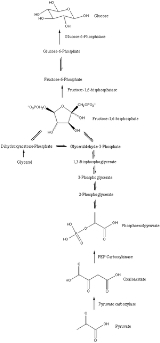
Gluconeogenesis is a pathway consisting of eleven enzyme-catalyzed reactions. The pathway can begin in the mitochondria or cytoplasm, depending on the substrate being used. Many of the reactions are reversible steps found in glycolysis.
  • Gluconeogenesis begins in the mitochondria with the formation of oxaloacetate through carboxylation of pyruvate at the expense of one molecule of ATP
    Adenosine triphosphate

    This article is about the chemical used by cells as an energy carrier. For other uses, see ATP .Adenosine-5'-triphosphate is a multifunctional nucleotide, and plays an important role in cell biology as a coenzyme that is the "molecule unit of currency" of intracellular energy transfer....
    . This reaction is catalyzed by pyruvate carboxylase
    Pyruvate carboxylase

    Pyruvate carboxylase is an enzyme of the ligase class that catalyzes the irreversible carboxylation of pyruvate to form oxaloacetate .It is an important Anaplerotic reactions that provides oxaloacetate precursor for the citric acid cycle....
    , which is stimulated by high levels of acetyl-CoA
    Acetyl-CoA

    Acetyl-CoA is an important molecule in metabolism, used in many biochemical reactions. Its main use is to convey the carbon atoms within the acetyl group to the citric acid cycle to be oxidation for energy production....
     (when fatty acid oxidation is high in the liver) and inhibited by high levels of ADP.
  • Oxaloacetate must then be reduced
    Redox

    Redox describes all chemical reactions in which atoms have their oxidation number changed.This can be either a simple redox process such as the oxidation of carbon to yield carbon dioxide or the reduction of carbon by hydrogen to yield methane , or it can be a complex process such as the oxidation of sugar in the human body through a ser...
     into malate
    using NADH
    Nicotinamide adenine dinucleotide

    Nicotinamide adenine dinucleotide, abbreviated NAD+, is a coenzyme found in all living cell s. The compound is a dinucleotide, since it consists of two nucleotides joined through their phosphate groups: with one nucleotide containing an adenine base, and the other containing nicotinamide....
     in order to be transported out of the mitochondria.
  • In the cytoplasm, malate is oxidized
    Redox

    Redox describes all chemical reactions in which atoms have their oxidation number changed.This can be either a simple redox process such as the oxidation of carbon to yield carbon dioxide or the reduction of carbon by hydrogen to yield methane , or it can be a complex process such as the oxidation of sugar in the human body through a ser...
     to oxaloacetate
    using NAD+
    Nicotinamide adenine dinucleotide

    Nicotinamide adenine dinucleotide, abbreviated NAD+, is a coenzyme found in all living cell s. The compound is a dinucleotide, since it consists of two nucleotides joined through their phosphate groups: with one nucleotide containing an adenine base, and the other containing nicotinamide....
    , where the remaining steps of gluconeogenesis occur.
  • Oxaloacetate is then decarboxylated and phosphorylated to produce phosphoenolpyruvate
    Phosphoenolpyruvate

    Phosphoenolpyruvic acid , or phosphoenolpyruvate as the anion, is an important chemical compound in biochemistry. It has the high-energy phosphate bond found in living organisms, and is involved in glycolysis and gluconeogenesis....
     by phosphoenolpyruvate carboxykinase
    Phosphoenolpyruvate carboxykinase

    Phosphoenolpyruvate carboxykinase is an enzyme used in the natural process of gluconeogenesis. It converts oxaloacetate into phosphoenolpyruvate and carbon dioxide....
    . One molecule of GTP
    Guanosine triphosphate

    Guanosine-5'-triphosphate is a purine nucleotide. One role is as substrate for the synthesis of RNA during transcription . Its structure is similar to that of the guanine nucleoside, the only difference being that there are three phosphate groups attached to the 5' carbon....
     is hydrolyzed to GDP
    Guanosine diphosphate

    Guanosine diphosphate, abbreviated GDP, is a nucleotide. It is an ester of pyrophosphoric acid with the nucleoside guanosine. GDP consists of the pyrophosphate Functional group, the pentose sugar ribose, and the nucleobase guanine....
     in the course of this reaction.
  • The next steps in the reaction are the same as reversed glycolysis
    Glycolysis

    Glycolysis is the metabolic pathway that converts glucose, C6H12O6, into pyruvate, C3H5O3-....
    . However, fructose-1,6-bisphosphatase converts fructose-1,6-bisphosphate to fructose 6-phosphate
    Fructose 6-phosphate

    Fructose 6-phosphate is fructose sugar phosphorylated on carbon 6 . The ?-D-form of this compound is very common in cell . The vast majority of glucose and fructose entering a cell will become converted to this at some point....
    . The purpose of this reaction is to overcome the large negative ?G.
  • Glucose-6-phosphate
    Glucose-6-phosphate

    Glucose 6-phosphate is glucose sugar phosphorylated on carbon 6. This compound is very common in cell as the vast majority of glucose entering a cell will become phosphorylated in this way....
     is formed from fructose 6-phosphate
    Fructose 6-phosphate

    Fructose 6-phosphate is fructose sugar phosphorylated on carbon 6 . The ?-D-form of this compound is very common in cell . The vast majority of glucose and fructose entering a cell will become converted to this at some point....
     by phosphoglucoisomerase. Glucose-6-phosphate can then be used in other metabolic pathways or dephosphorylated to free glucose. Whereas free glucose can easily diffuse in and out of the cell, the phosphorylated form (glucose-6-phosphate) is "locked" in the cell. The cell uses this mechanism as a way to control intracellular glucose levels.
  • The final reaction of gluconeogenesis, the formation of glucose, is carried out in the lumen
    Lumen (anatomy)

    A lumen in biology is the inside space of a tubular structure, such as an artery or intestine. By extension, a lumen can also be the inside space of a cellular component or structure, such as the endoplasmic reticulum....
     of the endoplasmic reticulum
    Endoplasmic reticulum

    The endoplasmic reticulum is a eukaryote organelle that forms an interconnected network of tubules, vesicle , and cisternae within cell . The lacey membranes of the endoplasmic reticulum were first seen by Keith R....
    . Glucose-6-phosphate is hydrolyzed by glucose-6-phosphatase to produce glucose. Glucose is then shuttled into the cytosol by glucose transporters located in the membrane of the endoplasmic reticulum.


Regulation

While most steps in gluconeogenesis are the reverse of those found in glycolysis
Glycolysis

Glycolysis is the metabolic pathway that converts glucose, C6H12O6, into pyruvate, C3H5O3-....
, three regulated and strongly exergonic reactions are replaced with more kinetically favorable reactions. Hexokinase/glucokinase, phosphofructokinase, and pyruvate kinase enzymes of glycolysis are replaced with glucose-6-phosphatase, fructose-1,6-bisphosphatase, and PEP carboxykinase. This system of reciprocal control allow glycolysis and gluconeogenesis to inhibit each other and prevent the formation of a futile cycle
Futile cycle

A futile cycle occurs when two metabolic pathways run simultaneously in opposite directions and have no overall effect other than to dissipation energy in the form of heat....
.

The majority of the enzymes responsible for gluconeogenesis are found in the cytoplasm
Cytoplasm

The cytoplasm is the part of a Cell that is enclosed within the plasma membrane. In eukaryote cells the cytoplasm contains organelles, such as mitochondrion, that are filled with liquid kept separate from the rest of the cytoplasm by biological membranes....
; the exceptions are mitochondrial pyruvate carboxylase
Pyruvate carboxylase

Pyruvate carboxylase is an enzyme of the ligase class that catalyzes the irreversible carboxylation of pyruvate to form oxaloacetate .It is an important Anaplerotic reactions that provides oxaloacetate precursor for the citric acid cycle....
, and, in animals, phosphoenolpyruvate carboxykinase
Phosphoenolpyruvate carboxykinase

Phosphoenolpyruvate carboxykinase is an enzyme used in the natural process of gluconeogenesis. It converts oxaloacetate into phosphoenolpyruvate and carbon dioxide....
. The latter exists as an isozyme located in both the mitochondrion
Mitochondrion

In cell biology, a mitochondrion is a membrane-enclosed organelle found in most eukaryote cell . These organelles range from 0.5–10 micrometers in diameter....
 and the cytosol
Cytosol

The cytosol or intracellular fluid is the liquid found inside cell . In eukaryotes this liquid is separated by cell membranes from the contents of the organelles suspended in the cytosol, such as the mitochondrial matrix inside the mitochondrion....
. As there is no known mechanism to transport phosphoenolpyruvate
Phosphoenolpyruvate

Phosphoenolpyruvic acid , or phosphoenolpyruvate as the anion, is an important chemical compound in biochemistry. It has the high-energy phosphate bond found in living organisms, and is involved in glycolysis and gluconeogenesis....
 from the mitochondrion
Mitochondrion

In cell biology, a mitochondrion is a membrane-enclosed organelle found in most eukaryote cell . These organelles range from 0.5–10 micrometers in diameter....
 into the cytosol, the cytosolic enzyme is believed to be the isozyme important for gluconeogenesis. The rate of gluconeogenesis is ultimately controlled by the action of a key enzyme, fructose-1,6-bisphosphatase, which is also regulated through signal tranduction by cAMP
CAMP

CAMP may stand for:* Cyclic adenosine monophosphate * Cathelicidin* Campaign Against Marijuana Planting* Central Atlantic Magmatic Province...
 and its phosphorylation.

Most factors that regulate the activity of the gluconeogenesis pathway do so by inhibiting the activity or expression of key enzymes. However, both acetyl CoA and citrate
Citrate

A citrate can refer either to the conjugate base of citric acid, , or to the esters of citric acid. An example of the former, a salt is trisodium citrate; an ester is triethyl citrate....
 activate gluconeogenesis enzymes (pyruvate carboxylase and fructose-1,6-bisphosphatase, respectively). Due to the reciprocal control of the cycle, acetyl-CoA and citrate also have inhibitory roles in the activity of pyruvate kinase
Pyruvate kinase

Pyruvate kinase is an enzyme involved in glycolysis. It catalyst the transfer of a phosphate group from phosphoenolpyruvate to adenosine diphosphate, yielding one molecule of pyruvate and one molecule of adenosine triphosphate....
.

External links