All Topics  
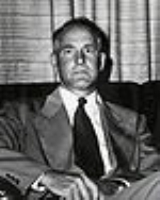
George Wells Beadle

 
George Wells Beadle

   Email Print
   Bookmark   Link


George Wells Beadle


George Wells Beadle (October 22, 1903 – June 9, 1989) was an American
United States

The United States of America is a Federal government constitutional republic comprising U.S. state and a federal district. The country is situated mostly in central North America, where its Contiguous United States and Washington, D.C., the Capital districts and territories, lie between the Pacific Ocean and Atlantic Oceans, Borders of the U...
 scientist
Scientist

A scientist, in the broadest sense, refers to any person that engages in a system activity to acquire knowledge or an individual that engages in such practices and traditions that are linked to schools of thought or philosophy....
 in the field of genetics
Genetics

Genetics , a discipline of biology, is the science of heredity and Genetic variation in living organisms. The fact that living things inherit traits from their parents has been used since prehistoric times to improve crop plants and animals through selective breeding....
, and Nobel Prize in Physiology or Medicine
Nobel Prize in Physiology or Medicine

The Nobel Prize in Physiology or Medicine is awarded once a year by the Swedish Karolinska Institutet. It is one of the five Nobel Prizes established by the will of Alfred Nobel in 1895, awarded for outstanding contributions in Nobel Prize in Physics, Nobel Prize in Chemistry, Nobel Prize in Literature, Nobel Peace Prize, and Physiology or Medic...
 Nobel laureate who with Edward Lawrie Tatum
Edward Lawrie Tatum

Edward Lawrie Tatum was an United States of America genetics. He shared half of the Nobel Prize in Physiology or Medicine in 1958 with George Wells Beadle for showing that genes control individual steps in metabolism....
 discovered the role of gene
Gene

A gene is the basic unit of heredity in a living organism. All living things depend on genes. Genes hold the information to build and maintain their cell and pass genetic trait to offspring....
s in regulating biochemical events within cells.

Beadle and Tatum's key experiments involved exposing the bread mold
Mold

Molds include all species of microscopic fungi that grow in the form of Multicellular organism filaments, called hyphae. In contrast, microscopic fungi that grow as single cells are called yeasts....
 Neurospora crassa
Neurospora crassa

Neurospora crassa is a type of red bread mold of the phylum Ascomycota. The genus name, meaning "nerve spore" refers to the characteristic striations on the spores....
 to x-ray
X-ray

X-radiation is a form of electromagnetic radiation. X-rays have a wavelength in the range of 10 to 0.01 nanometers, corresponding to frequency in the range 30 Hertz to 30 Hertz and energies in the range 120 Electron volt to 120 keV....
s, causing mutation
Mutation

In biology, mutations are changes to the nucleotide sequence of the genetic material of an organism. Mutations can be caused by copying errors in the genetic material during cell division, by exposure to ultraviolet or ionizing radiation, chemical mutagens, or virus , or can be induced by the organism, itself, by cellular processes such as s...
s. In a series of experiments, they showed that these mutations caused changes in specific enzyme
Enzyme

Enzymes are biomolecules that catalysis chemical reactions. Almost all enzymes are proteins. In enzymatic reactions, the molecules at the beginning of the process are called Substrate , and the enzyme converts them into different molecules, the products....
s involved in metabolic pathway
Metabolic pathway

In biochemistry, a metabolic pathway is a series of chemistry reactions occurring within a cell . In each pathway, a principal chemical is modified by chemical reactions....
s.


Discussion
Ask a question about 'George Wells Beadle'
Start a new discussion about 'George Wells Beadle'
Answer questions from other users
Full Discussion Forum


Encyclopedia


George Wells Beadle (October 22, 1903 – June 9, 1989) was an American
United States

The United States of America is a Federal government constitutional republic comprising U.S. state and a federal district. The country is situated mostly in central North America, where its Contiguous United States and Washington, D.C., the Capital districts and territories, lie between the Pacific Ocean and Atlantic Oceans, Borders of the U...
 scientist
Scientist

A scientist, in the broadest sense, refers to any person that engages in a system activity to acquire knowledge or an individual that engages in such practices and traditions that are linked to schools of thought or philosophy....
 in the field of genetics
Genetics

Genetics , a discipline of biology, is the science of heredity and Genetic variation in living organisms. The fact that living things inherit traits from their parents has been used since prehistoric times to improve crop plants and animals through selective breeding....
, and Nobel Prize in Physiology or Medicine
Nobel Prize in Physiology or Medicine

The Nobel Prize in Physiology or Medicine is awarded once a year by the Swedish Karolinska Institutet. It is one of the five Nobel Prizes established by the will of Alfred Nobel in 1895, awarded for outstanding contributions in Nobel Prize in Physics, Nobel Prize in Chemistry, Nobel Prize in Literature, Nobel Peace Prize, and Physiology or Medic...
 Nobel laureate who with Edward Lawrie Tatum
Edward Lawrie Tatum

Edward Lawrie Tatum was an United States of America genetics. He shared half of the Nobel Prize in Physiology or Medicine in 1958 with George Wells Beadle for showing that genes control individual steps in metabolism....
 discovered the role of gene
Gene

A gene is the basic unit of heredity in a living organism. All living things depend on genes. Genes hold the information to build and maintain their cell and pass genetic trait to offspring....
s in regulating biochemical events within cells.

Beadle and Tatum's key experiments involved exposing the bread mold
Mold

Molds include all species of microscopic fungi that grow in the form of Multicellular organism filaments, called hyphae. In contrast, microscopic fungi that grow as single cells are called yeasts....
 Neurospora crassa
Neurospora crassa

Neurospora crassa is a type of red bread mold of the phylum Ascomycota. The genus name, meaning "nerve spore" refers to the characteristic striations on the spores....
 to x-ray
X-ray

X-radiation is a form of electromagnetic radiation. X-rays have a wavelength in the range of 10 to 0.01 nanometers, corresponding to frequency in the range 30 Hertz to 30 Hertz and energies in the range 120 Electron volt to 120 keV....
s, causing mutation
Mutation

In biology, mutations are changes to the nucleotide sequence of the genetic material of an organism. Mutations can be caused by copying errors in the genetic material during cell division, by exposure to ultraviolet or ionizing radiation, chemical mutagens, or virus , or can be induced by the organism, itself, by cellular processes such as s...
s. In a series of experiments, they showed that these mutations caused changes in specific enzyme
Enzyme

Enzymes are biomolecules that catalysis chemical reactions. Almost all enzymes are proteins. In enzymatic reactions, the molecules at the beginning of the process are called Substrate , and the enzyme converts them into different molecules, the products....
s involved in metabolic pathway
Metabolic pathway

In biochemistry, a metabolic pathway is a series of chemistry reactions occurring within a cell . In each pathway, a principal chemical is modified by chemical reactions....
s. These experiments led them to propose a direct link between genes and enzymatic reactions, known as the "one gene, one enzyme" hypothesis.

Biography

Beadle was born in Wahoo, Nebraska
Wahoo, Nebraska

Wahoo is a city in Saunders County, Nebraska, Nebraska, United States. The population was 3,942 at the United States Census, 2000. It is the county seat of Saunders County, Nebraska....
. He received his Bachelor of Science degree in agronomy
Agronomy

Agronomy is the science and technology of using plants for food, fuel, feed, and fiber. Agronomy encompasses work in the areas of plant genetics, plant physiology, meteorology, and soil science....
 from the University of Nebraska's College of Agriculture in 1926 where he was a member of FarmHouse
FarmHouse

FarmHouse Fraternity International, Inc. is an all-male international social fraternities and sororities founded at the University of Missouri?Columbia on April 15th, 1905....
 fraternity. At the recommendation of his advisor, Franklin D. Keim, he then entered graduate school in agronomy at Cornell University
Cornell University

Cornell University located in Ithaca, New York, USA, is a private university with four Statutory college. Its two medical campuses are in New York City and Education City, Qatar....
, intending to study ecology. He soon switched his focus to genetics and cytology
Cytology

Cytology means "the study of cell s".Cytology is that branch of life science, which deals with the study of cells in terms of structure, function and chemistry....
, pursuing research on maize
Maize

Maize , known as corn in some countries, is a cereal domesticated in Mesoamerica and subsequently spread throughout the American continents....
 (corn) genetics under Rollins Adams Emerson—including some collaboration with Barbara McClintock
Barbara McClintock

Barbara McClintock , the 1983 Nobel Laureate in Nobel Prize in Physiology or Medicine, was an American scientist and one of the world's most distinguished cytogenetics....
. He received his Ph.D.
Doctor of Philosophy

Doctor of Philosophy, abbreviated Ph.D. or PhD for the Latin , meaning "teacher of philosophy", is an postgraduate academic degree awarded by University....
 from Cornell in 1931.

For post-doctoral work, Beadle joined Thomas Hunt Morgan
Thomas Hunt Morgan

Thomas Hunt Morgan was an American genetics and Embryology. Morgan received his PhD from Johns Hopkins University in 1890 and researched embryology during his tenure at Bryn Mawr College....
's "fly lab" at the California Institute of Technology
California Institute of Technology

The California Institute of Technology is a private university research university located in Pasadena, California, United States. Caltech maintains a strong emphasis on the natural sciences and engineering....
, where he worked with Alfred Sturtevant
Alfred Sturtevant

Alfred Henry Sturtevant was an United States geneticist. Sturtevant constructed the first genetic map of a chromosome in 1913. Throughout his career he worked on the organism Drosophila melanogaster with Thomas Hunt Morgan....
 and others on Drosophila
Drosophila melanogaster

Drosophila melanogaster is a two-winged insect that belongs to the Diptera, the Order of the Fly. The species is commonly known as the Drosophilidae or vinegar fly, and is one of the most commonly used model organisms in biology, including studies in genetics, physiology and Life history theory....
 genetics. There, working with Boris Ephrussi
Boris Ephrussi

Boris Ephrussi was a France genetics of Russian origin. He was one of the many famous Jewish Biology. He had published two papers in November 1966 which represented a key step in a decade of research in his laboratory....
, he helped develop a technique for transplanting foreign cells in fly larvae (creating a third eye in flies' abdomens); this technique was used to demonstrate that some mutations affecting eye color involved genes that controlled specific metabolic steps in the production of eye pigment. In an effort to precisely characterize the reactions and substances involved, he recruited biochemist Edward Tatum to work on the pigment problem as well. They eventually isolated and identified the pigment precursor found in the "vermilion" mutant, but did so shortly after an independent German group. Over the course of his Drosophila work, Beadle was a professor at Harvard University
Harvard University

Harvard University is a private university in Cambridge, Massachusetts, Massachusetts, United States, and a member of the Ivy League. Founded in 1636 by the colonial Massachusetts legislature, Harvard is the Colonial Colleges institution of higher learning in the United States....
, then Stanford University
Stanford University

Leland Stanford Junior University, commonly referred to as Stanford University or Stanford, is a private university research university located in Stanford, California, California, United States....
.

With Tatum, Beadle switched his focus to a model organism
Model organism

A model organism is a species that is extensively studied to understand particular biology phenomena, with the expectation that discoveries made in the organism model will provide insight into the workings of other organisms....
 more suited to biochemical genetics: Neurospora
Neurospora

Neurospora is a genus of Ascomycete fungi. The genus name, meaning "nerve spore" refers to the characteristic striations on the spores that resemble axons....
. By constructing mutant strains that required specific nutritional elements (amino acids or vitamins), they established that individual gene mutations were responsible for individual steps in the metabolism and synthesis of vital nutrients. This led, in 1941, to propose the "one gene-one enzyme hypothesis," the idea that a gene specifies a single enzyme, rather than a complex set of characteristics (as was generally assumed).

In 1946, with the support of Linus Pauling
Linus Pauling

Linus Carl Pauling was an United States scientist, peace activist, author and list of educators. He was one of the most influential chemists in history and ranks among the most important scientists in any field of the 20th century....
, Beadle was recruited to head the newly reorganized biology division of Caltech; the department was one of the prototypes of what would become known as molecular biology
Molecular biology

Molecular biology is the study of biology at a molecule level. The field overlaps with other areas of biology and chemistry, particularly genetics and biochemistry....
. During the early Cold War, Beadle was outspoken in his defense of colleagues under investigation for suspected Communist ties, and also worked on defining and publicizing the potential dangers of nuclear weapons-related radiation. In 1958, Beadle and Tatum were awarded the Nobel Prize in Physiology and Medicine for their work on biochemical genetics. Beadle went on to serve as president of the University of Chicago
University of Chicago

The University of Chicago is a private university located principally in the Hyde Park, Chicago neighborhood of Chicago. Although an older university by the same name existed prior to its founding, the modern University of Chicago credits its founding to the oil magnate John D....
 from 1961-1968, helping—through fund-raising and recruitment—to re-establish its reputation as a top research university. He published a book, The Language of Life, in 1966.

Following his retirement as university president, Beadle returned to research, now on the evolutionary relationship between corn and teosinte
Teosinte

The teosintes are a group of large grasses of the genus Zea found in Mexico, Guatemala and Nicaragua.There are five recognized species of teosinte: Zea diploperennis, Zea perennis, Zea luxurians, Zea nicaraguensis and Zea mays....
. He continued research until the late 1970s, when Alzheimer's disease
Alzheimer's disease

Alzheimer's disease , also called Alzheimer disease, Senile Dementia of the Alzheimer Type or simply Alzheimer's, is the most common form of dementia....
 made continued intellectual work impossible. George Beadle died in 1989; his second wife Muriel Barnett Beadle died in 1994. He had one son, David (b. 1931), with his first wife Marion Hill Beadle.

External links

  • Paul Berg and Maxine Singer. George Beadle: An Uncommon Farmer. The Emergence of Genetics in the 20th Century. Cold Springs Harbor Laboratory Press, 2003. ISBN 0-87969-688-5
  • Nobel Lectures, Physiology or Medicine 1942-1962, Elsevier Publishing Company, Amsterdam, 1964