

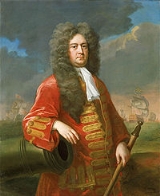
George Rooke

Overview
Admiral of the Fleet (Royal Navy)
Admiral of the fleet is the highest rank of the British Royal Navy and other navies, which equates to the NATO rank code OF-10. The rank still exists in the Royal Navy but routine appointments ceased in 1996....
Sir George Rooke (1650 – 24 January 1709) was an English naval commander. He is known for his service in the wars against France and particularly remembered today for his victory at Vigo Bay
Battle of Vigo Bay
The Battle of Vigo Bay, also known as the Battle of Rande , was a naval engagement fought on 23 October 1702 during the opening years of the War of the Spanish Succession. The engagement followed an Anglo-Dutch attempt to capture the Spanish port of Cádiz in September in an effort to secure a naval...
and for capturing Gibraltar
Capture of Gibraltar
The Capture of Gibraltar by the Anglo-Dutch forces of the Grand Alliance occurred between 1–3 August 1704 during the War of the Spanish Succession. Since the beginning of the war the Allies had been looking for a harbour in the Iberian Peninsula to control the Strait of Gibraltar and facilitate...
for the British in 1704.
Rooke was born at St Lawrence, near Canterbury
Canterbury
Canterbury is a historic English cathedral city, which lies at the heart of the City of Canterbury, a district of Kent in South East England. It lies on the River Stour....
in 1650. Entering the navy as a volunteer in 1672, he served in the Dutch Wars and became post captain in 1673.
He became Rear Admiral
Rear Admiral
Rear admiral is a naval commissioned officer rank above that of a commodore and captain, and below that of a vice admiral. It is generally regarded as the lowest of the "admiral" ranks, which are also sometimes referred to as "flag officers" or "flag ranks"...
in 1690, and fought at the Battle of Beachy Head
Battle of Beachy Head (1690)
The Battle of Beachy Head was a naval engagement fought on 10 July 1690 during the Nine Years' War. The battle was the greatest French tactical naval victory over their English and Dutch opponents during the war...
.
In May 1692 he served under Russell
Edward Russell, 1st Earl of Orford
Admiral of the Fleet Edward Russell, 1st Earl of Orford, PC was the First Lord of the Admiralty under King William III.-Naval career:...
at the Battle of Barfleur
Battles of Barfleur and La Hougue
The related naval battles of Barfleur and La Hogue took place between 29 May and 4 June New Style , 1692 ....
, and he greatly distinguished himself in a night attack on the French fleet at La Hogue
Battles of Barfleur and La Hougue
The related naval battles of Barfleur and La Hogue took place between 29 May and 4 June New Style , 1692 ....
, when he succeeded in burning twelve of their ships.
Unanswered Questions
