


Gang Show

Encyclopedia
A Gang Show is a theatrical performance with a cast of youth members of Scouts
and sometimes Guides too, by invitation. Adult leaders and parents help out behind the scenes. The aim of the shows is to give young people in Scouting and Guiding the opportunity to develop performance skills and perform in a close to professional theatrical environment. Opportunities are also afforded to young people to work backstage, in front of house roles and as musicians in musical items and in the pit band.
The production teams and cast, all volunteers, participate in many hours of planning, writing, composing, choreographing, building stage scenery/props, making costumes and rehearsing for several months before the actual performances. In order to reach the required performance standard for a Gang Show, a high level of commitment is needed from all involved in the production as well as support from their families. A typical Gang Show would require participants to attend between 15 and 30 rehearsals in preparation for the performances.
In addition some Gang Shows are organised in the manner of a typical scouting/guiding activity with the participants perhaps grouped into patrols, or attending special Gang Show camps, awaydays and activities in order to develop and enhance team cohesion.
Performances take place in theatres, schools, community centres – anywhere with an appropriate level of services for the show to function. Performance runs range from one day up to two weeks, and tickets are available to the general public. In the best examples, Gang Shows are an excellent shop window for the Scout movement.
While a Gang Show is always a performance by 'amateurs', the show attracts costs similar to a professional production, despite the huge amount of volunteer hours put in. Many shows are lucky enough to have the support of local businesses through advertising and sponsorship. Others have to do all the fundraising themselves.
or variety show; song, dance and short comedy sketches are the most common items. The number of items varies (commonly ranging between 12 and 25): some are stand-alone, others are a series of songs conforming to a chosen theme, or a running gag.
A typical show will include a big opening number, some comedy sketches, several musical items with a mix of group and solo work, dance numbers and of course a grand finale. Some of the material is well-known, other material is original to Gang Shows, sometimes even penned by the young people themselves.
The show's format was introduced by the late Ralph Reader
CBE, the original Gang Show producer, who went on to write many sketches and songs for Gang Shows, including the signature tune On the Crest of a Wave. Other "standards
" Reader wrote include Strolling, Great Great Game, Gee, It's A Wonderful life, A Touch of Silver, Three Cheers, Show Time, Together, and Scout Hymn. (Many of Reader's songs are no longer usable due to the change of language use and the rather stilted style of much of his music. Every Show, however, retains at least one or two of its own particular favourites.)
, then a Rover Scout who was trying to make his mark in theatre in the USA and London, was asked to write a Scout based amateur variety show to help raise money for a swimming pool at Downe Scout Camp
(now a Scout Association National Activity Centre). Rehearsals commenced under Reader's direction on 25 May 1932 (his 29th birthday).
Initially the show did not have a title, but during a rehearsal break, Reader recalled later, he asked a cast member if everyone was ready to which the response was "Aye, aye Skip, the gang's all here". The first production, under the title The Gang's All Here ran between 30 October and 1 November 1932 at the Scala Theatre
in central London.
Despite the fact that the show was not a sell out, enough money was raised to fund the swimming pool and the show was well received. Baden-Powell
, the founder of scouting, approached Reader and persuaded him to produce another show in 1933. This show was produced with the title The Gang Comes Back and ran for a week.
A tradition had been born and Reader continued to write and produce the London Gang Show. In 1934 the show became known as The Gang Show and the song Crest of a Wave was performed for the first time, becoming over the years the Show's international anthem.
In 1937 the London Gang Show achieved the distinction of being the first amateur production to have a Royal Command Performance
(an honour that was repeated in 1957 and 1964).
 When the Gang Show started in London in 1932, Reader decided that the cast should be organised as a Scout Troop
; a successful arrangement which still persists in a few shows. Members of the first Gang Show Troop wanted an identifying feature, with somebody deciding on a red scarf or necker. The red scarf has become a worldwide symbol of Gang shows, and to distinguish one show from another, an insignia in gold thread (usually a design related to the masks of comedy and tragedy and incorporating the show's name) is embroided into the point of the scarf. Members of Gang Shows in the United Kingdom are only allowed to wear the scarlet scarf if they are nationally recognised as up to the required standard. Every show must be re-assessed every five years.
In 1972, the London Gang Show Fellowship was founded by Reader, so current and former members of the London show could keep in touch. This membership was later expanded to anyone interested in the Gang Shows and Ralph Reader.
In 1958 Ralph Reader was invited to Chicago to produce and direct the first Gang Show ever held in America. He returned to Chicago the next year to guide Chicago’s second Gang Show. British-born Ralph Reeder actually first came to Chicago in 1920 as a teenager and began his stage career there. Some Gang Shows and other shows are held in the United States, but they are not common.
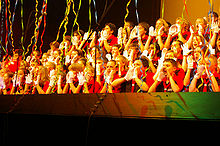 On the Crest of a Wave has become the signature tune for many Scout Gang Shows throughout the world and is usually performed at the end of a performance. On the Crest of a Wave was written by Ralph Reader
for use in the original London Gang Show and has hand actions associated with it that vary from show to show. Many Gang Shows choose only to sing the chorus (traditionally twice, the first time with gusto, the second time part-quiet and staccato, part with gusto once more) but there are also two verses.
A Touch of Silver (sometimes referred to as "Silver on the Scarlet"), written by Ralph Reader
and long serving Brisbane Gang Show producer Hugh "Kirra" McKee, is used as the signature tune of the Brisbane Gang Show and may be sung by any Gang Show which has achieved its 25th season.
Global Gangshow
History
Scouting
Scouting, also known as the Scout Movement, is a worldwide youth movement with the stated aim of supporting young people in their physical, mental and spiritual development, that they may play constructive roles in society....
and sometimes Guides too, by invitation. Adult leaders and parents help out behind the scenes. The aim of the shows is to give young people in Scouting and Guiding the opportunity to develop performance skills and perform in a close to professional theatrical environment. Opportunities are also afforded to young people to work backstage, in front of house roles and as musicians in musical items and in the pit band.
The production teams and cast, all volunteers, participate in many hours of planning, writing, composing, choreographing, building stage scenery/props, making costumes and rehearsing for several months before the actual performances. In order to reach the required performance standard for a Gang Show, a high level of commitment is needed from all involved in the production as well as support from their families. A typical Gang Show would require participants to attend between 15 and 30 rehearsals in preparation for the performances.
In addition some Gang Shows are organised in the manner of a typical scouting/guiding activity with the participants perhaps grouped into patrols, or attending special Gang Show camps, awaydays and activities in order to develop and enhance team cohesion.
Performances take place in theatres, schools, community centres – anywhere with an appropriate level of services for the show to function. Performance runs range from one day up to two weeks, and tickets are available to the general public. In the best examples, Gang Shows are an excellent shop window for the Scout movement.
While a Gang Show is always a performance by 'amateurs', the show attracts costs similar to a professional production, despite the huge amount of volunteer hours put in. Many shows are lucky enough to have the support of local businesses through advertising and sponsorship. Others have to do all the fundraising themselves.
Gang Show format
The format of a Gang Show is essentially a revueRevue
A revue is a type of multi-act popular theatrical entertainment that combines music, dance and sketches. The revue has its roots in 19th century American popular entertainment and melodrama but grew into a substantial cultural presence of its own during its golden years from 1916 to 1932...
or variety show; song, dance and short comedy sketches are the most common items. The number of items varies (commonly ranging between 12 and 25): some are stand-alone, others are a series of songs conforming to a chosen theme, or a running gag.
A typical show will include a big opening number, some comedy sketches, several musical items with a mix of group and solo work, dance numbers and of course a grand finale. Some of the material is well-known, other material is original to Gang Shows, sometimes even penned by the young people themselves.
The show's format was introduced by the late Ralph Reader
Ralph Reader
William Henry Ralph Reader CBE , known as Ralph Reader, was a British actor, theatrical producer and songwriter, best known for staging the original Gang Show, a variety entertainment presented by members of the Scouting Movement.Reader was born in Crewkerne, Somerset, England, the son of a...
CBE, the original Gang Show producer, who went on to write many sketches and songs for Gang Shows, including the signature tune On the Crest of a Wave. Other "standards
Standard (music)
In music, a standard is a tune or song of established popularity.-See also:* Blues standard* Jazz standard* Pop standard* Great American Songbook-Further reading:* Greatest Rock Standards, published by Hal Leonard ISBN 0793588391...
" Reader wrote include Strolling, Great Great Game, Gee, It's A Wonderful life, A Touch of Silver, Three Cheers, Show Time, Together, and Scout Hymn. (Many of Reader's songs are no longer usable due to the change of language use and the rather stilted style of much of his music. Every Show, however, retains at least one or two of its own particular favourites.)
History
In 1931, Ralph ReaderRalph Reader
William Henry Ralph Reader CBE , known as Ralph Reader, was a British actor, theatrical producer and songwriter, best known for staging the original Gang Show, a variety entertainment presented by members of the Scouting Movement.Reader was born in Crewkerne, Somerset, England, the son of a...
, then a Rover Scout who was trying to make his mark in theatre in the USA and London, was asked to write a Scout based amateur variety show to help raise money for a swimming pool at Downe Scout Camp
Downe Scout Activity Centre
Downe Scout Activity Centre is one of the National Scout Activity Centres under the direct control of The Scout Association in Downe near Orpington, Kent. It provides camping and indoor accommodations for Scouts and Guides....
(now a Scout Association National Activity Centre). Rehearsals commenced under Reader's direction on 25 May 1932 (his 29th birthday).
Initially the show did not have a title, but during a rehearsal break, Reader recalled later, he asked a cast member if everyone was ready to which the response was "Aye, aye Skip, the gang's all here". The first production, under the title The Gang's All Here ran between 30 October and 1 November 1932 at the Scala Theatre
Scala Theatre
The Scala Theatre was a theatre in London, sited on Charlotte Street, off Tottenham Court Road, in the London Borough of Camden. The first theatre on the site opened in 1772, and the theatre was demolished in 1969, after being destroyed by fire...
in central London.
Despite the fact that the show was not a sell out, enough money was raised to fund the swimming pool and the show was well received. Baden-Powell
Robert Baden-Powell, 1st Baron Baden-Powell
Robert Stephenson Smyth Baden-Powell, 1st Baron Baden-Powell, Bt, OM, GCMG, GCVO, KCB , also known as B-P or Lord Baden-Powell, was a lieutenant-general in the British Army, writer, and founder of the Scout Movement....
, the founder of scouting, approached Reader and persuaded him to produce another show in 1933. This show was produced with the title The Gang Comes Back and ran for a week.
A tradition had been born and Reader continued to write and produce the London Gang Show. In 1934 the show became known as The Gang Show and the song Crest of a Wave was performed for the first time, becoming over the years the Show's international anthem.
In 1937 the London Gang Show achieved the distinction of being the first amateur production to have a Royal Command Performance
Royal Command Performance
For the annual Royal Variety Performance performed in Britain for the benefit of the Entertainment Artistes' Benevolent Fund, see Royal Variety Performance...
(an honour that was repeated in 1957 and 1964).
Organisation
Scout troop
The Scout troop is a unit of Scouts, Boy Scouts, Girl Guides and Girl Scouts that usually meet weekly. Girl Guides often use Unit or Company instead. The troop is the fundamental unit, which a Scout joins and via which he or she participates in Scouting activities, such as camping, backpacking, and...
; a successful arrangement which still persists in a few shows. Members of the first Gang Show Troop wanted an identifying feature, with somebody deciding on a red scarf or necker. The red scarf has become a worldwide symbol of Gang shows, and to distinguish one show from another, an insignia in gold thread (usually a design related to the masks of comedy and tragedy and incorporating the show's name) is embroided into the point of the scarf. Members of Gang Shows in the United Kingdom are only allowed to wear the scarlet scarf if they are nationally recognised as up to the required standard. Every show must be re-assessed every five years.
In 1972, the London Gang Show Fellowship was founded by Reader, so current and former members of the London show could keep in touch. This membership was later expanded to anyone interested in the Gang Shows and Ralph Reader.
Gang Shows around the world
Since the first Gang Show in London, productions have been organised in many countries around the world including the United Kingdom, Ireland, Australia, and New Zealand. Whilst they are all individual in their character, they all share the general ethos of Reader's original concept and have some common elements, often including a finale performance of Reader's Gang Show 'anthem', Crest of a Wave.In 1958 Ralph Reader was invited to Chicago to produce and direct the first Gang Show ever held in America. He returned to Chicago the next year to guide Chicago’s second Gang Show. British-born Ralph Reeder actually first came to Chicago in 1920 as a teenager and began his stage career there. Some Gang Shows and other shows are held in the United States, but they are not common.
Signature Tunes
Ralph Reader
William Henry Ralph Reader CBE , known as Ralph Reader, was a British actor, theatrical producer and songwriter, best known for staging the original Gang Show, a variety entertainment presented by members of the Scouting Movement.Reader was born in Crewkerne, Somerset, England, the son of a...
for use in the original London Gang Show and has hand actions associated with it that vary from show to show. Many Gang Shows choose only to sing the chorus (traditionally twice, the first time with gusto, the second time part-quiet and staccato, part with gusto once more) but there are also two verses.
A Touch of Silver (sometimes referred to as "Silver on the Scarlet"), written by Ralph Reader
Ralph Reader
William Henry Ralph Reader CBE , known as Ralph Reader, was a British actor, theatrical producer and songwriter, best known for staging the original Gang Show, a variety entertainment presented by members of the Scouting Movement.Reader was born in Crewkerne, Somerset, England, the son of a...
and long serving Brisbane Gang Show producer Hugh "Kirra" McKee, is used as the signature tune of the Brisbane Gang Show and may be sung by any Gang Show which has achieved its 25th season.
External links
World Wide ForumGlobal Gangshow
History