

GParted

Encyclopedia
GParted is a GTK+
front-end to GNU Parted
and the official GNOME
Partition Editor application.
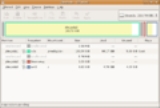
It is used for creating, deleting, resizing, moving, checking and copying partitions, and the file systems on them. This is useful for creating space for new operating systems (works with Vista / Windows 7 System & Data partitions), reorganizing disk usage, copying data residing on hard disks and mirroring one partition with another (disk imaging).
It uses libparted
to detect and manipulate devices and partition tables while several (optional) file system tools provide support for file systems not included in libparted. These optional packages will be detected at runtime and do not require a rebuild of GParted.
GParted is written in C++
and uses gtkmm
to interface with GTK+. The general approach is to keep the GUI
as simple as possible and in conformity with the Human interface guidelines
.
The GParted project provides a live operating system including GParted which can be written to a Live CD
, a Live USB
and other media. The operating system is based on Debian
GNU/Linux. GParted is also available on other GNU/Linux live CDs, including recent versions of Puppy, Knoppix
and Parted Magic.
GParted detects but does not support logical volume management
(LVM) at present, although this feature has been requested by many users and may be implemented in a future release.
GTK+
GTK+ is a cross-platform widget toolkit for creating graphical user interfaces. It is licensed under the terms of the GNU LGPL, allowing both free and proprietary software to use it. It is one of the most popular toolkits for the X Window System, along with Qt.The name GTK+ originates from GTK;...
front-end to GNU Parted
GNU Parted
GNU Parted is a free partition editor, used for creating, destroying, resizing, checking, and copying partitions, and the file systems on them. This is useful for creating space for new operating systems, reorganising hard disk usage, copying data between hard disks, and disk imaging...
and the official GNOME
GNOME
GNOME is a desktop environment and graphical user interface that runs on top of a computer operating system. It is composed entirely of free and open source software...
Partition Editor application.
It is used for creating, deleting, resizing, moving, checking and copying partitions, and the file systems on them. This is useful for creating space for new operating systems (works with Vista / Windows 7 System & Data partitions), reorganizing disk usage, copying data residing on hard disks and mirroring one partition with another (disk imaging).
It uses libparted
GNU Parted
GNU Parted is a free partition editor, used for creating, destroying, resizing, checking, and copying partitions, and the file systems on them. This is useful for creating space for new operating systems, reorganising hard disk usage, copying data between hard disks, and disk imaging...
to detect and manipulate devices and partition tables while several (optional) file system tools provide support for file systems not included in libparted. These optional packages will be detected at runtime and do not require a rebuild of GParted.
GParted is written in C++
C++
C++ is a statically typed, free-form, multi-paradigm, compiled, general-purpose programming language. It is regarded as an intermediate-level language, as it comprises a combination of both high-level and low-level language features. It was developed by Bjarne Stroustrup starting in 1979 at Bell...
and uses gtkmm
Gtkmm
gtkmm is the official C++ interface for the popular GUI library GTK+. gtkmm is free software distributed under the GNU Lesser General Public License ....
to interface with GTK+. The general approach is to keep the GUI
Graphical user interface
In computing, a graphical user interface is a type of user interface that allows users to interact with electronic devices with images rather than text commands. GUIs can be used in computers, hand-held devices such as MP3 players, portable media players or gaming devices, household appliances and...
as simple as possible and in conformity with the Human interface guidelines
Human Interface Guidelines
Human interface guidelines are software development documents which offer application developers a set of recommendations. Their aim is to improve the experience for the users by making application interfaces more intuitive, learnable, and consistent. Most guides limit themselves to defining a...
.
The GParted project provides a live operating system including GParted which can be written to a Live CD
Live CD
A live CD, live DVD, or live disc is a CD or DVD containing a bootable computer operating system. Live CDs are unique in that they have the ability to run a complete, modern operating system on a computer lacking mutable secondary storage, such as a hard disk drive...
, a Live USB
Live USB
A live USB is a USB flash drive or a USB external hard disk drive containing a full operating system that can be booted. Live USBs are closely related to live CDs, but sometimes have the ability to persistently save settings and permanently install software packages back onto the USB device...
and other media. The operating system is based on Debian
Debian
Debian is a computer operating system composed of software packages released as free and open source software primarily under the GNU General Public License along with other free software licenses. Debian GNU/Linux, which includes the GNU OS tools and Linux kernel, is a popular and influential...
GNU/Linux. GParted is also available on other GNU/Linux live CDs, including recent versions of Puppy, Knoppix
Knoppix
Knoppix, or KNOPPIX , is an operating system based on Debian designed to be run directly from a CD / DVD or a USB key , one of the first of its kind for any operating system. Knoppix was developed by Linux consultant Klaus Knopper. When starting a program, it is loaded from the removable medium...
and Parted Magic.
Supported features
GParted supports the following operations on file systems (provided that all features were enabled at compile-time and all required tools are present on the system):| Detect | Read | Create | Grow | Shrink | Move | Copy | Check | Label | |
|---|---|---|---|---|---|---|---|---|---|
| Btrfs Btrfs Btrfs is a GPL-licensed copy-on-write file system for Linux.Development began at Oracle Corporation in 2007.... |
|||||||||
| ext2 Ext2 The ext2 or second extended filesystem is a file system for the Linux kernel. It was initially designed by Rémy Card as a replacement for the extended file system .... |
|||||||||
| ext3 Ext3 The ext3 or third extended filesystem is a journaled file system that is commonly used by the Linux kernel. It is the default file system for many popular Linux distributions, including Debian... |
|||||||||
| ext4 Ext4 The ext4 or fourth extended filesystem is a journaling file system for Linux, developed as the successor to ext3.It was born as a series of backward compatible extensions to ext3, many of them originally developed by Cluster File Systems for the Lustre file system between 2003 and 2006, meant to... |
|||||||||
| Extended | |||||||||
| FAT16 File Allocation Table File Allocation Table is a computer file system architecture now widely used on many computer systems and most memory cards, such as those used with digital cameras. FAT file systems are commonly found on floppy disks, flash memory cards, digital cameras, and many other portable devices because of... |
|||||||||
| FAT32 File Allocation Table File Allocation Table is a computer file system architecture now widely used on many computer systems and most memory cards, such as those used with digital cameras. FAT file systems are commonly found on floppy disks, flash memory cards, digital cameras, and many other portable devices because of... |
|||||||||
| HFS Hierarchical File System Hierarchical File System is a file system developed by Apple Inc. for use in computer systems running Mac OS. Originally designed for use on floppy and hard disks, it can also be found on read-only media such as CD-ROMs... |
|||||||||
| HFS+ HFS Plus HFS Plus or HFS+ is a file system developed by Apple Inc. to replace their Hierarchical File System as the primary file system used in Macintosh computers . It is also one of the formats used by the iPod digital music player... |
|||||||||
| JFS | |||||||||
| swap Virtual memory In computing, virtual memory is a memory management technique developed for multitasking kernels. This technique virtualizes a computer architecture's various forms of computer data storage , allowing a program to be designed as though there is only one kind of memory, "virtual" memory, which... |
|||||||||
| NTFS NTFS NTFS is the standard file system of Windows NT, including its later versions Windows 2000, Windows XP, Windows Server 2003, Windows Server 2008, Windows Vista, and Windows 7.... |
|||||||||
| Reiser4 Reiser4 Reiser4 is a computer file system, successor to the ReiserFS file system, developed from scratch by Namesys and sponsored by DARPA as well as Linspire... |
|||||||||
| ReiserFS ReiserFS ReiserFS is a general-purpose, journaled computer file system designed and implemented by a team at Namesys led by Hans Reiser. ReiserFS is currently supported on Linux . Introduced in version 2.4.1 of the Linux kernel, it was the first journaling file system to be included in the standard kernel... |
|||||||||
| UFS Unix File System The Unix file system is a file system used by many Unix and Unix-like operating systems. It is also called the Berkeley Fast File System, the BSD Fast File System or FFS... |
|||||||||
| XFS XFS XFS is a high-performance journaling file system created by Silicon Graphics, Inc. It is the default file system in IRIX releases 5.3 and onwards and later ported to the Linux kernel. XFS is particularly proficient at parallel IO due to its allocation group based design... |
|||||||||
| LVM Logical volume management In computer storage, logical volume management or LVM provides a method of allocating space on mass-storage devices that is more flexible than conventional partitioning schemes... |
|||||||||
| crypt Dm-crypt dm-crypt is a transparent disk encryption subsystem in Linux kernel versions 2.6 and later and in DragonFly BSD. It is part of the device mapper infrastructure, and uses cryptographic routines from the kernel's Crypto API... / LUKS |
|||||||||
| exFAT ExFAT exFAT is a proprietary, patent-pending file system designed especially for USB flash drives. Developed by Microsoft, it is supported in Windows XP and Windows Server 2003 with update KB955704, Windows Embedded CE 6.0, Windows Vista with Service Pack 1, Windows Server 2008, Windows 7, Windows... |
|||||||||
| ZFS ZFS In computing, ZFS is a combined file system and logical volume manager designed by Sun Microsystems. The features of ZFS include data integrity verification against data corruption modes , support for high storage capacities, integration of the concepts of filesystem and volume management,... |
|||||||||
| MINIX MINIX file system -History:MINIX was written from scratch by Andrew S. Tanenbaum in the 1980s, as a Unix-like operating system whose source code could be used freely in education... |
|||||||||
| YAFFS YAFFS YAFFS was designed and written by Charles Manning, of Whitecliffs, New Zealand, for the company .Yaffs1 is the first version of this file system and works on NAND chips that have 512 byte pages + 16 byte spare areas. These older chips also generally allow 2 or 3 write cycles per page, which... |
GParted detects but does not support logical volume management
Logical volume management
In computer storage, logical volume management or LVM provides a method of allocating space on mass-storage devices that is more flexible than conventional partitioning schemes...
(LVM) at present, although this feature has been requested by many users and may be implemented in a future release.
See also
- Partition (computing)
- List of disk partitioning software
- GNU PartedGNU PartedGNU Parted is a free partition editor, used for creating, destroying, resizing, checking, and copying partitions, and the file systems on them. This is useful for creating space for new operating systems, reorganising hard disk usage, copying data between hard disks, and disk imaging...
- KDE Partition ManagerKDE Partition ManagerKDE Partition Manager is a disk partitioning application for the KDE Platform. It was first released for KDE SC 4.1. It is released independently of the central KDE release cycle....