
All Topics  
Funan

 
Funan

   Email Print
   Bookmark   Link


Funan


Funan (Old Khmer Bnam, Modern Khmer Phnom, Khmer script: ??????? (i.e., "city of mountain" or "state of mountain"), Vietnamese
Vietnamese language

Vietnamese , formerly known under French colonization as Annamese , is the national language and official language language of Vietnam. It is the mother tongue of the Vietnamese people , who constitute 86% of Demographics of Vietnam, and of about three million overseas Vietnamese, most of whom live in the United States....
 Phù Nam; Chinese
Chinese language

Chinese or the Sinitic language is a language family consisting of language mutually unintelligible to varying degrees. Originally the indigenous languages spoken by the Han Chinese in China, it forms one of the two branches of Sino-Tibetan languages of languages....
 ??, Fúnán; Thai
Thai language

Thai , is the national language and official language language of Thailand and the mother tongue of the Thai people, Thailand's dominant ethnic group....
 ?????, fu?na?n) was an ancient pre-Angkor
Angkor

Angkor is a name conventionally applied to the region of Cambodia serving as the seat of the Khmer empire that flourished from approximately the ninth century to the fifteenth century A.D....
 Indianized
Indianized kingdom

The concept of the Indianized kingdom, first described by George Coed?s, is based upon the Hindu and Buddhist cultural and economic influences in Southeast Asia....
 Khmer kingdom located around the Mekong Delta
Mekong Delta

The Mekong Delta is the region in southwestern Vietnam where the Mekong River approaches and empties into the sea through a network of distributaries....
. It is believed to have been established in the first century C.E, although extensive human settlement in the region may have gone back as far as the 4th century B.C.E.


Discussion
Ask a question about 'Funan'
Start a new discussion about 'Funan'
Answer questions from other users
Full Discussion Forum


Recent Posts


Encyclopedia


Funan (Old Khmer Bnam, Modern Khmer Phnom, Khmer script: ??????? (i.e., "city of mountain" or "state of mountain"), Vietnamese
Vietnamese language

Vietnamese , formerly known under French colonization as Annamese , is the national language and official language language of Vietnam. It is the mother tongue of the Vietnamese people , who constitute 86% of Demographics of Vietnam, and of about three million overseas Vietnamese, most of whom live in the United States....
 Phù Nam; Chinese
Chinese language

Chinese or the Sinitic language is a language family consisting of language mutually unintelligible to varying degrees. Originally the indigenous languages spoken by the Han Chinese in China, it forms one of the two branches of Sino-Tibetan languages of languages....
 ??, Fúnán; Thai
Thai language

Thai , is the national language and official language language of Thailand and the mother tongue of the Thai people, Thailand's dominant ethnic group....
 ?????, fu?na?n) was an ancient pre-Angkor
Angkor

Angkor is a name conventionally applied to the region of Cambodia serving as the seat of the Khmer empire that flourished from approximately the ninth century to the fifteenth century A.D....
 Indianized
Indianized kingdom

The concept of the Indianized kingdom, first described by George Coed?s, is based upon the Hindu and Buddhist cultural and economic influences in Southeast Asia....
 Khmer kingdom located around the Mekong Delta
Mekong Delta

The Mekong Delta is the region in southwestern Vietnam where the Mekong River approaches and empties into the sea through a network of distributaries....
. It is believed to have been established in the first century C.E, although extensive human settlement in the region may have gone back as far as the 4th century B.C.E. Though regarded by Chinese envoys as a single unified empire, Funan may have been a collection of city-states that sometimes warred with one another and at other times constituted a political unity. At its height, Funan and all its principalities covered much of mainland Southeast Asia
Southeast Asia

Southeast Asia or Southeastern Asia is a subregion of Asia, consisting of the countries that are geographically south of China, east of India and north of Australia....
, including within its scope the territory of modern day Cambodia
Cambodia

The Kingdom of Cambodia is a country in South East Asia with a population of over 13 million people. The kingdom's capital and largest city is Phnom Penh....
 and Southern Vietnam, as well as parts of Laos
Laos

Laos , officially the Lao People's Democratic Republic, is a landlocked country in southeast Asia, bordered by Burma and People's Republic of China to the northwest, Vietnam to the east, Cambodia to the south, and Thailand to the west....
, Thailand
Thailand

The Kingdom of Thailand is an independent country that lies in the heart of Southeast Asia. It is bordered to the north by Laos and Myanmar, to the east by Laos and Cambodia, to the south by the Gulf of Thailand and Malaysia, and to the west by the Andaman Sea and Myanmar....
 and Myanmar
Myanmar

Burma, officially the Union of Myanmar, is the largest country by geographical area in mainland Southeast Asia, or Indochina. The country is bordered by the People's Republic of China on the northeast, Laos on the east, Thailand on the southeast, Bangladesh on the west, India on the northwest, and the Bay of Bengal to the southwest with...
, and extending into the Malay Peninsula
Malay Peninsula

The Malay Peninsula or Thai-Malay Peninsula is a major peninsula located in Southeast Asia. It is also known as the Kra Peninsula and runs approximately north-south through the Kra Isthmus....
.

Little is known about Funan, except that it was a powerful trading state, as evidenced by the discovery of Roman
Roman Empire

The Roman Empire was the Roman Republic phase of the Ancient Rome, characterised by an autocracy form of government and large territorial holdings in Europe and around the Mediterranean....
, Chinese
China

China is a Culture of China, an ancient civilization, and, depending on perspective, a national or multinational entity extending over a large area in East Asia....
, and India
India

India, officially the Republic of India , is a country in South Asia. It is the List of countries and outlying territories by total area country by geographical area, the List of countries by population country, and the most populous liberal democracy in the world....
n goods during archaeological excavations at the ancient port of Oc Eo
Óc Eo

.?c Eo is an archaeological site proposed to be named by the French archaeologist site Louis Mallaret in southern An Giang Province, Vietnam, in the Mekong River Delta region of Vietnam This site may have been a busy port of the kingdom of Funan between the 1st and 7th centuries AD....
 in southern Vietnam
Vietnam

Vietnam , officially the Socialist Republic of Vietnam , is the easternmost country on the Indochina Peninsula in Southeast Asia. It is bordered by People's Republic of China to the north, Laos to the northwest, Cambodia to the southwest, and the South China Sea to the east....
. The capital, initially located at Vyadhapura (City of the Hunter) near the modern Cambodian town of Banam in Prey Veng Province
Prey Veng Province

Prey Veng is a provinces of Cambodia of Cambodia. The capital is Prey Veng town....
, may have been moved to Oc Eo at a later time. Most of what is known about Funan is from records by Chinese and Cham sources dating from the third to sixth centuries and from archaeological excavations. No archaeological research has been conducted on this state in Cambodia's Mekong Delta in several decades, and it is precisely this region that reputedly housed the capitals of Funan.

The Kambujas

Kambujamap006

Kambujas Migration

Numerous scholars including J. Fergusson, G. Coedes, D. G. E. Hall, Dr B. R. Chatterjee, Dr Buddha Prakash and many others etc accept the ancient historical, political and cultural connections between the Ancient Kambojas
Kambojas

The Kambojas were a Kshatriya tribe of Iron Age India, frequently mentioned in Sanskrit and Pali literature, making their first appearance Kambojas in the Mahabharata and contemporary Vedanga literature ....
 of the north-west and the Kambujas of the Indochina
Indochina

Indochina, or the Indochinese Peninsula, is a subregion in Southeast Asia. It lies roughly east of India, south of China.The word has French origins, Indochine, and was adopted when French colonizers in Vietnam began expanding their territory to bordering countries....
 archipelago.

Related articles:
  • Migration of Kambojas
    Migration of Kambojas

    References to Kambojas abound in ancient literature, and this may have been just the expansion of an Indo-Iranians tribe with both Indic and Persians affinities from their homeland in the present-day Afghanistan-Pakistan region along the foothills of the Himalayas towards Bengal, along the coast to Gujarat, to Sri Lanka, and possibly further...
  • Kambojas and Cambodia
  • Kamboja colonists of Sri Lanka
    Kamboja Colonists of Sri Lanka

    Sri Lanka is a tropical island nation off the southeast coast of the Indian subcontinent, about 31 kilometres south of India.'Lanka' in Sanskrit means island ....
  • Ancient Kamboja: The hub of international trade
  • Etymology of Kamboja
    Etymology of Kamboja

    Kamboja is the name of an ancient Indo-Iranians tribe whose spoken language belongs in the Indo-European languages family of languages. They are believed to have been located originally in Pamirs and Badakshan in Central Asia....


A section of the Kambysene hordes settled on north-west of India
India

India, officially the Republic of India , is a country in South Asia. It is the List of countries and outlying territories by total area country by geographical area, the List of countries by population country, and the most populous liberal democracy in the world....
 later came to be known as Kambojas
Kambojas

The Kambojas were a Kshatriya tribe of Iron Age India, frequently mentioned in Sanskrit and Pali literature, making their first appearance Kambojas in the Mahabharata and contemporary Vedanga literature ....
 and their province as Kamboja
Kamboja

Kamboja may refer to:*the ancient tribe of the Kambojas of the Hindukush in Iron Age India**Kambojas in South Asian literature*the Kamboja Kingdom, one of the Mahajanapadas of Iron Age India...
 in ancient Indian traditions. A section of these Scythianised Kambojas is believed to have reached Tibet
Tibet

Tibet is a Tibetan Plateau in Asia, north of the Himalayas, and the home to the indigenous Tibetan people and its related ethnic groups. With an average elevation of 4,900 metres , it is the highest region on Earth and has in recent decades increasingly been referred to as the "Roof of the World"....
an plateau
Plateau

In geology and earth science, a plateau, also called a high plateau or tableland, is an area of highland , usually consisting of relatively flat terrain....
 where they mixed with the locals; as a result some Tibetans are still called Kambojas. Through Tibet, they went further to Mekong
Mekong

The Mekong River is one of the world?s major rivers. It is the 12th-longest river in the world, and 7th longest in Asia. . Its estimated length is , and it drains an area of ....
 valley where they were called Kambujas (Cambodia
Cambodia

The Kingdom of Cambodia is a country in South East Asia with a population of over 13 million people. The kingdom's capital and largest city is Phnom Penh....
ns), now represented by the Cham
Cham people

The Cham people are an ethnic group in Southeast Asia. They are concentrated between Kampong Cham Province in Cambodia and central Vietnam Phan Rang-Thap Cham, Phan Thiet, Ho Chi Minh City and An Giang areas....
s, still a tall, fair, dolichocephalic people with non-mongoloid eyes, of the Mon-Khmers.

Intermarriages and blood mixing

The colonists and the ruling families of Kambuja who originally came from north-west Kamboja, for reasons of convenience, married with the local elites and thus there apparently occurred a blood mixing between the original population and the new colonists, at least, at the surfacial layer. This possibility has also been accepted by G Coedes and other scholars on this subject.

Prince
Prince

Prince, from the Latin root princeps, is a general term for a monarch, for a member of a monarch's or former monarch's family, and is a hereditary title in some members of Europe's highest nobility....
 Norodom Sihanouk
Norodom Sihanouk

King Norodom Sihanouk Khmer alphabet#Style wasthe King of Cambodia until his abdication on October 7, 2004. He is now "King-Father of Cambodia," a position in which he retains many of his former responsibilities as constitutional King....
, king of Cambodia visited India in March 1955. The Indian Kambojas organized grand meeting on March 18 in New Delhi
New Delhi

New Delhi is the capital city of India. With a total area of 42.7 km2, New Delhi is situated within the metropolis of Delhi and serves as the seat of the Government of India and the Government of the National Capital Territory of Delhi ....
 where the prince was honored and was presented an Abhinandan Patra on behalf of the All India Kamboj Mahasabha, by its President, Dr Ganga Singh Soni. Remarked prince Sihanouk "I am fortunate to be among my Indian Kamboj brethren and am proud of my ancient blood connection with the Indian Kambojas....". On special invitation from the Cambodian prince, a four member delegation of the Indian Kambojs comprising Dr Ganga Singh Soni, S. Hazara Singh Jossan, Col Lal Singh Turna and S. Himat Singh Thind visited Cambodia on November 13, 1959 to participate in the Jalutsava celebrations which is a national festival of Kambodia. The Kamboj delegation was given a wide publicity and rousing royal reception in Cambodia and its members were treated as special Guests of the State of Cambodia.

Kambujas international trade & colonization on Southeast Asia


Cambodia
  • Funan (68 AD – 550 AD)
  • Chenla
    Chenla

    Chenla , known as Zhenla in Chinese language and Ch?n L?p in Vietnamese language, was an early Khmer people kingdom.At first a vassal state to Funan , over the next 60 years it achieved its independence and eventually conquered all of Funan, absorbing its people and culture....
     (550 AD – 802 AD)
  • Khmer Empire
    Khmer Empire

    The Khmer Empire was the largest empire of South East Asia based in what is now Cambodia. The empire, which seceded from the kingdom of Chenla, at times ruled over and/or vassalised parts of modern-day Laos, Thailand,Vietnam, Myanmar, and Malaysia....
     (802 AD – 1431 AD)


Sri Lanka
Sri Lanka

Sri Lanka, officially the Democratic Socialist Republic of Sri Lanka is an island country in South Asia, located about off the southern coast of India....
  • Ancient Sinhala
    Sinhala Kingdom

    Sinhala was a kingdom in the island Lanka, modern day Sri Lanka, mentioned in the epic Mahabharata....
     (Sri-Lanka)


Malaysia
Malaysia

Malaysia is a federation that consists of States of Malaysia in Southeast Asia with a total landmass of . The capital city is Kuala Lumpur, while Putrajaya is the seat of the federal government....
 and Indonesia
Indonesia

The Republic of Indonesia , is a transcontinental country in Southeast Asia and Oceania. Comprising Islands of Indonesia, it is the world's largest Archipelago state....
  • Langkasuka
    Langkasuka

    Langkasuka was an ancient Hinduism Malay people kingdom located in the Malay Peninsula. Another possible source of its name could be the combination of ....
     (2nd–14th century)
  • Kedah Kingdom
    Kedah Kingdom

    Kadaram or Kedah Kingdom was founded by Maharaja Derbar Raja of Bandar Abbas, Persia, around 630 CE. The Persian-Hinduism dynasty ended with Phra Ong Mahawangsa converted to Islam and the Sultanate of Kedah continue to rule until today....
     ((630-1136)
  • Srivijaya
    Srivijaya

    Srivijaya or Sriwijaya was an ancient Malays kingdom on the island of Sumatra, Southeast Asia which influenced much of the Malay Archipelago. The earliest solid proof of its existence dates from the 7th century; a Chinese monk, I-Tsing, wrote that he visited Srivijaya in 671 for 6 months....
     (3rd to 14th centuries)
  • Majapahit (1293–1500)


Origin

The race and language of the Funanese are not known, but Chinese records dating from the third century A.D. reveals the same origin myth of the Khmer people
Khmer people

The Khmer people; ; are the predominant ethnic group in Cambodia, accounting for approximately 90% of the 14.2 million people in the country. Part of the larger Mon-Khmer languages ethnolinguistic peoples found throughout Southeast Asia, they speak the Khmer language....
 that survives in modern Khmer folklore. In a tenth century document of the Chinese official Rang Tai's visit to Funan in the middle of the third century A.D. records one of the earliest variants of the legend. In it, Rang Tai learned that the original sovereign of Funan was a women name Liu-Ye. According to the story, Kaundinya had been given instruction in a dream to take a magic bow from a temple and to embark on a journey. He did so and went to Cambodia, where a local queen (Liu-ye) launched an attack on the Brahmin's boat. With the aid of the divine bow, Kaundinya repelled the attack and persuaded the defeated queen to marry him. Their lineage became the royal dynasty of Funan. A similar account is recorded in the seventh century
History of Chin.

Although the Chinese records shows bias, similar names have been recorded in stone inscriptions at My Son dating to 657 A.D. In this Cham version, the prince is known as Kaudinya and the queen as Soma, the daughter of the naga
Naga

Naga may refer to:* Naga, a group of serpent deities in Hindu and Buddhist mythology....
 king. A Khmer inscription from the tenth century described the ruling line as descendants of Sri-Kaudinya and the daughter of Soma. The same origin myth in modern Khmer folklore gives the name Preah Thaong to the prince and Neang Neak to the queen. In this version, Preah Thaong arrives by sea to an island marked by a giant thlok tree, native to Cambodia. On the Island, he found the home of the nagas and met Neang Neak, daughter of the naga king. He married her with blessing from her father and returned to the human world. The naga king drank the sea around the island and gave the name Kampuchea Thipdei, which in Sanskrit
(Kambuja Dhipati) translates into the king of Kambuja. In another version, it is stated that Preah Thaong fights Neang Neak. The continuation of the same origin myth implies that modern Khmers are descendants of the Funanese people.

The first Khmer inscription dated shortly after the fall of Funan and those dating to later dates are concentrated in southern Cambodia suggests that the Khmers already inhabited lowland Cambodia.

History

Funanmap001
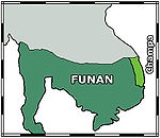
The Funanese Empire reached its greatest extent under the rule of Fan Shih-man in the early third century C.E., extending as far south as Malaysia
Malaysia

Malaysia is a federation that consists of States of Malaysia in Southeast Asia with a total landmass of . The capital city is Kuala Lumpur, while Putrajaya is the seat of the federal government....
 and as far west as Burma. The Funanese established a strong system of mercantilism and commercial monopolies that would become a pattern for empires in the region. Fan Shih-man expanded the fleet and improved the Funanese bureaucracy, creating a quasi-feudal pattern that left local customs and identities largely intact, particularly in the empire's farther reaches.

Organization


Keeping in mind that Funanese records do not survive into modern time, much of what is known is from archaeological excavation. Excavations yielded discoveries of brick wall structures, precious metals and pottery from southern Cambodia and Vietnam. Also found was a large canal system that linked the settlements of Angkor Borei and coastal outlets; this suggests a highly organized government. Funan, a complex and sophisticated society with a high population density, advanced technology, and a complex social system dominated the area of Cambodia because of the Khmer people's ability to produce food in Cambodia's fertile plains.

Culture


Funanese culture was a mixture of native beliefs and Indian ideas. The kingdom is said to have been heavily influenced by Indian culture, and to have employed Indians for state administration purposes. Sanskrit
Sanskrit

Sanskrit is a historical Indo-Aryan language, one of the liturgical languages of Hinduism and Buddhism, and one of the 22 official languages of India....
 was the language at the court, and the Funanese advocated Hindu and, after the fifth century, Buddhist religious doctrines. Records show that taxes were paid in silver, gold, pearls, and perfumed wood. K'ang T'ai reported that the Funanese practiced slavery and that justice was rendered through trial by ordeal
Trial by ordeal

Trial by ordeal is a judicial practice by which the guilt or innocence of the accused is determined by subjecting them to a painful task. If either the task is completed without injury, or the injuries sustained are healed quickly, the accused is considered innocent....
, including such methods as carrying a red-hot iron chain and retrieving gold rings and eggs from boiling water.

Archaeological evidence largely corresponds to Chinese records. the Chinese described the Funanese as people who lived on stilt houses, cultivated rice and sent tributes of gold, silver, ivory and exotic animals.

K'ang T'ai's report was unflattering to Funanese civilization, though Chinese court records show that a group of Funanese musicians visited China in 263 C.E. The Chinese Emperor was so impressed that he ordered the establishment of an institute for Funanese music near Nanking. The Funanese were reported also to have extensive book collections and archives throughout their country, demonstrating a high level of scholarly achievement.

Economy


Funan was Southeast Asia
Southeast Asia

Southeast Asia or Southeastern Asia is a subregion of Asia, consisting of the countries that are geographically south of China, east of India and north of Australia....
's first great economy. The Kingdom was rich because of trade and agriculture
Agriculture

Agriculture refers to the production of food and goods through farming and forestry. Agriculture was the key development that led to the rise of civilization, with the animal husbandry of domestication animals and plants creating food surpluses that enabled the development of more Population density and Social stratification societies....
. Funan grew wealthy because it dominated the Isthmus of Kra, the narrow portion of the Malay peninsula where merchants transported trade goods between China
China

China is a Culture of China, an ancient civilization, and, depending on perspective, a national or multinational entity extending over a large area in East Asia....
 and India
India

India, officially the Republic of India , is a country in South Asia. It is the List of countries and outlying territories by total area country by geographical area, the List of countries by population country, and the most populous liberal democracy in the world....
. They use their profits to construct an elaborate system of water storage and irrigation. Citizens lived relaxed lifestyles. The Funanese population was concentrated mainly along the Mekong River: the area was a natural region for the development of an economy based on fishing
Aquaculture

Aquaculture is the farming of freshwater and saltwater organisms including molluscs, crustaceans and aquatic plants. Unlike fishing, aquaculture, also known as aquafarming, implies the cultivation of aquatic populations under controlled conditions....
 and rice cultivation
Rice

Rice is a staple food for a large part of the world's human population, especially in tropical Latin America, and East Asia, South Asia and Southeast Asia, making it the second-most consumed cereal grain, after maize....
. The Funanese economy depended on rice
Rice

Rice is a staple food for a large part of the world's human population, especially in tropical Latin America, and East Asia, South Asia and Southeast Asia, making it the second-most consumed cereal grain, after maize....
 surpluses produced by an extensive inland irrigation
Irrigation

Irrigation is an artificial application of water to the soil usually for assisting in growing crops. In crop production it is mainly used in dry areas and in periods of rainfall shortfalls, but also to protect plants against frost....
 system. Maritime trade also played an extremely important role in the development of Funan. Archaeological remnants of what was the kingdom's main port, Oc Eo
Óc Eo

.?c Eo is an archaeological site proposed to be named by the French archaeologist site Louis Mallaret in southern An Giang Province, Vietnam, in the Mekong River Delta region of Vietnam This site may have been a busy port of the kingdom of Funan between the 1st and 7th centuries AD....
, were found to include Roman
Ancient Rome

Ancient Rome was a civilization that grew out of a small agricultural community founded on the Italian Peninsula as early as the 10th century BC....
 as well as Persian
Persian Empire

The 'Persian Empire' was a series of successive Iranian or Persianization empires that ruled over the Iranian plateau, the original Persian homeland, and beyond in Southwest Asia, South Asia, Central Asia and the Caucasus....
, Indian
History of India

The known history of India begins with the Indus Valley Civilization, which spread and flourished in the north-western part of the Indian subcontinent, from c....
, and Greek
Greeks

The Greeks , also known as Hellenes, are a nation and ethnic group native to Greece, Cyprus and neighbouring regions, who can also be found in Greek diaspora communities around the world....
 artifacts.

Legacy


King Fan Shih-man, the greatest king of Funan, and his successors sent ambassadors to China
China

China is a Culture of China, an ancient civilization, and, depending on perspective, a national or multinational entity extending over a large area in East Asia....
 and India
India

India, officially the Republic of India , is a country in South Asia. It is the List of countries and outlying territories by total area country by geographical area, the List of countries by population country, and the most populous liberal democracy in the world....
. The kingdom likely accelerated the process of Indianization into Southeast Asia
Southeast Asia

Southeast Asia or Southeastern Asia is a subregion of Asia, consisting of the countries that are geographically south of China, east of India and north of Australia....
. Later kingdoms of Southeast Asia emulated the Funanese court.

During its golden age Funan controlled modern southern Vietnam, Cambodia, central Thailand, northern Malaysia, and southern Burma. Although Funan collapsed under the pressure of neighboring Chenla
Chenla

Chenla , known as Zhenla in Chinese language and Ch?n L?p in Vietnamese language, was an early Khmer people kingdom.At first a vassal state to Funan , over the next 60 years it achieved its independence and eventually conquered all of Funan, absorbing its people and culture....
, its capital Vyadhapura remained the largest and most important urban center in the region until Angkor Thom
Angkor Thom

Angkor Thom was the last and most enduring capital city of the Khmer empire. It was established in the late twelfth century by king Jayavarman VII....
.

The Funan kingdom had an efficient navy and rose to prosperity by regulating the sea trade between China
China

China is a Culture of China, an ancient civilization, and, depending on perspective, a national or multinational entity extending over a large area in East Asia....
 and India
India

India, officially the Republic of India , is a country in South Asia. It is the List of countries and outlying territories by total area country by geographical area, the List of countries by population country, and the most populous liberal democracy in the world....
.

Funan collapsed in the sixth century and was absorbed by the Chenla
Chenla

Chenla , known as Zhenla in Chinese language and Ch?n L?p in Vietnamese language, was an early Khmer people kingdom.At first a vassal state to Funan , over the next 60 years it achieved its independence and eventually conquered all of Funan, absorbing its people and culture....
 kingdom who are undeniably Khmers
Khmer people

The Khmer people; ; are the predominant ethnic group in Cambodia, accounting for approximately 90% of the 14.2 million people in the country. Part of the larger Mon-Khmer languages ethnolinguistic peoples found throughout Southeast Asia, they speak the Khmer language....
. Funan is held to be the first Khmer kingdom and the forerunner of the mighty Khmer Empire
Khmer Empire

The Khmer Empire was the largest empire of South East Asia based in what is now Cambodia. The empire, which seceded from the kingdom of Chenla, at times ruled over and/or vassalised parts of modern-day Laos, Thailand,Vietnam, Myanmar, and Malaysia....
. The Khmers and the Funanese share the same origin myth and under Funan, Cambodia became an indianized polity which had a profound effect on its culture.

Relations


The French historian George Coedès
George Coedès

George C?d?s was a 20th century scholar of southeast Asian archaeology and history. Coed?s was born in Paris to a family of Hungarian people-Jewish emigres....
 once hypothesized a relation between the rulers of Funan and the Sailendra
Sailendra

Sailendra is the name of an influential Indonesian dynasty that emerged in 8th century Java.The Sailendras were active promoters of Mahayana Buddhism and covered the plains of Central Java with Buddhist monuments, including the world famous Borobudur....
 dynasty of Indonesia
Indonesia

The Republic of Indonesia , is a transcontinental country in Southeast Asia and Oceania. Comprising Islands of Indonesia, it is the world's largest Archipelago state....
. Coedès believed that the title of "mountain lord" used by the kings of Sailendra may also have been used by the kings of Funan, since the name "Funan" is related to the Khmer "phnom," which means "mountain." Other scholars have rejected this hypothesis, pointing to the lack of evidence in early Cambodian epigraphy for the use of any such titles. The Funanese also traded with the Liang dynasty of southern China.

Little is known about Funan's political history apart from its relations with China
China

China is a Culture of China, an ancient civilization, and, depending on perspective, a national or multinational entity extending over a large area in East Asia....
. A brief conflict is recorded to have happened in the 270's when Funan and its neighbor Champa
Champa

File:Shiva Dong Duong Style.jpgFile:VietnamChampa1.gifThe kingdom of Champa was an Indianized kingdom of Malayo-Polynesian origins and controlled what is now southern and central Vietnam from approximately the 7th century through to 1832....
 joined forces to attack the Chinese province of Tongking, located in what is now modern Northern Vietnam. In 357, Funan became a vassal of China, and would continue as such until its disintegration in the sixth century. Chenla
Chenla

Chenla , known as Zhenla in Chinese language and Ch?n L?p in Vietnamese language, was an early Khmer people kingdom.At first a vassal state to Funan , over the next 60 years it achieved its independence and eventually conquered all of Funan, absorbing its people and culture....
, a vassal of Funan eventually absorbed Funan entirely.

Funan rulers

-see List of Kings of Cambodia

External links