
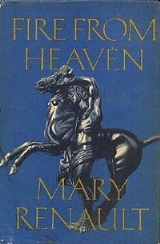
Fire from Heaven is a 1969
historical novelAccording to Encyclopædia Britannica, a historical novel is-Development:An early example of historical prose fiction is Luó Guànzhōng's 14th century Romance of the Three Kingdoms, which covers one of the most important periods of Chinese history and left a lasting impact on Chinese culture.The...
by
Mary RenaultMary Renault born Eileen Mary Challans, was an English writer best known for her historical novels set in Ancient Greece...
about the childhood and youth of
Alexander the Great. It reportedly was a major inspiration for the
Oliver StoneWilliam Oliver Stone is an American film director, producer and screenwriter. Stone became well known in the late 1980s and the early 1990s for directing a series of films about the Vietnam War, for which he had previously participated as an infantry soldier. His work frequently focuses on...
film
AlexanderAlexander is a 2004 epic film based on the life of Alexander the Great. It is not a remake of the 1956 film which starred Richard Burton. It was directed by Oliver Stone, with Colin Farrell in the title role...
. The book was nominated for the “
Lost Man Booker PrizeThe Lost Man Booker Prize was a special edition of the Man Booker Prize awarded by a public vote in 2010 to a novel from 1970, described by The New York Times as "an act of literary reparation"...
” of 1970, "a contest delayed by 40 years because a reshuffling of the fledgeling competition’s rules". but lost out to
TroublesTroubles is a 1970 novel by the English author J.G. Farrell. It won the Lost Man Booker Prize and the Geoffrey Faber Memorial Prize. Troubles concerns the dilapidation of a once grand Irish hotel , in the midst of the political upheaval during the Irish War of Independence .The novel is the first...
by J. G. Farrell.
Plot summary
The novel, whose memorable opening line is "The child was wakened by the knotting of the snake's coils about his waist," portrays Alexander's complicated relationship with his father,
Philip of MacedonPhilip II of Macedon "friend" + ἵππος "horse" — transliterated ; 382 – 336 BC), was a king of Macedon from 359 BC until his assassination in 336 BC. He was the father of Alexander the Great and Philip III.-Biography:...
, and his mother
OlympiasOlympias was a Greek princess of Epirus, daughter of king Neoptolemus I of Epirus, the fourth wife of the king of Macedonia, Philip II, and mother of Alexander the Great...
; his education under the philosopher
AristotleAristotle was a Greek philosopher and polymath, a student of Plato and teacher of Alexander the Great. His writings cover many subjects, including physics, metaphysics, poetry, theater, music, logic, rhetoric, linguistics, politics, government, ethics, biology, and zoology...
, whose later opposition to Alexander is foreshadowed; and his devotion to his lifelong companion Hephaistion, depicted as both a lover and an intimate friend. The novel contains a controversial portrait of the Athenian orator
DemosthenesDemosthenes was a prominent Greek statesman and orator of ancient Athens. His orations constitute a significant expression of contemporary Athenian intellectual prowess and provide an insight into the politics and culture of ancient Greece during the 4th century BC. Demosthenes learned rhetoric by...
, portraying him as arrogant, cowardly and vindictive. The novel ends with the assassination of Philip, with Alexander his heir poised to begin his career of conquests.
Literary significance and criticism
The novel has been criticized as an overly romanticized and sanitized portrait of Alexander. It was followed by two sequels,
The Persian BoyThe Persian Boy is a 1972 historical novel written by Mary Renault and narrated by Bagoas, a young Persian from an aristocratic family who is captured by his father's enemies, castrated, and sold as a slave to the king Darius III, who makes him his favorite...
(1972), dealing with Alexander's conquest of the Persian Empire, and
Funeral Games (1981), depicting the consequences of his death.