
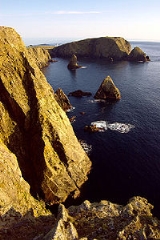
Fair Isle is an island in northern
ScotlandScotland is a country that is part of the United Kingdom. Occupying the northern third of the island of Great Britain, it shares a border with England to the south and is bounded by the North Sea to the east, the Atlantic Ocean to the north and west, and the North Channel and Irish Sea to the...
, lying around halfway between mainland Shetland and the Orkney islands. It is famous for its bird observatory and a
traditional style of knittingthumb|Fair Isle [[sweater|jumper]] done in the traditional style, from Fair Isle.Fair Isle is a traditional knitting technique used to create patterns with multiple colours. It is named after Fair Isle, a tiny island in the north of Scotland, that forms part of the Shetland islands...
.
Geography
Fair Isle is the most remote inhabited island in the United Kingdom. The island is administratively part of Shetland and lies 38 kilometres (23.6 mi) south-west of
Sumburgh HeadSumburgh Head is located at the southern tip of the Shetland Mainland in northernScotland. The head is a 100 m high rocky spur capped by the Sumburgh Head Lighthouse. The Old Norse name was Dunrøstar høfdi, it means "The Head onto the Thunderous Noise", referring to the noise of Sumburgh Roost...
on the Mainland of Shetland and 43 kilometres (26.7 mi) north-east of
North RonaldsayNorth Ronaldsay is the northernmost of the Orkney Islands, Scotland and with an area of is the fourteenth largest.-Geography:North Ronaldsay lies around north of its nearest neighbour, Sanday at . The island is around long along its length and is defined by two large sandy bays; Linklet Bay on...
, Orkney. 4.8 kilometres (3 mi) in length and 2.4 kilometres (1.5 mi) wide, it has an area of 768 hectares (3 square miles), making it the tenth largest of the Shetland Islands. It gives its name to one of the British Sea Areas.
The majority of the seventy islanders live in the
croftsA croft is a fenced or enclosed area of land, usually small and arable with a crofter's dwelling thereon. A crofter is one who has tenure and use of the land, typically as a tenant farmer.- Etymology :...
on the southern half of the island, with the northern half consisting of rocky
moorlandMoorland or moor is a type of habitat, in the temperate grasslands, savannas, and shrublands biome, found in upland areas, characterised by low-growing vegetation on acidic soils and heavy fog...
. The western coast consists of cliffs of up to 200 metres (660 feet) in height. The population has been decreasing steadily from around four hundred in around 1900. There are no pubs or restaurants on the island, and there is but a single primary school. After the age of eleven, children must attend secondary school in
LerwickLerwick is the capital and main port of the Shetland Islands, Scotland, located more than 100 miles off the north coast of mainland Scotland on the east coast of the Shetland Mainland...
and stay in a hostel there in term time.
Climate
As with the rest of the
British IslesThe British Isles are a group of islands off the northwest coast of continental Europe that include the islands of Great Britain and Ireland and over six thousand smaller isles. There are two sovereign states located on the islands: the United Kingdom of Great Britain and Northern Ireland and...
and Scotland, Fair Isle experiences a maritime climate with cool summers and mild winters. This is especially pronounced due to its location far from any sizeable landmass - Fair Isle has the smallest overall temperature range (least continental) of any Weather Station in the British Isles - an absolute maximum of 20.2 °C (68.4 °F) and an absolute minimum of -5.6 C since 1951. This 60 plus year temperature span is actually smaller than many places in inland southern England will record within a given 3 month period.
The lowest temperature recorded in recent year's was -4.6 C during February 2010. Rainfall, at under 1000mm is lower than one might expect for somewhere often in the main path of Atlantic depressions, this is explained by a lack of heavy convective rainfall during spring and summer months due to the absence of warm surface conditions.
Bird observatory
Fair Isle has a permanent
bird observatoryA bird observatory is a centre for the study of bird migration and bird populations. They are usually focused on local birds, but may also include interest in far flung areas. Most bird observatories are small operations with a limited staff, many volunteers and a not-for-profit educational status...
, founded by
George WaterstonGeorge Waterston was an ornithologist and conservationist in Scotland. He was Director of the Royal Society for the Protection of Birds in Scotland. He lived at 21 Regent Terrace, Edinburgh where he co-founded what was the Midlothian Ornithologists' Club and is now the Scottish Ornithologists'...
in 1948, because of its importance as a
bird migrationBird migration is the regular seasonal journey undertaken by many species of birds. Bird movements include those made in response to changes in food availability, habitat or weather. Sometimes, journeys are not termed "true migration" because they are irregular or in only one direction...
watchpoint and this provides most of the accommodation on the island. The first Director of the observatory was
Kenneth WilliamsonKenneth Williamson was a British ornithologist who had a strong association with Scotland and with bird migration.Williamson was born in Bury Lancashire. From 1941-1945 he served with the British occupation of the Faroe Islands in World War II, in 1944 marrying Esther Louise Rein of Tórshavn with...
. It is unusual amongst bird observatories in providing catered, rather than hostel-style, accommodation.
Many rare species of
birdBirds are feathered, winged, bipedal, endothermic , egg-laying, vertebrate animals. Around 10,000 living species and 188 families makes them the most speciose class of tetrapod vertebrates. They inhabit ecosystems across the globe, from the Arctic to the Antarctic. Extant birds range in size from...
have been found on the island, and it is probably the best place in
western EuropeWestern Europe is a loose term for the collection of countries in the western most region of the European continents, though this definition is context-dependent and carries cultural and political connotations. One definition describes Western Europe as a geographic entity—the region lying in the...
to see skulking
SiberiaSiberia is an extensive region constituting almost all of Northern Asia. Comprising the central and eastern portion of the Russian Federation, it was part of the Soviet Union from its beginning, as its predecessor states, the Tsardom of Russia and the Russian Empire, conquered it during the 16th...
n
passerineA passerine is a bird of the order Passeriformes, which includes more than half of all bird species. Sometimes known as perching birds or, less accurately, as songbirds, the passerines form one of the most diverse terrestrial vertebrate orders: with over 5,000 identified species, it has roughly...
s such as
Pechora PipitThe Pechora Pipit is a small passerine bird which breeds in the tundra of northern Asia, eastwards of Russia. It is a long-distance migrant, moving in winter to Indonesia. Rarely in September and October, the Pechora Pipit may be observed in western Europe.-Appearance:A. gustavi is a small pipit,...
,
Lanceolated WarblerThe Lanceolated Warbler is an Old World warbler in the grass warbler genus Locustella. It breeds from northeast European Russia across northern Asia to northern Hokkaidō, Japan...
and
Pallas's Grasshopper WarblerThe Pallas's Grasshopper Warbler, Locustella certhiola, is an Old World warbler in the grass warbler genus Locustella. It breeds in east Asia. It is migratory, wintering from India east to Indonesia....
. In spring 2008 a
Calandra LarkThe Calandra Lark, Melanocorypha calandra, breeds in warm temperate countries around the Mediterranean and eastwards through Turkey into northern Iran and southern Russia...
was identified in April, and in May a
Caspian PloverThe Caspian Plover is a wader in the plover family of birds.It breeds on open grassland in central Asia, mainly to the north and east of the Caspian Sea. This bird breeds in loose colonies, with three eggs being laid in a ground nest. These birds migrate south in winter to east Africa, usually...
was observed, only the fourth such record for the UK. On June 6 a
Citril FinchThe Citril Finch is a small songbird, a member of the true finch family Fringillidae. For a long time, this cardueline finch was placed in the genus Serinus, but it is apparently very closely related to the European Goldfinch .This bird is a resident breeder in the mountains of southwestern Europe...
was found and identified by Islander Tommy Hyndman, a first record for Britain. September was highlighted by Brown Flycatcher,
Red-flanked BluetailThe Red-flanked Bluetail , also known as the Orange-flanked Bush-robin, is a small passerine bird that was formerly classed as a member of the thrush family Turdidae, but is now more generally considered to be an Old World flycatcher, Muscicapidae...
and
Siberian ThrushThe Siberian Thrush, Zoothera sibirica, is a member of the Thrush family Turdidae.It breeds in taiga in Siberia. It is strongly migratory, with most birds moving to southeastern Asia during the winter. It is a very rare vagrant to western Europe. It is very secretive.The Siberian Thrush is similar...
. Fair Isle can claim to be the best place to find rare birds in Britain with at least 27 first records. Spring 2009 started well with notable birds including
White-tailed EagleThe White-tailed Eagle , also known as the Sea Eagle, Erne , or White-tailed Sea-eagle, is a large bird of prey in the family Accipitridae which includes other raptors such as hawks, kites, and harriers...
,
Green-winged TealThe Green-winged Teal is a common and widespread duck that breeds in the northern areas of North America except on the Aleutian Islands. It was considered conspecific with the Common Teal The Green-winged Teal (Anas carolinensis) is a common and widespread duck that breeds in the northern areas of...
,
Red-rumped SwallowThe Red-rumped Swallow is a small passerine bird in the swallow family. It breeds in open hilly country of temperate southern Europe and Asia from Portugal and Spain to Japan, India and tropical Africa. The Indian and African birds are resident, but European and other Asian birds are migratory...
and a
Brown-headed CowbirdThe Brown-headed Cowbird is a small brood parasitic icterid of temperate to subtropical North America. They are permanent residents in the southern parts of their range; northern birds migrate to the southern United States and Mexico in winter, returning to their summer habitat around March or...
(2nd for Britain). The island is home to an endemic subspecies of
Eurasian WrenThe Eurasian Wren , is a very small bird, and the only member of the wren family Troglodytidae found in Eurasia. In Anglophone Europe it is commonly known simply as the Wren...
, the
Fair Isle WrenThe Fair Isle Wren, Troglodytes troglodytes fridariensis, is a small passerine bird in the wren family. It is a subspecies of the Eurasian Wren endemic to Fair Isle, Shetland, Scotland...
Troglodytes troglodytes fridariensis.
History
Fair Isle has been occupied since the
Bronze AgeThe Bronze Age is a period characterized by the use of copper and its alloy bronze as the chief hard materials in the manufacture of some implements and weapons. Chronologically, it stands between the Stone Age and Iron Age...
which is remarkable because of the lack of raw materials on the island, although it is surrounded by rich fishing waters.
There are two known Iron Age sites - a promontory fort at Landberg and the foundations of a house underlying an early Christian settlement at Kirkigeo.
Most of the place-names date from after the ninth-century Norse settlement of the Northern Isles. By that time the croft lands had clearly been in use for many centuries.
On 20 August 1588 the flagship of the
Spanish ArmadaThis article refers to the Battle of Gravelines, for the modern navy of Spain, see Spanish NavyThe Spanish Armada was the Spanish fleet that sailed against England under the command of the Duke of Medina Sidonia in 1588, with the intention of overthrowing Elizabeth I of England to stop English...
,
El Gran GrifónEl Gran Grifón was the flagship of the Spanish Armada's supply squadron of Baltic hulks ; see List of Ships of the Spanish Armada...
, was shipwrecked in the cove of Stroms Heelor, forcing its 300 sailors to spend six weeks living with the islanders. The wreck was discovered in 1970.
Fair Isle was bought by the
National Trust for ScotlandThe National Trust for Scotland for Places of Historic Interest or Natural Beauty, commonly known as the National Trust for Scotland describes itself as the conservation charity that protects and promotes Scotland's natural and cultural heritage for present and future generations to...
in 1954 from George Waterston, the founder of the bird observatory.
Today about 60 crofters work the land on the island. It has 14 scheduled monuments, ranging from the earliest signs of human activity to the remains of a World War II radar station. The two automated lighthouses are protected as listed buildings.
The island's historic role as a signal station continues today with its high-technology relay stations carrying vital TV, radio, telephone and military communication links between Shetland, Orkney and the Scottish mainland.
Economy
Over the centuries the island changed hands many times. Trading links with northern Europe are reflected in Fair Isle Haa, a traditional Hanseatic trading booth located not far from the South Harbour traditionally used by residents of the southern part of the island. But rent was paid to
absentee landlordAbsentee landlord is an economic term for a person who owns and rents out a profit-earning property, but does not live within the property's local economic region. This practice is problematic for that region because absentee landlords drain local wealth into their home country, particularly that...
s (who rarely visited) in butter, cloth and fish oil.
Fishing has always been an important industry for the island. In 1702, the Dutch, who were interest in Shetland's herring fisheries, fought a naval battle against the French warships just off the island.
Fair Isle is also famous for its woollen
jumpersA sweater, jumper, pullover, sweatshirt, jersey or guernsey is a garment intended to cover the torso and arms. It is often worn over a shirt, blouse, T-shirt, or other top, but may also be worn alone as a top...
, with
knittingthumb|Fair Isle [[sweater|jumper]] done in the traditional style, from Fair Isle.Fair Isle is a traditional knitting technique used to create patterns with multiple colours. It is named after Fair Isle, a tiny island in the north of Scotland, that forms part of the Shetland islands...
forming an important source of income for the women of the islands. The principal activity for the male islanders is
croftingCrofting is a form of land tenure and small-scale food production unique to the Scottish Highlands, the Islands of Scotland, and formerly on the Isle of Man....
.
In January 2004, Fair Isle was granted
Fairtrade IslandFairtrade Town is a status awarded by a recognized Fairtrade certification body describing an area which is committed to the promotion of Fairtrade certified goods...
status.
Military role
During the Second World War, the
Royal Air ForceThe Royal Air Force is the aerial warfare service branch of the British Armed Forces. Formed on 1 April 1918, it is the oldest independent air force in the world...
built a radar station on top of Ward Hill 712 feet (217 m) during the battle of the Atlantic. The ruined buildings and
nissen hutA Nissen hut is a prefabricated steel structure made from a half-cylindrical skin of corrugated steel, a variant of which was used extensively during World War II.-Description:...
s are still present. A
Heinkel He 111The Heinkel He 111 was a German aircraft designed by Siegfried and Walter Günter in the early 1930s in violation of the Treaty of Versailles. Often described as a "Wolf in sheep's clothing", it masqueraded as a transport aircraft, but its purpose was to provide the Luftwaffe with a fast medium...
, from the
LuftwaffeLuftwaffe is a generic German term for an air force. It is also the official name for two of the four historic German air forces, the Wehrmacht air arm founded in 1935 and disbanded in 1946; and the current Bundeswehr air arm founded in 1956....
's weather patrol, crashed on to the island in 1940. Its remains can still be seen.
Electricity supply
Since 1982, two thirds of the community's power has been supplied by wind turbines, and a third by diesel generators.
The island has two electrical networks. Standard electricity service is provided on one network, and electric heating is delivered by a second set of cables. The electrical heating is mostly provided by excess electricity from the two wind turbines. Remote frequency-sensitive programmable relays control water heaters and storage heaters in the buildings of the community.
As Fair Isle is not connected to the national grid, electricity is provided by the Fair Isle Electricity Company. Power is generated by two
diesel generatorA diesel generator is the combination of a diesel engine with an electrical generator to generate electrical energy....
s and two
wind turbineA wind turbine is a device that converts kinetic energy from the wind into mechanical energy. If the mechanical energy is used to produce electricity, the device may be called a wind generator or wind charger. If the mechanical energy is used to drive machinery, such as for grinding grain or...
s. Diesel generators are automatically switched off if wind turbines provide sufficient power. Excess capacity is distributed through a separate network for home heating or if not enough energy can be dissipated through this, a dump load.
Communication
Fair Isle is home to two GSM 900MHz base stations operated by
VodafoneVodafone Group Plc is a global telecommunications company headquartered in London, United Kingdom. It is the world's largest mobile telecommunications company measured by revenues and the world's second-largest measured by subscribers , with around 341 million proportionate subscribers as of...
and Telefonica O2
Transport
- Fair Isle Airport
Fair Isle Airport , is a small airport located on Fair Isle between Orkney and Shetland.Fair Isle Aerodrome has a CAA Ordinary Licence that allows flights for the public transport of passengers or for flying instruction as authorised by the licensee...
serves the island with flights to LerwickLerwick is the capital and main port of the Shetland Islands, Scotland, located more than 100 miles off the north coast of mainland Scotland on the east coast of the Shetland Mainland...
and KirkwallKirkwall is the biggest town and capital of Orkney, off the coast of northern mainland Scotland. The town is first mentioned in Orkneyinga saga in the year 1046 when it is recorded as the residence of Rögnvald Brusason the Earl of Orkney, who was killed by his uncle Thorfinn the Mighty...
(Kirkwall only seasonal).
- The Good Shepherd IV
The Good Shepherd IV is a ferry connecting Fair Isle to Shetland Mainland owned by SIC Ferries.-History:The ship, built in Fife, has been in service since 1986 and is operated by the Shetland Islands Council....
plies between Fair Isle and GrutnessGrutness is a small settlement and headland at the southern tip of the main island of the Shetland Islands, Scotland. It is located close to Sumburgh Head, and is the terminus of the ferry service between the Shetland Mainland and Fair Isle.-External links:*...
.
External links