
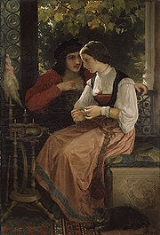
An
engagement or
betrothal is a promise to
marryMarriage is a social union or legal contract between people that creates kinship. It is an institution in which interpersonal relationships, usually intimate and sexual, are acknowledged in a variety of ways, depending on the culture or subculture in which it is found...
, and also the period of time between
proposalA marriage proposal is an event where one person in a relationship asks for the other's hand in marriage. If accepted, it marks the initiation of engagement. It often has a ritual quality, sometimes involving the presentation of an engagement ring and a formalized asking of a question such as "Will...
and marriage which may be lengthy or trivial. During this period, a couple is said to be
betrothed, affianced,
engaged to be married, or simply
engaged. Future
brideA bride is a woman about to be married or newlywed.The word may come from the Proto-Germanic verb root *brū-, meaning 'to cook, brew, or make a broth' which was the role of the daughter-in-law in primitive families...
s and
groomGroom may refer to:* Bridegroom, also shortened to "groom", a male wedding partner-Occupations:* Groom , a person responsible for the feeding and care of horses* Certain distinguished roles in the English Royal Household:...
s may be called
the betrothed, a
wife-to-be or
husband-to-be,
fiancées or
fiancés, respectively (from the French word fiancé). The duration of the courtship varies vastly.
Long engagements were once common in formal
arranged marriageAn arranged marriage is a practice in which someone other than the couple getting married makes the selection of the persons to be wed, meanwhile curtailing or avoiding the process of courtship. Such marriages had deep roots in royal and aristocratic families around the world...
s and it was not uncommon for parents betrothing children to arrange such many years before the engaged couple were old enough to marry.
Origin
The origin of European engagement in marriage practice is found in the Jewish law (
TorahTorah- A scroll containing the first five books of the BibleThe Torah , is name given by Jews to the first five books of the bible—Genesis , Exodus , Leviticus , Numbers and Deuteronomy Torah- A scroll containing the first five books of the BibleThe Torah , is name given by Jews to the first five...
), first exemplified by
AbrahamAbraham , whose birth name was Abram, is the eponym of the Abrahamic religions, among which are Judaism, Christianity and Islam...
, and outlined in the last
TalmudThe Talmud is a central text of mainstream Judaism. It takes the form of a record of rabbinic discussions pertaining to Jewish law, ethics, philosophy, customs and history....
ic tractate of the
NashimNashim is the third order of the Mishnah , containing the laws related to women and family life...
(Women) order, where
marriageMarriage is a social union or legal contract between people that creates kinship. It is an institution in which interpersonal relationships, usually intimate and sexual, are acknowledged in a variety of ways, depending on the culture or subculture in which it is found...
consists of two separate acts, called
erusinErusin is the Hebrew term for betrothal. In modern Hebrew, "erusin" means engagement, but this is not the historical meaning of the term, which is the first part of marriage ....
(or
kiddushin, meaning
sanctification), which is the betrothal ceremony, and
nissu'in or
chupah, the actual
ceremony for the marriageA wedding is the ceremony in which two people are united in marriage or a similar institution. Wedding traditions and customs vary greatly between cultures, ethnic groups, religions, countries, and social classes...
.
Erusin changes the couple's interpersonal status, while
nissu'in brings about the legal consequences of the change of status. (However, in the Talmud and other sources of Jewish law there is also a process, called
shidduchinThe Shidduch is a system of matchmaking in which Jewish singles are introduced to one another in Orthodox Jewish communities for the purpose of marriage....
, corresponding to what today is called engagement. Marrying without such an agreement is considered immoral. To complicate matters,
erusin in modern Hebrew means engagement, not betrothal.)
This was later adopted in Ancient Greece as the
gamos and
engeysis rituals, although unlike in Judaism the contract made in front of witness was only verbal. The giving of a ring was eventually borrowed from Judaism by Roman marriage law, with the fiancé presenting it after swearing the oath of marriage intent, and presenting of the gifts at the engagement party.
Betrothal
Betrothal (also called
espousal) is a formal state of engagement to be
marriedMarriage is a social union or legal contract between people that creates kinship. It is an institution in which interpersonal relationships, usually intimate and sexual, are acknowledged in a variety of ways, depending on the culture or subculture in which it is found...
.
In
Jewish weddingA Jewish wedding is a wedding ceremony that follows Jewish law and traditions.While wedding ceremonies vary, common features of a Jewish wedding include a ketuba signed by two witnesses, a wedding canopy , a ring owned by the groom that is given to the bride under the canopy, and the breaking of a...
s during Talmudic times (c.1st century BCE - 6th century CE), the two ceremonies of betrothal (
erusin) and wedding usually took place up to a year apart; the bride lived with her parents until the actual marriage ceremony (
nissuin), which would take place in a room or tent that the groom had set up for her. Since the Middle Ages the two ceremonies have taken place as a combined ceremony performed in public. The
betrothal is now generally part of the
Jewish weddingA Jewish wedding is a wedding ceremony that follows Jewish law and traditions.While wedding ceremonies vary, common features of a Jewish wedding include a ketuba signed by two witnesses, a wedding canopy , a ring owned by the groom that is given to the bride under the canopy, and the breaking of a...
ceremony, accomplished when the groom gives the bride the ring or another object of at least nominal value. As mentioned above, betrothal in Judaism is separate from engagement; breaking a betrothal requires a formal
divorceGet or GET may refer to:*Get , the offspring of an animal*Get , legal issues around the Jewish divorce procedure*Get , the Jewish divorce procedure...
, and violation of betrothal is considered
adulteryAdultery is sexual infidelity to one's spouse, and is a form of extramarital sex. It originally referred only to sex between a woman who was married and a person other than her spouse. Even in cases of separation from one's spouse, an extramarital affair is still considered adultery.Adultery is...
.
Typical steps of a match were the following:
- Negotiation of a match, usually done by the couple's families with bride and groom having varying levels of input, from no input, to veto power, to a fuller voice in the selection of marriage partner.
- This is not as widely practiced as it was historically, although it is still common in culturally conservative communities in Israel
The State of Israel is a parliamentary republic located in the Middle East, along the eastern shore of the Mediterranean Sea...
, IndiaIndia , officially the Republic of India , is a country in South Asia. It is the seventh-largest country by geographical area, the second-most populous country with over 1.2 billion people, and the most populous democracy in the world...
, Africa, and Persian Gulf countries, although most of these have a requirement that the bride be at least allowed veto power.
- Negotiation of bride price
Bride price, also known as bride wealth, is an amount of money or property or wealth paid by the groom or his family to the parents of a woman upon the marriage of their daughter to the groom...
or dowryA dowry is the money, goods, or estate that a woman brings forth to the marriage. It contrasts with bride price, which is paid to the bride's parents, and dower, which is property settled on the bride herself by the groom at the time of marriage. The same culture may simultaneously practice both...
- In most cultures evolved from Europe, the modern practice has reduced bride prices or dowries to the engagement ring
An engagement ring is a ring indicating that the person wearing it is engaged to be married, especially in Western cultures. In the United Kingdom, Ireland and North America, engagement rings are traditionally worn only by women, and rings can feature diamonds or other gemstones. In other cultures...
accompanying the marriage contract Judaism, while in other cultures (such as those on the Arabian Peninsula), these are still part of negotiating a marriage contract.
- Blessing by the parents and clergy
Clergy is the generic term used to describe the formal religious leadership within a given religion. A clergyman, churchman or cleric is a member of the clergy, especially one who is a priest, preacher, pastor, or other religious professional....
- Exchange of Vows and Signing of Contracts
- Often one of these is omitted
- Celebration
The exact duration of a betrothal varies according to culture and the participants’ needs and wishes. For adults, it may be anywhere from several hours (when the betrothal is incorporated into the wedding day itself) to a period of several years. A year and a day are common in neo-pagan groups today. In the case of
child marriageChild marriage and child betrothal customs occur in various times and places, whereby children are given in matrimony - before marriageable age as defined by the commentator and often before puberty. Today such customs are fairly widespread in parts of Africa, Asia, Oceania and South America: in...
, betrothal might last from infancy until the age of marriage.
The responsibilities and privileges of betrothal vary. In most cultures, the betrothed couple is expected to spend much time together, learning about each other. In some historical cultures (including colonial North America), the betrothal was essentially a trial marriage, with marriage only being required in cases of conception of a child. In almost all cultures there is a loosening of restrictions against physical contact between partners, even in cultures which would normally otherwise have strong prohibitions against it. The betrothal period was also considered to be a preparatory time, in which the groom would build a house, start a business or otherwise prove his readiness to enter adult society.
In medieval Europe, in
canon lawCanon law is the body of laws & regulations made or adopted by ecclesiastical authority, for the government of the Christian organization and its members. It is the internal ecclesiastical law governing the Catholic Church , the Eastern and Oriental Orthodox churches, and the Anglican Communion of...
, a betrothal could be formed by the exchange of vows in the future tense ("I
will take you as my wife/husband," instead of "I take you as my wife/husband"), but sexual intercourse consummated the vows, making a binding marriage rather than a betrothal. Although these betrothals could be concluded with only the vows spoken by the couple, they had legal implications:
Richard III of EnglandRichard III was King of England for two years, from 1483 until his death in 1485 during the Battle of Bosworth Field. He was the last king of the House of York and the last of the Plantagenet dynasty...
had his older brother's children declared illegitimate on the grounds their father had been betrothed to another woman when he married their mother.
A betrothal is considered to be a 'semi-binding' contract. Normal reasons for invalidation of a betrothal include:
- Revelation of a prior commitment or marriage,
- Evidence of infidelity
In many intimate relationships in many cultures there is usually an express or implied expectation of exclusivity, especially in sexual matters. Infidelity most commonly refers to a breach of the expectation of sexual exclusivity.Infidelity can occur in relation to physical intimacy and/or...
,
- Failure to conceive (in 'trial marriage' cultures),
- Failure of either party to meet the financial and property stipulations of the betrothal contract.
Normally a betrothal can also be broken at the behest of either party, though some financial penalty (such as forfeit of the bride price) usually will apply.
Orthodox Church
In the
Eastern OrthodoxThe Orthodox Church, officially called the Orthodox Catholic Church and commonly referred to as the Eastern Orthodox Church, is the second largest Christian denomination in the world, with an estimated 300 million adherents mainly in the countries of Belarus, Bulgaria, Cyprus, Georgia, Greece,...
and Greek-Catholic Churches, the Rite of Betrothal will traditionally be performed in the
narthexThe narthex of a church is the entrance or lobby area, located at the end of the nave, at the far end from the church's main altar. Traditionally the narthex was a part of the church building, but was not considered part of the church proper...
(entranceway) of the church, to indicate the couple's first entrance into the married estate. The priest will bless the couple and give them lit candles to hold. Then, after a
litanyEktenia , often called simply Litany, is a prayerful petition in the Eastern Orthodox/Eastern Catholic liturgy...
, and a prayer at which everyone bows, he places the bride's ring on the ring finger of the groom's right hand, and the groom's ring on the bride's finger. The rings are then exchanged three times, either by the priest or by the best man, after which the priest says a final prayer. Originally, the betrothal service would take place at the time the engagement was announced. In recent times, however, it tends to be performed immediately before the wedding ceremony itself. The exchange of rings is not a part of the wedding service in the Eastern Churches, but only occurs at the betrothal. Traditionally, the groom's ring is gold and the bride's ring is silver.
Historically betrothal in Catholicism was a formal
contractA contract is an agreement entered into by two parties or more with the intention of creating a legal obligation, which may have elements in writing. Contracts can be made orally. The remedy for breach of contract can be "damages" or compensation of money. In equity, the remedy can be specific...
considered as binding as marriage, and a divorce was necessary to terminate a betrothal. Betrothed couples were regarded legally as husband and wife - even before their wedding and physical union.
The concept of an official engagement period in Western European culture may have begun in 1215 at the Fourth Lateran Council, headed by
Pope Innocent IIIPope Innocent III was Pope from 8 January 1198 until his death. His birth name was Lotario dei Conti di Segni, sometimes anglicised to Lothar of Segni....
, which decreed that "marriages are to be ... announced publicly in the churches by the priests during a suitable and fixed time, so that if legitimate
impedimentsIn the Canon Law of the Catholic Church, a canonical impediment is a legal obstacle that prevents a sacrament from being performed validly and/or licitly. The term is used most frequently in relationship to the sacraments of Marriage and Holy Orders...
exist, they may be made known." Such a formal church announcement of the intent to marry is known as banns. In some jurisdictions, reading the banns may be part of one type of legal marriage.
Exceptions
Some couples choose not to label their agreement to marry as "engagement". This may be the case where one or both partners is marrying for the second time. In these cases, the groom may not
proposeA marriage proposal is an event where one person in a relationship asks for the other's hand in marriage. If accepted, it marks the initiation of engagement. It often has a ritual quality, sometimes involving the presentation of an engagement ring and a formalized asking of a question such as "Will...
in a formal manner; and an
engagement ringAn engagement ring is a ring indicating that the person wearing it is engaged to be married, especially in Western cultures. In the United Kingdom, Ireland and North America, engagement rings are traditionally worn only by women, and rings can feature diamonds or other gemstones. In other cultures...
might not be given or worn.
Engagement rings
Customs for engagement rings vary according to time, place, and culture. An engagement ring has historically been uncommon, and when such a gift was given, it was separate from the wedding ring.
The tradition of giving a ring for marriage engagement originated from
JudaismJudaism ) is the "religion, philosophy, and way of life" of the Jewish people...
that was originally a golden nose ring (
Chayei SarahChayei Sarah, Chaye Sarah, or Hayye Sarah is the fifth weekly Torah portion in the annual Jewish cycle of Torah reading. It constitutes Genesis Jews read it on the fifth Sabbath after Simchat Torah, generally in November....
24:22) given by Eliezer of Damascus to
RebeccaRebecca a biblical matriarch from the Book of Genesis and a common first name. In this book Rebecca was said to be a beautiful girl. As a name it is often shortened to Becky, Becki or Becca; see Rebecca ....
, with Saadiah Gaon also citing as a possible source of the practice in the phrase in
NehemiahNehemiah ]]," Standard Hebrew Nəḥemya, Tiberian Hebrew Nəḥemyāh) is the central figure of the Book of Nehemiah, which describes his work rebuilding Jerusalem and purifying the Jewish community. He was the son of Hachaliah, Nehemiah ]]," Standard Hebrew Nəḥemya, Tiberian Hebrew Nəḥemyāh) is the...
7:46
be’nei tabbaot (children of the rings). The latter case refers to betrothal (see above) rather than engagement; one of the three ways in which betrothal may be accomplished in Judaism is by the husband giving the bride money or an object of at leat nominal value. In fact, it is a long-standing practice within Judaism to contract the betrothal with a ring.
Romantic rings from the time of the
Roman EmpireThe Roman Empire was the post-Republican period of the ancient Roman civilization, characterised by an autocratic form of government and large territorial holdings in Europe and around the Mediterranean....
sometimes bore clasped hands symbolizing contract, from which the later
CeltThe Celts were a diverse group of tribal societies in Iron Age and Roman-era Europe who spoke Celtic languages.The earliest archaeological culture commonly accepted as Celtic, or rather Proto-Celtic, was the central European Hallstatt culture , named for the rich grave finds in Hallstatt, Austria....
ic
CladdaghThe Claddagh ring is a traditional Irish ring given as a token of friendship, love and/or as a wedding ring. The design and customs associated with it originated in the Irish fishing village of Claddagh, located just outside the city of Galway...
symbol (two hands clasping a heart) may have evolved as a symbol of love and commitment between two people. Romans believed the circle was a bond between the two people who were to be married and signified eternity, but was first practiced on the
fourth finger/ring fingerThe ring finger is the fourth digit of the human hand, and the second most ulnar finger, located between the middle finger and the little finger. It is also called digitus medicinalis, the fourth finger, digitus annularis, digitus quartus, or digitus IV in anatomy.- Etymology :According to László A...
by the
RomansThe Roman Empire was the post-Republican period of the ancient Roman civilization, characterised by an autocratic form of government and large territorial holdings in Europe and around the Mediterranean....
, who believed this finger to be the beginning of the
vena amorisVena amoris is a Latin name meaning, literally, "vein of love". Traditional belief established that this vein ran directly from the heart to the fourth finger of the left hand. This theory has been cited in western cultures as one of the reasons the engagement ring and/or wedding ring was placed...
("vein of love"), the vein that leads to the heart. In cultures with European origin, and many other countries, an
engagement ringAn engagement ring is a ring indicating that the person wearing it is engaged to be married, especially in Western cultures. In the United Kingdom, Ireland and North America, engagement rings are traditionally worn only by women, and rings can feature diamonds or other gemstones. In other cultures...
is worn following the practice of the Romans who "...wore the ring either on the right middle finger or the left ring [4th] finger, from which, according to ancient Egyptian physicians, a nerve led directly to the heart." The custom in
Continental EuropeContinental Europe, also referred to as mainland Europe or simply the Continent, is the continent of Europe, explicitly excluding European islands....
and other countries is to wear it on the right hand. One historical exception arose in monarchical regimes, in which a nobleman entering into
morganatic marriageIn the context of European royalty, a morganatic marriage is a marriage between people of unequal social rank, which prevents the passage of the husband's titles and privileges to the wife and any children born of the marriage...
, a marriage in which the person, usually the woman, of lower rank stayed at the same rank instead of rising ranks, would present his left hand to receive the ring, hence the alternative term 'marriage with the left hand' (Ger.
Ehe zur linken Hand), the offspring of such marriages considered to be disinherited from birth.
The modern Western form of the practice of giving or exchanging
engagement ringAn engagement ring is a ring indicating that the person wearing it is engaged to be married, especially in Western cultures. In the United Kingdom, Ireland and North America, engagement rings are traditionally worn only by women, and rings can feature diamonds or other gemstones. In other cultures...
s is traditionally thought to have begun in 1477 when
Maximilian I, Holy Roman EmperorMaximilian I , the son of Frederick III, Holy Roman Emperor and Eleanor of Portugal, was King of the Romans from 1486 and Holy Roman Emperor from 1493 until his death, though he was never in fact crowned by the Pope, the journey to Rome always being too risky...
, gave
Mary of BurgundyMary of Burgundy ruled the Burgundian territories in Low Countries and was suo jure Duchess of Burgundy from 1477 until her death...
a
diamondIn mineralogy, diamond is an allotrope of carbon, where the carbon atoms are arranged in a variation of the face-centered cubic crystal structure called a diamond lattice. Diamond is less stable than graphite, but the conversion rate from diamond to graphite is negligible at ambient conditions...
ring as an engagement present.
In other countries like
ArgentinaArgentina , officially the Argentine Republic , is the second largest country in South America by land area, after Brazil. It is constituted as a federation of 23 provinces and an autonomous city, Buenos Aires...
, men and women each wear a ring similar to wedding bands. They are made of silver ("alianza de plata") when manifesting an informal "boyfriend-girlfriend" relationship, though this first step might not always happen; howbeit depending on finances, this may be the only ring given at all. The gold band ("anillo de compromiso" or "alianza de oro") is given to the bride when the commitment is formal and the [optional] diamond ring ("cintillo") is reserved for the wedding ceremony when the groom gives it to the bride. The gold band that the groom wore during the engagement - or a new one, as some men choose not to wear them during engagement - is then given to the groom by the bride; and the bride receives both the original gold band and the new diamond at the ceremony. The bride's diamond ring is worn on top of the engagement band at the wedding and thereafter, especially at formal occasions or parties; otherwise the engagement band suffices for daily wear for both parties. At the wedding, the rings are swapped from the right to the left hand. In
BrazilBrazil , officially the Federative Republic of Brazil , is the largest country in South America. It is the world's fifth largest country, both by geographical area and by population with over 192 million people...
, they are always made of gold, and there is no tradition for the engagement ring. Both men and women wear the wedding band on their right hand while engaged, and, after they marry, they shift the rings to their left hands. In
Nordic countriesThe Nordic countries make up a region in Northern Europe and the North Atlantic which consists of Denmark, Finland, Iceland, Norway and Sweden and their associated territories, the Faroe Islands, Greenland and Åland...
such as
FinlandFinland , officially the Republic of Finland, is a Nordic country situated in the Fennoscandian region of Northern Europe. It is bordered by Sweden in the west, Norway in the north and Russia in the east, while Estonia lies to its south across the Gulf of Finland.Around 5.4 million people reside...
and
NorwayNorway , officially the Kingdom of Norway, is a Nordic unitary constitutional monarchy whose territory comprises the western portion of the Scandinavian Peninsula, Jan Mayen, and the Arctic archipelago of Svalbard and Bouvet Island. Norway has a total area of and a population of about 4.9 million...
, both men and women wear an engagement ring.
In the modern era, some women's wedding rings are made into two separate pieces. One part is given to her to wear as an engagement ring when she accepts the marriage proposal and the other during the wedding ceremony. When worn together, the two rings look like one piece of jewelry.
Engagement parties
Some engagements are announced at an engagement party, traditionally hosted by the bride's parents. These parties are given in the family's usual style of entertainment. Traditionally, engagement parties were normal parties at which a surprise announcement of the engagement was made by the father of the bride to his guests. Therefore, it is not a traditional gift-giving occasion since no guests were supposed to be aware of the engagement until after their arrival.
In modern times, engagement parties often celebrate a previously publicized engagement. Whether presents are given at these engagement parties varies from culture to culture.