
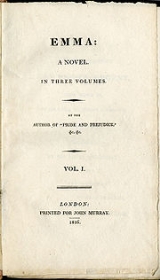
Emma, by
Jane AustenJane Austen was an English novelist whose works of romantic fiction, set among the landed gentry, earned her a place as one of the most widely read writers in English literature, her realism and biting social commentary cementing her historical importance among scholars and critics.Austen lived...
, is a novel about the perils of misconstrued romance. The novel was first published in December 1815. As in her other novels, Austen explores the concerns and difficulties of genteel women living in
GeorgianThe Georgian era is a period of British history which takes its name from, and is normally defined as spanning the reigns of, the first four Hanoverian kings of Great Britain : George I, George II, George III and George IV...
-Regency England; she also creates a lively '
comedy of mannersThe comedy of manners is a genre of play/television/film which satirizes the manners and affectations of a social class, often represented by stock characters, such as the miles gloriosus in ancient times, the fop and the rake during the Restoration, or an old person pretending to be young...
' among her characters.
Before she began the novel, Austen wrote, "I am going to take a heroine whom no one but myself will much like." In the very first sentence she introduces the title character as "Emma Woodhouse, handsome, clever, and rich." Emma, however, is also rather spoiled; she greatly overestimates her own matchmaking abilities; and she is blind to the dangers of meddling in other people's lives and is often mistaken about the meanings of others' actions.
Plot summary
Although convinced that she herself will never marry anyone,
Emma WoodhouseEmma Woodhouse is the 20-year old protagonist of Jane Austen's novel Emma. She is described in the novel's opening sentence as "handsome, clever, and rich, with a comfortable home and a happy disposition."...
, a precocious almost twenty-one-year-old resident of the village of Highbury, imagines herself to be naturally gifted in conjuring love matches. After self-declared success at matchmaking between her governess and Mr. Weston, a village widower, Emma takes it upon herself to find an eligible match for her new friend, Harriet Smith. Though Harriet’s parentage is unknown, Emma is convinced that Harriet deserves to be a gentleman’s wife and sets her friend’s sights on Mr. Elton, the village vicar. Meanwhile, Emma persuades Harriet to reject the proposal of Robert Martin, a well-to-do farmer for whom Harriet clearly has feelings.
Harriet becomes infatuated with Mr. Elton under Emma’s encouragement, but Emma’s plans go awry when Elton makes it clear that his affection is for Emma, not Harriet. Emma realizes that her obsession with making a match for Harriet has blinded her to the true nature of the situation. Mr. Knightley, the brother of Emma’s brother-in-law and her treasured friend, watches Emma’s matchmaking efforts with a critical eye. He believes that Mr. Martin is a worthy young man whom Harriet would be lucky to marry. He and Emma quarrel over Emma’s meddling, and, as usual, Mr. Knightley proves to be the wiser of the pair. Elton, spurned by Emma and offended by her insinuation that Harriet is his equal, leaves for the town of Bath and marries a young woman there almost immediately.
Emma is left to comfort Harriet and to wonder about the character of a new visitor expected in Highbury—Mr. Weston’s son, Frank Churchill. Frank is set to visit his father in Highbury after having been raised by his aunt and uncle in London, who have also adopted him as their heir. Emma knows nothing about Frank, who has long been deterred from visiting his father by his aunt’s illnesses and complaints. Mr. Knightley is immediately suspicious of the young man, especially after Frank rushes back to London merely to have his hair cut. Emma, however, finds Frank delightful and notices that his charms are directed mainly toward her. Though she plans to discourage these charms, she finds herself flattered and engages in a flirtation with the young man. Emma greets Jane Fairfax, another addition to the Highbury set, with less enthusiasm. Jane is beautiful and accomplished, but Emma dislikes her because of her reserve and, the narrator insinuates, because she is jealous of Jane.
Suspicion, intrigue, and misunderstandings ensue. Mr. Knightley defends Jane, saying that she deserves compassion because, unlike Emma, she has no independent fortune and must soon leave home to work as a governess. Mrs. Weston suspects that the warmth of Mr. Knightley’s defense comes from romantic feelings, an implication Emma resists. Everyone assumes that Frank and Emma are forming an attachment, though Emma soon dismisses Frank as a potential suitor and imagines him as a match for Harriet. At a village ball, Knightley earns Emma’s approval by offering to dance with Harriet, who has just been humiliated by Mr. Elton and his new wife. The next day, Frank saves Harriet from Gypsy beggars. When Harriet tells Emma that she has fallen in love with a man above her social station, Emma believes that she means Frank. Knightley begins to suspect that Frank and Jane have a secret understanding, and he attempts to warn Emma. Emma laughs at Knightley’s suggestion and loses Knightley’s approval when she flirts with Frank and insults Miss Bates, a kindhearted spinster and Jane’s aunt, at a picnic. When Knightley reprimands Emma, she weeps.
News comes that Frank’s aunt has died, and this event paves the way for an unexpected revelation that slowly solves the mysteries. Frank and Jane have been secretly engaged; his attentions to Emma have been a screen to hide his true preference. With his aunt’s death and his uncle’s approval, Frank can now marry Jane, the woman he loves. Emma worries that Harriet will be crushed, but she soon discovers that it is Knightley, not Frank, who is the object of Harriet’s affection. Harriet believes that Knightley shares her feelings. Emma finds herself upset by Harriet’s revelation, and her distress forces her to realize that she is in love with Knightley. Emma expects Knightley to tell her he loves Harriet, but, to her delight, Knightley declares his love for Emma. Harriet is soon comforted by a second proposal from Robert Martin, which she accepts. The novel ends with the marriage of Harriet and Mr. Martin and that of Emma and Mr. Knightley, resolving the question of who loves whom after all.
Principal characters
Emma WoodhouseEmma Woodhouse is the 20-year old protagonist of Jane Austen's novel Emma. She is described in the novel's opening sentence as "handsome, clever, and rich, with a comfortable home and a happy disposition."...
, the protagonist of the story, is a beautiful, high-spirited, intelligent, and 'slightly' spoiled young woman of the age of twenty. Her mother died when she was very young, and she has been mistress of the house ever since, certainly since her older sister got married. Although intelligent, she lacks the necessary discipline to practice or study anything in depth. She is portrayed as very compassionate to the poor, but at the same time has a strong sense of class. Her affection for and patience towards her hypochondriac father are also noteworthy. While she is in many ways mature for her age, Emma makes some serious mistakes, mainly due to her conviction that she is always right and her lack of real world experience. Although she has vowed she will never ever marry, she delights in making matches for others. She seems unable to fall in love, until jealousy makes her realize that she has loved Mr. Knightley all along.
George KnightleyGeorge Knightley is a principal character depicted by Jane Austen in her novel Emma, written in 1816. He is a very wealthy landowner and a lifetime friend of Emma's, though he is nearly seventeen years older than her...
, about thirty-seven years old, is a close friend of Emma, and her only critic, although he cares deeply for her. Mr. Knightley is the owner of the estate of Donwell Abbey, which includes extensive grounds and a farm. He is the elder brother of Mr. John Knightley, the husband of Emma's elder sister Isabella. Mr Knightley is very annoyed with Emma for persuading Harriet to turn down Mr Martin, thinking that the advantage is all on Harriet's side; he also warns Emma against matchmaking Harriet with Mr. Elton, correctly guessing that Mr. Elton has a much higher opinion of himself. He is suspicious of Frank Churchill and his motives; although his suspicion turns out to be based mainly on jealousy of the younger man, his instincts are proven correct by the revelation that Frank Churchill is not all that he seems.
Mr. Frank Churchill, Mr. Weston's son by his previous marriage, is an amiable young man, who manages to be liked by everyone except Mr. Knightley, who considers him quite immature, although this partially results from his jealously of Frank's supposed 'pursuit' of Emma. After his mother's death, he was raised by his wealthy aunt and uncle, whose last name he took. Frank enjoys dancing and music and living life to the fullest. Frank may be viewed as a careless but less villainous version of characters from other Austen novels, such as Mr. Wickham from
Pride and PrejudicePride and Prejudice is a novel by Jane Austen, first published in 1813. The story follows the main character Elizabeth Bennet as she deals with issues of manners, upbringing, morality, education and marriage in the society of the landed gentry of early 19th-century England...
or Willoughby from
Sense and SensibilitySense and Sensibility, published in 1811, is a British romance novel by Jane Austen, her first published work under the pseudonym, "A Lady." Jane Austen is considered a pioneer of the romance genre of novels, and for the realism portrayed in her novels, is one the most widely read writers in...
.
Jane Fairfax, an orphan whose only family consists of an aunt, Miss Bates, and a grandmother, Mrs. Bates, is regarded as a very beautiful, clever, and elegant woman, with the best of manners, and is also very well-educated and exceptionally talented at singing and playing the piano; in fact, she is the sole person whom Emma envies. She has little fortune, however, and seems destined to become a governess – a prospect she dislikes.
Harriet Smith, a young friend of Emma's, is a very pretty but unsophisticated girl who is too easily led by others, especially Emma; she has been educated at a nearby school. The illegitimate daughter of initially unknown parents, she is revealed in the last chapter to be the daughter of a fairly rich and decent tradesman, although not a "
gentlemanThe term gentleman , in its original and strict signification, denoted a well-educated man of good family and distinction, analogous to the Latin generosus...
". Emma takes Harriet under her wing early in the novel, and she becomes the subject of some of Emma's misguided matchmaking attempts. Harriet initially rebuffs a marriage proposal from farmer Robert Martin because of Emma's belief that he is beneath her, despite Harriet's own doubtful origins. She then develops a passion for Mr. Knightley, which is the catalyst for Emma realising her own feelings. Ultimately, Harriet and Mr. Martin are wed, despite Emma's initial meddling. The now wiser Emma approves of the match.
Philip Elton is a good-looking, well mannered, and ambitious young vicar. Emma wants him to marry Harriet; he wants to marry Emma. Mr. Elton displays his mercenary nature by quickly marrying another woman of means after Emma's rejection.
Augusta Elton, formerly Miss Hawkins, is Mr. Elton's wife. She is moneyed but lacks breeding and possesses moderately good manners, at best. She is a boasting, domineering, pretentious woman who likes to be the centre of attention and is generally disliked by Emma and her circle. She patronizes Jane, which earns Jane the sympathy of others.
Mrs. Anne Weston, formerly Miss Taylor, was Emma's governess for sixteen years and remains her closest friend and confidante after she marries Mr. Weston in the opening chapter. She is a sensible woman who adores and idolizes Emma. Mrs. Weston acts as a surrogate mother to her former charge and, occasionally, as a voice of moderation and reason, although she is the one to yield in arguments more often than not.
Mr. Weston, a recently wealthy man living in the vicinity of Hartfield, marries Emma's former governess, Miss Taylor, and by his first marriage is father to Frank Churchill, who was adopted and raised by his late wife's brother and sister-in-law. Mr. Weston is a sanguine, optimistic man, who enjoys socializing.
Miss Bates is a friendly, garrulous spinster whose mother, Mrs. Bates, is a friend of Mr. Woodhouse. Her accomplished niece, Jane Fairfax, is the light of her life. One day, Emma humiliates her on a day out in the country, when she pointedly alludes to her tiresome prolixity. Afterward, Mr. Knightley sternly rebukes Emma. Shamed, Emma tries to make amends.
Mr. Henry Woodhouse, Emma's father, is always concerned for his own health and comfort, and to the extent that it does not interfere with his own, the health and comfort of his friends. He is a
valetudinarian (i.e., similar to a hypochondriac but more likely to be genuinely ill). He assumes a great many things are hazardous to one's health, and is generally a difficult person to handle because he is always fussing about the trifling things which bother him and which he assumes must bother everyone else just the same, to the point of trying to convince his visitors to deny foods he considers too rich. He laments that "poor Isabella" and especially "poor Miss Taylor" have married and been taken away from him, because since he is unhappy about their being gone, he assumes they must be miserable as well; moreover, he dislikes change in general, and marriage is a form of change.
Isabella Knightley (née Woodhouse) is the elder sister of Emma and daughter of Henry. She is married to John Knightley, and spends much of her time at home caring for her five children (Henry, 'little' John, Bella, 'little' Emma, and George).
John Knightley is Isabella's husband and George's younger brother. He is an old acquaintance of Jane Fairfax. He indulges his family's desires for visits and vacations, although he would prefer to stay at home, especially if the weather is less than perfect.
Criticism
Early reviews of
Emma were generally favorable, but there were some criticisms about the lack of story. John Murray remarked that it lacked "incident and Romance";
Maria EdgeworthMaria Edgeworth was a prolific Anglo-Irish writer of adults' and children's literature. She was one of the first realist writers in children's literature and was a significant figure in the evolution of the novel in Europe...
, the author of
BelindaBelinda is an 1801 novel by the Irish writer Maria Edgeworth. It was first published in three volumes by Joseph Johnson of London in 1801, and was later reprinted by Pandora Press in 1986...
, to whom Austen had sent a complimentary copy, wrote:
there was no story in it, except that Miss Emma found that the man whom she designed for Harriet's lover was an admirer of her own – & he was affronted at being refused by Emma & Harriet wore the willow – and smooth, thin water-gruel is according to Emma's father's opinion a very good thing & it is very difficult to make a cook understand what you mean by smooth, thin water-gruel!!
Themes
Emma Woodhouse is the first Austen heroine with no financial concerns, which, she declares to the naïve Miss Smith, is the reason that she has no inducement to marry. This is a great departure from Austen's other novels, in which the quest for marriage and financial security are often important themes in the stories. Emma's ample financial resources put her in a much more privileged position than the heroines of Austen's earlier works, such as
Sense and SensibilitySense and Sensibility, published in 1811, is a British romance novel by Jane Austen, her first published work under the pseudonym, "A Lady." Jane Austen is considered a pioneer of the romance genre of novels, and for the realism portrayed in her novels, is one the most widely read writers in...
and
Pride and PrejudicePride and Prejudice is a novel by Jane Austen, first published in 1813. The story follows the main character Elizabeth Bennet as she deals with issues of manners, upbringing, morality, education and marriage in the society of the landed gentry of early 19th-century England...
. Jane Fairfax's prospects, in contrast, are bleak.
In contrast to other Austen heroines Emma seems immune to romantic attraction. Unlike
Marianne DashwoodMarianne Dashwood is a fictional character in the Jane Austen novel Sense and Sensibility. The 17-year-old second daughter of Mr. and Mrs. Henry Dashwood, she embodies the ‘sensibility’ of the title, as opposed to her elder sister Elinor’s ‘sense.’...
, who is attracted to the wrong man before she settles on the right one, Emma shows no romantic interest in the men she meets. She is genuinely surprised (and somewhat disgusted) when Mr Elton declares his love for her—much in the way
Elizabeth BennetElizabeth Bennet, later Elizabeth Darcy, is the protagonist in the 1813 novel Pride and Prejudice by Jane Austen. She is often referred to as Eliza or Lizzy by her friends and family...
singularly reacts to the obsequious Mr Collins. Her fancy for Frank Churchill represents more of a longing for a little drama in her life than a longing for romantic love. Notably too, Emma utterly fails to understand the budding affection between Harriet Smith and Robert Martin; she interprets the prospective match solely in terms of financial settlements and social ambition. It is only after Harriet Smith reveals her interest in Mr Knightley that Emma realizes her own feelings for him.
While Emma differs strikingly from Austen's other heroines in these two respects, she resembles
Elizabeth BennetElizabeth Bennet, later Elizabeth Darcy, is the protagonist in the 1813 novel Pride and Prejudice by Jane Austen. She is often referred to as Eliza or Lizzy by her friends and family...
and
Anne ElliotAnne Elliot is the protagonist of Jane Austen's sixth and last completed novel, Persuasion .-Description:Anne is the overlooked middle daughter of a narcissistic and extravagant baronet, Sir Walter Elliot of Kellynch Hall. Unique among Jane Austen heroines, she is 27 years old and seemingly a...
, among others, in another way: she is an intelligent young woman with too little to do and no ability to change her location or everyday routine. Though her family is loving and her economic status secure, Emma's everyday life is dull indeed; she has few companions her own age when the novel begins. Her determined though inept matchmaking may represent a muted protest against the narrow scope of a wealthy woman's life, especially that of a woman who is single and childless.
Film, television and stage adaptations
Emma has been the subject of many adaptations:
- 1948: Emma
- 1972: Emma
Jane Austen's novel Emma was released on British television in 1972.This dramatization brings to life the wit and humour of Jane Austen's arguably finest novel Emma, recreating her most irritatingly endearing female character, of whom she wrote "no one but myself could like."Emma presides over the...
(BBCThe British Broadcasting Corporation is a British public service broadcaster. Its headquarters is at Broadcasting House in the City of Westminster, London. It is the largest broadcaster in the world, with about 23,000 staff...
television), starring Doran GodwinDoran Godwin is a British actress.She is mainly remembered for her roles as Erica Bayliss in the popular TV detective series Shoestring and as Philippa Yeates in The Irish R.M., opposite Peter Bowles. She also played the title role in the 1972 BBC production of Emma. She has appeared extensively...
as Emma.
- 1995: Clueless, a loose modern adaptation of the novel, by Amy Heckerling, starring Alicia Silverstone
Alicia Silverstone is an American actress, author, and former fashion model. She first came to widespread attention in music videos for Aerosmith, and is perhaps best known for her roles in Hollywood films such as Clueless and her portrayal of Batgirl in Batman & Robin .-Early life:Silverstone...
as Cher Horowitz (Emma).
- 1996: Emma
Emma is a 1996 period film based on the novel of the same name by Jane Austen. Directed by Douglas McGrath, it stars Gwyneth Paltrow, Jeremy Northam, Toni Collette, and Ewan McGregor.- Synopsis :...
, a film starring Gwyneth PaltrowGwyneth Kate Paltrow is an American actress and singer. She made her acting debut on stage in 1990 and started appearing in films in 1991. After appearing in several films throughout the decade, Paltrow gained early notice for her work in films such as Se7en and Emma...
as Emma.
- 1996: Emma, a Television drama starring Kate Beckinsale
Kathryn Bailey "Kate" Beckinsale is an English actress. After some minor television roles, she made her film debut in Much Ado About Nothing while still a student at Oxford University...
as Emma.
- 2009: Emma
Emma is a four-part BBC television drama serial adaptation of Jane Austen's novel Emma, first published in 1815. The episodes were written by Sandy Welch, acclaimed writer of previous BBC costume-dramas Jane Eyre and North and South, and directed by Jim O'Hanlon...
(BBCThe British Broadcasting Corporation is a British public service broadcaster. Its headquarters is at Broadcasting House in the City of Westminster, London. It is the largest broadcaster in the world, with about 23,000 staff...
television), starring Romola GaraiRomola Sadie Garai is an English actress. She is known for appearing in the movies Amazing Grace, Atonement, and Glorious 39, and for appearing in the BBC adaptation of Emma.-Early life:...
as Emma.
- 2010: Aisha
- Tracklist :...
, starring Sonam KapoorSonam Kapoor is an Indian film actress who appears in Bollywood films. Kapoor made her acting debut in the unsuccessful film Saawariya opposite newcomer Ranbir Kapoor, which earned her a nomination for Filmfare Award for Best Female Debut. She earned her first commercial success in I Hate Luv...
as Aisha (Emma – Hindi language Version), produced by Rhea KapoorRhea Kapoor is an Indian film producer who produces Bollywood films. She is the producer of Aisha which is a remake of Jane Austen's Emma stars Sonam Kapoor and Abhay Deol.-Early life:...
- 2011: Jane Austen's Emma: A Romantic Musical Comedy presented by the Old Globe Theatre
The Old Globe is a professional theatre company located in Balboa Park in San Diego, California. It produces about 15 plays and musicals annually in summer and winter seasons...
in San Diego. Book, music and lyrics by Paul Gordon-Career:Gordon composed the music and lyrics for the stage musical Jane Eyre which ran on Broadway in 2001, for which he received a Tony Award nomination...
and directed by Jeff CalhounJeff Calhoun is an American director, choreographer, producer and dancer.As a student at Richland High School, now Pine-Richland High School , Calhoun was interested in both athletics and performance, playing football and studying tap dance. He danced in the ensemble at The Kenley Players in Ohio...
.
Popular culture
- The novel Emma is featured in the film Naked (1993)
Naked is a 1993 British film directed by Mike Leigh. Before this film, Leigh was known for subtler comedic dissections of middle-class and working-class manners. Naked was more stark and brutal than his previous works...
by Mike LeighMichael "Mike" Leigh, OBE is a British writer and director of film and theatre. He studied theatre at the Royal Academy of Dramatic Art, and studied further at the Camberwell School of Art and the Central School of Art and Design. He began as a theatre director and playwright in the mid 1960s...
, in which the character Johnny (played by David ThewlisDavid Thewlis is an English actor of stage and screen. His most commercially successful role to date has been that of Remus Lupin, in the Harry Potter film series...
) confuses the title and the name of the author.
- Joan Aiken
Joan Delano Aiken MBE was an English novelist. She was born in Rye, East Sussex, into a family of writers, including her father, American poet Conrad Aiken , her sister, Jane Aiken Hodge and her brother John Aiken Joan Delano Aiken MBE (4 September 1924 – 4 January 2004) was an English novelist....
wrote a companion novel, Jane Fairfax: The Secret Story of the Second Heroine in Jane Austen's Emma.
- Reginald Hill
Reginald Charles Hill is an English crime writer, and the winner in 1995 of the Crime Writers' Association Cartier Diamond Dagger for Lifetime Achievement.- Biography :...
wrote a 1987 short story "Poor Emma" (included in the 2007 paperback There are no Ghosts in the Soviet Union) in which finances and security play the central role.
- The Importance of Being Emma, a novel by Juliet Archer, is a modern version of Emma.
- Emma and the Werewolves: Jane Austen's Classic Novel with Blood-curdling Lycanthropy, a mashup novel
A mashup novel, or mashup book , is a work of fiction which combines a pre-existing text, often a classic work of fiction, with a certain popular genre such as vampire or zombie narratives...
by Adam Rann.
- Andrew Trees' novel Academy X, about a prep school in New York City, utilizes Emma in the plot. The main character, John, is head of the English department and teaches Emma to his senior literature class. The character of Caitlin is often compared to the eponymous heroine because of her looks, money, and high-standing position in the social hierarchy of the school.
- William Deresiewicz, "A Jane Austen Education: How Six Novels Taught Me About Love, Friendship, and the Things That Really Matter" (Penguin Press, 2011)
External links