
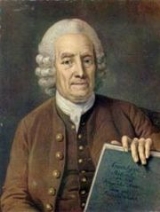
was a Swedish
scientistA scientist in a broad sense is one engaging in a systematic activity to acquire knowledge. In a more restricted sense, a scientist is an individual who uses the scientific method. The person may be an expert in one or more areas of science. This article focuses on the more restricted use of the word...
, philosopher, and theologian. He has been termed a Christian mystic by some sources, including the
Encyclopædia BritannicaThe Encyclopædia Britannica , published by Encyclopædia Britannica, Inc., is a general knowledge English-language encyclopaedia that is available in print, as a DVD, and on the Internet. It is written and continuously updated by about 100 full-time editors and more than 4,000 expert...
online version, and the
Encyclopedia of Religion (1987), which starts its article with the description that he was a "Swedish scientist and mystic." Others have not used the term, e.g. He termed himself “Servant of the Lord Jesus Christ” in
True Christian Religion, one of his published works.
Swedenborg had a prolific career as an inventor and
scientistA scientist in a broad sense is one engaging in a systematic activity to acquire knowledge. In a more restricted sense, a scientist is an individual who uses the scientific method. The person may be an expert in one or more areas of science. This article focuses on the more restricted use of the word...
. In 1741 at the age of fifty-three he entered into a spiritual phase in which he eventually began to experience
dreamDreams are successions of images, ideas, emotions, and sensations that occur involuntarily in the mind during certain stages of sleep. The content and purpose of dreams are not definitively understood, though they have been a topic of scientific speculation, philosophical intrigue and religious...
s and visions beginning on
EasterEaster is the central feast in the Christian liturgical year. According to the Canonical gospels, Jesus rose from the dead on the third day after his crucifixion. His resurrection is celebrated on Easter Day or Easter Sunday...
weekend April 6, 1744. This culminated in a spiritual awakening, whereupon he claimed he was appointed by the Lord to write a heavenly
doctrineDoctrine is a codification of beliefs or a body of teachings or instructions, taught principles or positions, as the body of teachings in a branch of knowledge or belief system...
to reform
ChristianityChristianity is a monotheistic religion based on the life and teachings of Jesus as presented in canonical gospels and other New Testament writings...
. He claimed that the Lord had opened his spiritual eyes, so that from then on he could freely visit
heavenHeaven, the Heavens or Seven Heavens, is a common religious cosmological or metaphysical term for the physical or transcendent place from which heavenly beings originate, are enthroned or inhabit...
and
hellIn many religious traditions, a hell is a place of suffering and punishment in the afterlife. Religions with a linear divine history often depict hells as endless. Religions with a cyclic history often depict a hell as an intermediary period between incarnations...
, and talk with
angelAngels are mythical beings often depicted as messengers of God in the Hebrew and Christian Bibles along with the Quran. The English word angel is derived from the Greek ἄγγελος, a translation of in the Hebrew Bible ; a similar term, ملائكة , is used in the Qur'an...
s,
demoncall - 1347 531 7769 for more infoIn Ancient Near Eastern religions as well as in the Abrahamic traditions, including ancient and medieval Christian demonology, a demon is considered an "unclean spirit" which may cause demonic possession, to be addressed with an act of exorcism...
s and other
spiritThe English word spirit has many differing meanings and connotations, most of them relating to a non-corporeal substance contrasted with the material body.The spirit of a living thing usually refers to or explains its consciousness.The notions of a person's "spirit" and "soul" often also overlap,...
s.
He said that the Last Judgement had already occurred, in 1757, though only visible in the spiritual world, where he had witnessed it. That Judgement was followed by the
Second ComingIn Christian doctrine, the Second Coming of Christ, the Second Advent, or the Parousia, is the anticipated return of Jesus Christ from Heaven, where he sits at the Right Hand of God, to Earth. This prophecy is found in the canonical gospels and in most Christian and Islamic eschatologies...
of Jesus Christ, which occurred, not by Christ in person, but by a revelation from Him through the inner, spiritual sense of the Word to Swedenborg. In fact, Swedenborg said, it is the presence of that spiritual sense that makes the Word Divine.
For the remaining 28 years of his life, he wrote and published 18 theological works, of which the best known was
Heaven and HellHeaven and Hell is the common English title of a book written by mystic Emanuel Swedenborg in Latin, published in 1758.The full title is Heaven and its Wonders and Hell From Things Heard and Seen, or in Latin: De Caelo et Ejus Mirabilibus et de inferno, ex Auditis et Visis.This book is a detailed...
(1758), and several unpublished theological works. Some followers of Swedenborg believe that, of his theological works, only those which Swedenborg published himself are fully Divinely inspired.
In
Life on Other Planets, Swedenborg stated that he conversed with spirits from Jupiter, Mars, Mercury, Saturn, Venus, and the moon. He did not report conversing with spirits from Uranus and Neptune, however, which were not discovered yet. This lack is seen by some to raise question about the credibility of all his reports on this matter. This issue has been extensively reviewed elsewhere.
Swedenborg explicitly rejected the common explanation of the
TrinityThe Christian doctrine of the Trinity defines God as three divine persons : the Father, the Son , and the Holy Spirit. The three persons are distinct yet coexist in unity, and are co-equal, co-eternal and consubstantial . Put another way, the three persons of the Trinity are of one being...
as a Trinity of Persons, which he said was not taught in the early Christian Church. There was, for instance, no mention in the
ApostolicApostolic may refer to:An Apostle meaning one sent on a mission*The Twelve Apostles of Jesus, or something related to them, such as the Church of the Holy Apostles...
writings of any “Son from eternity.” Instead he explained in his theological writings how the Divine Trinity exists in One Person, in One God, the Lord Jesus Christ, which he said is taught in Colossians 2:9. (See also 1 John 5:20, Matthew 28:18 and Acts 20:21)
Swedenborg also rejected the doctrine of salvation through faith alone, since he considered both
faithFaith is confidence or trust in a person or thing, or a belief that is not based on proof. In religion, faith is a belief in a transcendent reality, a religious teacher, a set of teachings or a Supreme Being. Generally speaking, it is offered as a means by which the truth of the proposition,...
and
charityIn Christian theology charity, or love , means an unlimited loving-kindness toward all others.The term should not be confused with the more restricted modern use of the word charity to mean benevolent giving.- Caritas: altruistic love :...
necessary for
salvationWithin religion salvation is the phenomenon of being saved from the undesirable condition of bondage or suffering experienced by the psyche or soul that has arisen as a result of unskillful or immoral actions generically referred to as sins. Salvation may also be called "deliverance" or...
, not one without the other. The purpose of faith, according to Swedenborg, is to lead a person to a life according to the truths of faith, which is charity, as is taught in 1 Corinthians 13:13 and James 2:20.
Swedenborg's theological writings have elicited a range of responses. However, he made no attempt to found a church. A few years after his death – 15 by one estimate – for the most part in England, small reading groups formed to study the truth they saw in his teachings. As one scholar has noted, Swedenborg’s teachings particularly appealed to the various dissenting groups that sprang up in the first half of the 19th century who were “surfeited with revivalism and narrow-mindedness” and found his optimism and comprehensive explanations appealing.
A variety of important cultural figures, both writers and artists, were influenced by Swedenborg, including
Johnny AppleseedJohnny Appleseed , born John Chapman, was an American pioneer nurseryman who introduced apple trees to large parts of Ohio, Indiana, and Illinois...
,
William BlakeWilliam Blake was an English poet, painter, and printmaker. Largely unrecognised during his lifetime, Blake is now considered a seminal figure in the history of both the poetry and visual arts of the Romantic Age...
,
Jorge Luis BorgesJorge Francisco Isidoro Luis Borges Acevedo , known as Jorge Luis Borges , was an Argentine writer, essayist, poet and translator born in Buenos Aires. In 1914 his family moved to Switzerland where he attended school, receiving his baccalauréat from the Collège de Genève in 1918. The family...
,
Daniel BurnhamDaniel Hudson Burnham, FAIA was an American architect and urban planner. He was the Director of Works for the World's Columbian Exposition in Chicago. He took a leading role in the creation of master plans for the development of a number of cities, including Chicago and downtown Washington DC...
,
Arthur Conan DoyleSir Arthur Ignatius Conan Doyle DL was a Scottish physician and writer, most noted for his stories about the detective Sherlock Holmes, generally considered a milestone in the field of crime fiction, and for the adventures of Professor Challenger...
,
Ralph Waldo EmersonRalph Waldo Emerson was an American essayist, lecturer, and poet, who led the Transcendentalist movement of the mid-19th century...
,
John FlaxmanJohn Flaxman was an English sculptor and draughtsman.-Early life:He was born in York. His father was also named John, after an ancestor who, according to family tradition, had fought for Parliament at the Battle of Naseby, and afterwards settled as a carrier or farmer in Buckinghamshire...
,
George InnessGeorge Inness was an American landscape painter; born in Newburgh, New York; died at Bridge of Allan in Scotland. His work was influenced, in turn, by that of the old masters, the Hudson River school, the Barbizon school, and, finally, by the theology of Emanuel Swedenborg, whose spiritualism...
,
Henry James Sr.Henry James Sr. was an American theologian and Swedenborgian, best known as the father of the philosopher William James, novelist Henry James, and diarist Alice James.-Forebears:...
,
Carl JungCarl Gustav Jung was a Swiss psychiatrist and the founder of Analytical Psychology. Jung is considered the first modern psychiatrist to view the human psyche as "by nature religious" and make it the focus of exploration. Jung is one of the best known researchers in the field of dream analysis and...
,
Immanuel KantImmanuel Kant was a German philosopher from Königsberg , researching, lecturing and writing on philosophy and anthropology at the end of the 18th Century Enlightenment....
,
Helen KellerHelen Adams Keller was an American author, political activist, and lecturer. She was the first deafblind person to earn a Bachelor of Arts degree....
, Czesław Miłosz,
August StrindbergJohan August Strindberg was a Swedish playwright, novelist, poet, essayist and painter. A prolific writer who often drew directly on his personal experience, Strindberg's career spanned four decades, during which time he wrote over 60 plays and more than 30 works of fiction, autobiography,...
, D.T. Suzuki, and W.B. Yeats.
His philosophy had a great impact on The Duke of Sodermanland, later King Carl XIII, who as the Grand master of Swedish Freemasonry (Svenska Frimurare Orden) built its unique system of degrees and wrote its rituals.
In contrast, one of the most prominent Swedish authors of Swedenborg's day,
Johan Henric KellgrenJohan Henrik Kellgren was a Swedish poet and critic.-Biography:He was born at Floby in Västergötland...
, called Swedenborg "nothing but a fool". A
heresyHeresy is a controversial or novel change to a system of beliefs, especially a religion, that conflicts with established dogma. It is distinct from apostasy, which is the formal denunciation of one's religion, principles or cause, and blasphemy, which is irreverence toward religion...
trial was initiated in Sweden in 1768 against Swedenborg's writings and two men who promoted these ideas.
In the two centuries since Swedenborg's death, various
interpretationsThere are many organizations that are classified as a Swedenborgian Church. These organizations are Christian churches who understand the Bible in the light of the theological writings of Emanuel Swedenborg.-Denominations in the United States:...
of his theology have been made, and he has also been scrutinized in biographies and psychological studies.
Early life
Swedenborg's father,
Jesper SwedbergJesper Swedberg was a bishop of Skara, Sweden. He was one of Sweden's most notable churchmen. He published the first edition ever of a Swedish book of hymns in 1694, and was the father of scientist and mystic Emanuel Swedenborg.- Early life :Jesper Swedberg was born as the son of a bergsman...
(1653–1735), descended from a wealthy mining family. He travelled abroad and studied theology, and on returning home he was eloquent enough to impress the Swedish king,
Charles XICharles XI also Carl, was King of Sweden from 1660 until his death, in a period in Swedish history known as the Swedish empire ....
, with his sermons in
StockholmStockholm is the capital and the largest city of Sweden and constitutes the most populated urban area in Scandinavia. Stockholm is the most populous city in Sweden, with a population of 851,155 in the municipality , 1.37 million in the urban area , and around 2.1 million in the metropolitan area...
. Through the King's influence he would later become professor of theology at
Uppsala UniversityUppsala University is a research university in Uppsala, Sweden, and is the oldest university in Scandinavia, founded in 1477. It consistently ranks among the best universities in Northern Europe in international rankings and is generally considered one of the most prestigious institutions of...
and Bishop of
SkaraSkara is a locality and the seat of Skara Municipality, Västra Götaland County, Sweden with 18595 inhabitants in 2005. Despite its small size, it has a long educational and ecclesiastical history. One of Sweden's oldest high schools, Katedralskolan , is situated in Skara...
.
Jesper took an interest in the beliefs of the dissenting Lutheran
PietistPietism was a movement within Lutheranism, lasting from the late 17th century to the mid-18th century and later. It proved to be very influential throughout Protestantism and Anabaptism, inspiring not only Anglican priest John Wesley to begin the Methodist movement, but also Alexander Mack to...
movement, which emphasised the virtues of communion with
GodGod is the English name given to a singular being in theistic and deistic religions who is either the sole deity in monotheism, or a single deity in polytheism....
rather than relying on sheer faith (
sola fideSola fide , also historically known as the doctrine of justification by faith alone, is a Christian theological doctrine that distinguishes most Protestant denominations from Catholicism, Eastern Christianity, and some in the Restoration Movement.The doctrine of sola fide or "by faith alone"...
). Sola fide is a tenet of the Lutheran Church, and Jesper was charged with being a pietist
hereticHeresy is a controversial or novel change to a system of beliefs, especially a religion, that conflicts with established dogma. It is distinct from apostasy, which is the formal denunciation of one's religion, principles or cause, and blasphemy, which is irreverence toward religion...
. While controversial, the beliefs were to have a major impact on his son Emanuel's spirituality. Jesper furthermore held the unconventional belief that angels and
spiritThe English word spirit has many differing meanings and connotations, most of them relating to a non-corporeal substance contrasted with the material body.The spirit of a living thing usually refers to or explains its consciousness.The notions of a person's "spirit" and "soul" often also overlap,...
s were present in everyday life. This also came to have a strong impact on Emanuel.
Swedenborg completed his university course at
Uppsala- Economy :Today Uppsala is well established in medical research and recognized for its leading position in biotechnology.*Abbott Medical Optics *GE Healthcare*Pfizer *Phadia, an offshoot of Pharmacia*Fresenius*Q-Med...
in 1709, and in 1710 made his
grand tourThe Grand Tour was the traditional trip of Europe undertaken by mainly upper-class European young men of means. The custom flourished from about 1660 until the advent of large-scale rail transit in the 1840s, and was associated with a standard itinerary. It served as an educational rite of passage...
through the Netherlands, France, and Germany, before reaching London, where he would spend the next four years. It was also a flourishing center of scientific ideas and discoveries. Emanuel studied
physicsPhysics is a natural science that involves the study of matter and its motion through spacetime, along with related concepts such as energy and force. More broadly, it is the general analysis of nature, conducted in order to understand how the universe behaves.Physics is one of the oldest academic...
,
mechanicsMechanics is the branch of physics concerned with the behavior of physical bodies when subjected to forces or displacements, and the subsequent effects of the bodies on their environment....
, and
philosophyPhilosophy is the study of general and fundamental problems, such as those connected with existence, knowledge, values, reason, mind, and language. Philosophy is distinguished from other ways of addressing such problems by its critical, generally systematic approach and its reliance on rational...
, and read and wrote
poetryPoetry is a form of literary art in which language is used for its aesthetic and evocative qualities in addition to, or in lieu of, its apparent meaning...
. According to the preface of a book by the Swedish critic Olof Lagerkrantz, Swedenborg wrote to his benefactor and brother-in-law
Eric BenzeliusErik Benzelius the younger was a priest, theologian, librarian, and Archbishop of Uppsala, Sweden, 1742–1743. He was a highly learned man and one of Sweden's important Enlightenment figures....
that he believed he (Swedenborg) might be destined to be a great scientist.
Scientific period
In 1715 Swedenborg returned to Sweden, where he was to devote himself to natural science and engineering projects for the next two decades. A first step was his noted meeting with King
Charles XII of SwedenCharles XII also Carl of Sweden, , Latinized to Carolus Rex, Turkish: Demirbaş Şarl, also known as Charles the Habitué was the King of the Swedish Empire from 1697 to 1718...
in the city of
Lund-Main sights:During the 12th and 13th centuries, when the town was the seat of the archbishop, many churches and monasteries were built. At its peak, Lund had 27 churches, but most of them were demolished as result of the Reformation in 1536. Several medieval buildings remain, including Lund...
, in 1716. The Swedish inventor
Christopher PolhemChristopher Polhammar , better known as , which he took after his ennoblement, was a Swedish scientist, inventor and industrialist. He made significant contributions to the economic and industrial development of Sweden, particularly mining.-Biography:Polhem was born on the island of Gotland...
, who became a close friend of Swedenborg, was also present. Swedenborg's purpose was to persuade the king to fund an
observatoryAn observatory is a location used for observing terrestrial or celestial events. Astronomy, climatology/meteorology, geology, oceanography and volcanology are examples of disciplines for which observatories have been constructed...
in northern Sweden. However, the warlike king did not consider this project important enough, but did appoint Swedenborg assessor-extraordinary on the
Swedish Board of MinesThe Swedish Board of Mines was a Swedish government agency that worked between 1637–1857 with the task of guiding and controlling the mining industry and metal processing in Sweden. Between 1637–1649 its name was Generalbergsamtet, also called Bergsämbetet....
(
Bergskollegium) in
StockholmStockholm is the capital and the largest city of Sweden and constitutes the most populated urban area in Scandinavia. Stockholm is the most populous city in Sweden, with a population of 851,155 in the municipality , 1.37 million in the urban area , and around 2.1 million in the metropolitan area...
.
From 1716 to 1718 Swedenborg published a scientific periodical entitled
Daedalus Hyperboreus (
"The Northern DaedalusIn Greek mythology, Daedalus was a skillful craftsman and artisan.-Family:...
"), a record of mechanical and mathematical inventions and discoveries. One notable description was that of a flying machine, the same he had been sketching a few years earlier (see
Flying Machine (Swedenborg)Swedenborg's Flying Machine was first sketched by the Swedish scientist Emanuel Swedenborg in 1714, when he was 26 years old. It was later published in his periodical in 1716. It postdates Leonardo_da_Vinci's designs.- Background :...
).
Upon the death of Charles XII, Queen Ulrika Eleonora ennobled Swedenborg and his siblings. It was common in Sweden during the 17th and 18th centuries for the children of bishops to receive this honour as a recognition of the services of their father. The family name was changed from Swedberg to Swedenborg.
In 1724 he was offered the chair of
mathematicsMathematics is the study of quantity, space, structure, and change. Mathematicians seek out patterns and formulate new conjectures. Mathematicians resolve the truth or falsity of conjectures by mathematical proofs, which are arguments sufficient to convince other mathematicians of their validity...
at
Uppsala UniversityUppsala University is a research university in Uppsala, Sweden, and is the oldest university in Scandinavia, founded in 1477. It consistently ranks among the best universities in Northern Europe in international rankings and is generally considered one of the most prestigious institutions of...
but he declined, saying that he had mainly dealt with
geometryGeometry arose as the field of knowledge dealing with spatial relationships. Geometry was one of the two fields of pre-modern mathematics, the other being the study of numbers ....
,
chemistryChemistry is the science of matter, especially its chemical reactions, but also its composition, structure and properties. Chemistry is concerned with atoms and their interactions with other atoms, and particularly with the properties of chemical bonds....
and
metallurgyMetallurgy is a domain of materials science that studies the physical and chemical behavior of metallic elements, their intermetallic compounds, and their mixtures, which are called alloys. It is also the technology of metals: the way in which science is applied to their practical use...
during his career. He also noted that he did not have the gift of eloquent speech because of a speech impediment. The speech impediment in question was
stutteringStuttering , also known as stammering , is a speech disorder in which the flow of speech is disrupted by involuntary repetitions and prolongations of sounds, syllables, words or phrases, and involuntary silent pauses or blocks in which the stutterer is unable to produce sounds...
, noted by many acquaintances of his: it forced him to speak slowly and carefully and there are no known occurrences of his speaking in public. The Swedish critic Olof Lagerkrantz proposed that Swedenborg compensated for his impediment by extensive argumentation in writing.
New direction of studies
During the 1730s Swedenborg undertook many studies of
anatomyAnatomy is a branch of biology and medicine that is the consideration of the structure of living things. It is a general term that includes human anatomy, animal anatomy , and plant anatomy...
and
physiologyPhysiology is the science of the function of living systems. This includes how organisms, organ systems, organs, cells, and bio-molecules carry out the chemical or physical functions that exist in a living system. The highest honor awarded in physiology is the Nobel Prize in Physiology or...
. He had the first anticipation, as far as known, of the
neuronA neuron is an electrically excitable cell that processes and transmits information by electrical and chemical signaling. Chemical signaling occurs via synapses, specialized connections with other cells. Neurons connect to each other to form networks. Neurons are the core components of the nervous...
concept It was not till a century later that science recognized the full significance of the nerve cell. He also had prescient ideas about the
cerebral cortexThe cerebral cortex is a sheet of neural tissue that is outermost to the cerebrum of the mammalian brain. It plays a key role in memory, attention, perceptual awareness, thought, language, and consciousness. It is constituted of up to six horizontal layers, each of which has a different...
, the hierarchical organization of the
nervous systemThe nervous system is an organ system containing a network of specialized cells called neurons that coordinate the actions of an animal and transmit signals between different parts of its body. In most animals the nervous system consists of two parts, central and peripheral. The central nervous...
, the localization of the
cerebrospinal fluidCerebrospinal fluid , Liquor cerebrospinalis, is a clear, colorless, bodily fluid, that occupies the subarachnoid space and the ventricular system around and inside the brain and spinal cord...
and the functions of the
pituitary glandIn vertebrate anatomy the pituitary gland, or hypophysis, is an endocrine gland about the size of a pea and weighing 0.5 g , in humans. It is a protrusion off the bottom of the hypothalamus at the base of the brain, and rests in a small, bony cavity covered by a dural fold...
. In some cases his conclusions have been experimentally verified in modern times. There is also evidence that Swedenborg may have preceded Kant by 20 years in the development of the nebular hypothesis.
In the 1730s Swedenborg also became increasingly interested in spiritual matters and was determined to find a theory which would explain how matter relates to spirit. Swedenborg's desire to understand the order and purpose of creation first led him to investigate the structure of matter and the process of creation itself. In the
PrincipiaPrincipia could refer to:*Philosophiae Naturalis Principia Mathematica, Isaac Newton's three-volume work containing explanations of his laws of motion and his law of universal gravitation*Principia , a stem-group coralline alga...
he outlined his philosophical method, which incorporated experience, geometry (the means whereby the inner order of the world can be known), and the power of reason; and he presented his cosmology, which included the first presentation of his Nebular hypothesis.
In
LeipzigLeipzig Leipzig has always been a trade city, situated during the time of the Holy Roman Empire at the intersection of the Via Regia and Via Imperii, two important trade routes. At one time, Leipzig was one of the major European centres of learning and culture in fields such as music and publishing...
, 1735, he published a three volume work entitled
Opera philosophica et mineralis (
"Philosophical and mineralogical works"), where he tries to conjoin philosophy and
metallurgyMetallurgy is a domain of materials science that studies the physical and chemical behavior of metallic elements, their intermetallic compounds, and their mixtures, which are called alloys. It is also the technology of metals: the way in which science is applied to their practical use...
. The work was mainly appreciated for its chapters on the analysis of the
smeltingSmelting is a form of extractive metallurgy; its main use is to produce a metal from its ore. This includes iron extraction from iron ore, and copper extraction and other base metals from their ores...
of
ironIron is a chemical element with the symbol Fe and atomic number 26. It is a metal in the first transition series. It is the most common element forming the planet Earth as a whole, forming much of Earth's outer and inner core. It is the fourth most common element in the Earth's crust...
and
copperCopper is a chemical element with the symbol Cu and atomic number 29. It is a ductile metal with very high thermal and electrical conductivity. Pure copper is soft and malleable; an exposed surface has a reddish-orange tarnish...
, and it was this work which gave Swedenborg international reputation.
The same year he also published the small manuscript
de Infinito (
"On the Infinite"), where he attempted to explain how the finite is related to the infinite, and how the soul is connected to the body. This was the first manuscript where he touched upon these matters. He knew that it might clash with established theologies, since he presents the view that the soul is based on material substances.
He also conducted dedicated studies of the fashionable philosophers of the time
John LockeJohn Locke FRS , widely known as the Father of Liberalism, was an English philosopher and physician regarded as one of the most influential of Enlightenment thinkers. Considered one of the first of the British empiricists, following the tradition of Francis Bacon, he is equally important to social...
, Christian von Wolff, Leibniz, and Descartes, as well as returning to earlier thinkers
PlatoPlato , was a Classical Greek philosopher, mathematician, student of Socrates, writer of philosophical dialogues, and founder of the Academy in Athens, the first institution of higher learning in the Western world. Along with his mentor, Socrates, and his student, Aristotle, Plato helped to lay the...
,
AristotleAristotle was a Greek philosopher and polymath, a student of Plato and teacher of Alexander the Great. His writings cover many subjects, including physics, metaphysics, poetry, theater, music, logic, rhetoric, linguistics, politics, government, ethics, biology, and zoology...
,
PlotinusPlotinus was a major philosopher of the ancient world. In his system of theory there are the three principles: the One, the Intellect, and the Soul. His teacher was Ammonius Saccas and he is of the Platonic tradition...
,
AugustineAugustine of Hippo , also known as Augustine, St. Augustine, St. Austin, St. Augoustinos, Blessed Augustine, or St. Augustine the Blessed, was Bishop of Hippo Regius . He was a Latin-speaking philosopher and theologian who lived in the Roman Africa Province...
, and others.
In 1743, at the age of 55, Swedenborg requested a leave of absence to go abroad. His purpose was to gather source material for
Regnum animale (
The Animal Kingdom, or
Kingdom of Life), a subject on which books were not readily available in Sweden. The aim of the book was to explain the soul from an anatomical point of view. He had planned to produce a total of seventeen volumes.
Journal of Dreams
By 1744 he had traveled to the Netherlands. Around this time he began having strange dreams. Swedenborg carried a travel journal with him on most of his travels, and did so on this journey. The whereabouts of the diary were long unknown, but it was discovered in the Royal Library in the 1850s and published in 1859 as
Drömboken, or
Journal of Dreams.
He experienced many different dreams and visions, some greatly pleasurable, others highly disturbing. The experiences continued as he travelled to London to continue the publication of
Regnum animale. This cathartic process continued for six months. It has been compared to the
CatholicThe word catholic comes from the Greek phrase , meaning "on the whole," "according to the whole" or "in general", and is a combination of the Greek words meaning "about" and meaning "whole"...
concept of
PurgatoryPurgatory is the condition or process of purification or temporary punishment in which, it is believed, the souls of those who die in a state of grace are made ready for Heaven...
. Analyses of the diary have concluded that what Swedenborg was recording in his Journal of Dreams was a battle between the love of his self, and the love of God.
Visions and spiritual insights
In the last entry of the journal from October 26–27, 1744, Swedenborg appears to be clear as to which path to follow. He felt he should drop his current project, and write a new book about the worship of God. He soon began working on
De cultu et amore Dei, or
The Worship and Love of God. It was never fully completed, but Swedenborg still had it published in London in June 1745.
One explanation why the work was never finished is given in a well-known and often referenced story. In April 1745, Swedenborg was dining in a private room at a
tavernA tavern is a place of business where people gather to drink alcoholic beverages and be served food, and in some cases, where travelers receive lodging....
in London. By the end of the meal, a darkness fell upon his eyes, and the room shifted character. Suddenly he saw a person sitting at a corner of the room, telling Swedenborg: "
Do not eat too much!". Swedenborg, scared, hurried home. Later that night, the same man appeared in his dreams. The man told Swedenborg that He was the Lord, that He had appointed Swedenborg to reveal the spiritual meaning of the Bible, and that He would guide Swedenborg in what to write. The same night, the spiritual world was opened to Swedenborg.
Scriptural commentary and writings
In June 1747, Swedenborg resigned his post as assessor of the board of mines. He explained that he was obliged to complete a work he had begun and requested to receive half his salary as a
pensionIn general, a pension is an arrangement to provide people with an income when they are no longer earning a regular income from employment. Pensions should not be confused with severance pay; the former is paid in regular installments, while the latter is paid in one lump sum.The terms retirement...
. He took up afresh his study of
HebrewHebrew is a Semitic language of the Afroasiatic language family. Culturally, is it considered by Jews and other religious groups as the language of the Jewish people, though other Jewish languages had originated among diaspora Jews, and the Hebrew language is also used by non-Jewish groups, such...
and began to work on the spiritual interpretation of the
BibleThe Bible refers to any one of the collections of the primary religious texts of Judaism and Christianity. There is no common version of the Bible, as the individual books , their contents and their order vary among denominations...
with the goal of interpreting the spiritual meaning of every verse. From sometime between 1746 and 1747, and for ten years henceforth, he devoted his energy to this task. Usually abbreviated as
Arcana Cœlestia and under the Latin variant
Arcana Caelestia (translated as
Heavenly Arcana,
Heavenly Mysteries, or
Secrets of Heaven depending on modern English-language editions), the book became his
magnum opusMasterpiece in modern usage refers to a creation that has been given much critical praise, especially one that is considered the greatest work of a person's career or to a work of outstanding creativity, skill or workmanship....
and the basis of his further theological works.
The work was anonymous and Swedenborg was not identified as the author until the late 1750s. It consisted of eight volumes, published between 1749 and 1756. It attracted little attention, as few people could penetrate its meaning.
His life from 1747 until his death in 1772 was spent in Stockholm, Holland, and London. During these twenty five years he wrote another fourteen works of a spiritual nature of which most were published during his lifetime.
One of his lesser known works presents a startling claim, that the Last Judgment had begun in the previous year (1757) and was completed by the end of that year and that he had witnessed the whole thing. According to Swedenborg, the Last Judgment took place, not in the physical world, but in the World of Spirits, which is located half-way between heaven and hell, and which everyone passes through on their way to heaven or hell. The Judgment took place because the Christian church had lost its charity and faith, resulting in a loss of spiritual free will that threatened the equilibrium between heaven and hell in everyone’s life
In another of his theological works, Swedenborg wrote that eating meat, regarded in itself, “is something profane,” and was not practiced in the early days of the human race. This teaching appears to have given rise to the idea that Swedenborg was a vegetarian. This conclusion may have been reinforced by the fact that a number of Swedenborg’s early followers were part of the vegetarian movement that arose in Great Britain in the 19th century. However, the only reports on Swedenborg himself are contradictory. His landlord in London, Shearsmith, said he ate no meat but his maid, who served Swedenborg, said that he ate eels and pigeon pie.
Swedenborg published his work in London or Holland due to the freedom of the press unique to those countries.
Throughout this period he was befriended by many people who regarded him as a kind and warm-hearted man. When in the company of others, he was jovial, and conversed about whatever subject was discussed. Those who talked with him understood that he was devoted to his beliefs. He never argued matters of religion, except when ridiculed, when he replied sharply, so that the ridicule would not be repeated.
In July, 1770, at the age of 82, he traveled to
AmsterdamAmsterdam is the largest city and the capital of the Netherlands. The current position of Amsterdam as capital city of the Kingdom of the Netherlands is governed by the constitution of August 24, 1815 and its successors. Amsterdam has a population of 783,364 within city limits, an urban population...
to complete the publication of his last work. The book,
Vera Christiana Religio (
The True Christian Religion), was published in Amsterdam in 1771 and was one of the most appreciated of his works. Designed to explain his teachings to Lutheran Christians, it was the most concrete of his works.
In the summer of 1771, he traveled to London. Shortly before
ChristmasChristmas or Christmas Day is an annual holiday generally celebrated on December 25 by billions of people around the world. It is a Christian feast that commemorates the birth of Jesus Christ, liturgically closing the Advent season and initiating the season of Christmastide, which lasts twelve days...
he suffered a stroke and was partially paralyzed and confined to bed. His health improved somewhat, but he died on March 29, 1772. There are several accounts of his last months, made by those he stayed with, and by Arvid Ferelius, a pastor of the Swedish Church in London, who visited him several times.
There is evidence that Swedenborg wrote a letter to John Wesley, the founder of Methodism, in February, saying he (Swedenborg) had been told in the world of spirits that Wesley wanted to speak with him. Wesley, startled, since he had not told anyone of his interest in Swedenborg, replied that he was going on a journey for six months and would contact Swedenborg on his return. Swedenborg replied that that would be too late since he (Swedenborg) would be going to the spiritual world for the last time on March 29. (Wesley later read and commented extensively on Swedenborg’s work.) Swedenborg’s landlord's servant girl, Elizabeth Reynolds, also said Swedenborg had predicted this date, and that Swedenborg was as happy about it as if was “going on holiday or to some merrymaking.”
In Swedenborg’s final hours, his friend, Pastor Ferelius, told him some people thought he had written his theology just to make a name for himself and asked Swedenborg if he would like to recant. Raising himself up on his bed, his hand on his heart, Swedenborg earnestly replied,
"As truly as you see me before your eyes, so true is everything that I have written; and I could have said more had it been permitted. When you enter eternity you will see everything, and then you and I shall have much to talk about."
He then died, in the afternoon, on the date he had predicted, March 29.
He was buried in the Swedish Church in
ShadwellShadwell is an inner-city district situated within the London Borough of Tower Hamlets located on the north bank of the Thames between Wapping to the south and Ratcliff to the east...
, London. On the 140th anniversary of his death, in 1912/1913, his earthly remains were transferred to
Uppsala CathedralUppsala Cathedral is a cathedral located centrally in the city of Uppsala, Sweden. It dates back to the late 13th century and at a height of 118.7 m is the tallest church building in Scandinavia. Originally built under Roman Catholicism and used for coronations of the Swedish monarch, since the...
in Sweden, where they now rest close to the grave of the botanist
Carolus LinnaeusCarl Linnaeus , also known after his ennoblement as , was a Swedish botanist, physician, and zoologist, who laid the foundations for the modern scheme of binomial nomenclature. He is known as the father of modern taxonomy, and is also considered one of the fathers of modern ecology...
. In 1917, the Swedish Church in Shadwell was demolished and the Swedish community that had grown around the parish moved to West London. In 1938 the site of the former church where he had been buried in London was redeveloped, and in his honor the local road was renamed Swedenborg Gardens. In 1997 a garden, play area and memorial near the road were created in his memory.
Veracity
Swedenborg's transition from scientist to
mysticMysticism is the knowledge of, and especially the personal experience of, states of consciousness, i.e. levels of being, beyond normal human perception, including experience and even communion with a supreme being.-Classical origins:...
has fascinated many people ever since it occurred, including such people as
Immanuel KantImmanuel Kant was a German philosopher from Königsberg , researching, lecturing and writing on philosophy and anthropology at the end of the 18th Century Enlightenment....
,
William BlakeWilliam Blake was an English poet, painter, and printmaker. Largely unrecognised during his lifetime, Blake is now considered a seminal figure in the history of both the poetry and visual arts of the Romantic Age...
,
GoetheJohann Wolfgang von Goethe was a German writer, pictorial artist, biologist, theoretical physicist, and polymath. He is considered the supreme genius of modern German literature. His works span the fields of poetry, drama, prose, philosophy, and science. His Faust has been called the greatest long...
,
Arthur Conan DoyleSir Arthur Ignatius Conan Doyle DL was a Scottish physician and writer, most noted for his stories about the detective Sherlock Holmes, generally considered a milestone in the field of crime fiction, and for the adventures of Professor Challenger...
,
BalzacHonoré de Balzac was a French novelist and playwright. His magnum opus was a sequence of short stories and novels collectively entitled La Comédie humaine, which presents a panorama of French life in the years after the 1815 fall of Napoleon....
,
Jorge Luis BorgesJorge Francisco Isidoro Luis Borges Acevedo , known as Jorge Luis Borges , was an Argentine writer, essayist, poet and translator born in Buenos Aires. In 1914 his family moved to Switzerland where he attended school, receiving his baccalauréat from the Collège de Genève in 1918. The family...
,
August StrindbergJohan August Strindberg was a Swedish playwright, novelist, poet, essayist and painter. A prolific writer who often drew directly on his personal experience, Strindberg's career spanned four decades, during which time he wrote over 60 plays and more than 30 works of fiction, autobiography,...
,
Ralph Waldo EmersonRalph Waldo Emerson was an American essayist, lecturer, and poet, who led the Transcendentalist movement of the mid-19th century...
and
Carl JungCarl Gustav Jung was a Swiss psychiatrist and the founder of Analytical Psychology. Jung is considered the first modern psychiatrist to view the human psyche as "by nature religious" and make it the focus of exploration. Jung is one of the best known researchers in the field of dream analysis and...
.
Some have asserted that Swedenborg lost his mind, suffering some sort of
mental illnessA mental disorder or mental illness is a psychological or behavioral pattern generally associated with subjective distress or disability that occurs in an individual, and which is not a part of normal development or culture. Such a disorder may consist of a combination of affective, behavioural,...
or
nervous breakdownMental breakdown is a non-medical term used to describe an acute, time-limited phase of a specific disorder that presents primarily with features of depression or anxiety.-Definition:...
. While this idea was not uncommon during Swedenborg's own time, it is mitigated by his activity in the Swedish Riddarhuset (The House of the Nobility), the
RiksdagThe Riksdag is the national legislative assembly of Sweden. The riksdag is a unicameral assembly with 349 members , who are elected on a proportional basis to serve fixed terms of four years...
(the Swedish parliament), and the
Royal Swedish Academy of SciencesThe Royal Swedish Academy of Sciences or Kungliga Vetenskapsakademien is one of the Royal Academies of Sweden. The Academy is an independent, non-governmental scientific organization which acts to promote the sciences, primarily the natural sciences and mathematics.The Academy was founded on 2...
. A close analysis of the historical facts of his life conducted by the Swedenborg Scientific Association concluded that he was sane. Additionally, the system of thought in his theological writings is remarkably coherent.
Swedenborg has had a variety of biographers, favorable and critical. Some propose that he did not in fact have a revelation at all, but rather developed his theological ideas from sources ranging from his father to earlier figures in the history of thought, notably
PlotinusPlotinus was a major philosopher of the ancient world. In his system of theory there are the three principles: the One, the Intellect, and the Soul. His teacher was Ammonius Saccas and he is of the Platonic tradition...
.This position was first and most notably taken by the Swedish writer Martin Lamm, who wrote a biography of Swedenborg in 1915, which is still in print.
Olof LagercrantzOlof Gustaf Hugo Lagercrantz was a Swedish writer, critic, literary scholar and publicist . The son of bank director Carl Lagercrantz and Countess Agnes Hamilton, he married Martina Ruin , daughter of Professor Hans Ruin and Karin Sievers, in 1939...
, the Swedish critic and publicist, had a similar point of view, calling Swedenborg's theological writing
"a poem about a foreign country with peculiar laws and customs".
Swedenborg's approach to demonstrating the veracity of his theological teachings was to find and use voluminous quotations from the
Old TestamentThe Old Testament, of which Christians hold different views, is a Christian term for the religious writings of ancient Israel held sacred and inspired by Christians which overlaps with the 24-book canon of the Masoretic Text of Judaism...
and
New TestamentThe New Testament is the second major division of the Christian biblical canon, the first such division being the much longer Old Testament....
to demonstrate agreement between the
BibleThe Bible refers to any one of the collections of the primary religious texts of Judaism and Christianity. There is no common version of the Bible, as the individual books , their contents and their order vary among denominations...
or Word of God and his theological teachings. The demonstration of this agreement is found throughout his theological writings, since he rejected blind faith and declared true faith is an internal acknowledgment of the truth. The vast and consistent use of Biblical confirmations in Swedenborg's theological writings led a Swedish Royal Council in 1771, examining the heresy charges of 1770 against two Swedish supporters of his theological writings, to declare "there is much that is true and useful in Swedenborg's writings."
Scientific beliefs
Swedenborg proposed many scientific ideas during his lifetime. In his youth, he wanted to present a new idea every day, as he wrote to his brother-in-law
Erik BenzeliusErik Benzelius may refer to:*Erik Benzelius the Elder , bishop of Strängnäs, later archbishop of Uppsala*Erik Benzelius the Younger , bishop of Gothenburg, later of Linköping, finally appointed archbishop of Uppsala...
in 1718. Around 1730, he had changed his mind, and instead believed that higher knowledge is not something that can be acquired, but that it is based on intuition. After 1745, he instead considered himself receiving scientific knowledge in a spontaneous manner from angels.
From 1745, when he considered himself to have entered a spiritual state, he tended to phrase his "experiences" in
empiricalThe word empirical denotes information gained by means of observation or experimentation. Empirical data are data produced by an experiment or observation....
terms, claiming to report accurately things he had experienced on his spiritual journeys.
One of his ideas that is considered most crucial for the understanding of his theology is his notion of
correspondencesIn theology, correspondence is the relationship between spiritual and natural realities, or between mental and physical realities.- Correspondence and esotericism :Pierre A...
. But in fact, he first presented the theory of correspondences in 1744, in the first volume of
Regnum Animale dealing with the human soul.
The basis of the correspondence theory is that there is a relationship between the natural ("physical"), the spiritual, and the divine worlds. The foundations of this theory can be traced to
NeoplatonismNeoplatonism , is the modern term for a school of religious and mystical philosophy that took shape in the 3rd century AD, based on the teachings of Plato and earlier Platonists, with its earliest contributor believed to be Plotinus, and his teacher Ammonius Saccas...
and the philosopher
PlotinusPlotinus was a major philosopher of the ancient world. In his system of theory there are the three principles: the One, the Intellect, and the Soul. His teacher was Ammonius Saccas and he is of the Platonic tradition...
in particular. With the aid of this scenario, Swedenborg now interpreted the Bible in a different light, claiming that even the most apparently trivial sentences could hold a profound spiritual meaning.
Psychic accounts
Three incidents of purported psychic ability of Swedenborg exist in the literature. There are several versions of each story.
The fire anecdote
The first was from July 29, 1759, when during a dinner in
GothenburgGothenburg is the second-largest city in Sweden and the fifth-largest in the Nordic countries. Situated on the west coast of Sweden, the city proper has a population of 519,399, with 549,839 in the urban area and total of 937,015 inhabitants in the metropolitan area...
, he excitedly told the party at six o' clock that there was a fire in
StockholmStockholm is the capital and the largest city of Sweden and constitutes the most populated urban area in Scandinavia. Stockholm is the most populous city in Sweden, with a population of 851,155 in the municipality , 1.37 million in the urban area , and around 2.1 million in the metropolitan area...
(405 km away), that it consumed his neighbour's home and was threatening his own. Two hours later, he exclaimed with relief that the fire stopped three doors from his home. Two days later, reports confirmed every statement to the precise hour that Swedenborg first expressed the information.
However, though the fire was real enough and spared Swedenborg’s house, the fire
anecdoteAn anecdote is a short and amusing or interesting story about a real incident or person. It may be as brief as the setting and provocation of a bon mot. An anecdote is always presented as based on a real incident involving actual persons, whether famous or not, usually in an identifiable place...
– one of the most well-known
psychicA psychic is a person who professes an ability to perceive information hidden from the normal senses through extrasensory perception , or is said by others to have such abilities. It is also used to describe theatrical performers who use techniques such as prestidigitation, cold reading, and hot...
anecdotes – may have an alternative explanation:
In Sweden, the fire is known as
Mariabranden (after the church Maria Kyrkan, which was severely damaged). In the high and increasing wind it spread very fast, consumed about 300 houses and made 2000 people homeless. However, the fire undoubtedly broke out Thursday July 19 (about 3 p.m.) and was put out during the following night or early morning. At that time, a messenger could bring the news from Stockholm to Gothenburg within two or three days. Under the July 29 interpretation, Swedenborg did not need any supernatural power or psychic ability to correctly visualize the fire. However, this explanation depends upon there being a belief in the July 29 date-based alternative. Since, as just noted, it seems clear that the July 19 date is correct there appears to be no credible basis for an explanation based on the 29th. It also seems unlikely in the extreme that the many witnesses to Swedenborg’s distress during the fire, and the immediate report of it to the provincial governor, would have believed any such claim.
In the fire anecdote, July 29 is said to be a Saturday. It was a Sunday.
It has been proposed that, according to Swedenborg biographer John Garth Wilkinson, "On Saturday, at 4 o'clock, p.m.," says Kant," when Swedenborg arrived at Gottenburg [Gothenburg] from England, Mr. William Castel invited him to his house, together with a party of fifteen persons." If so, Swedenborg could not participate in a party on July 19 because this date was a Thursday. If the dinner was arranged the first Saturday thereafter, on Saturday 21 July, Swedenborg also could be informed on the fire by a natural way.
This interpretation has several problems: One, as noted above, is that current scholarship does place the incident on July 19. The original Knobloch letter quoted from Kant here does not specify a day of the week, but the definitive
The Swedenborg Epic biography associates the 19th with Saturday. Furthermore, if the 29th is associated with Sunday, as just noted, then the 19th would be associated with Saturday. And, finally, there is, again, the simple logic that, if Swedenborg had received news of the fire at the same time as everyone else in Gothenburg, there would have been no anomaly perceived at the time and recorded for history.
The Queen of Sweden
The second event was in 1758 when Swedenborg visited Queen
Louisa UlrikaLouisa Ulrika of Prussia was Queen of Sweden between 1751 and 1771 as the spouse of King Adolf Frederick of Sweden, and queen mother during the reign of King Gustav III of Sweden.-Background:...
of Sweden, who asked him to tell her something about her deceased brother
Prince Augustus William of PrussiaAugustus William of Prussia was Prince of Prussia and a brother of Frederick the Great...
. The next day, Swedenborg whispered something in her ear that turned the Queen pale and she explained that this was something only she and her brother could know about.
The lost document
The third was a woman who had lost an important document, and came to Swedenborg asking if a recently deceased person could tell him where it was, which he (in some sources) was said to have done the following night.
Although not typically cited along with these three episodes, there was one further piece of evidence of possible pertinence here: Swedenborg was noted by the seamen of the ships that he sailed between Stockholm and London to always have excellent sailing conditions. When asked about this by a friend, Swedenborg played down the matter, saying he was surprised by this experience himself and that he was certainly not able to do miracles.
Kant on Swedenborg
In 1763,
Immanuel KantImmanuel Kant was a German philosopher from Königsberg , researching, lecturing and writing on philosophy and anthropology at the end of the 18th Century Enlightenment....
(1724–1804), then at the beginning of his career, was impressed by these accounts and made inquiries to find out if they were true. He also ordered all eight volumes of the expensive
Arcana Cœlestia (
Heavenly Arcana or
Heavenly Mysteries). One Charlotte von Knobloch wrote Kant asking his opinion of Swedenborg’s psychic experiences Kant wrote a very affirmative reply, referring to Swedenborg’s “miraculous” gift, and characterizing him as “reasonable, agreeable, remarkable and sincere” and “a scholar”, in one of his letters to Mendelssohn, and expressing regret that he (Kant) had never met Swedenborg. An English friend who investigated the matter for Kant, including visiting Swedenborg’s home, found Swedenborg to be a “sensible, pleasant and openhearted” man and, here again, a scholar.
However, three years later, in 1766, Kant wrote and anonymously published a small book entitled
Träume eines Geistersehers (
Dreams of a Spirit-Seer) that was a scathing critique of Swedenborg and his writings. He termed Swedenborg a “spook hunter”“without official office or occupation” As rationale for his critique Kant said that he wanted to stop “ceaseless questioning” and inquiries about "Dreams" from “inquisitive” persons, “both known and unknown,” and “importunate appeals from known and unknown friends.” as well as from “moon calves” He also said he did not want to expose himself to ”mockery.” More significantly, He became concerned about being seen as an apologist for both Swedenborg and for Spiritism in the guise of the interest in Swedenborg., which might have damaged his career. It seems clear that
Dreams was intended as a refutation of all such thinking. This left Kant in the ironic or hypocritical position of trying to free himself of ridicule while at the same time applying ridicule to Swedenborg .
However, there has long been a suspicion among some scholars that, despite "Dreams", Kant actually had a behind-the-scenes respect for Swedenborg. Certainly there were inconsistencies in Kant’s handling of this issue. For instance,
(1) Kant’s writing style was usually “complex, labored, dry ...and earnest” but in ‘‘Dreams’’ was often “playful, ironic and humorous”.
(2) While he mocked Swedenborg in print, in the preserved notes of Kant’s lectures on metaphysics taken by a student named Herder, Kant treated Swedenborg with respect, “not to be sneezed at”. At one point, Herder’s notes term Swedenborg’s visions as “quite sublime”.
(3) Kant’s friend Moses Mendelssohn thought there was a “joking pensiveness” in "Dreams" that sometimes left the reader in doubt as to whether "Dreams” was meant to make “metaphysics laughable or spirit-seeking credible”.
(4) In a one of his letters to Mendelssohn Kant refers to "Dreams" less-than-enthusiastically as a “desultory little essay”.
Finally, a case has been made that Kant wrote "Dreams" before, not after, the Knobloch letter and that this was accomplished by accidentally or deliberately falsifying the dates of the documents involved, notably that of the Knobloch letter. This alteration, if true, would strengthen the case for Swedenborg’s work being viewed by Kant, in the last analysis, positively. However, the fact of the matter is difficult to determine since the key date involved is that of the original of the Knobloch letter, which is lost.
Theology
Swedenborg considered his
theologyTheology is the systematic and rational study of religion and its influences and of the nature of religious truths, or the learned profession acquired by completing specialized training in religious studies, usually at a university or school of divinity or seminary.-Definition:Augustine of Hippo...
a revelation of the true Christian religion that had become obfuscated through centuries of theology. However, he did not refer to his writings as theology since he considered it based on actual experiences, unlike theology, except in the title of his last work. Neither did he wish to compare it to
philosophyPhilosophy is the study of general and fundamental problems, such as those connected with existence, knowledge, values, reason, mind, and language. Philosophy is distinguished from other ways of addressing such problems by its critical, generally systematic approach and its reliance on rational...
, a discipline he discarded in 1748 because it
"darkens the mind, blinds us, and wholly rejects the faith".
The foundation of Swedenborg's theology was laid down in
Arcana Cœlestia (
Heavenly Mysteries), published in eight Latin volumes from 1749 to 1756. In a significant portion of that work, he interprets the Biblical passages of Genesis and Exodus. He reviews what he says is the inner spiritual sense of these two works of the Word of God. (He later made a similar review of the inner sense of the book of Revelation in
Apocalypse Revealed.) Most of all, he was convinced that the Bible describes a human's transformation from a materialistic to a spiritual being, which he calls rebirth or regeneration. He begins this work by outlining how the creation myth was not an account of the creation of Earth, but an account of man's rebirth or regeneration in six steps represented by the six days of creation. Everything related to mankind in the Bible could also be related to Jesus Christ, and how Christ freed himself from materialistic boundaries through the glorification of his human presence by making it Divine. Swedenborg examines this idea in his exposition of Genesis and Exodus.
Marriage
One aspect of Swedenborg's writing that is often discussed is his ideas of
marriageMarriage is a social union or legal contract between people that creates kinship. It is an institution in which interpersonal relationships, usually intimate and sexual, are acknowledged in a variety of ways, depending on the culture or subculture in which it is found...
. Swedenborg himself remained a bachelor all his life, but that did not hinder him from writing voluminously about the subject. His work on
Marriage Love (
Conjugial Love in older translation)(1768) was dedicated to this purpose.
The quality of the relationship between husband and wife resumes in the spiritual world in whatever state it was at their
deathDeath is the permanent termination of the biological functions that sustain a living organism. Phenomena which commonly bring about death include old age, predation, malnutrition, disease, and accidents or trauma resulting in terminal injury....
in this world. Thus, a couple in true spiritual
loveLove is an emotion of strong affection and personal attachment. In philosophical context, love is a virtue representing all of human kindness, compassion, and affection. Love is central to many religions, as in the Christian phrase, "God is love" or Agape in the Canonical gospels...
remain together in that state in
heavenHeaven, the Heavens or Seven Heavens, is a common religious cosmological or metaphysical term for the physical or transcendent place from which heavenly beings originate, are enthroned or inhabit...
for
eternityWhile in the popular mind, eternity often simply means existence for a limitless amount of time, many have used it to refer to a timeless existence altogether outside time. By contrast, infinite temporal existence is then called sempiternity. Something eternal exists outside time; by contrast,...
. A couple lacking in that love by one or both partners, however, will separate after death and each will be given a compatible new partner. A partner is also given to a person who loved the ideal of spiritual marriage but never found a true partner in this world. The exception in both cases is a person who hates chaste marriage and thus cannot receive such a partner.
Swedenborg saw creation as a series of pairings, descending from the Divine love and wisdom that define
GodGod is the English name given to a singular being in theistic and deistic religions who is either the sole deity in monotheism, or a single deity in polytheism....
and are the basis of
creationCreation may refer to:In religion and philosophy:*Creation myth, stories of the supernatural creation of the Earth and its inhabitants*Genesis creation narrative, The Biblical account of creationIn science and technology:...
. This duality can be seen in the pairing of good and truth, charity and faith, God and the church, and husband and wife. In each case, the goal for these pairs is to achieve
conjunctionConjunction can refer to:* Conjunction , an astronomical phenomenon* Astrological aspect, an aspect in horoscopic astrology* Conjunction , a part of speech** Conjunctive mood , same as subjunctive mood...
between the two component parts. In the case of marriage, the object is to bring about the joining together of the two partners at the spiritual and physical levels, and the happiness that comes as a consequence.
Trinity
Swedenborg was sharply opposed to the Christian doctrine of the
TrinityThe Christian doctrine of the Trinity defines God as three divine persons : the Father, the Son , and the Holy Spirit. The three persons are distinct yet coexist in unity, and are co-equal, co-eternal and consubstantial . Put another way, the three persons of the Trinity are of one being...
as three Persons, the Person of the Father, the Person of the Son, and the Person of the Holy Spirit. Instead, he claimed that the three were different components of the one God, one Person, in whom is the Divine Trinity, and that divinity is impossible if divided into three Persons. The three components are the Divine Himself (the Father), the Divine Human (the Son, Jesus Christ), and the going forth into the world of God’s influence, which is the Holy Spirit. All three components, soul, mind and body, can be seen in people, who are created in God’s image.
Swedenborg spoke against the Trinity of Persons in virtually all his works. The Divinity or Divine essence of the three is one, as the Person is one. According to Swedenborg, Muslims, Jews and people of other religions are mainly opposed to Christianity because its doctrine of the Trinity of Persons makes One God into three Gods. He considered the separation of the Trinity into three separate Persons to have originated with the
First Council of NicaeaThe First Council of Nicaea was a council of Christian bishops convened in Nicaea in Bithynia by the Roman Emperor Constantine I in AD 325...
in 325 AD and the
Athanasian CreedThe Athanasian Creed is a Christian statement of belief, focusing on Trinitarian doctrine and Christology. The Latin name of the creed, Quicumque vult, is taken from the opening words, "Whosoever wishes." The Athanasian Creed has been used by Christian churches since the sixth century...
, circa 500. For example:
Swedenborg's theological teachings about the Trinity being in the One Person Jesus Christ is labeled by some as modalism because it identifies three aspects (not persons) of One God, a unitarian God.
Sola fide (Faith Alone)
He also spoke sharply against the tenet called
Sola fideSola fide , also historically known as the doctrine of justification by faith alone, is a Christian theological doctrine that distinguishes most Protestant denominations from Catholicism, Eastern Christianity, and some in the Restoration Movement.The doctrine of sola fide or "by faith alone"...
, which means that salvation or righteousness before God is achievable by a gift of God's grace ("Sola gratia"), through faith alone, irrespective of the person's deeds in life. Sola fide was a doctrine averred by Martin Luther, John Calvin, Ulrich Zwingli and others during the Protestant Reformation, and was a core belief especially in the theology of the Lutheran reformers
Martin LutherMartin Luther was a German priest, professor of theology and iconic figure of the Protestant Reformation. He strongly disputed the claim that freedom from God's punishment for sin could be purchased with money. He confronted indulgence salesman Johann Tetzel with his Ninety-Five Theses in 1517...
and Philip Melanchthon. Swedenborg instead held that salvation is only possible through the conjunction of faith and charity in a person, and that the purpose of faith is to lead a person to live according to the truths of faith, which is
charityIn Christian theology charity, or love , means an unlimited loving-kindness toward all others.The term should not be confused with the more restricted modern use of the word charity to mean benevolent giving.- Caritas: altruistic love :...
. He further states that faith and charity must be exercised by doing good out of willing good whenever possible, which are good works or good uses or the conjunction perishes. In one section he wrote:
Works
List of referenced works by Swedenborg and the year they were first published.
Within parenthesis, the common name used in text, based on the New Church online bookstore. Then follows the name of the original title in its original publication. Various minor reports and tracts have been omitted from the list.
- 1716–1718, (Daedalus Hyperboreus) Swedish: Daedalus Hyperboreus, eller några nya mathematiska och physicaliska försök. (English: The Northern inventor, or some new experiments in mathematics and physics)
- 1721, (Principles of Chemistry) Latin: Prodromus principiorum rerum naturalium : sive novorum tentaminum chymiam et physicam experimenta geometrice explicandi
- 1722, (Miscellaneous Observations) Latin: Miscellanea de Rebus Naturalibus
- 1734, (Principia) Latin: Opera Philosophica et Mineralia (English: Philosophical and Mineralogical Works), three volumes
- (Principia, Volume I) Latin: Tomus I. Principia rerum naturlium sive novorum tentaminum phaenomena mundi elementaris philosophice explicandi
- (Principia, Volume II) Latin: Tomus II. Regnum subterraneum sive minerale de ferro
- (Principia, Volume III) Latin: Tomus III. Regnum subterraneum sive minerale de cupro et orichalco
- 1734, (The Infinite and Final Cause of Creation) Latin: Prodromus Philosophiz Ratiocinantis de Infinito, et Causa Finali Creationis; deque Mechanismo Operationis Animae et Corporis.
- 1744–1745, (The Animal Kingdom) Latin: Regnum animale, 3 volumes
- 1745, (The Worship and Love of God) Latin: De Cultu et Amore Dei, 2 volumes
- 1749–1756, (Arcana Coelestia
The Arcana Cœlestia, quae in Scriptura Sacra seu Verbo Domini sunt, detecta, usually abbreviated as Arcana Coelestia or under its Latin variant, Arcana Caelestia, is the first and largest work published by Emanuel Swedenborg in his theological period...
(or Cœlestia including Latin variant, Arcana Caelestia (Heavenly Mysteries) Latin: Arcana Cœlestia, quae in Scriptura Sacra seu Verbo Domini sunt, detecta, 8 volumes
- 1758, (Heaven and Hell
Heaven and Hell is the common English title of a book written by mystic Emanuel Swedenborg in Latin, published in 1758.The full title is Heaven and its Wonders and Hell From Things Heard and Seen, or in Latin: De Caelo et Ejus Mirabilibus et de inferno, ex Auditis et Visis.This book is a detailed...
) Latin: De Caelo et Ejus Mirabilibus et de inferno. Ex Auditis et Visis.
- 1758, (The Last Judgment) Latin: De Ultimo Judicio
- 1758, (The White Horse) Latin: De Equo Albo de quo in Apocalypsi Cap.XIX.
- 1758, (Earths in the Universe) Latin: De Telluribus in Mundo Nostro Solari, quæ vocantur planetæ: et de telluribus in coelo astrifero: deque illarum incolis; tum de spiritibus & angelis ibi; ex auditis & visis.
- 1758, (The New Jerusalem and Its Heavenly Doctrine) Latin: De Nova Hierosolyma et Ejus Doctrina Coelesti
- 1763, (Doctrine of the Lord) Latin:Doctrina Novæ Hierosolymæ de Domino.
- 1763, (Doctrine of the Sacred Scripture) Latin: Doctrina Novæ Hierosolymæ de Scriptura Sacra.
- 1763, (Doctrine of Life) Latin: Doctrina Vitæ pro Nova Hierosolyma ex præceptis Decalogi.
- 1763, (Doctrine of Faith) Latin: Doctrina Novæ Hierosolymæ de Fide.
- 1763, (Continuation of The Last Judgement) Latin: Continuatio De Ultimo Judicio: et de mundo spirituali.
- 1763, (Divine Love and Wisdom) Latin: Sapientia Angelica de Divino Amore et de Divina Sapientia. Sapientia Angelica de Divina Providentia.
- 1764, (Divine Providence) Latin: Sapientia Angelica de Divina Providentia.
- 1766, (Apocalypse Revealed) Latin: Apocalypsis Revelata, in quae detegunter Arcana quae ibi preedicta sunt.
- 1768, (Conjugial Love, or Marriage Love) Latin: Deliciae Sapientiae de Amore Conjugiali; post quas sequumtur voluptates insaniae de amore scortatorio.
- 1769, (Brief Exposition) Latin: Summaria Expositio Doctrinæ Novæ Ecclesiæ, quæ per Novam Hierosolymam in Apocalypsi intelligitur.
- 1769, (Interaction of the Soul and the Body) Latin: De Commercio Animæ & Corporis.
- 1771, (True Christian Religion) Latin: Vera Christiana Religio, continens Universam Theologiam Novae Ecclesiae
- 1859, Drömboken, Journalanteckningar, 1743–1744
- 1983–1997, (Spiritual Diary) Latin: Diarum, Ubi Memorantur Experientiae Spirituales.
See also
- General Church of the New Jerusalem
The General Church of the New Jerusalem is an international church based in Bryn Athyn, Pennsylvania, and based on the Old Testament, the New Testament, and the theological works of Emanuel Swedenborg...
- Herman Vetterling
Carl Herman Vetterling , also known by the Tibetan pseudonym of Philangi Dasa, was a Swedenborgian philosopher who converted to Buddhism in 1884 and took the Tibetan name. He was one of the first Americans to officially embrace Buddhism...
- List of Christian thinkers in science
- Lord's New Church Which Is Nova Hierosolyma
The Lord's New Church Which Is Nova Hierosolyma is an international, Christian church based on the Old Testament, the New Testament, and the theological writings of Emanuel Swedenborg, which its members view as the Third Testament...
- The New Church
The New Church is the name for a New religious movement developed from the writings of the Swedish scientist and theologian Emanuel Swedenborg . Swedenborg claimed to have received a new revelation from Jesus Christ through continuous heavenly visions which he experienced over a period of at least...
- New Thought
New Thought promotes the ideas that "Infinite Intelligence" or "God" is ubiquitous, spirit is the totality of real things, true human selfhood is divine, divine thought is a force for good, sickness originates in the mind, and "right thinking" has a healing effect.Although New Thought is neither...
- Religious Science
Religious Science, also known as Science of Mind, was established in 1927 by Ernest Holmes and is a spiritual, philosophical and metaphysical religious movement within the New Thought movement. In general, the term "Science of Mind" applies to the teachings, while the term "Religious Science"...
- Second Coming
In Christian doctrine, the Second Coming of Christ, the Second Advent, or the Parousia, is the anticipated return of Jesus Christ from Heaven, where he sits at the Right Hand of God, to Earth. This prophecy is found in the canonical gospels and in most Christian and Islamic eschatologies...
- Swedenborgian Church of North America
The Swedenborgian Church in North America . The Administrative Offices of the denomination are located at 11 Highland Avenue, Newton, MA.-Beliefs:...
- Swedenborg Rite
The Swedenborg Rite or Rite of Swedenborg was a fraternal order modeled on Freemasonry and based upon the teachings of Emanuel Swedenborg. It comprised six Degrees: Apprentice, Fellow Craft, Master Neophyte, Illuminated Theosophite, Blue Brother, and Red Brother.It was created in Avignon in 1773...
- Unity Church
Unity, known informally as Unity Church, is a religious movement within the wider New Thought movement and is best known to many through its Daily Word devotional publication...
Further reading
Newer material:
- The Arms of Morpheus—Essays on Swedenborg and Mysticism, ed. Stephen McNeilly (London: Swedenborg Society, 2007), ISBN 978-0-85448-150-7.
- Between Method and Madness—Essays on Swedenborg and Literature, ed. Stephen McNeilly (London: Swedenborg Society, 2005), ISBN 978-0-85448-145-3.
- In Search of the Absolute—Essays on Swedenborg and Literature, ed. Stephen McNeilly (London: Swedenborg Society, 2005), ISBN 978-0-85448-141-5.
- On the True Philosopher and the True Philosophy—Essays on Swedenborg, ed. Stephen McNeilly (London: Swedenborg Society, 2005), ISBN 978-0-85448-134-7.
- Swedenborg and His Influence, ed. Erland J. Brock, (Bryn Athyn, Pennsylvania: The Academy of the New Church, 1988), ISBN 0-910557-23-3.
- Jonathan S. Rose, ed. Emanuel Swedenborg: Essays for the New Century Edition on His Life, Work, and Impact (West Chester, Pennsylvania: Swedenborg Foundation, 2002), ISBN 0-87785-473-4. 580 pages. Multiple scholars contributed to this collection of excellent information on Swedenborg, his manuscripts, and his cultural influence. Republished in 2004 under new title, Scribe of Heaven: Swedenborg's Life, Work, and Impact ISBN 0-87785-474-2.
- Wilson van Dusen, The Presence of Other Worlds, Swedenborg Foundation, Inc., New York, Harper & Row, 1974. ISBN 0-87785-166-2
- "The Madness Hypothesis," a special issue of The New Philosophy (1998;101: whole number), a journal produced by the Swedenborg Scientific Association, reviews the question of Swedenborg's sanity in scholarly detail, making the case that he was in fact quite sane.
- Donald L. Rose, ed., Afterlife: A Guided Tour of Heaven and Its Wonders. Swedenborg Foundation, 2006. (Excellent abridged version of Heaven and Hell)
- D. T. Suzuki, translated by Andrew Bernstein, Afterword by David Loy, Swedenborg: Buddha of the North. Swedenborg Foundation, 1996. (Brilliantly shows relevance of Swedenborg's ideas to Buddhist thought.)
- Sig Synnestvedt, ed., The Essential Swedenborg: Basic Religious Teachings of Emanuel Swedenborg. Swedenborg Foundation, 1970.
Older material of importance, some of it not in print:
- The most extensive work is: RL Tafel, Documents concerning the Life and Character of Swedenborg, collected, translated and annotated (3 vols., Swedenborg Society, 1875—1877);
- J. Hyde, A Bibliography of the Works of Emanuel Swedenborg (Swedenborg Society).
- Kant's Träume eines Geistersehers (1766; the most recent edition in English is from 1975, ISBN 3-7873-0311-1 );
- J. G. Herder's "Emanuel Swedenborg," in his Adrastea (Werke zur Phil. und Gesch., xii. 110–125).
- Transactions of the International Swedenborg Congress (London, 1910), summarized in The New Church Magazine (August, 1910).
- Swedenborg and Esoteric Islam (Swedenborg Studies, No 4) by Henry Corbin
Henry Corbin was a philosopher, theologian and professor of Islamic Studies at the Sorbonne in Paris, France.Corbin was born in Paris in April 1903. As a boy he revealed the profound sensitivity to music so evident in his work...
, Leonard Fox
- Ralph Waldo Emerson
Ralph Waldo Emerson was an American essayist, lecturer, and poet, who led the Transcendentalist movement of the mid-19th century...
, "Swedenborg; or, the Mystic", in Emerson: Essays and Lectures (New York, New York: The Library of America, 1983), ISBN 978-0-940450-15-8.
External links
- Australian centre providing a range of services and information about Swedenborg and his spiritual teachings. Full on-line catalogue..
- Emanuel Swedenborg Studies is dedicated to collecting, analyzing, and preserving the historical record of the life and times of Emanuel Swedenborg (1688–1772). Among the existing broad context of apologists and critics of Emanuel Swedenborg, it is the mission of Emanuel Swedenborg Studies to establish an objective and comprehensive record of the facts of Emanuel Swedenborg’s Life – all of the facts and only the facts.About, Emanuel Swedenborg Studies, accessed April 30, 2007.
- A Journal of Dreams.
- Information Swedenborg Inc The mission of Information Swedenborg Inc. is to raise awareness of the life and work of Emanuel Swedenborg. Sells books by, about and related to Swedenborg, world wide but especially within Canada.
- The Swedenborg Foundation is a non-profit publisher, book seller, and educational organization which publishes the theological works of Swedenborg, contemporary books and videos on spiritual growth, offers lectures and workshops, and maintains a library of Swedenborgian literature.
- The Heavenly Doctrines, a searchable library of Swedenborg's "revelatory phase" theological writings.
- Small Canon Search Swedenborg enumerated in his Arcana Coelestia #10,325 the books of the Bible that were, according to his revelation, Divinely inspired. In his True Christian Religion # 779 he indicated that books of his revelation that he published were also Divine revelation. This search engine, then, for the convenience of the reader, searches only the works thus inspired. For further review of this issue, see Which of Swedenborg's books are Divine revelation?
- Emanuel Swedenborg Swicki, a collaborative community searching the World Wide Web for information about Emanuel Swedenborg.
- The Swedenborg Project A 501(c)(3) non-profit organization incorporated in the state of Maryland for the purpose of disseminating the teachings of the Second Coming of Jesus Christ, revealed through Swedenborg. The Project’s website provides an overview and reference information in keeping with that goal.
- The Swedenborg Digital Library contains online full-text versions of books about Swedenborg and the Second Coming as well as access to the books of the Second Coming teachings that Swedenborg himself published.First Translation of Swedenborg's theological writings: 16th Chapter of Genesis as explained in the Arcana Cœlestia (This translation from Latin into English was commissioned by Swedenborg himself and is a photocopy of a first edition copy: PDF - 12MB).
- The Swedenborg Society The Swedenborg Society translates, prints and publishes works by the Swedish scientist, philosopher and visionary, Emanuel Swedenborg.
- The New Jerusalem and its Heavenly Doctrine According to What Has Been Heard from Heaven With an Introduction Concerning The New Heaven and the New Earth (Swedenbog Society 1911; Swedenborg Foundation 1951) This book is one of the Writings but is included in the present section because it provides an extremely compact summary of the Writings that was written by Swedenborg himself.