
All Topics  
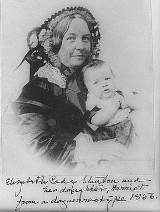
Elizabeth Cady Stanton

 
Elizabeth Cady Stanton

   Email Print
   Bookmark   Link


Elizabeth Cady Stanton


Elizabeth Cady Stanton (November 12, 1815 – October 26, 1902) was an American social activist and leading figure of the early woman's movement. Her Declaration of Sentiments
Declaration of Sentiments

The Declaration of Sentiments is a document signed in 1848 by 68 women and 32 men, delegates to the first women's rights convention, in Seneca Falls, New York, now known to historians as the 1848 Women's Rights Convention....
, presented at the first women's rights convention
Seneca Falls Convention

The Seneca Falls Convention, was held in Seneca Falls , New York, New York. It was the first women's rights convention held in the United States....
 held in 1848 in Seneca Falls
Seneca Falls (village), New York

Seneca Falls is a village in Seneca County, New York, New York, United States. The population was 6,861 at the 2000 census. The village is in the Seneca Falls , New York, east of Geneva, New York....
, New York
New York

The State of New York is a U.S. state in the Mid-Atlantic States and Northeastern United States regions of the United States and is the nation's List of U.S....
, is often credited with initiating the first organized woman's rights and woman's suffrage movements in the United States.

Before Stanton narrowed her political focus almost exclusively to women's rights, she was an active abolitionist together with her husband, Henry Brewster Stanton and cousin, Gerrit Smith
Gerrit Smith

Gerrit Smith was a leading United States social reformer, abolitionist, politician, and philanthropist. He was an unsuccessful candidate for President of the United States in 1848, 1852, and 1856....
.


Discussion
Ask a question about 'Elizabeth Cady Stanton'
Start a new discussion about 'Elizabeth Cady Stanton'
Answer questions from other users
Full Discussion Forum


Quotations


All honor to the noble women that have devoted earnest lives to the intellectual needs of mankind!

No mortal ever has been, no mortal ever will be like the soul just launched on the sea of life.

The isolation of every human soul and the necessity of self-dependence must give each individual the right, to choose his own surroundings.

The history of mankind is a history of repeated injuries and usurpations on the part of man toward woman.

Declaration of Sentiments, Seneca Falls Conference (July 19-20, 1848)

In entering upon the great work before us, we anticipate no small amount of misconception, misrepresentation, and ridicule;.

Declaration of Sentiments

Women's degradation is in man's idea of his sexual rights. Our religion, laws, customs, are all founded on the belief that woman was made for man. Come what will, my whole soul rejoices in the truth that I have uttered.

Letter to Susan B. Anthony (June 14, 1860)


Encyclopedia


Elizabeth Cady Stanton (November 12, 1815 – October 26, 1902) was an American social activist and leading figure of the early woman's movement. Her Declaration of Sentiments
Declaration of Sentiments

The Declaration of Sentiments is a document signed in 1848 by 68 women and 32 men, delegates to the first women's rights convention, in Seneca Falls, New York, now known to historians as the 1848 Women's Rights Convention....
, presented at the first women's rights convention
Seneca Falls Convention

The Seneca Falls Convention, was held in Seneca Falls , New York, New York. It was the first women's rights convention held in the United States....
 held in 1848 in Seneca Falls
Seneca Falls (village), New York

Seneca Falls is a village in Seneca County, New York, New York, United States. The population was 6,861 at the 2000 census. The village is in the Seneca Falls , New York, east of Geneva, New York....
, New York
New York

The State of New York is a U.S. state in the Mid-Atlantic States and Northeastern United States regions of the United States and is the nation's List of U.S....
, is often credited with initiating the first organized woman's rights and woman's suffrage movements in the United States.

Before Stanton narrowed her political focus almost exclusively to women's rights, she was an active abolitionist together with her husband, Henry Brewster Stanton and cousin, Gerrit Smith
Gerrit Smith

Gerrit Smith was a leading United States social reformer, abolitionist, politician, and philanthropist. He was an unsuccessful candidate for President of the United States in 1848, 1852, and 1856....
. Unlike many of those involved in the women's rights movement, Stanton addressed a number of issues pertaining to women beyond voting rights. Her concerns included women's parental and custody rights, property rights, employment and income rights, divorce
Divorce

Divorce or dissolution of marriage is a legal process in which a judge or other authority dissolves the bonds of matrimony existing between two persons, thus restoring them to the marital status of being single....
 laws, the economic health of the family, and birth control
Birth control

Birth control, sometimes synonymous with contraception, is a regimen of one or more actions, devices, or medications followed in order to deliberately prevent or reduce the likelihood of pregnancy or childbirth....
. She was also an outspoken supporter of the 19th-century temperance movement
Temperance movement

A temperance movement attempts to reduce the amount of alcohol consumed within a community or society in general -- and even to prohibit its production and consumption entirely....
.

After the American Civil War
American Civil War

The American Civil War , also known as the War Between the States and several Naming the American Civil War, was a civil war in the United States....
, Stanton's commitment to female suffrage
Suffrage

Suffrage is the civil right to vote, or the exercise of that right. In that context, it is also called political franchise or simply the franchise....
 caused a schism in the women's rights movement when she, along with Susan B. Anthony
Susan B. Anthony

Susan Brownell Anthony was a prominent United States civil rights leader who played a pivotal role in the 19th century women's rights movement to introduce History of women's suffrage in the United States....
, declined to support passage of the Fourteenth
Fourteenth Amendment to the United States Constitution

The Fourteenth Amendment to the United States Constitution is one of the post-American Civil War Reconstruction Amendments that was first intended to secure the rights of former Slavery in the United States....
 and Fifteenth
Fifteenth Amendment to the United States Constitution

The Fifteenth Amendment to the United States Constitution prohibits each government in the United States from denying a citizen the right to vote based on that citizen's "race, colored or previous condition of servitude" ....
 Amendments to the United States Constitution
United States Constitution

The Constitution of the United States of America is the supreme law of the United States. It is the foundation and source of the legal authority underlying the existence of the United States of America; the Federal Government of the United States; and all the State & local governments and Territorial Administrative bodies contained therein....
. She opposed giving added legal protection and voting rights to African American
African American

African Americans or Black Americans are citizens or residents of the United States who have origins in any of the Black people populations of Africa....
 men while continuing to deny women, black and white, the same rights. Her position on this issue, together with her thoughts on organized Christianity
Christianity

Christianity is a Monotheistic religion #Christian view religion centered on the life and teachings of Jesus as New Testament view on Jesus' life....
 and women's issues beyond voting rights, led to the formation of two separate women's rights organizations that were finally rejoined, with Stanton as president of the joint organization, approximately 20 years later.

Childhood and family background

Elizabeth Cady Stanton, the eighth of 11 children, was born in Johnstown
Johnstown (city), New York

Johnstown, surrounded by the Johnstown , New York, is the county seat of Fulton County, New York, New York, USA. As of the 2000 census, the city had population of 8,511....
, New York, to Daniel Cady
Daniel Cady

Daniel Cady was a prominent lawyer and judge in upstate New York. While perhaps better known today as the father of Elizabeth Cady Stanton, Judge Cady had a full and accomplished life of his own....
 and Margaret Livingston Cady. Five of her siblings died in early childhood or infancy. A sixth sibling, her brother Eleazar, died at age 20 just prior to his graduation from Union College
Union College

Union College is a private, non-denominational Liberal arts colleges in the United States located in Schenectady, New York. In 1795, Union became the first college chartered by the Regents of the State of New York....
 in Schenectady, New York
Schenectady, New York

Schenectady is a city in Schenectady County, New York, New York, United States, of which it is the county seat. As of the United States Census 2000, the city had a population of 61,821, making it the ninth-largest city in New York....
. Only Elizabeth Cady and four sisters lived well into adulthood and old age. Later in life, Elizabeth named her two daughters after two of her sisters, Margaret and Harriot.

Daniel Cady, Stanton's father, was a prominent attorney who served one term in the United States Congress (Federalist
Federalist

The term "'federalist'" describes several political beliefs around the world. It also has reference to the concept of federalism or the type of government called a federation....
; 1814-1817) and later became both a circuit court judge and, in 1847, a New York Supreme Court justice. Judge Cady introduced his daughter to the law and, together with her brother-in-law, Edward Bayard
Bayard family

The Bayard family has been a prominent family of lawyers and politicians throughout American history, primarily from Wilmington, Delaware. Beginning as United States Federalist Party, they joined the party of Andrew Jackson and remained leaders of the Democratic Party into the 20th century....
, planted the early seeds that grew into her legal and social activism. Even as a young girl, she enjoyed perusing her father's law library and debating legal issues with his law clerks. It was this early exposure to law that, in part, caused Stanton to realize how disproportionately the law favored men over women, particularly over married women. Her realization that married women had virtually no property, income, employment, or even custody rights over their own children, helped set her course toward changing these inequities.

Stanton's mother, Margaret Livingston Cady, a descendant of early Dutch settlers, was the daughter of Colonel James Livingston
James Livingston (American Revolution)

Colonel James Livingston was an American colonist living in Province of Quebec who fought on the Colonial side of the American Revolutionary War....
, an officer in the Continental Army
Continental Army

The American Continental Army was an army formed after the outbreak of the American Revolutionary War by the colonies that became the United States. Established by a resolution of the Continental Congress on June 15, 1775, the army was created to coordinate the military efforts of the Thirteen Colonies in their struggle against the rule of Kingdom...
 during the American Revolution
American Revolutionary War

The American Revolutionary War , also known as the American War of Independence, began as a war between the Kingdom of Great Britain and Thirteen Colonies on the North America, and ended in a global war between several European great powers....
. Having fought at Saratoga
Battle of Saratoga

The Battles of Saratoga in September and October 1777 were decisive Continental Army victories in the American Revolutionary War, resulting in the surrender of an entire British army of over 6,000 men invading New York from Canada....
 and Quebec
Battle of Quebec (1775)

The Battle of Quebec was an attempt on December 31, 1775, by American colonial forces to capture the Quebec City and enlist French Canadian support for the American Revolutionary War....
, Livingston assisted in the capture of Major John Andre at West Point, New York
West Point, New York

West Point is a federal military reservation located North of the Highland Falls, New York in Orange County, New York, United States. The population was 7,138 at the 2000 census....
 where Andre and Benedict Arnold
Benedict Arnold

Benedict Arnold V was a General officer during the American Revolutionary War who originally fought for the American Continental Army, but switched sides to the British Empire....
, who escaped aboard the HMS Vulture
HMS Vulture

Several vessels of the Royal Navy have been named HMS Vulture, including:*Vulture, a sloop of war which served in the American Revolution...
, were scheming to turn West Point over to the English
English people

The English are a nation and ethnic group native to England who speak English language in England. The English identity as a people is of early medieval origin, when they were known in Old English as the Anglecynn....
. Margaret Cady, an unusually tall woman for her time, had a commanding presence, and Stanton routinely described her as "queenly." While Stanton's daughter, Harriot Stanton Blatch
Harriot Eaton Stanton Blatch

Harriot Eaton Stanton Blatch was a notable USA writer and suffragist and the daughter of pioneering women's rights activist Elizabeth Cady Stanton....
, remembers her grandmother as being fun, affectionate, and lively, Stanton herself did not apparently share such memories. Emotionally devastated by the loss of so many children, Margaret Cady fell into a depression
Clinical depression

Major depressive disorder is a mental disorder characterized by a pervasive depression , low self-esteem, and anhedonia in normally enjoyable activities....
, which kept her from being fully involved in the lives of her surviving children and left a maternal void in Stanton's childhood.

Since Stanton's father contended with this loss by immersing himself in his work, many of the childrearing responsibilities fell to Stanton's elder sister, Tryphena, 11 years her senior, and Tryphena's husband, Edward Bayard, a Union College classmate of Eleazar Cady's and son of James A. Bayard, Sr., a U.S. Senator from Wilmington
Wilmington, Delaware

Wilmington is the largest city in the state of Delaware, United States and is located at the confluence of the Christina River and Brandywine Creek , near where the Christina flows into the Delaware River....
, Delaware
Delaware

Delaware is a U.S. state located on the East Coast of the United States in the Mid-Atlantic States region of the United States. The state takes its name from Thomas West, 3rd Baron De La Warr, a British nobleman and Virginia's first colonial governor, after whom Cape Henlopen was originally named....
. At the time of his engagement and marriage to Tryphena, Edward Bayard worked as an apprentice in Daniel Cady's law office and was instrumental in nurturing Stanton's growing understanding of the explicit and implicit gender
Gender

Gender comprises a range of differences between man and woman, extending from the biological to the social. Biologically, the male gender is defined by the presence of a Y-chromosome, and its absence in the female gender....
 hierarchies within the legal system.

Slavery did not end in New York State until July 10, 1817, and, like many men of his day, Stanton's father was a slaveowner. Peter Teabout, a slave in the Cady household who was later freed in Johnstown, took care of Stanton and her sister Margaret. He is remembered with particular fondness by Stanton in her memoir, Eighty Years & More, where she reminisces about the pleasure she took in attending the Episcopal
Episcopal

Episcopal and episcopalian may refer to:*Bishop, an overseer in the Christian church*Diocese, the see of a bishop, a diocese*Episcopal polity, the church united under the oversight of bishops...
 church with Teabout, where, as Judge Cady's daughters, she and her sister enjoyed sitting with him in the back of the church rather than alone in front with the white families of the congregation. It seems it was, however, not immediately the fact that her family owned at least one slave, but her exposure to the abolition movement as a young woman visiting her cousin, Gerrit Smith, in Peterboro, New York
Peterboro, New York

Peterboro, located about twenty-five miles southeast of Syracuse, New York, New York, is a historic village situated in the Smithfield, New York, Madison County, New York, New York....
, that led to her staunch abolitionist sentiments.

Education and intellectual development

Unlike many women of her era, Stanton was formally educated. She attended Johnstown Academy, where she studied Latin
Latin

Latin is an Italic language, historically spoken in Latium and Ancient Rome. Through the Military history of the Roman Empire, Latin spread throughout the Mediterranean and a large part of Europe....
, Greek
Greek language

Greek is an Indo-European languages native to the southern Balkan peninsula, the language of the Greek people. It forms an independent branch within Indo-European....
 and mathematics
Mathematics

Mathematics is the study of quantity, structure, space, change, and related topics of pattern and form. Mathematicians seek out patterns whether found in numbers, space, natural science, computers, imaginary abstractions, or elsewhere....
 until the age of 16. At the Academy, she enjoyed being in co-educational classes where she could compete intellectually and academically with boys her age and older. She did this very successfully, winning several academic awards and honors, including the award for Greek language.

In her memoir, Stanton credits the Cadys' neighbor, Rev. Simon Hosack, with strongly encouraging her intellectual development and academic abilities at a time when she felt these were undervalued by her father. Writing of her brother, Eleazar's, death in 1826, Stanton remembers trying to comfort her father, saying that she would try to be all her brother had been. At the time, her father's response devastated Stanton: "Oh, my daughter, I wish you were a boy!" Understanding from this that her father valued boys above girls, Stanton tearfully took her disappointment to Hosack, whose firm belief in her abilities counteracted her father's perceived disparagement. Hosack went on to teach Stanton Greek, encouraged her to read widely, and ultimately bequeathed to her his own Greek lexicon
Lexicon

In linguistics, the lexicon of a language is its vocabulary, including its words and expressions. More formally, it is a language's inventory of lexemes....
 along with other books. His confirmation of her intellectual abilities strengthened Stanton's confidence and self-esteem.

Upon graduation from Johnstown Academy, Stanton received one of her first tastes of sexual discrimination. Stanton watched with dismay as the young men graduating with her, many of whom she had surpassed academically, went on to Union College, as her older brother, Eleazar, had done previously. In 1830, with Union College taking only men, Stanton enrolled in the Troy Female Seminary in Troy, New York
Troy, New York

Troy is a city in New York, United States, and the county seat of Rensselaer County, New York. As of the United States Census 2000, the population was 49,170....
, which was founded and run by Emma Willard
Emma Willard

Emma C. Willard was an United States women's rights advocate and the pioneer who founded the first women's school of higher education.Emma Willard was born Emma Hart in Berlin, Connecticut, the sixteenth of her father's seventeen children and the ninth of her mother's ten children, of Samuel Hart and his second wife, Lydia Hinsdale Hart...
. (In 1895, the school was renamed the Emma Willard School
Emma Willard School

The Emma Willard School, originally called Troy Female Seminary and often referred to simply as "Emma," is an independent university-preparatory school day and boarding school for young women, located in Troy, New York on the scenic Mount Ida, offering grades 9-12 and PG....
 in honor of its founder, and Stanton, spurred by her respect for Willard and despite her growing infirmities, was a keynote speaker at this event.)

Early during her student days in Troy, Stanton remembers being strongly influenced by Charles Grandison Finney
Charles Grandison Finney

Charles Grandison Finney was a Christian minister who became an important figure in the Second Great Awakening. His influence during this period was enough that he has been called "The Father of Modern Revivalism"....
, an evangelical
Evangelicalism

Evangelicalism is a Protestantism Christian movement which began in Great Britain in the 1730s.Most adherents consider its key characteristics to be: a belief in the need for personal conversion ; some expression of the gospel in effort; a high regard for Biblical authority; and an emphasis on the death and resurrection of Jesus....
 preacher and central figure in the revivalist
Revivalist

Revivalist may refer to:* An individual who is involved in a revivalism movement relating to religious faith* Revivalist artist - a performer dedicated to reviving a musical or cultural form from an earlier era...
 movement. His influence, combined with the Calvinistic Presbyterianism
Presbyterianism

Presbyterianism is a group of Christian congregations adhering to the Calvinism theological tradition within Protestantism. Presbyterian theology typically emphasizes the sovereignty of God, the authority of the Bible and the necessity of Divine grace through faith in Christ....
 of her childhood, caused her great unease. After hearing Finney speak, Stanton became terrified at the possibility of her own damnation
Damnation

"Damnation" is the concept of condemnation by God such that results in a being's punishment. The word "damn" is widely used as a moderate profanity....
: "Fear of judgment seized my soul. Visions of the lost haunted my dreams. Mental anguish prostrated my health. Dethronement of my reason was apprehended by my friends." Stanton credits her father and brother-in-law, Edward Bayard, with convincing her to ignore Finney's warnings and, after taking her on a rejuvenating trip to Niagara Falls
Niagara Falls

The Niagara Falls are massive waterfalls on the Niagara River, straddling the Canada?United States border between the Provinces and territories of Canada of Ontario and the U.S....
, restoring her reason and sense of balance. She never returned to organized Christianity
Christianity

Christianity is a Monotheistic religion #Christian view religion centered on the life and teachings of Jesus as New Testament view on Jesus' life....
 and, after this experience, always maintained that logic and a humane sense of ethics were the best guides to both thought and behavior.

Marriage and family

As a young woman, Elizabeth Cady met Henry Brewster Stanton through her early involvement in the temperance
Temperance movement

A temperance movement attempts to reduce the amount of alcohol consumed within a community or society in general -- and even to prohibit its production and consumption entirely....
 and the abolition movements. Henry Stanton was an acquaintance of Elizabeth Cady's cousin, Gerrit Smith
Gerrit Smith

Gerrit Smith was a leading United States social reformer, abolitionist, politician, and philanthropist. He was an unsuccessful candidate for President of the United States in 1848, 1852, and 1856....
, an abolitionist and member of the "Secret Six
Secret Six

The Secret Six, or the Secret Committee of Six, were six wealthy and influential men who secretly funded the American Abolitionism, John Brown ....
" that supported John Brown's
John Brown (abolitionist)

John Brown was an United States abolitionist who advocated and practiced armed insurrection as a means to end all slavery. He led the Pottawatomie Massacre in 1856 in Bleeding Kansas and made his name in the unsuccessful raid at John Brown's raid on Harpers Ferry in 1859....
 raid at Harpers Ferry
Harpers Ferry, West Virginia

Harpers Ferry is a historic town in Jefferson County, West Virginia, West Virginia. It is situated at the confluence of the Potomac River and Shenandoah Rivers where the U.S....
, West Virginia
West Virginia

West Virginia is a U.S. state in the Appalachian, Upland South, and Mid-Atlantic States regions of the United States, bordered by Virginia on the southeast, Kentucky on the southwest, Ohio on the northwest, and Pennsylvania and Maryland on the northeast....
. Stanton was a journalist, an antislavery orator, and, after his marriage to Elizabeth Cady, an attorney. Despite Daniel Cady's reservations, the couple were married in 1840. At their wedding, Elizabeth Cady refused to promise to "obey" her husband in the vows, later writing "I obstinately refused to obey one with whom I supposed I was entering into an equal relation." They had six children, carefully planned, between 1842 and 1856. The Stantons' seventh and last child, Robert, was an unplanned menopausal baby born in 1859 when Elizabeth Cady Stanton was forty-four.

Soon after returning to the United States from their European honeymoon, the Stantons moved into the Cady household in Johnstown. Henry Stanton studied law under his father-in-law until 1843, when the Stantons moved to Boston, Massachusetts
Massachusetts

The Commonwealth of Massachusetts is a U.S. state located in the New England region of the Northeastern United States United States. It borders Rhode Island and Connecticut to the south, New York to the west, and Vermont and New Hampshire to the north....
, where Henry joined a law firm. While living in Boston, Elizabeth thoroughly enjoyed the social, political, and intellectual stimulation that came with a constant round of abolitionist gatherings and meetings. Here she enjoyed the company of and was influenced by such people as Frederick Douglass
Frederick Douglass

Frederick Douglass was an American Abolitionism, History of women's suffrage in the United States, editing, orator, author, statesman and Reform movement....
, William Lloyd Garrison
William Lloyd Garrison

William Lloyd Garrison was a prominent United States abolitionism, journalist, and social reformer. He is best known as the editor of the radical abolitionist newspaper, The Liberator, and as one of the founders of the American Anti-Slavery Society, he promoted "immediate emancipation" of slaves in the United States....
, Louisa May Alcott, and Ralph Waldo Emerson
Ralph Waldo Emerson

Ralph Waldo Emerson was an American essayist, philosopher, poet, and leader of the transcendentalism movement in the early 19th century. His teachings directly influenced the growing New Thought movement of the mid 1800s....
, among others.

Throughout her marriage and eventual widowhood, Stanton took her husband's surname as part of her own, signing herself Elizabeth Cady Stanton or E. Cady Stanton, but she refused to be addressed as Mrs. Henry B. Stanton. Asserting that women were individual persons, she stated that, "[t]he custom of calling women Mrs. John This and Mrs. Tom That and colored men Sambo and Zip Coon
List of ethnic slurs

The following is a list of ethnic slurs that are, or have been, used as insinuations or allegations about members of a given ethnicity or to refer to them in a derogatory , pejorative , or insulting manner in the English language-speaking world....
, is founded on the principle that white men are lords of all." She further refused to include the promise "to obey" her husband as part of her wedding vows, agreeing instead to treat him as an equal.

The Stanton marriage was not entirely without tension and disagreement. Henry Stanton, like Daniel Cady, disagreed with the notion of female suffrage. Because of employment, travel, and financial considerations, husband and wife lived more often apart than together. Friends of the couple found them very similar in temperament and ambition, but quite dissimilar in their views on certain issues including women's rights. In 1842, abolitionist reformer Sarah Grimke
Sarah Grimké

Sarah Moore Grimk? was an United States of America abolitionist, writer, and suffragist....
 counseled Elizabeth in a letter: "Henry greatly needs a humble, holy companion and thou needest the same." However, both Stantons considered their marriage an overall success, and the marriage lasted for 47 years, ending with Henry Stanton's death in 1887.

In 1847, concerned about the effect of New England
New England

New England is a region of the United States located in the northeastern corner of the country, bounded by the Atlantic Ocean, Canada and New York State, and consisting of the modern U.S....
 winters on Henry Stanton's fragile health, the Stantons moved from Boston to Seneca Falls
Seneca Falls

Seneca Falls refers to a town and a village in Seneca County, New York, New York:* Seneca Falls , New York* Seneca Falls , New York* The Seneca Falls Convention, often called the birthplace of the American women's rights movement...
, New York, situated at the northern end of Cayuga Lake
Cayuga Lake

Cayuga Lake is the longest of western New York's glacial Finger Lakes, and is the largest in surface area and second largest in volume. It is just under 40 miles long....
, one of the Finger Lakes
Finger Lakes

The Finger Lakes are a chain of lakes in the west-central section of Upstate New York that are a popular tourist destination. There are actually eleven lakes in the region, but only seven of the largest are commonly identified as the Finger Lakes....
 found in upstate New York. Their house
Elizabeth Cady Stanton House (Seneca Falls, New York)

Elizabeth Cady Stanton House was the home of suffragette Elizabeth Cady Stanton in Seneca Falls, New York. She and her family lived there from 1847 to 1862....
, purchased for them by Daniel Cady, was located some distance from town. The couple's last four children, two sons and two daughters, were born there, with Stanton asserting that her children were conceived under a program she called "voluntary motherhood," asserting her firm belief that women should have command over their sexuality
Sexuality

Sexuality may refer to:*Sexuality or sex*Sexuality or gender identity*Sexuality or sexual orientation*Animal sexuality or animal sexual behaviour...
 and childbearing
Childbirth

Childbirth is the culmination of a human pregnancy or gestation period with the delivery of one or more newborn infants from a woman's uterus. The process of normal human childbirth is categorized in three stages of labour: the shortening and dilation of the cervix, descent and delivery of the infant, and delivery of the placenta.....
. As a mother who advocated homeopathy
Homeopathy

File:LedumPalustre15CH.jpgHomeopathy is a form of alternative medicine first expounded by Samuel Hahnemann in 1796, that treats a disease with heavily diluted preparations created from substances that would ordinarily cause effects similar to the disease's symptoms....
, freedom of expression, lots of outdoor activity, and a solid, highly academic education for all of her children, Stanton nurtured a breadth of interests, activities, and learning in both her sons and daughters. She was remembered by her daughter Margaret as being "cheerful, sunny and indulgent".

Although she enjoyed motherhood and assumed primary responsibility for rearing the children, Stanton found herself unsatisfied and even depressed by the lack of intellectual companionship and stimulation in Seneca Falls. As an antidote to the boredom and loneliness, Stanton became increasingly involved in the community and, by 1848, had established ties to similarly-minded women in the area. By this time, she was firmly committed to the nascent women's rights movement and was ready to engage in organized activism.

Early activism in the Women's Rights Movement

Prior to living in Seneca Falls, Stanton had become a great admirer and friend of Lucretia Mott
Lucretia Mott

Lucretia Coffin Mott was an United States Religious Society of Friends, abolitionist, social reformer and proponent of women's rights. She is credited as the first American "feminist" in the early 1800s but was, more accurately, the initiator of women's political advocacy....
, the Quaker minister, feminist
Feminism

Feminism is the belief that women should have equal political, social, sexual, intellectual and economic rights to men. It involves various movements, Theory, and philosophies, all concerned with issues of gender difference, that advocate equality for women and that campaign for women's rights and interests....
, and abolitionist whom she had met at the International Anti-Slavery Convention in London, England in the spring of 1840 while on her honeymoon. The two women became allies when the male delegate
Delegate

A delegate is a person representing an organization at a meeting or conference between organizations of the same level ....
s attending the convention voted that women should be denied participation in the proceedings, even if they, like Mott, had been nominated to serve as official delegates of their respective abolitionist societies. After considerable debate, the women were required to sit in a roped-off section hidden from the view of the men in attendance. They were soon joined by the prominent abolitionist, William Lloyd Garrison
William Lloyd Garrison

William Lloyd Garrison was a prominent United States abolitionism, journalist, and social reformer. He is best known as the editor of the radical abolitionist newspaper, The Liberator, and as one of the founders of the American Anti-Slavery Society, he promoted "immediate emancipation" of slaves in the United States....
, who arrived after the vote had been taken and, in protest of the outcome, refused his seat, electing instead to sit with the women.

Mott's example and the decision to prohibit women from participating in the convention strengthened Stanton's commitment to women's rights. By 1848, her early life experiences, together with the experience in London
London

London is the capital of both England and the United Kingdom, and the most populous municipality in the European Union. An important settlement for two millennia, History of London goes back to its founding by the Roman Empire....
 and her initially debilitating experience as a housewife in Seneca Falls, galvanized Stanton. She later wrote:
"The general discontent I felt with woman's portion as wife, housekeeper, physician, and spiritual guide, the chaotic conditions into which everything fell without her constant supervision, and the wearied, anxious look of the majority of women, impressed me with a strong feeling that some active measures should be taken to remedy the wrongs of society in general, and of women in particular. My experience at the World Anti-slavery Convention, all I had read of the legal status of women, and the oppression I saw everywhere, together swept across my soul, intensified now by many personal experiences. It seemed as if all the elements had conspired to impel me to some onward step. I could not see what to do or where to begin -- my only thought was a public meeting for protest and discussion."
In 1848, acting on these feelings and perceptions, Stanton joined Mott, her sister Martha Coffin Wright
Martha Coffin Wright

Martha Coffin Wright was an American feminist, abolitionist, and signatory of the Declaration of Sentiments....
, and a handful of other women in Seneca Falls. Together they organized the first women's rights convention
Seneca Falls Convention

The Seneca Falls Convention, was held in Seneca Falls , New York, New York. It was the first women's rights convention held in the United States....
 held in Seneca Falls on July 19 and 20. Stanton drafted a Declaration of Sentiments
Declaration of Sentiments

The Declaration of Sentiments is a document signed in 1848 by 68 women and 32 men, delegates to the first women's rights convention, in Seneca Falls, New York, now known to historians as the 1848 Women's Rights Convention....
, which she read at the convention. Modeled on the United States Declaration of Independence, Stanton's declaration proclaimed that men and women are created equal. She proposed, among other things, a then-controversial resolution demanding voting rights for women. The final resolutions, including female suffrage, were passed, in no small measure, because of the support of Frederick Douglass, who attended and informally spoke at the convention.

Soon after the convention, Stanton was invited to speak at a second women's rights convention in Rochester, New York
Rochester, New York

Rochester is a city in Monroe County, New York, New York State, south of Lake Ontario in the United States. The Rochester metropolitan area is the second largest economy in New York State, behind the New York City metropolitan area....
, solidifying her role as an activist and reformer. In 1851, Stanton was introduced to Susan B. Anthony
Susan B. Anthony

Susan Brownell Anthony was a prominent United States civil rights leader who played a pivotal role in the 19th century women's rights movement to introduce History of women's suffrage in the United States....
 on a street in Seneca Falls by Amelia Bloomer
Amelia Bloomer

Amelia Jenks Bloomer was an United States women's rights and Temperance movement advocate. She created the "Loose Bloomer" for women's comfort....
, a feminist and mutual acquaintance who had not signed the Declaration of Sentiments and subsequent resolutions despite her attendance at the Seneca Falls convention.

Although best known for their joint work on behalf of women's suffrage, Stanton and Anthony first joined the temperance movement
Temperance movement

A temperance movement attempts to reduce the amount of alcohol consumed within a community or society in general -- and even to prohibit its production and consumption entirely....
. Together, they were instrumental in founding the short-lived Woman's State Temperance Society (1852-53). During her presidency of the organization, Stanton scandalized many supporters by suggesting that drunkenness be made sufficient cause for divorce. Stanton and Anthony's focus, however, soon shifted to female suffrage and women's rights.

Single and having no children, Anthony had the time and energy to do the speaking and traveling that Stanton was unable to do. Their skills complemented each other; Stanton, the better orator and writer, scripted many of Anthony's speeches, while Anthony was the movement's organizer and tactician. Writing a tribute that appeared in the New York Times when Stanton died, Anthony described Stanton as having "forged the thunderbolts" that she (Anthony) "fired." Unlike Anthony's relatively narrow focus on suffrage
Suffrage

Suffrage is the civil right to vote, or the exercise of that right. In that context, it is also called political franchise or simply the franchise....
, Stanton wanted to push for a broader platform of women's rights in general. While their opposing viewpoints led to some discussion and conflict, no disagreement threatened their friendship or working relationship; the two women remained close friends and colleagues until Stanton's death some 50 years after their initial meeting.

While always recognized as movement leaders whose support was sought, Stanton and Anthony's voices were soon joined by others who began assuming leadership positions within the movement. These women included, among others, Lucy Stone
Lucy Stone

Lucy Stone was a prominent United States suffragist. Stone was the first recorded American woman to keep her own last name upon marriage and the first woman in Massachusetts to receive a college degree....
 and Matilda Joslyn Gage
Matilda Joslyn Gage

Matilda Electa Joslyn Gage was a women's suffrage, a Native Americans in the United States activist, an Abolitionism, a Free thought, and a prolific author, who was "born with a hatred of oppression"....
.

Ideological divergence with abolitionists and the women's rights movement


After the American Civil War
American Civil War

The American Civil War , also known as the War Between the States and several Naming the American Civil War, was a civil war in the United States....
, both Stanton and Anthony broke with their abolitionist backgrounds and lobbied strongly against ratification of the Fourteenth
Fourteenth Amendment to the United States Constitution

The Fourteenth Amendment to the United States Constitution is one of the post-American Civil War Reconstruction Amendments that was first intended to secure the rights of former Slavery in the United States....
 and Fifteenth Amendment
Fifteenth Amendment to the United States Constitution

The Fifteenth Amendment to the United States Constitution prohibits each government in the United States from denying a citizen the right to vote based on that citizen's "race, colored or previous condition of servitude" ....
s to the US Constitution, which granted African American men the right to vote. Believing that African American men, by virtue of the Thirteenth Amendment
Thirteenth Amendment to the United States Constitution

The Thirteenth Amendment to the United States Constitution officially abolished and continues to prohibit slavery and involuntary servitude, except as punishment for a crime....
, already had the legal protections, except for suffrage, offered to white male citizens and that so largely expanding the male franchise in the country would only increase the number of voters prepared to deny women the right to vote, both Stanton and Anthony were angry that the abolitionists, their former partners in working for both African American and women's rights, refused to demand that the language of the amendments be changed to include women.

Eventually, Stanton's oppositional rhetoric took on racial overtones. Arguing on behalf of female suffrage, Stanton posited that women voters of "wealth, education, and refinement" were needed to offset the effect of former slaves and immigrants whose "pauperism, ignorance, and degradation" might negatively affect the American political system. She declared it to be "a serious question whether we had better stand aside and see 'Sambo
Sambo (ethnic slur)

Sambo is a racial term for a person with mixed Indigenous peoples of the Americas and African heritage in the Caribbean, also for a black people or South Asian person in the United States and the United Kingdom....
' walk into the kingdom [of civil rights] first." Some scholars have argued that Stanton's emphasis on property ownership and education, opposition to black male suffrage, and desire to hold out for universal suffrage fragmented the civil rights movement by pitting African-American men against women and, together with Stanton's emphasis on "educated suffrage," in part established a basis for the literacy requirements
Literacy test

Literacy Test refers to the government practice of testing the literacy of potential citizens at the federal level, and potential voters at the state level....
 that followed in the wake of the passage of the fifteenth amendment.

Stanton's position caused a significant rift between herself and many civil rights leaders, particularly Frederick Douglass
Frederick Douglass

Frederick Douglass was an American Abolitionism, History of women's suffrage in the United States, editing, orator, author, statesman and Reform movement....
, who believed that white women, already empowered by their connection to fathers, husbands, and brothers, at least vicariously had the vote. According to Douglass, their treatment as slaves entitled the now liberated African-American men, who lacked women's indirect empowerment, to voting rights before women were granted the franchise. African-American women, he believed, would have the same degree of empowerment as white women once African-American men had the vote; hence, general female suffrage was, according to Douglass, of less concern than black male suffrage.

Disagreeing with Douglass, and despite the racist
Racism

Racism, by its simplest definition is the belief that Race is the primary determinant of human traits and capacities and that racial differences produce an inherent superiority of a particular race....
 language she sometimes resorted to, Stanton firmly believed in a universal franchise that empowered blacks and whites, men and women. Speaking on behalf of black women, she stated that not allowing them to vote condemned African American freedwomen "to a triple bondage that man never knows," that of slavery, gender, and race. She was joined in this belief by Anthony, Olympia Brown
Olympia Brown

Olympia Brown was an American Women's suffrage. She is regarded as the first woman to graduate from a theological school, as well as becoming the first full time ordained minister....
, and most especially Frances Gage
Frances Dana Barker Gage

Frances Dana Barker Gage was a leading United States reformer, feminism and abolitionism. She worked closely with Susan B. Anthony and Elizabeth Cady Stanton, along with other leaders of the early women's rights movement in the United States....
, who was the first suffragist to champion voting rights for freedwomen.

Thaddeus Stevens
Thaddeus Stevens

Thaddeus Stevens , of Pennsylvania, was a History of the United States Republican Party and one of the most powerful members of the United States House of Representatives....
, a Republican congressman from Pennsylvania
Pennsylvania

The Commonwealth of Pennsylvania , often colloquially referred to as PA by natives and Northeasterners, is a U.S. state located in the Northeastern United States and Mid-Atlantic States regions of the United States....
 and ardent abolitionist, agreed that voting rights should be universal. In 1866, Stanton, Anthony, and several other suffragists drafted a universal suffrage petition demanding that the right to vote be given without consideration of sex or race. The petition was introduced in the United States Congress by Stevens. Despite these efforts, the Fourteenth Amendment was passed, without adjustment, in 1868.

By the time the Fifteenth Amendment was making its way through Congress, Stanton's position led to a major schism in the women's rights movement itself. Many leaders in the women's rights movement, including Lucy Stone, Elizabeth Blackwell, and Julia Ward Howe
Julia Ward Howe

Julia Ward Howe was a prominent United States Abolitionism, activism, and poet most famous as the author of "The Battle Hymn of the Republic."...
, strongly argued against Stanton's "all or nothing" position. By 1869, disagreement over ratification of the Fifteenth Amendment had given birth to two separate women's suffrage organizations. The National Woman's Suffrage Association
National Woman's Suffrage Association

The National Woman Suffrage Association was formed on May 15, 1869 in New York in response to a split in the American Equal Rights Association over the Fifteenth Amendment to the United States Constitution to the United States Constitution....
 (NWSA) was founded in May 1869 by Anthony and Stanton, who served as its president for 21 years. The NWSA opposed passage of the Fifteenth Amendment without changes to include female suffrage and, under Stanton's influence in particular, championed a number of women's issues that were deemed too radical by more conservative members of the suffrage movement. The American Woman's Suffrage Association
National American Suffrage Association

The National American Woman Suffrage Association was created in 1890, when two competing United States women's suffrage advocacy groups united....
 (AWSA), founded the following November and led by Stone, Blackwell, and Howe, supported the Fifteenth Amendment as written and preferred to focus only on female suffrage rather than advocate for broader women's rights such as gender-neutral divorce laws, a woman's right to sexually refuse her husband, increased economic opportunities for women, and the right of women to serve on juries, issues which were espoused by Stanton.

Believing that men should not be given the right to vote without women also being granted the franchise, Sojourner Truth
Sojourner Truth

Sojourner Truth was the self-given name, from 1843, of Isabella Baumfree, an American slave, Abolitionism and women's rights activist. Truth was born into slavery in Swartekill, New York, New York....
, a former slave and feminist, affiliated herself with Stanton and Anthony's organization. Stanton, Anthony, and Truth were joined by Matilda Joslyn Gage, who later worked on The Women's Bible with Stanton. Despite Stanton's position and the efforts of her and others to expand the Fifteenth Amendment to include voting rights for all women, this amendment also passed, as originally written, in 1870.

Later years

In the decade following ratification of the Fifteenth Amendment, both Stanton and Anthony increasingly took the position, first advocated by Victoria Woodhull
Victoria Woodhull

Victoria Claflin Woodhull was an United States Suffragette who was described by Gilded Age newspapers as a leader of the American woman's suffrage movement in the 19th century....
, that the Fourteenth and Fifteenth Amendments actually did give women the right to vote. They argued that the Fourteenth Amendment, which defined citizens as "all persons born or naturalized in the United States and subject to the jurisdiction thereof," included women and that the Fifteenth Amendment provided all citizens with the right to vote. Using this logic, they asserted that women now had the constitutional right to vote and that it was simply a matter of claiming that right. This constitutionally-based argument, which came to be called "the new departure" in women's rights circles because of its divergence from earlier attempts to change voting laws on a state-by-state basis, led to first Anthony (in 1872), and later Stanton (in 1880), going to the polls and demanding to vote. Despite this, and similar attempts made by hundreds of other women, it would be nearly 50 years before women obtained the right to vote throughout the United States.

During this time, Stanton maintained a broad focus on women's rights in general rather than narrowing her focus only to female suffrage in particular. After passage of the Fifteenth Amendment in 1870 and its support by the Equal Rights Association and prominent suffragists such as Stone, Blackwell, and Howe, the gap between Elizabeth Cady Stanton and other leaders of the women's movement widened as Stanton took issue with the fundamental religious leanings of several movement leaders. Unlike many of her colleagues, Stanton believed organized Christianity
Christianity

Christianity is a Monotheistic religion #Christian view religion centered on the life and teachings of Jesus as New Testament view on Jesus' life....
 relegated women to an unacceptable position in society. She explored this view in The Woman's Bible, which elucidated a feminist understanding of biblical
Bible

The Bible is the central religious text of Judaism and Christianity. The exact Books of the Bible is dependent on the religious traditions of specific denominations....
 scripture and sought to correct the fundamental sexism
Sexism

Sexism, a term coined in the late 20th century, refers to the belief or attitude that one gender or sex is inferior to or less valuable than the other....
 Stanton saw as being inherent to organized Christianity. Likewise, Stanton supported divorce rights, employment rights, and property rights for women, issues in which the American Women's Suffrage Association (AWSA) preferred not to become involved.

Her more radical positions included acceptance of interracial marriage
Interracial marriage

Interracial marriage occurs when two people of differing Race groups Marriage, often creating multiracial children. This is a form of exogamy and can be seen in the broader context of miscegenation ....
. Despite her opposition to giving African-American men the right to vote without enfranchising all women and the derogatory language she had resorted to in expressing this opposition, Stanton had no objection to interracial marriage and wrote a congratulatory letter to Frederick Douglass upon his marriage to Helen Pitts
Helen Pitts

Helen Pitts was an United States suffragist and the second wife of Frederick Douglass. She also created the Frederick Douglass Memorial and Historical Association....
, a white woman, in 1884. Anthony, fearing public condemnation of the National Woman Suffrage Association (NWSA) and wanting to keep the demand for female suffrage foremost, pleaded with Stanton not to make her letter to Douglass or support for his marriage publicly known.

Stanton went on to write many of the more important books, documents, and speeches of the women's rights movement. In 1881, Harper & Brothers Publishers issued the first volume of The History of Woman Suffrage, a seminal, six-volume work containing the full history, documents, and letters of the woman's suffrage movement. While Stanton, along with Anthony and Gage, wrote the first three volumes, the work was eventually completed in 1922 by Ida Harper
Ida Husted Harper

Ida Husted Harper was a prominent figure in the United States women's suffrage movement. She was an United States author and journalist who wrote primarily to document the movement and show support of its ideals....
. Stanton's other major writings included The Women's Bible, first published in 1895; Eighty Years & More: Reminiscences 1815-1897, her autobiography, published in 1898; and The Solitude of Self, or "Self-Sovereignty," which she first delivered as a speech at the 1892 convention of the National American Women's Suffrage Association in Washington, D.C.
Washington, D.C.

Washington, D.C. , formally the District of Columbia and commonly referred to as Washington, the District, or simply D.C., is the Capital of the United States, founded on July 16, 1790....
.

In 1868 Stanton — together with Susan B. Anthony and Parker Pillsbury
Parker Pillsbury

Parker Pillsbury was an United States minister and advocate for abolition and women's rights.Pillsbury was born in Hamilton, Massachusetts. He moved to Henniker, New Hampshire where he later farmed and worked as a wagoner....
, a leading male feminist of his day — began publishing a weekly periodical, Revolution, with editorials by Stanton that focused on a wide array of women's issues. In a view different from many modern feminists, Stanton, who supported birth control and likely used it herself, believed that abortion
Abortion

An abortion is the termination of a pregnancy by the removal or expulsion of an embryo or fetus from the uterus, resulting in or caused by its death....
 was infanticide, a position she discussed in Revolution. At this time, Stanton also joined the New York Lyceum Bureau, embarking on a 12-year career on the Lyceum Circuit
Lyceum movement

The lyceum movement in the United States was a trend in architecture inspired by Aristotle's Lyceum in Ancient Greece. Lyceums flourished in the mid-19th century, particularly in the northeast and middle west, and some lasted until the early 20th century....
. Traveling and lecturing for eight months every year provided her both with the funds to put her two youngest sons through college and, given her popularity as a lecturer, with a way to spread her ideas among the general population, gain broad public recognition, and further establish her reputation as a pre-eminent leader in the women's rights movement. Among her most popular speeches were "Our Girls", "Our Boys", "Co-education", "Marriage and Divorce", "Prison Life", and "The Bible and Woman's Rights". Her lecture travels so occupied her that Stanton, although president, presided at only four of 15 conventions of the National Women's Suffrage Association during this period.

In addition to her writing and speaking, Stanton was also instrumental in promoting women's suffrage in various states, particularly New York
New York

The State of New York is a U.S. state in the Mid-Atlantic States and Northeastern United States regions of the United States and is the nation's List of U.S....
, Missouri
Missouri

Missouri is a U.S. state in the Midwestern United States of the United States bordered by Iowa, Illinois, Kentucky, Tennessee, Arkansas, Oklahoma, Kansas and Nebraska....
, Kansas
Kansas

The State of Kansas is a Midwestern U.S. state in the Central United States of the United States of America, an area often referred to as the United States "Heartland"....
, where it was included on the ballot in 1867, and Michigan
Michigan

Michigan is a Midwestern United States U.S. state of the United States of America. It was named after Lake Michigan, whose name is a French adaptation of the Anishinaabe language term mishigama, meaning "large water" or "large lake"....
, where it was put to the vote in 1874. She made an unsuccessful bid for a U.S. Congressional seat from New York in 1868, and she was the primary force behind passage of the "Woman's Property Bill" that was eventually passed by the New York State Legislature. She worked toward female suffrage in Wyoming
Wyoming

The State of Wyoming is a sparsely populated U.S. state in the Northwestern United States of the United States. The majority of the state is dominated by the mountain ranges and rangelands of the Rocky Mountains, while the easternmost section of the state is a high altitude prairie region known as the High Plains ....
, Utah
Utah

The State of Utah is a western United States U.S. state of the United States. It was the List of U.S. states by date of statehood admitted to the United States on January 4, 1896....
, and California
California

California is a U.S. state on the West Coast of the United States of the United States, along the Pacific Ocean. It is bordered by Oregon to the north, Nevada to the east, Arizona to the southeast, and to the south the Mexico state of Baja California....
, and in 1878, she convinced California Senator Aaron A. Sargent to introduce a female suffrage amendment using wording similar to that of the Fifteenth Amendment passed some eight years previously.
Elizabethcadystanton Veeder
Stanton was also active internationally, spending a great deal of time in Europe
Europe

Europe is, conventionally, one of the world's seven continents. Comprising the westernmost peninsula of Eurasia, Europe is generally divided from Asia to its east by the water divide of the Ural Mountains, the Ural , the Caspian Sea, and by the Caucasus Mountains to the southeast....
, where her daughter and fellow feminist Harriot Stanton Blatch lived. In 1888, she helped prepare for the founding of the International Council of Women
International Council of Women

The International Council of Women was established in 1888 in Seneca Falls, New York State, USA by Susan B. Anthony and other women's rights activists....
. In 1890, Stanton opposed the merger of the National Woman's Suffrage Association with the more conservative and religiously based American Woman Suffrage Association. Over her objections, the organizations merged, creating the National American Woman Suffrage Association
National American Woman Suffrage Association

The National American Woman Suffrage Association , an United States women's rights organization, was formed as an amalgamation of the National Woman Suffrage Association and the American Woman Suffrage Association in May 1890....
 (NAWSA). Despite her opposition to the merger, Stanton became its first president, largely because of Susan B. Anthony's intervention. In good measure because of the Women's Bible and her position on issues such as divorce, she was, however, never popular among the more religiously conservative members of the "National American".

On January 18, 1892, approximately 10 years before she died, Stanton — together with Anthony, Stone, and Isabella Beecher Hooker
Isabella Beecher Hooker

Isabella Beecher Hooker was a leader in the women's suffrage movement and an author.Born in Litchfield, Connecticut, she was a daughter of Reverend Lyman Beecher, a noted abolitionist....
 — addressed the issue of suffrage before the United States House Committee on the Judiciary
United States House Committee on the Judiciary

U.S. House Committee on the Judiciary, or the House Judiciary Committee, is a standing committee of the United States House of Representatives....
. After nearly five decades of fighting for female suffrage and women's rights, it was Elizabeth Cady Stanton's final appearance before members of the United States Congress. Using the text of what became The Solitude of Self, she spoke of the central value of the individual, noting that value was not based on gender. As with the Declaration of Sentiments
Declaration of Sentiments

The Declaration of Sentiments is a document signed in 1848 by 68 women and 32 men, delegates to the first women's rights convention, in Seneca Falls, New York, now known to historians as the 1848 Women's Rights Convention....
 she had penned some 45 years earlier, Stanton's statement expressed not only the need for women's voting rights in particular, but the need for a revamped understanding of women's position in society and even of women in general:

"The isolation of every human soul
Soul

In many religions and parts of philosophy, the soul is the immaterial part of a person. It is usually thought to consist of one's thoughts and Personality psychology, and can be synonymous with the spirit, mind or self....
 and the necessity of self-dependence must give each individual the right to choose his own surroundings. The strongest reason for giving woman all the opportunities for higher education, for the full development of her faculties, her forces of mind and body; for giving her the most enlarged freedom of thought and action; a complete emancipation from all forms of bondage, of custom, dependence, superstition; from all the crippling influences of fear — is the solitude and personal responsibility of her own individual life. The strongest reason why we ask for woman a voice in the government under which she lives; in the religion she is asked to believe; equality in social life, where she is the chief factor; a place in the trades and professions, where she may earn her bread, is because of her birthright to self-sovereignty; because, as an individual, she must rely on herself [...]."


Death, burial, and remembrance

Stanton died of heart failure at her home in New York City on October 26, 1902, nearly 20 years before women were granted the right to vote in the United States. Survived by six of her seven children and by seven grandchildren, she was interred in Woodlawn Cemetery
Woodlawn Cemetery, Bronx

Located in The Bronx, Woodlawn Cemetery is one of the largest cemetery in New York City. It opened as a rural cemetery in 1863, out in "the country," in what was then southern Westchester County, New York, which was annexed to New York City in 1874....
 in the Bronx, New York. Although Elizabeth Cady Stanton had been unable to attend a formal college or university, her daughters did. Margaret Livingston Stanton Lawrence attended Vassar College
Vassar College

Vassar College is a private, coeducational, Liberal arts colleges in the United States situated in the town of Poughkeepsie , New York, New York, United States....
 (1876) and Columbia University
Columbia University

Columbia University in the City of New York , is a private university in the United States and a member of the Ivy League. Columbia's main campus lies in the Morningside Heights, Manhattan neighborhood in the borough of Manhattan, in New York City....
 (1891), and Harriot Stanton Blatch received both her undergraduate and graduate degrees from Vassar College in 1878 and 1891 respectively.

After Stanton's death, her unorthodox ideas about religion and emphasis on female employment and other women's issues led many suffragists to focus on Anthony, rather than Stanton, as the founder of the women's suffrage movement. Because of her ongoing involvement in the National American Woman Suffrage Association (NAWSA), Anthony was more familiar to many of the younger members of the movement. By 1923, in celebrating the 75th anniversary of the Seneca Falls Convention
Seneca Falls Convention

The Seneca Falls Convention, was held in Seneca Falls , New York, New York. It was the first women's rights convention held in the United States....
, only Harriot Stanton Blatch paid tribute to the role her mother had played in instigating the women's rights movement. Even as late as 1977, Anthony received most of the attention as the founder of the movement, while Stanton was not mentioned. .

Over time, however, Stanton received more attention. Stanton was commemorated along with Lucretia Mott
Lucretia Mott

Lucretia Coffin Mott was an United States Religious Society of Friends, abolitionist, social reformer and proponent of women's rights. She is credited as the first American "feminist" in the early 1800s but was, more accurately, the initiator of women's political advocacy....
 and Susan B. Anthony in a sculpture by Adelaide Johnson
Adelaide Johnson

Adelaide Johnson was an United States sculptor whose work is displayed in the U.S. Capitol and a feminist who was devoted to the cause for equality of women....
 at the United States Capitol
United States Capitol

The United States Capitol serves as the seat of government for the United States Congress, the legislature of the federal government of the United States....
, unveiled in 1921. Originally kept on display in the crypt of the US Capitol, the sculpture was moved to its current location and more prominently displayed in the rotunda in 1997. The Elizabeth Cady Stanton House
Elizabeth Cady Stanton House

Elizabeth Cady Stanton House can refer to:Listings on the National Register of Historic Places:* Elizabeth Cady Stanton House * Elizabeth Cady Stanton House ...
 in Seneca Falls was declared a National Historic Landmark
National Historic Landmark

A National Historic Landmark is a building, :wiktionary:site, structure, object, or district, that is officially recognized by the Federal government of the United States for its historical significance....
 in 1965, and by the 1990s, interest in Stanton was substantially rekindled when Ken Burns
Ken Burns

Kenneth Lauren Burns is an United States director and producer of documentary films known for his style of making use of archival footage and photographs....
, among others, presented the life and contributions of Elizabeth Cady Stanton. Once again, attention was drawn to her central, founding role in shaping not only the woman's suffrage movement, but a broad women's rights movement in the United States that included women's suffrage, women's legal reform, and women's roles in society as a whole.

Stanton is commemorated in the calendar of saints
Calendar of saints (Episcopal Church in the United States of America)

The veneration of saints in the Episcopal Church is a continuation of an ancient tradition from the early Church which honors important people of the Christian faith....
 of the Episcopal Church on July 20, together with Amelia Bloomer
Amelia Bloomer

Amelia Jenks Bloomer was an United States women's rights and Temperance movement advocate. She created the "Loose Bloomer" for women's comfort....
, Sojourner Truth
Sojourner Truth

Sojourner Truth was the self-given name, from 1843, of Isabella Baumfree, an American slave, Abolitionism and women's rights activist. Truth was born into slavery in Swartekill, New York, New York....
 and Harriet Ross Tubman
Harriet Tubman

Harriet Tubman was an African-American abolitionist, humanitarian, and Union spy during the American Civil War. After escaping from Slavery in the United States, into which she was born, she made thirteen missions to rescue over seventy slaves using the network of antislavery activists and safe houses known as the Underground Railroad....
.

Writings of Elizabeth Cady Stanton (author, co-author)


Books

  • History of Woman Suffrage ; Volumes 1-3 (written with Susan B. Anthony and Matilda Joslyn Gage; vol 4-6 completed by other authors, including Anthony, Gage, and Ida Harper) (1881-1922)
  • Solitude of Self (originally delivered as a speech in 1892; later published as a book)
  • Woman's Bible (1895)
  • Eighty Years & More: Reminiscenses 1815-1897 (1898)


Selected periodicals and journals

  • Revolution (Stanton, co-editor) (1868-1870)
  • Lily (published by Amelia Bloomer; Stanton as contributor)
  • Una (published by Paulina Wright Davis; Stanton as contributor)
  • New York Tribune (published by Horace Greeley; Stanton as contributor)


Selected papers, essays, and speeches

  • Declaration of Rights & Sentiments (1848)
  • A Petition for Universal Suffrage (1866)
  • Self-government the Best Means of Self-development (1884)
  • Solitude of Self (1892)
  • The Degradation of Disenfranchisement (1892)
  • Lyceum speeches: "Our Girls," "Our Boys," "Co-education," "Marriage and Divorce," "Prison Life," and "The Bible and Woman's Rights," among others


Stanton's papers are archived at Rutgers University
Rutgers University

Rutgers, The State University of New Jersey , is the largest institution for higher education in the U.S. state of New Jersey. It was originally chartered as Queen's College in 1766 and is the Colonial colleges in the United States....
: (See particularly entries for Ann D. Gordon, Editor, in the bibliography below.)

See also

  • USS Elizabeth C. Stanton (AP-69)
    USS Elizabeth C. Stanton (AP-69)

    was the lead ship of Elizabeth C. Stanton class transport ship of Second World War United States Navy transport ships, named for the suffragist and abolitionist Elizabeth C....
  • History of feminism
    History of feminism

    The history of feminism is the history of feminist movements and their efforts to overturn gender inequality. Feminist scholars have divided feminism's history into three "waves"....


Bibliography

  • Baker, Jean H. Sisters: The Lives of America's Suffragists. Hill and Wang, New York, 2005. ISBN 0-8090-9528-9.
  • Banner, Lois W
    Lois Banner

    Lois Wendland Banner, more commonly known as Lois W. Banner is an American feminist author.She received her Doctor of Philosophy at Columbia University....
    . Elizabeth Cady Stanton: A Radical for Women's Rights. Addison-Wesley Publishers, 1997. ISBN 0-673-39319-4.
  • Blatch, Harriot Stanton and Alma Lutz; Challenging Years: the Memoirs of Harriot Stanton Blatch; G.P. Putnam's Sons; New York, NY, 1940.
  • Burns, Ken
    Ken Burns

    Kenneth Lauren Burns is an United States director and producer of documentary films known for his style of making use of archival footage and photographs....
    , director. Not for Ourselves Alone - The Story of Elizabeth Cady Stanton & Susan B. Anthony. DVD & VHS tape, PBS Home Video, (1999).
  • Burns, Ken and Geoffrey C. Ward; Not for Ourselves Alone: The Story of Elizabeth Cady Stanton and Susan B. Anthony; Alfred A. Knoph; New York, NY, 1999. ISBN 0-375-40560-7.
  • Douglass, Frederick; Autobiographies: Narrative of the Life, My Bondage and Freedom, Life and Times. Ed. Henry Louis Gates, Jr. Penguin Putnam, Inc.; New York, NY, 1994. ISBN 0-94045-079-8.
  • Dubois, Ellen Carol, editor. The Elizabeth Cady Stanton-Susan B. Anthony Reader: Correspondence, Writings, Speeches. Northeastern University Press, September 1994. ISBN 1-55553-149-0.
  • Dubois, Ellen Carol. Feminism & Suffrage: The Emergence of an Independent Women's Movement in America, 1848-1869. Cornell University Press; Ithaca, NY, 1999. ISBN 0-80148-641-6.
  • Foner, Philip S., editor. Frederick Douglass: Selected Speeches and Writings. Lawrence Hill Books (The Library of Black America); Chicago, IL, 1999. ISBN 1-55652-352-1.
  • Gaylor, Annie Laurie. Women Without Superstition : No Gods - No Masters. Publisher: FFRF
    Freedom From Religion Foundation

    The Freedom From Religion Foundation is an United States freethought organization based in Madison, Wisconsin, Wisconsin. Its purposes, as stated in its bylaws, are to promote the separation of church and state, the removal of religion from public life, and to educate the public on matters relating to atheism, agnosticism, and nontheism....
    ; 1st edition, January 1, 1997. ISBN 1-877733-09-1.
  • Gordon, Ann D., editor. The Selected Papers of Elizabeth Cady Stanton & Susan B. Anthony Volume I: In the School of Anti-Slavery 1840-1866. Rutgers University Press
    Rutgers University Press

    Rutgers University Press is a nonprofit academic publishing house, operating in Piscataway, New Jersey under the auspices of Rutgers University....
    ; New Brunswick, NJ, 2001. ISBN 0-8135-2317-6.
  • Gordon, Ann D., editor. The Selected Papers of Elizabeth Cady Stanton & Susan B. Anthony Volume II: Against an Aristocracy of Sex 1866-1873. Rutgers University Press
    Rutgers University Press

    Rutgers University Press is a nonprofit academic publishing house, operating in Piscataway, New Jersey under the auspices of Rutgers University....
    ; New Brunswick, NJ, 2000. ISBN 0-8135-2318-4.
  • Gordon, Ann D., editor. The Selected Papers of Elizabeth Cady Stanton & Susan B. Anthony Volume III: National Protection for National Citizens 1873-1880. Rutgers University Press
    Rutgers University Press

    Rutgers University Press is a nonprofit academic publishing house, operating in Piscataway, New Jersey under the auspices of Rutgers University....
    ; New Brunswick, NJ, 2003. ISBN 0-8135-2319-2.
  • Gordon, Ann D., editor. The Selected Papers of Elizabeth Cady Stanton & Susan B. Anthony Volume IV: When Clowns Make Laws for Queens 1880-1887. Rutgers University Press
    Rutgers University Press

    Rutgers University Press is a nonprofit academic publishing house, operating in Piscataway, New Jersey under the auspices of Rutgers University....
    ; New Brunswick, NJ, 2006. ISBN 0-8135-2320-6.
  • Griffith, Elisabeth. In Her Own Right: The Life of Elizabeth Cady Stanton. Oxford University Press; New York, NY, 1985. ISBN 0-19-503729-4. Also by Galaxy Books, ISBN 0-19-503440-6.
  • James, Edward T., editor. Notable American Women a Biographical Dictionary (1607-1950); Volume II (G-O). "GAGE, Matilda Joslyn" (pp4-6) and "HOWE, Julia Ward" (pp225-229). The Belknap Press of Harvard University Press; Cambridge, MA, 1971. ISBN 0-674-62734-2.
  • James, Edward T., editor. Notable American Women a Biographical Dictionary (1607-1950); Volume III (P-Z). "STANTON, Elizabeth Cady" (pp342-347) and "STONE, Lucy" (pp387-390). The Belknap Press of Harvard University Press; Cambridge, MA, 1971. ISBN 0-674-62734-2.
  • Kern, Kathi. Mrs. Stanton's Bible. Cornell University Press; Ithaca, NY, 2001. ISBN 0-8014-8288-7.
  • Klein, Milton M., editor. The Empire State: a History of New York. Cornell University Press; Ithaca, NY, 2001. ISBN 0-8014-3866-7.
  • Langley, Winston E. & Vivian C. Fox, editors. Women's Rights in the United States: A Documentary History. Praeger Publishers; Westport, CT, 1994. ISBN 0-27-596527-9.
  • Mason, Alpheus Thomas; Free Government in the Making: Readings in American Political Thought, 3rd Edition. Oxford University Press; New York, 1975.
  • ; accessed November 12, 2006.
  • Palmer, Beverly Wilson, editor. Selected Letters of Lucretia Coffin Mott. University of Illinois Press; 2002. ISBN 0-252-02674-8.
  • Renehan, Edward J., The Secret Six: The True Tale of the Men Who Conspired with John Brown. New York. Crown Publishers, Inc.; 1995. ISBN 0-517-59028-X.
  • Sigerman, Harriet. Elizabeth Cady Stanton: The Right Is Ours. Oxford University Press, November 2001. ISBN 0-19-511969-X.
  • Sklar, Kathryn Kish. Women's Rights Emerges within the Antislavery Movement 1830-1870: A Brief History with Documents. Bedford/St. Martins (The Bedford Series in History and Culture), 2000. ISBN 0-312-10144-9.
  • Stanton, Elizabeth Cady. Eighty Years & More: Reminiscences 1815-1897. Northeastern University Press; Boston, 1993. ISBN 1-55553-137-7.
  • Stanton, Elizabeth Cady. Solitude of Self. Paris Press; Ashfield, MA, 2001. ISBN 1-930464-01-0.
  • Stanton, Elizabeth Cady (foreword by Maureen Fitzgerald). The Woman's Bible. Northeastern University Press; Boston, 1993. ISBN 1-55553-162-8
  • Stanton, Elizabeth Cady. The Woman's Bible. Prometheus Books; Great Minds Series; Amherst, NY, 1999. ISBN-10 1-57392-696-6.
  • Stanton, Elizabeth et al., eds., History of Woman Suffrage, vol. 4, 1902
  • Stanton, Theodore & Harriot Stanton Blatch, eds., Elizabeth Cady Stanton As Revealed in Her Letters Diary and Reminiscences, Volume One. Arno & The New York Times; New York, 1969. (Originally published by Harper & Brothers Publishers).
  • Stanton, Theodore & Harriot Stanton Blatch, eds., Elizabeth Cady Stanton As Revealed in Her Letters Diary and Reminiscences, Volume Two. Arno & The New York Times; New York, 1969. (Originally published by Harper & Brothers Publishers).
  • Ward, Geoffrey C. and Ken Burns. Not for Ourselves Alone: The Story of Elizabeth Cady Stanton and Susan B. Anthony. Knopf Publishing Group, December 2001. ISBN 0-375-70969-X.


External links


Collected works of Elizabeth Cady Stanton available online

  • from Harvard University
    Harvard University

    Harvard University is a private university in Cambridge, Massachusetts, Massachusetts, United States, and a member of the Ivy League. Founded in 1636 by the colonial Massachusetts legislature, Harvard is the Colonial Colleges institution of higher learning in the United States....
  • from the Library of Congress
    Library of Congress

    The Library of Congress is the de facto national library of the United States and the research arm of the United States Congress. Located in three buildings in Washington, D.C., it is the largest library in the world by shelf space and holds the largest number of books....
  • from Rutgers University
    Rutgers University

    Rutgers, The State University of New Jersey , is the largest institution for higher education in the U.S. state of New Jersey. It was originally chartered as Queen's College in 1766 and is the Colonial colleges in the United States....

Individual writings by Elizabeth Cady Stanton available online

  • with from the Women's Rights National Historical Park
    Women's Rights National Historical Park

    Women's Rights National Historical Park was established in 1980, and covers a total of 6.83 acres of land in Seneca Falls and nearby Waterloo, New York, New York....
  • from the University of Pennsylvania
    University of Pennsylvania

    The University of Pennsylvania is a private research university located in Philadelphia, Pennsylvania, United States. Penn is America's first university and is the fourth-oldest institution of higher education in the United States....
     digital library
  • from the Antislavery Literature Project

Other online sources about Elizabeth Cady Stanton

  • from the United States National Park Service
    National Park Service

    The National Park Service is the List of United States federal agencies that manages all List of areas in the United States National Park System, many U.S....
  • by Ken Burns
    Ken Burns

    Kenneth Lauren Burns is an United States director and producer of documentary films known for his style of making use of archival footage and photographs....
     from PBS
  • from The New York Times
    The New York Times

    The New York Times is an American daily newspaper published in New York City. The largest metropolitan newspaper in the United States, "The Gray Lady"?named for its staid appearance and style?is regarded as a national newspaper of record....
  • from Women's eNews
  • from the National Park Service
  • from the National Park Service