

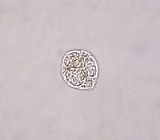
Ebriid

Encyclopedia
The Ebridea is a group of phagotrophic flagellate
protist
present in marine coastal plankton communities worldwide. Ebria tripartita is one of two (possibly four) described extant species in the Ebridea.
Members of this group are named for their idiosyncratic method of movement (ebrius, "drunk").
Ebriids are usually encountered in low abundance and have a peculiar combination of ultrastructural characters including a large nucleus with permanently condensed chromosome
s and an internal skeleton composed of siliceous rods.
The taxonomic history of the group has been tumultuous and has included a variety of affiliations, such as silicoflagellate
s, dinoflagellates, 'radiolarians' and 'neomonads'.
Recently the Ebridea is treated as a eukaryotic taxon with an unclear phylogenetic position, but last molecular studies (Canadian Institute for Advanced Research) place of ebriids within the Cercozoa
.
Flagellate
Flagellates are organisms with one or more whip-like organelles called flagella. Some cells in animals may be flagellate, for instance the spermatozoa of most phyla. Flowering plants do not produce flagellate cells, but ferns, mosses, green algae, some gymnosperms and other closely related plants...
protist
Protist
Protists are a diverse group of eukaryotic microorganisms. Historically, protists were treated as the kingdom Protista, which includes mostly unicellular organisms that do not fit into the other kingdoms, but this group is contested in modern taxonomy...
present in marine coastal plankton communities worldwide. Ebria tripartita is one of two (possibly four) described extant species in the Ebridea.
Members of this group are named for their idiosyncratic method of movement (ebrius, "drunk").
Ebriids are usually encountered in low abundance and have a peculiar combination of ultrastructural characters including a large nucleus with permanently condensed chromosome
Chromosome
A chromosome is an organized structure of DNA and protein found in cells. It is a single piece of coiled DNA containing many genes, regulatory elements and other nucleotide sequences. Chromosomes also contain DNA-bound proteins, which serve to package the DNA and control its functions.Chromosomes...
s and an internal skeleton composed of siliceous rods.
The taxonomic history of the group has been tumultuous and has included a variety of affiliations, such as silicoflagellate
Silicoflagellate
Dictyochales are a small group of unicellular heterokont algae, found in marine environments.-Characteristics:In one stage of their life cycle, they produce a siliceous skeleton, composed of a network of bars and spikes arranged to form an internal basket...
s, dinoflagellates, 'radiolarians' and 'neomonads'.
Recently the Ebridea is treated as a eukaryotic taxon with an unclear phylogenetic position, but last molecular studies (Canadian Institute for Advanced Research) place of ebriids within the Cercozoa
Cercozoa
The Cercozoa are a group of protists. They are sometimes described as a kingdom.-Characteristics:The group includes most amoeboids and flagellates that feed by means of filose pseudopods. These may be restricted to part of the cell surface, but there is never a true cytostome or mouth as found in...
.