

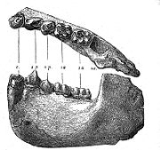
Dryopithecus

Encyclopedia
Dryopithecus was a genus
of ape
s that is known from Eastern Africa
into Eurasia
during the late Miocene
period. The first species of Dryopithecus was discovered at the site of Saint-Gaudens, Haute-Garonne, France, in 1856. Other dryopithecids have been found in Hungary, Spain, and China.
Like Sivapithecus
, Dryopithecus was suspensory
, had a large brain, and a delayed development, but, unlike the former, it had a gracile jaw with thinly enameled molars and suspensory forelimbs; notes that the similarities and differences between them provides insight into the timing and paleogeography of hominid origins and the phylogenetic divide between Asian and Afro-European great apes.
s, but that it used the flat of its hands, like a monkey, rather than knuckle-walking, like modern apes. Its face exhibited klinorhynchy, with its face being tilted downwards in profile.
It likely spent most of its life in trees, and was probably a brachiator
, similar to modern orangutan
s and gibbons. Its molar
s had relatively little enamel, suggesting that it ate soft leaves and fruit, an ideal food for a tree-dwelling animal.
The five-cusp
and juvenile fissure pattern of its molar teeth, known as the Y-5 arrangement, is typical of the dryopithecids and of hominoids in general.
Genus
In biology, a genus is a low-level taxonomic rank used in the biological classification of living and fossil organisms, which is an example of definition by genus and differentia...
of ape
Ape
Apes are Old World anthropoid mammals, more specifically a clade of tailless catarrhine primates, belonging to the biological superfamily Hominoidea. The apes are native to Africa and South-east Asia, although in relatively recent times humans have spread all over the world...
s that is known from Eastern Africa
Africa
Africa is the world's second largest and second most populous continent, after Asia. At about 30.2 million km² including adjacent islands, it covers 6% of the Earth's total surface area and 20.4% of the total land area...
into Eurasia
Eurasia
Eurasia is a continent or supercontinent comprising the traditional continents of Europe and Asia ; covering about 52,990,000 km2 or about 10.6% of the Earth's surface located primarily in the eastern and northern hemispheres...
during the late Miocene
Miocene
The Miocene is a geological epoch of the Neogene Period and extends from about . The Miocene was named by Sir Charles Lyell. Its name comes from the Greek words and and means "less recent" because it has 18% fewer modern sea invertebrates than the Pliocene. The Miocene follows the Oligocene...
period. The first species of Dryopithecus was discovered at the site of Saint-Gaudens, Haute-Garonne, France, in 1856. Other dryopithecids have been found in Hungary, Spain, and China.
Like Sivapithecus
Sivapithecus
Sivapithecus is a genus of extinct primates. Fossil remains of animals now assigned to this genus, dated from 12.5 million to 8.5 million years old in the Miocene, have been found since the 19th century in the Siwalik Hills in what is now India, Nepal, and Pakistan...
, Dryopithecus was suspensory
Suspensory behavior
Suspensory Behavior, exhibited by primates, is a form of arboreal locomotion or a feeding behavior which involves hanging or suspension of the body below or among the branches, rather than moving or sitting on top of the branches...
, had a large brain, and a delayed development, but, unlike the former, it had a gracile jaw with thinly enameled molars and suspensory forelimbs; notes that the similarities and differences between them provides insight into the timing and paleogeography of hominid origins and the phylogenetic divide between Asian and Afro-European great apes.
Description
Dryopithecus was about 60 centimetres (23.6 in) in body length, and more closely resembled a monkey than a modern ape. The structure of its limbs and wrists show that it walked in a similar way to modern chimpanzeeChimpanzee
Chimpanzee, sometimes colloquially chimp, is the common name for the two extant species of ape in the genus Pan. The Congo River forms the boundary between the native habitat of the two species:...
s, but that it used the flat of its hands, like a monkey, rather than knuckle-walking, like modern apes. Its face exhibited klinorhynchy, with its face being tilted downwards in profile.
It likely spent most of its life in trees, and was probably a brachiator
Brachiator
Brachiators are a type of primate mostly from the family Hylobatidae, which includes gibbons. Brachiators use their arms to move from tree branch to tree branch, through a process called brachiation. Their arms are longer than their legs, and are much more powerful.-Evolution:Brachiators began as...
, similar to modern orangutan
Orangutan
Orangutans are the only exclusively Asian genus of extant great ape. The largest living arboreal animals, they have proportionally longer arms than the other, more terrestrial, great apes. They are among the most intelligent primates and use a variety of sophisticated tools, also making sleeping...
s and gibbons. Its molar
Molar (tooth)
Molars are the rearmost and most complicated kind of tooth in most mammals. In many mammals they grind food; hence the Latin name mola, "millstone"....
s had relatively little enamel, suggesting that it ate soft leaves and fruit, an ideal food for a tree-dwelling animal.
The five-cusp
Cusp (dentistry)
A cusp is an occlusal or incisal eminence on a tooth.Canine teeth, otherwise known as cuspids, each possess a single cusp, while premolars, otherwise known as bicuspids, possess two each. Molars normally possess either four or five cusps...
and juvenile fissure pattern of its molar teeth, known as the Y-5 arrangement, is typical of the dryopithecids and of hominoids in general.