
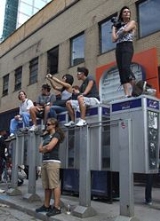
Documentary photography usually refers to a popular form of photography used to chronicle significant and historical events. It is typically covered in
professionalA professional is a person who is paid to undertake a specialised set of tasks and to complete them for a fee. The traditional professions were doctors, lawyers, clergymen, and commissioned military officers. Today, the term is applied to estate agents, surveyors , environmental scientists,...
photojournalismPhotojournalism is a particular form of journalism that creates images in order to tell a news story. It is now usually understood to refer only to still images, but in some cases the term also refers to video used in broadcast journalism...
, but it may also be an
amateurAn amateur is generally considered a person attached to a particular pursuit, study, or science, without pay and often without formal training....
, artistic, or academic pursuit. The photographer attempts to produce truthful, objective, and usually
candid photographyCandid photography is photography that focuses on spontaneity rather than technique, on the immersion of a camera within events rather than focusing on setting up a staged situation or on preparing a lengthy camera setup.-Description:...
of a particular subject, most often pictures of people.
History
The term
documentary applied to photography antedates the mode or genre itself. Photographs meant to accurately describe otherwise unknown, hidden, forbidden, or difficult-to-access places or circumstances date to the earliest daguerreotype and calotype "surveys" of the ruins of the Near East, Egypt, and the American wilderness areas. Nineteenth century archaeologist John Beasly Greene, for example, traveled to Nubia in the early 1850s to photograph the major ruins of the region; One early documentation project was the French
Missions Heliographiques organized by the official
Commission des Monuments historiques to develop an archive of France's rapidly-disappearing architectural and human heritage; the project included such photographic luminaries as
Henri Le SecqHenri Jean-Louis Le Secq was a French painter and photographer. After the French government made the daguerreotype open for public in 1851, Le Secq was one of the five photographers selected to carry out a photographic survey of architecture .-Early life:Henri Le Secq was born in 1818 in Paris and...
, Edouard Denis Baldus, and
Gustave Le GrayJean-Baptiste Gustave Le Gray has been called "the most important French photographer of the nineteenth century" because of his technical innovations in the still new medium of photography, his role as the teacher of other noted photographers, and the extraordinary imagination he brought to picture...
.
In the United States, photographs tracing the progress of the
American Civil WarThe American Civil War was a civil war fought in the United States of America. In response to the election of Abraham Lincoln as President of the United States, 11 southern slave states declared their secession from the United States and formed the Confederate States of America ; the other 25...
by photographers for at least three consortia of photographic publisher-distributors, most notably
Mathew BradyMathew B. Brady was one of the most celebrated 19th century American photographers, best known for his portraits of celebrities and his documentation of the American Civil War...
and
Alexander GardnerAlexander Gardner was a Scottish photographer who moved to the United States in 1856 where he developed his profession. He is best known for his photographs of the American Civil War, American President Abraham Lincoln, and the execution of the conspirators to Lincoln's...
, resulted in a major archive of photographs ranging from dry records of battle sites to harrowing images of the dead by
Timothy O'SullivanTimothy H. O'Sullivan was a photographer widely known for his work related to the American Civil War and the Western United States.O'Sullivan was born in New York City. As a teenager, he was employed by Mathew Brady...
and evocative images by George N. Barnard. A huge body of photography of the vast regions of the Great West was produced by official government photographers for the Geological and Geographical Survey of the Territories (a predecessor of the USGS), during the period 1868–1878, including most notably the photographers
Timothy O'SullivanTimothy H. O'Sullivan was a photographer widely known for his work related to the American Civil War and the Western United States.O'Sullivan was born in New York City. As a teenager, he was employed by Mathew Brady...
and
William Henry JacksonWilliam Henry Jackson was an American painter, Civil War, geological survey photographer and an explorer famous for his images of the American West...
.
Both the Civil War and USGS photographic works point up an important feature of documentary photography: the production of an archive of historical significance, and the distribution to a wide audience through publication. The US Government published Survey photographs in the annual
Reports, as well as portfolios designed to encourage continued funding of scientific surveys.
The development of new reproduction methods for photography provided impetus for the next era of documentary photography, in the late 1880s and 1890s, and reaching into the early decades of the 20th century. This period decisively shifted documentary from antiquarian and landscape subjects to that of the city and its crises. The refining of
photogravurePhotogravure is an intaglio printmaking or photo-mechanical process whereby a copper plate is coated with a light-sensitive gelatin tissue which had been exposed to a film positive, and then etched, resulting in a high quality intaglio print that can reproduce the detail and continuous tones of a...
methods, and then the introduction of
halftoneHalftone is the reprographic technique that simulates continuous tone imagery through the use of dots, varying either in size, in shape or in spacing...
reproduction around 1890 made low cost mass-reproduction in newspapers, magazines and books possible. The figure most directly associated with the birth of this new form of documentary is the journalist and urban social reformer
Jacob RiisJacob August Riis was a Danish American social reformer, "muckraking" journalist and social documentary photographer. He is known for using his photographic and journalistic talents to help the impoverished in New York City; those impoverished New Yorkers were the subject of most of his prolific...
. Riis was a New York police-beat reporter who had been converted to urban social reform ideas by his contact with medical and public-health officials, some of whom were amateur photographers. Riis used these acquaintances at first to gather photographs, but eventually took up the camera himself. His books, most notably
How the Other Half LivesHow the Other Half Lives: Studies Among the Tenements of New York was an early publication of photojournalism by Jacob Riis, documenting squalid living conditions in New York City slums in the 1880s...
of 1890 and
The Children of the Slums of 1892, used those photographs, but increasingly he also employed visual materials from a wide variety of sources, including police "mug shots" and photojournalistic images.
Riis's documentary photography was passionately devoted to changing the inhumane conditions under which the poor lived in the rapidly-expanding urban-industrial centers. His work succeeded in embedding photography in urban reform movements, notably the
Social GospelThe Social Gospel movement is a Protestant Christian intellectual movement that was most prominent in the early 20th century United States and Canada...
and
ProgressiveProgressivism is an umbrella term for a political ideology advocating or favoring social, political, and economic reform or changes. Progressivism is often viewed by some conservatives, constitutionalists, and libertarians to be in opposition to conservative or reactionary ideologies.The...
movements. His most famous successor was the photographer Lewis Wickes Hine, whose systematic surveys of conditions of child-labor in particular, made for the National Child Labor Commission and published in sociological journals like The Survey, are generally credited with strongly influencing the development of child-labor laws in New York and the United States more generally.
In the 1930s, the
Great DepressionThe Great Depression was a severe worldwide economic depression in the decade preceding World War II. The timing of the Great Depression varied across nations, but in most countries it started in about 1929 and lasted until the late 1930s or early 1940s...
brought a new wave of documentary, both of rural and urban conditions. The
Farm Security AdministrationInitially created as the Resettlement Administration in 1935 as part of the New Deal in the United States, the Farm Security Administration was an effort during the Depression to combat American rural poverty...
, a common term for the Historical Division, supervised by
Roy StrykerRoy Emerson Stryker was an American economist, government official, and photographer. He is most famous for heading the Information Division of the Farm Security Administration during the Great Depression and launching the documentary photography movement of the FSA.After serving in the infantry...
, funded legendary photographic documentarians, including
Walker EvansWalker Evans was an American photographer best known for his work for the Farm Security Administration documenting the effects of the Great Depression. Much of Evans's work from the FSA period uses the large-format, 8x10-inch camera...
,
Dorothea LangeDorothea Lange was an influential American documentary photographer and photojournalist, best known for her Depression-era work for the Farm Security Administration...
,
Russell LeeRussell Lee was an American photographer and photojournalist.Lee had trained as a chemical engineer, and in the fall of 1936 became a member of the team of photographers assembled under Roy Stryker for the federally sponsored Farm Security Administration documentation project...
,
John Vachon
, and
Marion Post WolcottMarion Post was a noted photographer who worked for the Farm Security Administration during the Great Depression documenting poverty and deprivation. She was born in New Jersey. Her parents split up and she was sent to boarding school, spending time at home with her mother in Greenwich Village...
among others. This generation of documentary photographers is generally credited for codifying the documentary code of accuracy mixed with impassioned advocacy, with the goal of arousing public commitment to social change.
During the wartime and postwar eras, documentary photography increasingly became subsumed under the rubric of
photojournalismPhotojournalism is a particular form of journalism that creates images in order to tell a news story. It is now usually understood to refer only to still images, but in some cases the term also refers to video used in broadcast journalism...
. Swiss-American photographer
Robert FrankRobert Frank , born in Zürich, Switzerland, is an important figure in American photography and film. His most notable work, the 1958 photobook titled The Americans, was influential, and earned Frank comparisons to a modern-day de Tocqueville for his fresh and skeptical outsider's view of American...
is generally credited with developing a counterstrain of more personal, evocative, and complex documentary, exemplified by his work in the 1950s, published in the United States in his 1959 book,
The AmericansThe Americans, by Robert Frank, was a highly influential book in post-war American photography. It was first published in France in 1958, and the following year in the United States. The photographs were notable for their distanced view of both high and low strata of American society...
. In the early 1960s, his influence on photographers like
Garry WinograndGarry Winogrand was a street photographer known for his portrayal of America in the mid-20th century. John Szarkowski called him the central photographer of his generation....
and
Lee FriedlanderLee Friedlander is an American photographer and artist. In the 1960s and 70s, working primarily with 35mm cameras and black and white film, Friedlander evolved an influential and often imitated visual language of urban "social landscape," with many of the photographs including fragments of...
resulted in an important exhibition at the
Museum of Modern ArtThe Museum of Modern Art is an art museum in Midtown Manhattan in New York City, on 53rd Street, between Fifth and Sixth Avenues. It has been important in developing and collecting modernist art, and is often identified as the most influential museum of modern art in the world...
[MoMA], which brought those two photographers together with their colleague
Diane ArbusDiane Arbus March 14, 1923 – July 26, 1971) was an American photographer and writer noted for black-and-white square photographs of "deviant and marginal people or of people whose normality seems ugly or surreal." A friend said that Arbus said that she was "afraid.....
under the title,
New Documents. MoMA curator
John SzarkowskiJohn Szarkowski was a photographer, curator, historian, and critic. From 1962 to 1991 Szarkowski was the Director of Photography at New York's Museum of Modern Art.-Early life and career:...
proposed in that exhibition that a new generation, committed not to social change but to formal and iconographical investigation of the social experience of modernity, had replaced the older forms of
social documentary photographySocial documentary photography may be defined as the act of recording, with a camera, human beings in their natural condition. Often is also refers to a socially critical genre of photography dedicated to showing the life of underprivileged or disadvantaged people.-Origin of social documentary...
.
In the 1970s and 1980s, a spirited attack on traditional documentary was mounted by historians, critics, and photographers. One of the most notable was the photographer-critic
Allan SekulaAllan Sekula is an American artist of Polish descent, writer, and critic based at the California Institute of the Arts in Valencia, California.-Work:...
, whose ideas and the accompanying bodies of pictures he produced, influenced a generation of "new new documentary" photographers, whose work was philosophically more rigorous, often more stridently leftist in its politics. Sekula emerged as a champion of these photographers, in critical writing and editorial work. Notable among this generation are the photographers Fred Lonidier, whose 'Health and Safety Game" of 1976 became a model of post-documentary, and
Martha RoslerMartha Rosler is an American artist. She was born in Brooklyn, New York, where she now lives. She graduated from Brooklyn College and the University of California, San Diego . Rosler works in video, photo-text, installation, and performance, as well as writing about art and culture...
, whose "The Bowery in Two Inadequate Descriptive Systems" of 1974-75 served as a milestone in the critique of classical humanistic documentary as the work of privileged elites imposing their visions and values on the dis-empowered.
Acceptance by the art world
Since the late 1970s, documentary photography has increasingly been accorded a place in art galleries alongside
fine art photographyFine art photography refers to photographs that are created in accordance with the creative vision of the photographer as artist. Fine art photography stands in contrast to photojournalism, which provides a visual account for news events, and commercial photography, the primary focus of which is to...
.
Luc DelahayeLuc Delahaye is a French photographer known for his large-scale color works depicting conflicts, world events or social issues. His pictures are characterized by detachment, directness and rich details, a documentary approach which is however countered by dramatic intensity and a narrative...
, Manuel Rivera-Ortiz and the members of
VII Photo AgencyVII is a photo agency representing 30+ photojournalists, known for its focus on conflict photography. This collective employs a three tier system: members, non-members and mentorees, titles which reflect the level of service and commitment provided by the company to the photographers.VII derives...
are among many who regularly exhibit in galleries and museums.
Notable documentary photographers
United States
- Joel Meyerowitz
Joel Meyerowitz is a street photographer who began photographing in color in 1962 and was an early advocate of the use of color during a time when there was significant resistance to the idea of color photography as serious art...
- Berenice Abbott
Berenice Abbott , born Bernice Abbott, was an American photographer best known for her black-and-white photography of New York City architecture and urban design of the 1930s.-Youth:...
- Steve Davis
- William Eggleston
William Eggleston , is an American photographer. He is widely credited with increasing recognition for color photography as a legitimate artistic medium to display in art galleries—which, until the 1970s, often tended to privilege work by photographers making black-and-white prints.- Early years...
- Walker Evans
Walker Evans was an American photographer best known for his work for the Farm Security Administration documenting the effects of the Great Depression. Much of Evans's work from the FSA period uses the large-format, 8x10-inch camera...
- Lee Friedlander
Lee Friedlander is an American photographer and artist. In the 1960s and 70s, working primarily with 35mm cameras and black and white film, Friedlander evolved an influential and often imitated visual language of urban "social landscape," with many of the photographs including fragments of...
- Jim Goldberg
Jim Goldberg is an American photographer and writer whose work reflects long-term, in-depth collaborations with neglected, ignored, or otherwise outside-the-mainstream populations.-Artistic career:...
- Nan Goldin
Nancy "Nan" Goldin is an American photographer.-Life and work:Goldin was born in Washington, D.C., and grew up in the Boston, Massachusetts suburb of Lexington, to middle class Jewish parents whose ideas, moderately liberal and progressive, were put to the test when on April 12, 1965 their eldest...
- Lauren Greenfield
Lauren Greenfield is an American artist, documentary photographer, and documentary filmmaker. She has published three monographs of her photographic work, directed four documentary films, exhibited her photographic prints in museums throughout the world, and had her work published in a variety of...
- Lewis Hine
Lewis Wickes Hine was an American sociologist and photographer. Hine used his camera as a tool for social reform. His photographs were instrumental in changing the child labor laws in the United States.-Early life:...
- Dorothea Lange
Dorothea Lange was an influential American documentary photographer and photojournalist, best known for her Depression-era work for the Farm Security Administration...
- Mary Ellen Mark
Mary Ellen Mark is an American photographer known for her photojournalism, portraiture, and advertising photography. She has had 16 collections of her work published and has been exhibited at galleries and museums worldwide. She has received numerous accolades, including three Robert F...
- Steve McCurry
Steve McCurry is an American photojournalist best known for his photograph, "Afghan Girl" that originally appeared in National Geographic magazine.-Early life:...
- James Nachtwey
James Nachtwey is an American photojournalist and war photographer.He grew up in Massachusetts and graduated from Dartmouth College, where he studied Art History and Political Science ....
- Gordon Parks
Gordon Roger Alexander Buchanan Parks was a groundbreaking American photographer, musician, poet, novelist, journalist, activist and film director...
- Eugene Richards
Eugene Richards is a noted American documentary photographer.During the 1960s, Richards was a civil rights activist and VISTA volunteer...
- Jim Richardson
- W. Eugene Smith
William Eugene Smith was an American photojournalist known for his refusal to compromise professional standards and his brutally vivid World War II photographs.- Life and work :...
- Peter Sekaer
Peter Sekaer was a Danish-American photographer and artist.thumb|250px|Peter Sekaer, Trailers for defense workers at Vultee Aircraft Plant. Nashville, Tennessee, 1941...
- Garry Winogrand
Garry Winogrand was a street photographer known for his portrayal of America in the mid-20th century. John Szarkowski called him the central photographer of his generation....
- Sally Mann
Sally Mann is an American photographer, best known for her large black-and-white photographs—at first of her young children, then later of landscapes suggesting decay and death.-Early life and education:...
- Daniel Lorenzetti
Daniel Lorenzetti, born in Fort Lauderdale, Florida, is an American writer, documentary photographer and explorer. He is also a frequent speaker on the subject of entertainment innovation specifically in the area of Transmedia and Collaborative Storytelling....
Europe
- Eugène Atget
Eugène Atget was a French photographer noted for his photographs documenting the architecture and street scenes of Paris....
- Gertrude Blom
Gertrude "Trudi" Duby Blom was a journalist, social anthropologist, and documentary photographer who spent five decades documenting the Mayan cultures of Chiapas, Mexico, particularly the culture of the Lacandon Maya. She was also a pioneering environmental activist...
- Bill Brandt
Bill Brandt was an influential British photographer and photojournalist known for his high-contrast images of British society and his distorted nudes and landscapes.-Career and life:...
- Brassaï
Brassaï was a Hungarian photographer, sculptor, and filmmaker who rose to international fame in France in the 20th century. He was one of the numerous Hungarian artists who flourished in Paris beginning between the World Wars...
- Henri Cartier-Bresson
Henri Cartier-Bresson was a French photographer considered to be the father of modern photojournalism. He was an early adopter of 35 mm format, and the master of candid photography...
- Robert Frank
Robert Frank , born in Zürich, Switzerland, is an important figure in American photography and film. His most notable work, the 1958 photobook titled The Americans, was influential, and earned Frank comparisons to a modern-day de Tocqueville for his fresh and skeptical outsider's view of American...
- Gisèle Freund
Gisèle Freund was a German-born French photographer, famous for her documentary photography and portraits of writers and artists. Her best-known book is Photographie et société , about the uses and abuses of the photographic medium.-Early life:Freund was born near Berlin to a wealthy Jewish family...
- David Hurn
David Hurn, born July 21, 1934, in Redhill, Surrey, England of Welsh descent, is a documentary photographer and member of Magnum Photos.-Career:...
- Josef Koudelka
Josef Koudelka is a Czech photographer.-Biography:Josef Koudelka was born in 1938 in Boskovice, Moravia, town of about 10,000 inhabitants. He began photographing his family and the surroundings with a 6 x 6 Bakelite camera...
- Don McCullin
Donald McCullin, FRPS CBE is an internationally known British photojournalist, particularly recognized for his war photography and images of urban strife...
- Martin Parr
Martin Parr is a British documentary photographer, photojournalist and photobook collector. He is known for his photographic projects that take a critical look at aspects of modern life, in particular provincial and suburban life in England...
- Jacob Riis
Jacob August Riis was a Danish American social reformer, "muckraking" journalist and social documentary photographer. He is known for using his photographic and journalistic talents to help the impoverished in New York City; those impoverished New Yorkers were the subject of most of his prolific...
- August Sander
August Sander was a German portrait and documentary photographer. Sander's first book Face of our Time was published in 1929...
- Roman Vishniac
Roman Vishniac was a Russian-American photographer, best known for capturing on film the culture of Jews in Central and Eastern Europe before the Holocaust. A complete archive of his work now rests at the International Center of Photography....
Other
- David Goldblatt
David Goldblatt is a South African photographer noted for his portrayal of South Africa during the period of apartheid and more recently that country's landscapes.-Life and work:...
(South Africa)
- Peter Magubane
-Early life:He was born in Vrededorp, now Pageview, a suburb in Johannesburg and grew up in Sophiatown. He started taking some photographs using a Kodak Brownie box camera as a schoolboy....
(South Africa)
- Manuel Rivera-Ortiz
Manuel Rivera-Ortiz is an American documentary photographer of Puerto Rican descent, the author of several photographic collections and the recipient of a number of awards. He is best known for his documentary photographs of people's living conditions in less developed countries...
(Puerto Rico)
- Sebastiao Salgado
Sebastião Salgado is a Brazilian social documentary photographer and photojournalist.-Biography:Salgado was born on February 8, 1944 in Aimorés, in the state of Minas Gerais, Brazil. After a somewhat itinerant childhood, Salgado initially trained as an economist, earning a master’s degree in...
(Brazil)
- Andrew Stark
Andrew Stark is an Australian street photographer mainly photographing in Sydney since the early 1980s. He was educated at Newington College .-Professional exhibits and books:...
(Australia)
- John Wilson (Australia)
- Sergey Mikhaylovich Prokudin-Gorsky (Russia)
- Raghu Rai
Raghu Rai is an Indian photographer and photojournalist. A protege of Henri Cartier-Bresson who appointed Rai, then a young photojournalist to Magnum Photos in 1977, which he co-founded....
(India)
- Sanjay Austa (India)
General
- "A New History of Photography" Könemann Verlagsgesellschaft/Michel Frizot 1998
- "DOWN THE LINE; LIGHT RAIL'S FIRST DAY; Getting off on the right track"; Star Tribune, June 27, 2004.