


Dimictic lake

Encyclopedia
Dimictic lakes are lakes that mix from top to bottom during two mixing periods each year. Dimictic lakes are holomictic
, a category which includes all lakes which mix one or more times per year. During winter they are covered by ice. During summer they are thermally stratified, with temperature-derived density differences separating the warm surface waters (the epilimnion
), from the colder bottom waters (the hypolimnion
).
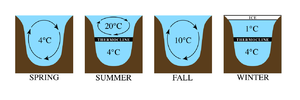
Mixing typically occurs during the spring and autumn, when the lake is "isothermal" (i.e., at the same temperature from the top to the bottom). At this time the water throughout the lake is about 4°C, and, in the absence of any temperature or density differences, the lake readily mixes from top to bottom. These lakes are common in regions with temperate climates.
Holomictic
Holomictic lakes are lakes, which, at some time during the year, have a uniform temperature and density from top to bottom, allowing the lake waters to completely mix. Holomictic lakes are non-meromictic lakes....
, a category which includes all lakes which mix one or more times per year. During winter they are covered by ice. During summer they are thermally stratified, with temperature-derived density differences separating the warm surface waters (the epilimnion
Epilimnion
The epilimnion is the top-most layer in a thermally stratified lake, occurring above the deeper hypolimnion. It is warmer and typically has a higher pH, but lower dissolved oxygen concentration than the hypolimnion....
), from the colder bottom waters (the hypolimnion
Hypolimnion
The hypolimnion is the dense, bottom layer of water in a thermally-stratified lake. It is the layer that lies below the thermocline.Typically the hypolimnion is the coldest layer of a lake in summer, and the warmest layer during winter...
).
Mixing typically occurs during the spring and autumn, when the lake is "isothermal" (i.e., at the same temperature from the top to the bottom). At this time the water throughout the lake is about 4°C, and, in the absence of any temperature or density differences, the lake readily mixes from top to bottom. These lakes are common in regions with temperate climates.
See also
- AmicticAmicticAmictic lakes are holomictic lakes that are permanently ice-covered. They are restricted to very cold climates .-See also:* Dimictic lake* Holomictic* Meromictic* Monomictic* Polymictic* Thermocline...
- HolomicticHolomicticHolomictic lakes are lakes, which, at some time during the year, have a uniform temperature and density from top to bottom, allowing the lake waters to completely mix. Holomictic lakes are non-meromictic lakes....
- MeromicticMeromicticA meromictic lake has layers of water that do not intermix. In ordinary, "holomictic" lakes, at least once each year there is a physical mixing of the surface and the deep waters...
- MonomicticMonomicticMonomictic lakes are holomictic lakes that mix from top to bottom during one mixing period each year. Monomictic lakes may be subdivided into Cold and Warm types.-Cold monomictic lakes:...
- PolymicticPolymicticPolymictic lakes are holomictic lakes that are too shallow to develop thermal stratification; thus, their waters can mix from top to bottom throughout the ice-free period...
- ThermoclineThermoclineA thermocline is a thin but distinct layer in a large body of fluid , in which temperature changes more rapidly with depth than it does in the layers above or below...