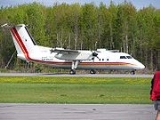
{|In the 1970s, de Havilland Canada had invested heavily in its Dash 7 project, concentrating on STOL and short-field performance, the company's traditional area of expertise. Using four medium-power engines with large four-bladed propellers resulted in very low noise levels which, combined with its excellent STOL characteristics, made the Dash 7 suitable for operating from small in-city airports, a market DHC felt would be compelling. However, only a handful of air carriers employed the Dash 7, as most
regional airlineRegional airlines are airlines that operate regional aircraft to provide passenger air service to communities without sufficient demand to attract mainline service...
s were more interested in operational costs than short-field performance.
In 1980, de Havilland responded by dropping the short-field performance requirement and adapting the basic Dash 7 layout to use only two, more powerful engines. Its favoured engine supplier,
Pratt & Whitney CanadaPratt & Whitney Canada is a Canadian aircraft engine manufacturer. PWC's headquarters are in Longueuil, Quebec, just outside Montreal. It is a division of the larger US-based Pratt & Whitney , itself a business unit of United Technologies...
, developed the new PW100 series engines for the role, more than doubling the power from its
PT6The Pratt & Whitney Canada PT6 is one of the most popular turboprop aircraft engines in history, and is produced by Pratt & Whitney Canada. The PT6 family is particularly well known for its extremely high reliability, with MTBO's on the order of 9000 hours in some models. In US military use, they...
. Originally designated the PT7A-2R engine, it later became the PW120. When the Dash 8 rolled out on April 19, 1983, more than 3,800 hours of testing had been accumulated over two years on five PW100 series test engines. Certification of the PW120 followed in late 1983.
Distinguishing features of the Dash 8 design are the large
T-tailthumb|right|Grob motor gliderA T-tail is an aircraft tail stabilizer configuration in which the horizontal surfaces are mounted to the top of the vertical stabilizer. Traditionally, the horizontal control surfaces are mounted to the fuselage at the base of the vertical stabilizer...
intended to keep the tail free of prop wash during takeoff, a very high
aspect ratioIn aerodynamics, the aspect ratio of a wing is essentially the ratio of its length to its breadth . A high aspect ratio indicates long, narrow wings, whereas a low aspect ratio indicates short, stubby wings....
wing, the elongated engine
nacelleThe nacelle is a cover housing that holds engines, fuel, or equipment on an aircraft. In some cases—for instance in the typical "Farman" type "pusher" aircraft, or the World War II-era P-38 Lightning—an aircraft's cockpit may also be housed in a nacelle, which essentially fills the...
s also holding the rearward-folding
landing gearLanding Gear is Devin the Dude's fifth studio album. It was released on October 7, 2008. It was his first studio album since signing with the label Razor & Tie. It features a high-profile guest appearance from Snoop Dogg. As of October 30, 2008, the album has sold 18,906 copies.-Track...
, and the pointed nose profile. First flight was on June 20, 1983, and the airliner entered service in 1984 with
NorOntairNorOntair is a defunct airline from Canada that operated its first scheduled flight October 18, 1971 and its last flight March 29, 1996.-Dash 8 service:* Fort Frances* Kapuskasing* North Bay* Sault Ste...
. In 1984,
Piedmont AirlinesPiedmont Airlines is an American regional airline operating for US Airways Express. It is a wholly owned subsidiary of the US Airways Group, headquartered in unincorporated Wicomico County, Maryland, near the city of Salisbury, it conducts flight operations using De Havilland Canada Dash 8 aircraft...
, formerly Henson Airlines, was the first US customer for the Dash 8.
The Dash 8 design has better cruise performance than the Dash 7, is less expensive to operate and much less expensive to maintain, due largely to having only two engines. The Dash 8 has the lowest cost per passenger mile of any
regional airlinerA regional airliner or a feederliner is a small airliner designed to fly up to 100 passengers on short-haul flights, usually feeding larger carriers' hubs from small markets. This class of airliners are typically flown by the regional airlines that are either contracted by or subsidiaries of the...
of the era. It was a little noisier than the Dash 7 and could not match the STOL performance of its earlier DHC forebears, although it was still able to operate from small airports with 3000 ft (914.4 m) runways, compared to the 2200 ft (670.6 m) required by a fully loaded Dash 7.
In April 2008, Bombardier announced that production of the Classic versions (Series 100, 200, 300) would be ended, leaving the Series 400 as the only Dash 8 still in production. 671 Dash 8 Classics were produced, the last one delivered to
Air NelsonAir Nelson, a subsidiary of Air New Zealand is a regional airline based in Nelson, New Zealand. It operates services on provincial routes under the Air New Zealand Link brand. Its main base is Nelson Airport, with hubs at Auckland, Napier, New Plymouth, Wellington, Tauranga and Christchurch.The...
in May 2008.
Q400X
Bombardier is proposing development of a 90-seat stretch of the Q400 with two plug-in segments, currently called the
Q400X project. In response to this project, ATR is also studying a 90-seat stretch.
On June 15, 2009, Bombardier commercial aircraft president Gary Scott indicated that the Q400X will be "definitely part of our future" for possible introduction in 2013-14, although he has not detailed the size of the proposed version or committed to an introduction date.
In 2010 Bombardier's vice president, Phillipe Poutissou made comments explaining the company was still studying the prospects of designing the Q400X and talking with potential customers.
Operational history
The Dash 8 was introduced at a particularly advantageous time; most airlines were in the process of adding new aircraft to their fleets as the airline industry expanded greatly in the 1980s. The older generation of regional airliners from the 1950s and 1960s were nearing retirement, leading to high sales figures. De Havilland Canada was unable to meet the demand with sufficient production.
In 1988,
BoeingThe Boeing Company is an American multinational aerospace and defense corporation, founded in 1916 by William E. Boeing in Seattle, Washington. Boeing has expanded over the years, merging with McDonnell Douglas in 1997. Boeing Corporate headquarters has been in Chicago, Illinois since 2001...
bought the company in a bid to improve production at DHC's Downsview Airport plants, as well as better position itself to compete for a new
Air CanadaAir Canada is the flag carrier and largest airline of Canada. The airline, founded in 1936, provides scheduled and charter air transport for passengers and cargo to 178 destinations worldwide. It is the world's tenth largest passenger airline by number of destinations, and the airline is a...
order for large intercontinental airliners. Air Canada was a Crown corporation at the time, and both Boeing and
AirbusAirbus SAS is an aircraft manufacturing subsidiary of EADS, a European aerospace company. Based in Blagnac, France, surburb of Toulouse, and with significant activity across Europe, the company produces around half of the world's jet airliners....
were competing heavily via political channels for the contract. It was eventually won by Airbus, which received an order for 34 A320 aircraft in a highly controversial move. The allegations of bribery are today known as the
Airbus affairThe Airbus affair refers to allegations of secret commissions paid to members of the Government of Canada during the term of Prime Minister Brian Mulroney, in exchange for then-crown corporation Air Canada's purchase of a large number of Airbus jets...
. Following its failure in the competition, Boeing immediately put de Havilland Canada up for sale. The company was eventually purchased by Bombardier in 1992.
The market demand for short-haul airliners was so great that
AérospatialeAérospatiale was a French aerospace manufacturer that built both civilian and military aircraft, rockets and satellites. It was originally known as Société Nationale Industrielle Aérospatiale...
of France paired with Italy's Alenia to form ATR. Their once separate efforts combined to compete directly with the Dash 8. The resulting
ATR 42-Civil operators:The largest operators of the ATR-42 are FedEx Express, Airlinair, TRIP Linhas Aéreas,and Mexico City-based Aeromar respectively. Number of aircraft as of 2010:Some 70 other airlines operate smaller numbers of the type....
was even more economical than the Dash 8, but de Havilland Canada responded with newer models to close the gap. Other companies competed with smaller or more tailored designs, like the
Saab 340The Saab 340 is a discontinued Swedish two-engine turboprop aircraft designed and initially produced by a partnership between Saab and Fairchild Aircraft in a 65:35 ratio...
and Embraer Brasilia, but by the time these were introduced the market was already reaching saturation.
All Dash 8s delivered from the second quarter of 1996 (including all Series 400s) include the Active Noise and Vibration Suppression (ANVS) system designed to reduce cabin noise and vibration levels to nearly those of jet airliners. To emphasize their quietness, Bombardier renamed the Dash 8 models as the Q-Series turboprops (Q200, Q300 and Q400).
The Dash 8-100 is no longer in production, with the last Dash 8-102 built in 2005. Production of the Q200 and Q300 ceased in May 2009.
Regional jet competition
The introduction of the
regional jetA Regional jet , is a class of short to medium-range turbofan powered airliners.-History:The term "Regional jet" describes a range of short to medium-haul turbofan powered aircraft, whose use throughout the world expanded after the advent of Airline Deregulation in the United States in...
altered the sales picture. Although more expensive than turboprops, regional jets allow airlines to operate passenger services on routes not suitable for turboprops. Turboprop aircraft have lower fuel consumption and can operate from shorter runways than regional jets, but have higher engine maintenance costs, shorter ranges and lower cruising speeds.
The market for new aircraft to replace existing turboprops once again grew in the mid-1990s, and DHC responded with the improved "Series 400" design.
When world oil prices drove up short-haul airfares in 2006, an increasing number of airlines that had bought regional jets began to reassess turboprop regional airliners, which use about 30-60% less fuel than regional jets. Although the market does not appear to be as robust as in the 1980s when the first Dash 8s were introduced, 2007 saw increased sales of the only two 40+ seat regional turboprops still in western production, Bombardier's Q400 and its competitor, the ATR series of 50-70 seat turboprops. The Q400 has a cruising speed close to that of most regional jets, and its mature engines and systems require less frequent maintenance, reducing its disadvantage.
According to Bombardier marketing, the aircraft breaks even with about 1/3 of its seats filled (or 1/4 with more closely spaced seats), making it particularly attractive on routes with varying passenger numbers where many seats would be empty on some flights. For example,
Island AirIsland Air is an independent American commuter airline based in Honolulu CDP, City and County of Honolulu, Hawaii. It operates scheduled inter-island passenger services in Hawaii...
in
HawaiiHawaii is the newest of the 50 U.S. states , and is the only U.S. state made up entirely of islands. It is the northernmost island group in Polynesia, occupying most of an archipelago in the central Pacific Ocean, southwest of the continental United States, southeast of Japan, and northeast of...
calculated that the use of a 50-seat Regional Jet would break even at 45 passenger seats compared to the Q400's 35-36 seats (around 55% breakeven load factor). Most short-haul routes are less than 350 miles (500 km), so the time spent on taxiing, takeoff and landing virtually eliminates a competing jet's speed advantage. As the Q400's 360 knot (414 mph, 667 km/h) cruise speed approaches jet speeds, short-haul airlines can usually replace a regional jet with a Q400 without changing their gate-to-gate schedules.
Bombardier has singled out the Q400 for more aggressive marketing, launching a website centered around the aircraft. The aircraft is also being considered for a further stretched version (currently designated Q400X) to compete in the 90-seat market range. Bombardier commercial aircraft president Gary Scott has affirmed that 2013-2014 is "the sort of time period we're looking at today" for offering a stretched version of the Q400 turboprop.
Series 100
DHC-8-100 series
- Original 37–39 passenger version that entered service in 1984. The original engine was the PW120A (CAA validated on December 13, 1985); later units used the PW121 (CAA validated on February 22, 1990). Rated engine power is 1,800 shp (1,340 kW).
DHC-8-101
- 1984 variant powered by either two PW120 or PW120A engines and a 33,000 lb (15,000 kg) takeoff weight.
- 1986 variant powered by either two PW120A or PW121 engines and a 34,500 lb (15,650 kg) takeoff weight.
DHC-8-103
- 1987 variant powered by two PW121 engines and a 34,500 lb (15,650 kg) takeoff weight (can be modified for a 35,200 lb [15,950 kg] take-off weight)
DHC-8-102A
- 1990 variant powered by two PW120A engines with revised Heath Tecna interior.
DHC-8-106
- 1992 variant powered by two PW121 engines and a 36,300 lb (16,450 kg) takeoff weight.
DHC-8M-100
- Two aircraft for Maritime Pollution Surveillance, operated by Transport Canada
Transport Canada is the department within the government of Canada which is responsible for developing regulations, policies and services of transportation in Canada. It is part of the Transportation, Infrastructure and Communities portfolio...
, equipped with the MSS 6000 Surveillance system.
CC-142
- Military transport version for the Canadian Forces
The Canadian Forces , officially the Canadian Armed Forces , are the unified armed forces of Canada, as constituted by the National Defence Act, which states: "The Canadian Forces are the armed forces of Her Majesty raised by Canada and consist of one Service called the Canadian Armed Forces."...
in Europe.
CT-142
- Military navigation training version for the Canadian Forces.
E-9A
- A United States Air Force
The United States Air Force is the aerial warfare service branch of the United States Armed Forces and one of the American uniformed services. Initially part of the United States Army, the USAF was formed as a separate branch of the military on September 18, 1947 under the National Security Act of...
range control aircraft equipped with AN/APS-143(V)-1 radar that operates out of Tyndall AFB, Florida to ensure that the overwater military ranges in the Gulf of MexicoThe Gulf of Mexico is a partially landlocked ocean basin largely surrounded by the North American continent and the island of Cuba. It is bounded on the northeast, north and northwest by the Gulf Coast of the United States, on the southwest and south by Mexico, and on the southeast by Cuba. In...
are clear of civilian boats and aircraft during live fire tests of air-launched missiles and other hazardous military activities. Two aircraft are assigned to the 82d Aerial Targets SquadronThe 82nd Aerial Targets Squadron ' is a United States Air Force unit. It is assigned to the 53rd Weapons Evaluation Group and stationed at Tyndall Air Force Base, Florida.-Overview:...
for the support of training missions.
Series 200
DHC-8-200 Series: Series 100 airframe with more powerful Pratt & Whitney Canada PW123 engines (rated at 2,150 shp or 1,600 kW) for improved performance also capable of carrying 37 to 39 passengers.
DHC-8-201
- 1995 variant powered by two PW123C engines.
DHC-8-202
- 1995 variant powered by two PW123D engines.
Q200
- Version of the DHC-8-200 with the ANVS system.
Series 300
DHC-8-300 Series
- Stretched 3.43 m (11 ft) over the Series 100/200, a 50–56 passenger version that entered service in 1989. The Q300 is powered by the Pratt & Whitney PW123 or PW123B or PW123E, rated at 2,380-2,500 shp or 1,774-1,864 kW.
DHC-8-301
- 1989 variant powered by two PW123 engines
DHC-8-311
- 1990 variant powered by two PW123A engines with revised Heath Tecna interior.
DHC-8-314
- 1992 variant powered by two PW123B engines
DHC-8-315
- 1995 variant powered by two PW123E engines
DHC-8-300A
- Version of the DHC-8-300 with increased payload.
Q300
- Version of the DHC-8-300 with the ANVS system.
DHC-8-300 MSA
- Upgraded variant with L3 for maritime surveillance platform.
Series 400
Q400
- Stretched and improved 70–78 passenger version that entered service in 2000. Its 360 knot (667 km/h) cruise speed is 60-90 knots (111-166 km/h) higher than its competitors/predecessors. Powered by PW150A engines rated at 5,071 shp (3,781 kW) at maximum power (4,850 shp or 3,620 kW maximum continuous rated). The maximum operating altitude is 25,000 ft (7,600 m) for the standard version, although a version with drop-down oxygen masks is offered, which increases maximum operating altitude to 27,000 ft (8,200 m). All Q400s include the ANVS system.
Q400
NextGen
- Version of the Q400 with updated cabins, lighting, windows, overhead bins, landing gear, as well as reduced fuel and maintenance costs.
Q400-MR
- 2 Q400 adapted to the water bombing role by Cascade Aerospace
Cascade Aerospace Inc. of Abbotsford, British Columbia, Canada is a privately-held Canadian specialty aerospace and defence contractor focused on providing long-term integrated aircraft support programs for Original Equipment Manufacturers , military, government and commercial customers...
for the French Sécurité CivileOperating for the French Ministry of the Interior, the Direction de la Défense de la Sécurité Civile is a French Government civil defence agency, employing some 2,500 civilian and military personnel over 60 sites...
. The tanker mode can carry 2,600 US gallon of retardant, foam or water and travel at 340 knots.
DHC-8-400
- 1999 variant with a maximum of 68 passengers.
DHC-8-401
- 1999 variant with a maximum of 70 passengers.
DHC-8-402
- 1999 variant with a maximum of 78 passengers.
DHC-8-402PF
- 2008 converted pallet freighter variant with a payload of 9000 kg.
DHC-8 MPA-D8
- 2007 converted for use as a maritime patrol aircraft.
Notable accidents
- November 21, 1990: a Bangkok Airways
Bangkok Airways Co., Ltd. is a regional airline based in Chatuchak District, Bangkok, Thailand. It operates scheduled services to destinations in Thailand, Cambodia, China, Laos, Maldives, Burma, India and Singapore...
DHC-8-103 crashed on Koh Samui while attempting to land in heavy rain and high winds. All 38 people on board died.
- January 6, 1993: Lufthansa Cityline Flight 5634
The accident happened on 6 January 1993 when Lufthansa Cityline Flight 5634 was on a flight from Bremen Airport to Paris-Charles de Gaulle Airport in France. The Dash 8-311 registration D-BEAT with 23 passengers and crew took off from Bremen Airport at 17:30...
crashed short of the runway near Paris-Charles de Gaulle Airport, France. The crash killed four out of 23 passengers and crew.
- June 9, 1995: Ansett New Zealand Flight 703
Ansett New Zealand Flight 703 was an Ansett New Zealand scheduled passenger transport flight from Auckland Airport to Palmerston North. On 9 June 1995, the Dash 8 aircraft flying this route crashed west of the Tararua Ranges and 16 km east of Palmerston North airport, during an instrument...
, a Dash 8-102 flying from Auckland Airport to Palmerston NorthPalmerston North is the main city of the Manawatu-Wanganui region of the North Island of New Zealand. It is an inland city with a population of and is the country's seventh largest city and eighth largest urban area. Palmerston North is located in the eastern Manawatu Plains near the north bank...
crashed on the western slopes of the Tararua Ranges and 16 km east of Palmerston North Airport during an instrument approach in inclement weather; four occupants were killed.
- February 12, 2009: Colgan Air Flight 3407
Colgan Air Flight 3407, marketed as Continental Connection under a codeshare agreement with Continental Airlines, was a daily U.S. regional airline commuter flight from Newark Liberty International Airport in New Jersey to Buffalo Niagara International Airport in New York State.A Bombardier...
a Q400, from Newark Liberty International AirportNewark Liberty International Airport , first named Newark Metropolitan Airport and later Newark International Airport, is an international airport within the city limits of both Newark and Elizabeth, New Jersey, United States...
to Buffalo Niagara International AirportBuffalo Niagara International Airport is an airport located in Cheektowaga CDP, Town of Cheektowaga, in Erie County, New York, USA. It is named after the Buffalo – Niagara Falls metropolitan area. The airport serves Buffalo, New York as well as Southern Ontario, Canada...
, stalled and crashed into a house in Clarence Center, New YorkClarence Center is a hamlet located in the Town of Clarence in Erie County, New York, United States. The population was 1,747 at the 2000 census...
, while preparing to land at the airport. All 49 people on board, including four crew and one off duty pilot, as well as one person on the ground, were killed. Two other people on the ground received minor injuries. The National Transportation Safety BoardThe National Transportation Safety Board is an independent U.S. government investigative agency responsible for civil transportation accident investigation. In this role, the NTSB investigates and reports on aviation accidents and incidents, certain types of highway crashes, ship and marine...
determined that the aircraft had no known mechanical or computer malfunctions (including the auto-pilot), and pilot error, including a "startle and confusion" response by the captain, was the primary contributor to the accident.
- November 23, 2009: a DHC-8-200, being operated on behalf of United States Africa Command
The United States Africa Command is one of nine Unified Combatant Commands of the United States Armed Forces, headquartered at Kelley Barracks, Stuttgart, Germany. It is responsible for U.S. military operations and military relations with 53 African nations – an area of responsibility covering all...
, made an emergency landing at Tarakigné, MaliMali , officially the Republic of Mali , is a landlocked country in Western Africa. Mali borders Algeria on the north, Niger on the east, Burkina Faso and the Côte d'Ivoire on the south, Guinea on the south-west, and Senegal and Mauritania on the west. Its size is just over 1,240,000 km² with...
and was substantially damaged when the undercarriage collapsed and the starboard wing was ripped off. The incident was caused by the aircraft running out of fuel 29 seconds prior to the forced landing. The captain had opted not to refuel at the previous departure airport.
- October 13, 2011: an Airlines PNG Dash 8-102, registration P2-MCJ, crashed about 20km south of Madang
Madang is the capital of Madang Province and is a town with a population of 27,420 on the north coast of Papua New Guinea. It was first settled by the Germans in the 19th century....
in Papua New GuineaPapua New Guinea , officially the Independent State of Papua New Guinea, is a country in Oceania, occupying the eastern half of the island of New Guinea and numerous offshore islands...
while en route from LaeLae, the capital of Morobe Province, is the second-largest city in Papua New Guinea. It is located at the start of the Highlands Highway which is the main land transport corridor from the Highlands region to the coast...
with 32 people on board. The aircraft subsequently ignited, resulting in 28 deaths. Both pilots, as well as a flight attendant and a passenger, survived. Following the accident, Airlines PNG grounded its fleet of 12 Dash 8 aircraft.
Major landing gear incidents
In September 2007, two separate incidents of similar landing gear failures occurred within four days of each other on SAS Dash 8-Q400 aircraft. A third incident occurred in October 2007, leading to the withdrawal of the type from the airline's fleet.
On September 9, 2007 the crew of Scandinavian Airlines (SAS) Flight 1209, en route from
CopenhagenCopenhagen is the capital and largest city of Denmark, with an urban population of 1,199,224 and a metropolitan population of 1,930,260 . With the completion of the transnational Øresund Bridge in 2000, Copenhagen has become the centre of the increasingly integrating Øresund Region...
to
Aalborg-Transport:On the north side of the Limfjord is Nørresundby, which is connected to Aalborg by a road bridge Limfjordsbroen, an iron railway bridge Jernbanebroen over Limfjorden, as well as a motorway tunnel running under the Limfjord Limfjordstunnelen....
, reported problems with the locking mechanism of the right side landing gear, and
Aalborg AirportAalborg Airport is a dual-use airport located in Nørresundby, Denmark, which is northwest of Aalborg. Aalborg Airport is the third largest airport in Denmark with approximately 1.4 million travellers per year.-Duty Free Shopping:...
was prepared for an emergency landing. Shortly after touchdown the right main gear collapsed and the airliner skidded off the runway while fragments of the right propeller shot against the cabin and the right engine caught fire. Of 69 passengers and four crew on board, 11 were sent to hospital, five with only minor injuries. The accident was filmed by a local news channel (TV2-Nord) and broadcast live on national television.
Three days later on September 12, Scandinavian Airlines Flight 2748 from Copenhagen to
PalangaPalanga and beautiful sand dunes. Officially Palanga has the status of a city municipality and includes Šventoji, Nemirseta, Būtingė and other settlements, which are considered as part of the city of Palanga.-Legend:...
had a similar problem with the landing gear, forcing the aircraft to land in
VilniusVilnius is the capital of Lithuania, and its largest city, with a population of 560,190 as of 2010. It is the seat of the Vilnius city municipality and of the Vilnius district municipality. It is also the capital of Vilnius County...
. No passengers or crew were injured. Immediately after this incident SAS grounded all 33 Q400 airliners in its fleet and, a few hours later, Bombardier recommended that all Q400s with more than 10,000 flights be grounded until further notice. This affected about 60 aircraft, out of 140 Q400s then in service.
On October 27, 2007, Scandinavian Airlines Flight 2867 en route from
BergenBergen is the second largest city in Norway with a population of as of , . Bergen is the administrative centre of Hordaland county. Greater Bergen or Bergen Metropolitan Area as defined by Statistics Norway, has a population of as of , ....
to Copenhagen had severe problems with the landing gear during landing in Kastrup Airport. The right wing gear did not deploy properly (or partially), and the aircraft skidded off the runway in a controlled emergency landing. The Q400 was carrying 38 passengers, two infants and four crew members on board. No injuries were reported. The next day, SAS permanently removed its entire Dash 8 Q400 fleet from service. In a press release on October 28, 2007, the company's president said: "Confidence in the Q400 has diminished considerably and our customers are becoming increasingly doubtful about flying in this type of aircraft. Accordingly, with the Board of Directors' approval, I have decided to immediately remove Dash 8 Q400 aircraft from service." The preliminary Danish investigation determined the latest Q400 incident was unrelated to the airline's earlier corrosion problems, in this particular case caused by a misplaced
O-ringAn O-ring, also known as a packing, or a toric joint, is a mechanical gasket in the shape of a torus; it is a loop of elastomer with a disc-shaped cross-section, designed to be seated in a groove and compressed during assembly between two or more parts, creating a seal at the interface.The O-ring...
found blocking the orifice in the restrictor
valveA valve is a device that regulates, directs or controls the flow of a fluid by opening, closing, or partially obstructing various passageways. Valves are technically pipe fittings, but are usually discussed as a separate category...
.
In all, eight Q400s had landing gear failures while landing during 2007: four in Denmark, one in Germany, one in Japan, one in
LithuaniaLithuania , officially the Republic of Lithuania is a country in Northern Europe, the biggest of the three Baltic states. It is situated along the southeastern shore of the Baltic Sea, whereby to the west lie Sweden and Denmark...
and one in
South KoreaThe Republic of Korea , , is a sovereign state in East Asia, located on the southern portion of the Korean Peninsula. It is neighbored by the People's Republic of China to the west, Japan to the east, North Korea to the north, and the East China Sea and Republic of China to the south...
. In November 2007, it was revealed that the
Swedish Civil Aviation AdministrationThe Swedish Civil Aviation Administration, or Luftfartsverket was the Swedish Government agency which regulated and oversaw all aspects of aviation in Sweden until 2005...
had begun an investigation and as a result accused Scandinavian Airlines System of cutting corners in its maintenance. The airline reportedly made 2,300 flights in which safety equipment was not up to standard. On March 10, 2008, SAS ordered 27 more aircraft from Bombardier in a compensation deal; 14 Q400 NextGen turboprops and 13
CRJ900The Bombardier CRJ700, CRJ900, and CRJ1000 are regional airliners based on the Bombardier CRJ200. Final assembly of the aircraft is at Montréal-Mirabel International Airport in Mirabel, Quebec, outside Montreal, Canada.-Development:...
jets.
Specifications
{| class=wikitable style="text-align: center;"
|-
! !! Series 100 !! Series 200!! Series 300!! Series 400
|- bgColor="#c9d5e6"
| Unit cost (US$) || $12.5 million || $13 million || $17 million || $27 million
|- bgColor="#e1e8f1"
| Entered service || 1984 || 1995 || 1989 || 2000
|- bgColor="#e1e8f1"
! Aircraft dimensions || colspan="4" |
|- bgColor="#c9d5e6
| Overall length || colspan="2" | 73 ft (22.25 m) || 84 ft 3 in (25.68 m) || 107 ft 8 in (32.81 m)
|- bgColor="#e1e8f1"
| Height (to top of horizontal tail) || colspan="3" | 24 ft 7 in (7.49 m) || 27 ft 3 in (8.3 m)
|- bgColor="#c9d5e6"
| Fuselage diameter || colspan="4" | 8 ft 10 in (2.69 m)
|- bgColor="#e1e8f1"
| Maximum cabin width || colspan="4" | 8 ft 3 in (2.51 m)
|- bgColor="#c9d5e6"
| Cabin length || colspan="2" | 29 ft 10 in (9.1 m) || 41 ft 4 in (12.6 m) || 61 ft 8 in (18.8 m)
|- bgColor="#e1e8f1"
| Wingspan (geometric) || colspan="2" | 84 ft 11 in (25.89 m) || 90 ft (27.43 m) || 93 ft 2 in (28.4 m)
|- bgColor="#c9d5e6"
| Wing area (reference) || colspan="2" | 585 ft² 80 in² (54.4 m²) || 604 ft² 134 in² (56.2 m²) || 679 ft² 29 in² (63.1 m²)
|-
! Basic operating data || colspan="4" |
|- bgColor="#c9d5e6"
| Engines || 2
PW120A/PW121
|| 2
PW123C/D
|| 2
PW123B
|| 2 PW150A
|- bgColor="#e1e8f1"
| Typical passenger seating || colspan="2" | 37 (Single Class) || 50 (Single Class) || 78 (Single Class)
|- bgColor="#c9d5e6"
| Passenger seating range || colspan="2" | 37-39 || 50-56 || 68-80
|- bgColor="#e1e8f1"
| Typical cruise speed || 310 mph (500 km/h) 269 knots|| 334 mph (537 km/h) 290 knots|| 328 mph (528 km/h) 285 knots|| 414 mph (667 km/h) 360 knots
|- bgColor="#c9d5e6"
| Maximum operating altitude || colspan="3" | 25,000 ft (7,620 m) || 27,000 ft (8,230 m)
|- bgColor="#e1e8f1"
| Range (w/typical pax) || 1,174 miles (1,889 km) || 1,065 miles (1,713 km) || 968 miles (1,558 km) || 1,567 miles (2,522 km)
|- bgColor="#c9d5e6"
| Range (w/LR tanks) || colspan="2" | n/a || 1,264 miles (2,034 km) || n/a
|- bgColor="#e1e8f1"
| Takeoff run at MTOW || colspan="2" |2,625 ft (800 m) || 3,865 ft (1,178 m) || 4,600 ft (1,402 m)
|-
! Design weights || colspan="4" |
|- bgColor="#c9d5e6"
| Maximum takeoff weight || colspan="2" | 36,300 lb (16,470 kg) || 43,000 lb (19,500 kg) || 64,500 lb (29,260 kg)
|- bgColor="#e1e8f1"
| Maximum landing weight || colspan="2" | 34,500 lb (15,650 kg) || 42,000 lb (19,050 kg) || 61,750 lb (28,010 kg)
|- bgColor="#c9d5e6"
| Maximum zero fuel weight || colspan="2" | 32,400 lb (14,700 kg) || 39,500 lb (17,920 kg) || 57,000 lb (25,850 kg)
|- bgColor="#e1e8f1"
| Maximum fuel capacity || colspan="3" | 835 imp gal (3,160L) || colspan="1" | 1,724 imp gal (6,526L) (11830 pounds)
|- bgColor="#c9d5e6"
| Typical operating weight empty || colspan="2" | 23,111 lb (10,483 kg) || 25,995 lb (11,791 kg)|| 37,886 lb (17,185 kg)
|- bgColor="#e1e8f1"
| Typical volumetric payload || colspan="2" | 7,511 lb (3,407 kg)|| 11,327 lb (5,138 kg)|| 19,114 lb (8,670 kg)
|}
Orders and deliveries
{| style="text-align: center; font-size: 97%;" class="wikitable"
|- bgcolor="#DDDD"
!Model Series
!Orders
!Deliveries
!Unfilled
|- bgcolor="#EEEEEE"
|Series 100|| 299 || 299 || -
|- bgcolor="#EEEEEE"
|Series 200|| 105 || 105 || -
|- bgcolor="#EEEEEE"
|Series 300|| 267 || 267 || -
|- bgcolor="#EEEEEE"
|Series 400|| 408 || 368 || 40
|- bgcolor="#EEEEEE"
| Grand Total || 1079 || 1039 || 40
|}
All data as of July 31, 2011.
See also
External links