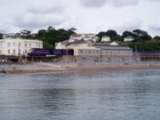
Dawlish railway station is on the London to Penzance Line and serves the town of
DawlishDawlish is a town on the south coast of Devon, England, 12 miles from the County town of Exeter, with a population of around 13,000 people. During the eighteenth century, it grew from a small fishing port to become a well-known seaside resort....
in
DevonDevon is a large county in England. The county is also referred to as Devonshire, although that is an unofficial name, rarely used inside of the county itself and often indicating a traditional or historical context. The county shares borders with Cornwall to the west and Dorset and Somerset to...
, England. The station and line is built on the
sea wallThe South Devon Railway sea wall is situated on the south coast of Devon in England. It is probably the most photographed section of railway in the United Kingdom as a footpath runs alongside the railway between Dawlish Warren and Dawlish, and another footpath forms a continuation to the sea front...
, and has often suffered from storm damage due its proximity to the sea. South of the station the line passes through five tunnels through the cliffs as it follows the coast.
The station was opened by the
South Devon RailwayThe South Devon Railway Company built and operated the railway from Exeter to Plymouth and Torquay in Devon, England. It was a broad gauge railway built by Isambard Kingdom Brunel-Chronology:* 1844 South Devon Railway Act passed by parliament...
on 30 May 1846. The strange wall with bricked up windows that can be seen in the car park is the remains of the
engine houseThe South Devon Railway engine houses were built in Devon, England, to power the atmospheric trains on the South Devon Railway between Exeter St Davids and Plymouth Millbay railway stations. They contained boilers that provided the power to pumps that created the vacuum to move the trains...
that used to power the trains while they were worked by
atmospheric powerAn atmospheric railway uses air pressure to provide power for propulsion. A pneumatic tube is laid between the rails, with a piston running in it suspended from the train through a sealable slot in the top of the tube...
from 13 September 1847 until 9 September 1848.
Dawlish railway station is on the London to Penzance Line and serves the town of
DawlishDawlish is a town on the south coast of Devon, England, 12 miles from the County town of Exeter, with a population of around 13,000 people. During the eighteenth century, it grew from a small fishing port to become a well-known seaside resort....
in
DevonDevon is a large county in England. The county is also referred to as Devonshire, although that is an unofficial name, rarely used inside of the county itself and often indicating a traditional or historical context. The county shares borders with Cornwall to the west and Dorset and Somerset to...
, England. The station and line is built on the
sea wallThe South Devon Railway sea wall is situated on the south coast of Devon in England. It is probably the most photographed section of railway in the United Kingdom as a footpath runs alongside the railway between Dawlish Warren and Dawlish, and another footpath forms a continuation to the sea front...
, and has often suffered from storm damage due its proximity to the sea. South of the station the line passes through five tunnels through the cliffs as it follows the coast.
History
The station was opened by the
South Devon RailwayThe South Devon Railway Company built and operated the railway from Exeter to Plymouth and Torquay in Devon, England. It was a broad gauge railway built by Isambard Kingdom Brunel-Chronology:* 1844 South Devon Railway Act passed by parliament...
on 30 May 1846. The strange wall with bricked up windows that can be seen in the car park is the remains of the
engine houseThe South Devon Railway engine houses were built in Devon, England, to power the atmospheric trains on the South Devon Railway between Exeter St Davids and Plymouth Millbay railway stations. They contained boilers that provided the power to pumps that created the vacuum to move the trains...
that used to power the trains while they were worked by
atmospheric powerAn atmospheric railway uses air pressure to provide power for propulsion. A pneumatic tube is laid between the rails, with a piston running in it suspended from the train through a sealable slot in the top of the tube...
from 13 September 1847 until 9 September 1848. At this time it was one of
Isambard Kingdom BrunelIsambard Kingdom Brunel, FRS , was a British engineer. He is best known for the creation of the Great Western Railway, a series of famous steamships, including the first propeller-driven transatlantic steamship, and numerous important bridges and tunnels...
's
broad gaugeBroad gauge railways use a rail gauge greater than the standard gauge of .- List :For a list see: List of broad gauges, by gauge and country- History :...
railways.
The station initially had just one
platformA railway platform is a section of pathway, alongside rail tracks at a train station, metro station or tram stop, at which passengers may board or alight from trains or trams. Almost all stations for rail transport have some form of platforms, with larger stations having multiple platforms...
on the landward side with a loop line closer to the sea, but a second platform was added to serve the loop line on 1 May 1858. The original wooden station and
train shedA train shed is an adjacent building to a railway station where the tracks and platforms are covered by a roof. It is also known as an overall roof...
was burnt down on 14 August 1873 and the present buildings opened to replace it on 12 April 1875. The platforms have been extended several times to cope with the crowds and now reach all the way to Coastguards' Footbridge, although the Exeter platform was shortened again in 1970.
The South Devon Railway was amalgamated into the
Great Western RailwayThe Great Western Railway was a British railway company that linked London with the south west and west of England and most of Wales. It was founded in 1833, received its enabling Act of Parliament in 1835, and ran its first trains three years later...
on 1 February 1876, and on 20 May 1892 the line was converted to
standard gaugeThe standard gauge is a widely-used rail gauge. Approximately 60% of the world's existing railway lines are built to this gauge...
. The Great Western in turn was nationalised into British Railways on 1 January 1948.
The decorative iron and glass canopies above the platforms were replaced by concrete beams and glass panels in 1961 but the glass has since been replaced by Perspex. Goods traffic was withdrawn on 17 May 1965.
Signalling
The first signal box was provided on the seaward platform beside the north end of the waiting room but this was replaced by a new two-storey signal box on 9 September 1920 on the opposite platform. So as to fit on the narrow platform the brick-built lower storey which contained the interlocking equipment was narrower than usual, with the upper storey was vaulted out from this to give a full size operating floor.
After the summer of 1970 the signal box was only opened on summer weekends or if there were problems working along the sea wall. It finally closed on 27 September 1986 since when the trains have been controlled from Exeter, but the distinctive structure remains on the platform.
Accident
On 22 September 1921 a
PlymouthPlymouth Millbay railway station was the original railway terminus in Plymouth, Devon, England. It was used for passenger trains from 1849 to 1941.- History :...
to
CreweCrewe railway station was completed in 1837 and is one of the most historic railway stations in the world. Built in fields near to Crewe Hall, it originally served the village of Crewe with a population of just 70 residents...
passenger train collided with an
ExeterExeter St Davids station is the most important of seven National Rail stations in the city of Exeter in southwest England. Today the station is owned by Network Rail and operated by First Great Western.-History:...
to
Newton AbbotNewton Abbot railway station serves the town of Newton Abbot in Devon, England. It is from London on the London to Penzance Line, at the junction for the branch to . For many years it was also the junction for Moretonhampstead and the site of a large locomotive workshop...
goods train which was shunting in the station. The passenger train, hauled by
Star ClassThe Great Western Railway Star Class 2-2-2 broad gauge steam locomotives for passenger train work. This class was introduced into service between November 1838 and November 1841, and withdrawn between April 1864 and September 1871....
4055
Princess Sophia, failed to stop at a danger signal. Cranes cleared the line by lifting damaged wagons onto the beach where they remained for a couple of days.
Description
The station is adjacent to the beach near the gardens at the centre of the town. The main frontage is in banded
rusticatedthumb|250px|Two different styles of rustication in the [[Palazzo Medici-Riccardi]] in [[Florence]].Rustication is an architectural term that contrasts with ashlar, smoothly finished, squared block masonry surfaces...
masonry. The remaining walls are rendered except for the east elevation, which faces the sea, which is in
rubbleRubble is broken stone, of irregular size,shape and texture. This word is closely connected in derivation with "rubbish", which was formerly also applied to what we now call "rubble". Rubble naturally found in the soil is known also as brash...
stone. It has two storeys as the railway runs above street level and a café occupies most of the street frontage. The main entrance is at road level on the side served by trains to
ExeterExeter St Davids station is the most important of seven National Rail stations in the city of Exeter in southwest England. Today the station is owned by Network Rail and operated by First Great Western.-History:...
. This opens onto a booking office with an ornate ceiling from where a flight of stairs lead up to the Exeter platform, but step-free access can be obtained through a gate from the car park beside the station buildings, which is only access route when the booking office is closed.
Access to the opposite platform is by way of a covered
footbridgeA footbridge or pedestrian bridge is a bridge designed for pedestrians and in some cases cyclists, animal traffic and horse riders, rather than vehicular traffic. In many developed countries, footbridges are both functional and can be beautiful works of art and sculpture...
, the stairways of which are contained within the building. Passengers who cannot use the steps can be escorted across the barrow crossing at the south end of the station by the station staff.
Immediately to the south of the station is the low Colonnade Viaduct, which carries the railway above the small river that runs through the gardens and the main footpath from the town to the beach and the
South West Coast PathThe South West Coast Path is Britain's longest waymarked long-distance footpath and a National Trail. It stretches for , running from Minehead in Somerset, along the coasts of Devon and Cornwall, to Poole Harbour in Dorset. Since it rises and falls with every river mouth, it is also one of the more...
. To the north of the station is Coastguards Footbridge, with Coastguards Cottage, now a café, on the hill above the line to the west, and Brunel's Boat House between the line and the beach to the east.
Services
Dawlish is served by
First Great WesternFirst Great Western is the operating name of First Greater Western Ltd, a British train operating company owned by FirstGroup, which operates services in the west and south west of England and South Wales....
local trains in both directions on an approximately hourly basis during the day. Most trains run between
ExmouthExmouth station serves the town of Exmouth in Devon, England and is south east of -History:The railway to Exmouth was opened on 1 May 1861. New docks were opened in 1868 and a short branch was laid to connect them to the goods yard....
and
PaigntonPaignton railway station is the railway station serving Paignton in Devon, England. It is the terminus of the Riviera Line from Exeter and is also an interchange between National Rail services and the preserved Paignton and Dartmouth Steam Railway.-History:...
; on Sundays the service is less frequent and most trains only run between
Exeter St DavidsExeter St Davids station is the most important of seven National Rail stations in the city of Exeter in southwest England. Today the station is owned by Network Rail and operated by First Great Western.-History:...
and Paignton. The line from Exeter St Davids through Dawlish to Paignton is marketed as the "
Riviera LineThe Riviera Line is a local railway line that connects the city of Exeter to the "English Riviera" resorts of Torbay in Devon, England. It is closely linked with the London to Penzance Line with which it shares the route along the South Devon sea wall...
".
A few First Great Western trains from
BristolBristol Temple Meads railway station is the oldest and largest railway station in Bristol, England. It is an important interchange hub for public transport in Bristol, with bus services to various parts of the city and surrounding districts, and a ferry service to the city centre in addition to the...
or from London Paddington station also call at Dawlish, as do most
South West TrainsSouth West Trains is the trading name of a train operating company operating in the United Kingdom, providing train services to the south-west of London, chiefly in Greater London and the counties of Surrey, Hampshire, Dorset, Devon, Somerset, Berkshire, Wiltshire and the Isle of Wight, the area...
services from London Waterloo station and
CrossCountryCrossCountry is the brand name of XC Trains Ltd., a British train operating company owned by Arriva. The company operates a network of express and long-distance train services between a variety of towns and cities outside London.- Formation :...
services from the North of England. Most of these services, including the
Torbay ExpressThe Torbay Express is a named passenger train operating in the United Kingdom.-Great Western Railway:Historically, the Torbay Express name was applied to services operated by the Great Western Railway from London Paddington to Torquay and Paignton....
from Paddington, continue to Paignton but a few run instead to
PlymouthPlymouth railway station serves the city of Plymouth, Devon, England. It is situated on the northern edge of the city centre close to the North Cross roundabout...
and even
PenzancePenzance railway station serves the town of Penzance, Cornwall, UK. The station is the western terminus of the Cornish Main Line from London Paddington. The current journey time to or from London is about five hours....
. At other times passengers travelling east or north catch a local train and change into main line trains at Exeter St Davids, or at Newton Abbot if travelling westwards.
From December 2009
South West TrainsSouth West Trains is the trading name of a train operating company operating in the United Kingdom, providing train services to the south-west of London, chiefly in Greater London and the counties of Surrey, Hampshire, Dorset, Devon, Somerset, Berkshire, Wiltshire and the Isle of Wight, the area...
will stop operating services west of Exeter, this means passengers will have to change at Exeter St David's.
Further reading