

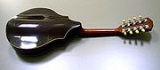
Cylinder-back mandolin

Encyclopedia
The cylinder-back is a style of mandolin
manufactured by the Vega Company
of Boston, MA between 1913 and roughly 1925. The design patent (US patent number D44838) for the instrument was issued on November 4, 1913 to David L. Day, who was director and chief acoustical engineer for the stringed instrument division of the Vega Company. The unique design feature of the cylinder-back instruments (originally referred to as mando-lutes by their manufacturer) is a cylindrical bulge running longitudinally along the back plate, from the tailpiece to the neck heel. This bulge increases the internal volume of the instrument. The result has been described as a compromise between the earlier Neapolitan-style bowl-back mandolins and the more modern styles with relatively flat backs that were manufactured primarily in the United States around the time of the cylinder-back's first appearance. In addition to the mandolin, the same bulged-back concept was applied to the Vega mandola
, mandcello, and mando-bass as well as to a series of hybrid 10-string instruments than spanned the pitch range between adjacently-sized 8-string models.
Mandolin
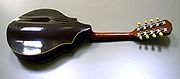
A mandolin is a musical instrument in the lute family . It descends from the mandore, a soprano member of the lute family. The mandolin soundboard comes in many shapes—but generally round or teardrop-shaped, sometimes with scrolls or other projections. A mandolin may have f-holes, or a single...
manufactured by the Vega Company
Vega Company
The Vega Company was one of an illustrious group of musical instrument manufacturers trading in Boston, Massachusetts at the latter part of the 19th and early part of the 20th centuries. The company first took shape in 1881 under the guidance of Swedish-born Julius Nelson, his brother Carl, and a...
of Boston, MA between 1913 and roughly 1925. The design patent (US patent number D44838) for the instrument was issued on November 4, 1913 to David L. Day, who was director and chief acoustical engineer for the stringed instrument division of the Vega Company. The unique design feature of the cylinder-back instruments (originally referred to as mando-lutes by their manufacturer) is a cylindrical bulge running longitudinally along the back plate, from the tailpiece to the neck heel. This bulge increases the internal volume of the instrument. The result has been described as a compromise between the earlier Neapolitan-style bowl-back mandolins and the more modern styles with relatively flat backs that were manufactured primarily in the United States around the time of the cylinder-back's first appearance. In addition to the mandolin, the same bulged-back concept was applied to the Vega mandola
Mandola
The mandola or tenor mandola is a fretted, stringed musical instrument. It is to the mandolin what the viola is to the violin: the four double courses of strings tuned in fifths to the same pitches as the viola , a fifth lower than a mandolin...
, mandcello, and mando-bass as well as to a series of hybrid 10-string instruments than spanned the pitch range between adjacently-sized 8-string models.