

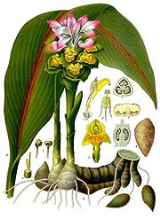
Curcuma

Encyclopedia
Curcuma is a genus
of about 80 accepted species in the plant family Zingiberaceae
that contains such species as turmeric
and Siam Tulip
. The name comes from Arabic kurkum (كركم) meaning "turmeric
". Since assembly of the genus Curcuma by Linnaeus in 1753 about 130 species have been described so far. Some of the species descriptions are without Latin diagnosis or type specimen, therefore the legitimate status of many species is suspicious and remains unclear. An overview about the taxonomical classification along with citation of the most relevant literature of Curcuma species can be found at Wikispecies http://species.wikimedia.org/wiki/Curcuma.
Genus
In biology, a genus is a low-level taxonomic rank used in the biological classification of living and fossil organisms, which is an example of definition by genus and differentia...
of about 80 accepted species in the plant family Zingiberaceae
Zingiberaceae
Zingiberaceae, or the Ginger family, is a family of flowering plants consisting of aromatic perennial herbs with creeping horizontal or tuberous rhizomes, comprising ca. 52 genera and more than 1300 species, distributed throughout tropical Africa, Asia, and the Americas.Many species are important...
that contains such species as turmeric
Turmeric
Turmeric is a rhizomatous herbaceous perennial plant of the ginger family, Zingiberaceae. It is native to tropical South Asia and needs temperatures between 20 °C and 30 °C and a considerable amount of annual rainfall to thrive...
and Siam Tulip
Siam Tulip
The Siam Tulip or Summer Tulip is a tropical plant native to northern Thailand and Cambodia. Despite its name, it is not related to the tulip, but to the various ginger species such as turmeric...
. The name comes from Arabic kurkum (كركم) meaning "turmeric
Turmeric
Turmeric is a rhizomatous herbaceous perennial plant of the ginger family, Zingiberaceae. It is native to tropical South Asia and needs temperatures between 20 °C and 30 °C and a considerable amount of annual rainfall to thrive...
". Since assembly of the genus Curcuma by Linnaeus in 1753 about 130 species have been described so far. Some of the species descriptions are without Latin diagnosis or type specimen, therefore the legitimate status of many species is suspicious and remains unclear. An overview about the taxonomical classification along with citation of the most relevant literature of Curcuma species can be found at Wikispecies http://species.wikimedia.org/wiki/Curcuma.
Species
- Curcuma aeruginosa Roxb.
- Curcuma albicoma S.Q.Tong
- Curcuma albiflora Thwaites
- Curcuma alismatifolia Gagnep. : Siam tulip
- Curcuma amada Roxb. : mango-ginger
- Curcuma amarissima Roscoe
- Curcuma angustifolia Roxb.
- Curcuma aromaticaCurcuma aromaticaCurcuma aromatica is a member of the Curcuma genus belonging to the family Zingiberaceae. Botanically close to Curcuma australasica, wild turmeric has been widely used as a cosmetic herbal in South Asia and nearby regions.- Nomenclature :* Common name in English: wild turmeric, aromatic turmeric*...
Salisb. : wild turmeric - Curcuma attenuata Wall. ex Baker
- Curcuma aurantiaca van Zijp
- Curcuma australasicaCurcuma australasicaCurcuma australasica, Native Turmeric, or Cape York Lily, is a rhizomatous herbaceous perennial plant of the Zingiberaceae or ginger family.-NomenclatureDescription:...
Hook.f. - Curcuma bakeriana Hemsl. nomen illegit.
- Curcuma bicolor Mood & K.Larsen
- Curcuma bhatii (R.M.Smith) Skornickova & M.Sabu
- Curcuma burttii K.Larsen & R.M.Smith
- Curcuma caesia Roxb. : black turmeric
- Curcuma ceratotheca K.Schum.
- Curcuma chuanezhu Z.Y.Zhu nomen illegit.
- Curcuma chuanhuangjiang Z.Y.Zhu nomen illegit.
- Curcuma chuanyujin C.K.Hsieh & H.Zhang
- Curcuma cochinchinensis Gagnep.
- Curcuma codonantha Skornickova
- Curcuma coerulea K.Schum.
- Curcuma colorata Valeton
- Curcuma comosaCurcuma comosaCurcuma comosa is a species of flowering plant in the ginger family. It is native to much of Asia, including Thailand, Indonesia, and Malaysia. The herb is cultivated in Thailand, especially in the Northern Province, including Petchaboon, and the Northeastern Province, including Loei...
Roxb. - Curcuma coriacea Mangaly & M.Sabu
- Curcuma decipiens Dalzell
- Curcuma domestica Valeton
—syn. Curcuma longa Linn. - Curcuma ecalcarata Sivar. & Balach.
- Curcuma euchroma Valeton
- Curcuma ecomata Craib
- Curcuma elata Roxb.
- Curcuma exigua N.Liu
- Curcuma ferruginea Roxb.
- Curcuma flaviflora S.Q.Tong
- Curcuma glans K.Larsen & Mood
- Curcuma gracillima Gagnep.
- Curcuma grandiflora Wall. ex Baker
- Curcuma haritha Mangaly & M.Sabu
- Curcuma harmandii Gagnep.
- Curcuma heyneana Valeton & van Zijp
- Curcuma inodora Blatt.
- Curcuma karnatakensis Amalraj
- Curcuma kudagensis Velayudhan, V.S.Pillai & Amalraj
- Curcuma kwangsiensis S.G.Lee & C.L.Liang
- Curcuma lanceolata Ridley
- Curcuma larsenii C.Maknoi & T.Jenjittikul
- Curcuma latiflora Valeton
- Curcuma latifolia Roscoe
- Curcuma leucorrhiza Roxb.
- Curcuma loerzingii Valeton
- Curcuma longa L. : turmeric
- Curcuma longispica Valeton
- Curcuma malabarica Velayudhan, Amalraj & Muralidharan
- Curcuma meraukensis Valeton
- Curcuma mutabilis Skornickova, M.Sabu & Prasanthkumar
- Curcuma neilgherrensis Wight
- Curcuma nilamburensis K.C.Velayudhan et al.
- Curcuma oligantha Trimen
- Curcuma ornata Wall. ex Baker
- Curcuma parviflora Wall.
- Curcuma parvula Gage
- Curcuma peethapushpa Sasidh. & Sivar.
- Curcuma petiolataCurcuma petiolataCurcuma petiolata is a plant of the Zingiberaceae or ginger family.It is native to Thailand and Malaysia....
Roxb. - Curcuma phaeocaulis Valeton
- Curcuma pierreana Gagnep.
- Curcuma plicata Wall. ex Baker
- Curcuma porphyrotaenia Zipp. ex Span.
- Curcuma prakashaCurcuma prakashaCurcuma prakasha is a species in the ginger family of plants, somewhat new to science. It was collected from open grassland in the Garo Hills of Meghalaya State in India by its binomial author, Sunil Tripathi. He named it in Honor of Dr. Visvesvaraiah Prakash, an economic botanist, ethnobotanist...
S.Tripathi - Curcuma pseudomontana J.Graham
- Curcuma purpurascens Blume
- Curcuma purpurea Blatt.
- Curcuma raktakanta Mangaly & M.Sabu
- Curcuma reclinata Roxb.
- Curcuma rhabdota Sirirugsa & M.F.Newman
- Curcuma rhomba Mood & K.Larsen
- Curcuma roscoeanaCurcuma roscoeanaCurcuma Roscoeana is a plant of the Zingiberaceae or ginger family....
Wall. - Curcuma rubescens Roxb.
- Curcuma rubrobracteata Skornickova, M.Sabu & Prasanthkumar
- Curcuma sattayasaii A.Chaveerach & R.Sudmoon
- Curcuma sichuanensis X.X.Chen
- Curcuma singularis Gagnep.
- Curcuma sparganiifolia Gagnep.
- Curcuma stenochila Gagnep.
- Curcuma strobilifera Wall. ex Baker
- Curcuma sulcata Haines
- Curcuma sumatrana Miq.
- Curcuma sylvatica Valeton
- Curcuma thalakaveriensis Velayudhan et al.
- Curcuma thorelii Gagnep.
- Curcuma trichosantha Gagnep.
- Curcuma vamana M.Sabu & Mangaly
- Curcuma vellanikkarensis K.C.Velayudhan et al.
- Curcuma wenyujin Y.H.Chen & C.Ling
- Curcuma wenchowensis Y.H.Chen & C.Ling
- Curcuma xanthorrhiza Roxb. : temu lawak
- Curcuma yunnanensis N.Liu & C.Senjen
- Curcuma zedoaria (Christm.) Roscoe : zedoary
- Curcuma zedoaroides A.Chaveerach & T.Tanee