


Cryptobotany

Encyclopedia
Scientific community
The scientific community consists of the total body of scientists, its relationships and interactions. It is normally divided into "sub-communities" each working on a particular field within science. Objectivity is expected to be achieved by the scientific method...
, but which exist in myth, literature or unsubstantiated reports.
Folk legend and ethnic usage of plants, often as interdisciplinary research, is presented and developed for an unknown species, in the hope of allowing those species to be collected or adequately identified. Any researcher or writer can identify himself or herself as a cryptobotanist; the field is surveyed within cryptozoological or other journals, or with varying degrees of skepticism as a protoscience
Protoscience
In the philosophy of science, a protoscience is an area of scientific endeavor that is in the process of becoming established. Protoscience is distinguished from pseudoscience by its standard practices of good science, such as a willingness to be disproven by new evidence, or to be replaced by a...
.
Many plants remain undiscovered or are yet to be classified, however cryptobotany usually focuses on fantastical plants believed to have harmful or therapeutic interactions with people. Sources of data may be secondary or scant; reports may be plausible or outlandish.
Man eating plants
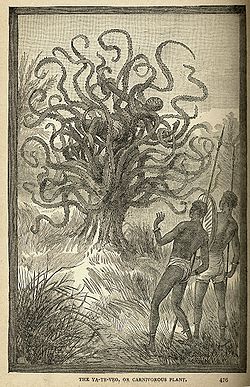
Man-eating tree
Man-eating tree can refer to any of various legendary or cryptid carnivorous plants that are large enough to kill and consume a person or other large animal. In actuality, the carnivorous plant with the largest known traps is probably Nepenthes rajah, which produces pitchers up to tall with a...
, most frequently inhabiting the jungles of Africa in popular fiction, may have been based on initial reports of plants that could trap and kill mammals, such as Nepenthes rajah
Nepenthes rajah
Nepenthes rajah is an insectivorous pitcher plant species of the Nepenthaceae family. It is endemic to Mount Kinabalu and neighbouring Mount Tambuyukon in Sabah, Malaysian Borneo. Nepenthes rajah grows exclusively on serpentine substrates, particularly in areas of seeping ground water where the...
. However, there are unconfirmed reports, primarily from Latin America, that allege the existence of still-undiscovered species of large carnivorous plants, according to British cryptozoologist Karl Shuker
Karl Shuker
Karl P. N. Shuker is a British zoologist, cryptozoologist, and author living in the West Midlands, England. He works as a full-time freelance zoological consultant, media consultant, and noted author specializing in cryptozoology.- Career :...
's book The Beasts That Hide From Man (2003).