


Crary Mountains

Encyclopedia
Mountain
Image:Himalaya_annotated.jpg|thumb|right|The Himalayan mountain range with Mount Everestrect 58 14 160 49 Chomo Lonzorect 200 28 335 52 Makalurect 378 24 566 45 Mount Everestrect 188 581 920 656 Tibetan Plateaurect 250 406 340 427 Rong River...
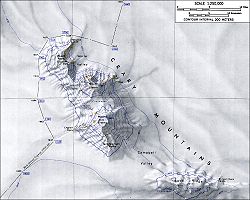
s, 56 km (35 mi) long, rising to 3,655 m at Mount Frakes
Mount Frakes
Mount Frakes is a prominent shield volcano marking the highest elevation in the Crary Mountains, in Marie Byrd Land, Antarctica.The mountain was mapped by the USGS from surveys and U.S. Navy air photos, 1959-66. Named by US-ACAN for Lawrence A. Frakes, USARP geologist who worked three summer...
and including Mount Rees
Mount Rees
Mount Rees is a named after Margaret N. Rees, geologist, University of Nevada; conducted field studies in the Transatlantic Mountains, including the Skelton Glacier area of the Hillary Coast, through several seasons, 1984-90....
, Mount Steere
Mount Steere
Mount Steere is a prominent shield volcano standing 6.4 km NNW of Mount Frakes in the Crary Mountains of Marie Byrd Land, Antarctica....
and Boyd Ridge. The mountains are located 80 km (50 mi) SW of Toney Mountain
Toney Mountain
Toney Mountain is an elongated snow-covered shield volcano, 60 km long and rising to 3,595 m in Richmond Peak, located 56 km SW of Kohler Range in Marie Byrd Land...
in Marie Byrd Land
Marie Byrd Land
Marie Byrd Land is the portion of West Antarctica lying east of the Ross Ice Shelf and the Ross Sea and south of the Pacific Ocean, extending eastward approximately to a line between the head of the Ross Ice Shelf and Eights Coast. It stretches between 158°W and 103°24'W...
.
The mountains were probably among those viewed by Admiral Byrd and other members of the USAS in plane flights from the ship Bear on Feb. 24 and 25, 1940. They were mapped in the course of the 1957-58 oversnow traverse from Byrd Station to the Sentinel Range
Sentinel Range
The Sentinel Range is a major mountain range situated northward of Minnesota Glacier and forming the northern half of the Ellsworth Mountains in Antarctica. The range trends NNW-SSE for about and is 24 to 48 km wide...
led by C.R. Bentley, and named after Albert P. Crary
Albert P. Crary
Albert Paddock Crary , was a pioneer polar geophysicist and glaciologist. He made it to the North and then to the South Pole on February 12, 1961 as the leader of a team of eight. The south pole expedition had set out from McMurdo Station on December 10, 1960, using three Snowcats with trailers...
, who was then Deputy Chief Scientist for the US-IGY
International Geophysical Year
The International Geophysical Year was an international scientific project that lasted from July 1, 1957, to December 31, 1958. It marked the end of a long period during the Cold War when scientific interchange between East and West was seriously interrupted...
Antarctic Program.