
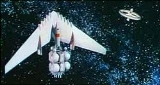
Conquest of Space is a 1955
science fictionScience fiction is a genre of fiction dealing with imaginary but more or less plausible content such as future settings, futuristic science and technology, space travel, aliens, and paranormal abilities...
movieA film, also called a movie or motion picture, is a series of still or moving images. It is produced by recording photographic images with cameras, or by creating images using animation techniques or visual effects...
produced by
George PalGeorge Pal , born György Pál Marczincsak, was a Hungarian-born American animator and film producer, principally associated with the science fiction genre...
which depicts a voyage to Mars. The science and technology were intended to be as realistic as possible. The poster tagline was "See how it will happen in your lifetime!"
Plot summary
Sometime in the late 1950s, mankind has achieved the capability of manned space flight and built a space station in orbit around the Earth, headed by Captain Merritt, whose son is feeling a little homesick (he'd left Earth three months after just marrying). At the moment, the space station's personnel have been at work constructing a giant spaceship to go to the moon, but on one occasion, a crew member becomes a victim of space fatigue after failing to connect a wire on time.
Later on, as Captain Merritt Sr has taken his men to the galley for dinner, the space station is lightly damaged by a meteor shower, but damages are soon repaired. After the incident, an inspector comes up from Earth and (after being questioned over the moonship's inclusion of wings) gives Captain Merritt fresh orders from the president: not only is Merritt being promoted to General, but the so called moonship is going to Mars instead. As General Merritt selects five men to go with him, his close friend is turned down for being three months too young, and Sgt Imoto expresses his view on the Martian mission, explaining how Japan, before
World War TwoWorld War II, or the Second World War , was a global conflict lasting from 1939 to 1945, involving most of the world's nations—including all of the great powers—eventually forming two opposing military alliances: the Allies and the Axis...
, served as an example for a world becoming overpopulated and about to run out of valuable resources.
After the selected crew members watch a news broadcast wishing them farewell, the Mars mission sets off, only for the General to find that his friend stowed away by hiding in one of the spacesuits. En route, something goes wrong with the communication antenna, so two men go out on a spacewalk to make repairs. They manage to get the antenna working just in time as the monitor shows an asteroid, twenty times bigger than the Mars ship, coming at them from the stern. Thanks to the general, the ship manages to avoid a collision, but meteors from the asteroid kill one of the spacewalking astronauts by puncturing an airline, leaving the crew to abandon him in space.
Eight months later, as the crew approaches Mars, the general becomes increasingly disturbed (showing that space fatigue is beginning to affect him), and as they come in for a landing and the "space speed indicator" approaches zero, he suddenly says "We haven't the right!" and puts on full throttle. His son, now the captain of the mission, struggles with him, wrenches his hand from the throttle, and brings the ship in to a rough but safe landing. Later, as the crew takes their first steps on the Martian surface, they spot fuel for the return journey leaking from the rocket. Getting aboard quickly the captain discovers the saboteur is the general. In a fight with his son (as the leak is stopped), the two struggle and Captain Merritt fires his father's gun, killing the general. Sgt. Mahoney, who'd seen the last stages of the fight, threatens to have Captain Merritt confined for his actions.
The crew discovers, apparently surprised, that Mars is inhospitable and that that it is going to be a severe struggle to survive with their limited water for the year it will take for Earth to reach the right orbital position for a successful return. Despite the absence of water on Mars, like the child in
Ruth KraussRuth Krauss was an author of children's books, one of the most well known being The Carrot Seed, and an author of theatrical poems for an adult audience. Many of her books are still in print....
's book
The Carrot SeedThe Carrot Seed is a 1945 children's book by Ruth Krauss. , The Carrot Seed has been in print continuously since its first publication in 1945. It was illustrated by Krauss's husband, Crockett Johnson. At 101 words, it was one of the shortest picture book texts when it was published in 1945.The...
, Japanese crew member Sgt. Imoto plants a seed hopefully in the Martian soil.
The crew celebrates Christmas on Mars glumly. Wisecracking Brooklynite Sgt. Siegle plays Christmas carols somberly on a harmonica while the other actors chew the scenery. Siegle complains they are on "a lousy, dried-up ball in the corner pocket of nowhere."
- Sgt. Mahoney: The General wasn't crazy, he was right! We asked for it! There's a curse on this ship and everybody in it!
- Sgt. Siegle: Baloney! You leave that stuff back on Earth. But it don't operate past the thousand-mile limit. "Only God can make a tree." Okay? Where is it? Where's the trees, and the flowers, and the grass? Where's the water? You hear me? Where's the water?!
Just then, Sgt. Imoto, who has been staring out the window yells "Look!" Since it is snowing on Christmas Day, the crew is saved and they manage to replenish their water supply. In due course, as the launch date approaches, the seed Imoto planted sprouts into a tiny flower. The viewer infers that Mars has water and can grow flowers; since "only God can make a tree," God is present on Mars and God must intend for humankind to exploit not only the Earth but also Mars and the rest of the universe.
The joy over the discovery of the flower is, however, short lived as the crew hear rumbling sounds and see rocks falling and cavities opening up in the ground, proving that Mars has underground water. The ground sinks slightly under the ship and even though the ship doesn't sink into the ground, it is leaning at an angle too risky to make an emergency liftoff. The crew then decides to try a more risky but desperate attempt to straighten up the ship: using the ship's motors to open up a new cavity, which does work, and the ship lifts off before the ground collapses.
As the movie closes, Sgt. Mahoney, who had threatened to accuse Capt. Merritt of murdering his own father on their return, changes his mind and decides that it would be better to forget about it and let the world remember the general not as a nutcase who tried to sabotage the flight but as a brave man "sacrificin' his life as he did, to bring his ship and his crew safely to a landing on the rocky desert of a new planet! … Fittin' end for a grand soldier." The captain nods and adds, "For the man who conquered space." The Irishman offers him "a cup o' tea", the captains says "thanks", the music rises to a climax, and the rocket glides off into a starry firmament behind the words "THE END."
Background and sources
Conquest of Space was based on
The Conquest of SpaceThe Conquest of Space is a 1949 speculative science book illustrated by Chesley Bonestell and written by Willy Ley. The book contains a portfolio of paintings by Bonestell depicting the possible future exploration of the solar system with explanatory text by Ley.Some of Bonestell's designs inspired...
, a non-fiction 1949 book illustrated by
Chesley BonestellChesley Bonestell was an American painter, designer and illustrator. His paintings were a major influence on science fiction art and illustration, and he helped inspire the American space program...
and written by
Willy LeyWilly Ley was a German-American science writer and space advocate who helped popularize rocketry and spaceflight in both Germany and the United States. The crater Ley on the far side of the Moon is named in his honor.-Life:...
. Bonestell is noted for his photorealistic paintings of views from outer space, and worked on the space background art for the movie. The film also incorporated material from
Wernher von BraunWernher Magnus Maximilian, Freiherr von Braun was a German rocket scientist, aerospace engineer, space architect, and one of the leading figures in the development of rocket technology in Nazi Germany during World War II and in the United States after that.A former member of the Nazi party,...
's 1952 book
The Mars ProjectThe Mars Project is a nonfiction science book by German rocket physicist, astronautics engineer and space architect, Wernher von Braun. It was translated from the original German by Henry J. White and first published in English by the University of Illinois Press in 1953.The Mars Project is a...
. The two books are straight popular science, with no story line. Except for their speculative element, they are nonfiction.
Had Pal followed either book, he would have produced a documentary, much like some of the
Tomorrowland- Tomorrowland 1955–1967 :The first Tomorrowland opened at Disneyland on July 18, 1955, with only several of its planned attractions open, due to budget cuts. The construction of the park was rushed, so Tomorrowland was the last land to be finished. It became something of a corporate showcase,...
-set 1955
(Walt Disney's) Disneyland television episodes featuring von Braun (
Man in SpaceMan in Space is an episode of Disneyland which originally aired on March 9, 1955. It was directed by Disney animator Ward Kimball. Later, it was edited into a featurette to play in theaters, accompanying Davy Crockett and the River Pirates. This Disneyland episode , was narrated partly by Kimball...
,
Man and the MoonMan and the Moon is an episode of Disneyland which originally aired on December 28, 1955. It was directed by Disney animator Ward Kimball, and is about the Moon. It begins with a humorous look with Man's fascination with the Moon through animation...
,
Mars and BeyondMars and Beyond is an episode of Disneyland which aired on December 4, 1957. It was directed by Ward Kimball and narrated by Paul Frees. This episode discusses the possibility of life on other planets, especially Mars. It begins with an introduction of Walt Disney and his robot friend Garco, who...
). Instead, writers Philip Yordan, Barré Lyndon and George Worthing Yates created a story out of whole cloth.
Critical reception
Upon the movie's release, the
New York Times said "There is very little doubt who should receive a generous amount of credit and praise… They are the special effects artists, John P. Fulton, Irmin Roberts, Paul Lerpae, Ivyle Burks, and Jan Domela… They created top-flight effects such as 'the wheel', a self-contained station orbiting around earth, rocket flights in space and a horrendous near-collision with an asteroid. These facets of the Paramount production—and fortunately they are many and frequent—are much to marvel at. But then," it says ominously, "there is a story."
Judgements of the quality of the special effects vary. As noted above, contemporary reviewers were thrilled. Today's audiences are apt to notice the presence of visible matte lines. Reviewer Glenn Erickson says that "the ambitious special effects were some of the first to garner jeers for their lack of realism." Paul Brenner says "Pal pulls out all stops in the special effects department, creating 'The Wheel', rocket launches into space, and a breathtaking near collision with an asteroid."
The Encyclopedia of Science FictionThe Encyclopedia of Science Fiction is an English language reference work on science fiction.- Publication history :The first edition, edited by Peter Nicholls with John Clute and Brian Stableford appeared in 1979, published by Granada. It was retitled The Science Fiction Encyclopedia in the US...
says "The special effects are quite ambitious but clumsily executed, in particular the matte work." Paul Corupe says that often "the overall image on screen that inspires awe: the Martian landscape, the general's high-tech office and the vastness of the cosmos. The film's budget is certainly up on screen for your entertainment, but it's just spectacle for spectacle's sake." He too complains of matte lines but acknowledges that "the composites are convincing enough for the time the film was made in."
But as
The TimesThe Times is a British daily national newspaper, first published in London in 1785 under the title The Daily Universal Register . The Times and its sister paper The Sunday Times are published by Times Newspapers Limited, a subsidiary since 1981 of News International...
says, "there is a story", and one that has come in for almost universal disparagement.
The best the
Times reviewer could say is that "as plots go… it is not offensive." He is relieved that there is "nothing on Mars but red dirt and rock. There are no
things, thank heavens." But "To have the water-less spacemen saved on Mars by a heavy snowfall on Christmas day was stepping on the toes of incredulity [sic]." The "spatial excursion should not bore anyone," he says; not high praise. The public was even less kind. Erickson calls the movie "a flop that seriously hindered George Pal's career as a producer." Corupe describes it as the "first big flop in Pal's career. It was a major setback that saw him abandon science fiction filmmaking for five years, including a planned sequel to
When Worlds Collide." The Encyclopedia of Science Fiction remarks "A truly awful film,
The Conquest of Space is probably George Pal's worst production."
Space conquest as blasphemy
The central theme of
Conquest of Space probably reflects a controversy of the early 1940s. By the time the film was produced, this controversy was so utterly outdated that audiences were baffled. The
British Interplanetary SocietyThe British Interplanetary Society founded in 1933 by Philip E. Cleator, is the oldest space advocacy organisation in the world whose aim is exclusively to support and promote astronautics and space exploration.-Structure:...
, founded in 1933, was perhaps the earliest space advocacy group, promoting the then-fantastic notion that space flight via rockets was technically feasible and that it ought to be attempted. Their ideas found opposition from a number of intellectual British Christians, notably
C. S. LewisClive Staples Lewis , commonly referred to as C. S. Lewis and known to his friends and family as "Jack", was a novelist, academic, medievalist, literary critic, essayist, lay theologian and Christian apologist from Belfast, Ireland...
. He wrote three books superficially in the science-fiction/fantasy genre,
The Space TrilogyThe Space Trilogy, Cosmic Trilogy or Ransom Trilogy is a trilogy of science fiction novels by C. S. Lewis, famous for his later series The Chronicles of Narnia. A philologist named Elwin Ransom is the hero of the first two novels and an important character in the third.The books in the trilogy...
, intended to counter the views of the British scientific establishment.
In
PerelandraPerelandra is the second book in the Space Trilogy of C. S. Lewis, set in the Field of Arbol...
(1943), a fictional account of a trip to Venus, Lewis referred to "the vast astronomic distances which are God's quarantine regulations". Lewis believed that God intended humankind to stay on Earth and that attempts to leave it were blasphemous. He thought that the very word "Space" was wrong, charged with the notion of emptiness and maintained that it should be thought of as "Heaven", inhabited by higher beings which, in his fantasy novels, he calls by names other than "God" or "angels". In the 1940s and 1950s, it was common to justify spaceflight as a parallel to the great sea voyages that led to colonization: a means of finding fresh territory, literal "new worlds", more living space for humanity, and, of course, a source of valuable raw materials (like the "asteroid mines" of science fiction). Lewis was outraged by the idea that humankind, having overexploited the Earth, would proceed to colonize and overexploit the rest of the universe.
Pal's adapters present a dramatic controversy that closely parallels the
ClarkeSir Arthur Charles Clarke, CBE, FRAS was a British science fiction author, inventor, and futurist, famous for his short stories and novels, among them 2001: A Space Odyssey, and as a host and commentator in the British television series Mysterious World. For many years, Robert A. Heinlein,...
-Lewis debate. The overarching story turns, in fact, on the question of whether God has given humankind no more than the Earth or ALSO Mars and the rest of the universe.
En route to Mars, Captain Barney Merritt, son of mission commander General Samuel Merritt, spots the general reading a Bible.
- Gen. Sam Merritt: Man's every move, his every thought, his every action is in there somewhere, recorded or predicted. Every move except… this one. According to the Bible, Man was created on the Earth. Nothing is ever mentioned of his going to other planets. Not one blessed word.
- Capt. Barney Merritt: Well, at the time the Bible was written, it wouldn't have made much sense, would it?
- Sam: Does it now? The Biblical limitations of Man's wanderings are set down as being the four corners of the Earth. Not Mars, or Jupiter, or infinity. The question is, Barney, what are we? Explorers? Or invaders?
- Barney: Invaders? Of what, sir?
- Sam: The sacred domain of God. His heavens. To Man, God gave the Earth — nothing else. This taking of… of other planets… it's almost like an act of blasphemy.
- Barney: But why? They belong to no one else.
- Sam: Huh. We don't know that.
- Barney: But look, sir. It couldn't be just an accident that, at the very time when Man's resources on Earth are reaching an end, Man develops the ability to leave his own world and seek replenishment on other planets. The timing is what fascinates me. It's too perfect to be accidental.
- Sam: Those other planets might already be tenanted.
- Barney: Oh, I don't think so. The universe was put here for Man to conquer.
If the theological debate on the Man's right to explore space had ever made much impression on the public, by 1955, it was long forgotten. The general did not strike viewers as thoughtful but as a nutcase with a bizarre obsession.
Further reading
- Bonestell, Chesley and Willy Ley, The Conquest of Space, New York: Viking, 1949.
- Clarke, Arthur C., and Lewis, C. S. From Narnia to a Space Odyssey: The War of Letters Between Arthur C. Clarke and C.S. Lewis, 2003. ISBN 0-7434-7518-6.
- "Special Effects Show Conquest of Space", New York Times May 28, 1955 p. 7; review by "O. A. G."
External links